The Severed Municipal Fire Main And The Flooded HOA Golf Cart
CHAPTER 4: THE GEYSER IN THE GUTTER
The final structural failure of the valve housing was instantaneous and catastrophic.
Under eighty pounds per square inch of unrelenting hydrostatic pressure, the fractured cast-iron collar blew apart like an artillery shell. A twelve-inch section of the heavy iron sleeve was hurled upward, shattering the remaining red brick pavers into jagged shrapnel that scattered forty feet across the street.
The water did not merely leak; it detonated.
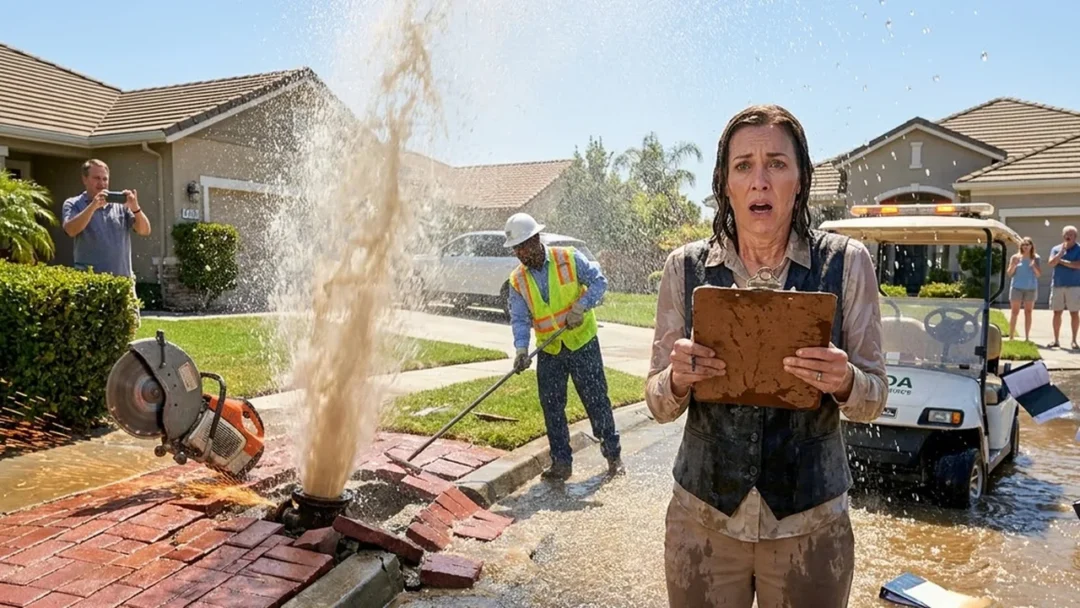
A massive, roaring column of pressurized municipal water, eight inches in diameter, erupted from the center of the curb with the deafening roar of a jet engine on takeoff. The towering geyser shot forty-five feet straight into the morning sky, tearing through the branches of the dogwood trees and stripping leaves and blossoms into a swirling vortex of green and white.
The sheer, unbridled kinetic force of the water blast struck the underside of the screaming Husqvarna cut-off saw.
The twenty-pound industrial machine was ripped out of Regina’s hands with terrifying ease. The saw cartwheeled through the air like a piece of cardboard, flying fifteen feet across the road before crashing into Gregory Hayes’s front lawn, where its hot engine hissed and choked under the falling deluge before falling permanently silent.
The full volume of the eighty-PSI geyser caught Regina Vance dead center.
The concussive force knocked her backward off her feet. She skidded four feet across the asphalt on her back, screaming as hundreds of gallons of cold, muddy municipal water crashed down on her like a collapsing roof. Her designer sunglasses were ripped from her face, her silver hair was plastered across her eyes, and her tailored tennis clothes were instantly soaked through and weighed down with red Georgia clay.
The geyser was venting over nine hundred gallons of water per minute directly into the street gutter.
Because the street curved downhill toward Sweetwater Court, the rushing torrent of muddy water followed the asphalt curb line with devastating velocity. And sitting squarely in the lowest point of the gutter, parked barely five feet away with its open sides and lowered floorboards, was Regina’s prized pearl-white Club Car golf cart.
Within fifteen seconds, the water in the gutter reached a depth of eighteen inches.
The muddy deluge surged over the cart’s chrome rocker panels, pouring through the open cab in a roaring, brown river. The custom marine-grade leather seats were submerged; the dashboard audio console sputtered, emitted a puff of blue electrical smoke, and died; and the clipboard organizer—containing months of Regina’s architectural violation notices and neighbor citation records—was swept away, its paper records dissolving into floating pulp across the flooded street.
Worse, the water level breached the under-seat battery compartment.
The golf cart had been fitted with an expensive forty-eight-volt commercial lithium-iron-phosphate battery conversion kit. As the flood of mineral-rich red clay water enveloped the battery terminals and high-current solenoid switches, an electrical short circuit ignited.
A sharp, agonizing screech erupted from the cart’s dashboard horn.
Deprived of electronic control, the horn locked into a continuous, deafening, one-hundred-decibel blast that echoed across the entire neighborhood:
HOOOOOOOOOOOOOOOOOOOOOOOOOOOOOOOOOOOOOOONK!
Regina scrambled to her hands and knees in the roaring water, spitting out red clay, clutching her head in absolute, paralyzed horror as she watched her twenty-two-thousand-dollar luxury cart drown in the flood she had created.
The hydrodynamics of a severed high-pressure water main are violent and unforgiving. At eighty pounds per square inch, an eight-inch orifice releases water at a velocity exceeding forty feet per second, generating thousands of foot-pounds of kinetic energy every minute. The geyser that erupted into the Georgia morning sky was not a clean garden fountain; it was an industrial cutting jet laden with pulverized concrete slurry, crushed red brick aggregate, and abrasive river gravel sucked from the sub-base. The airborne debris stripped the bark from adjacent dogwood limbs and peppered the facades of neighboring homes with muddy shrapnel.
The topography of the street accelerated the destruction. Because Magnolia Trace was engineered with sloping gutters designed to channel heavy summer thunderstorms toward retention ponds, the street grade funneled the deluge directly into the depression where Regina had parked her luxury golf cart. Modern electric golf carts, especially lifted custom conversions with aftermarket lithium packs, are engineered for fairways and dry paved paths, not for wading through flash floods. The unsealed electrical connectors beneath the floorboards were instantly submerged in mineral-rich red clay water, creating multiple low-resistance paths for the high-amperage direct current.