They Chained the Farm Road He Had Used for Thirty Years—Then the Old Survey Line Changed Everything
Chapter 1: The New Chain Across an Old Farm Road
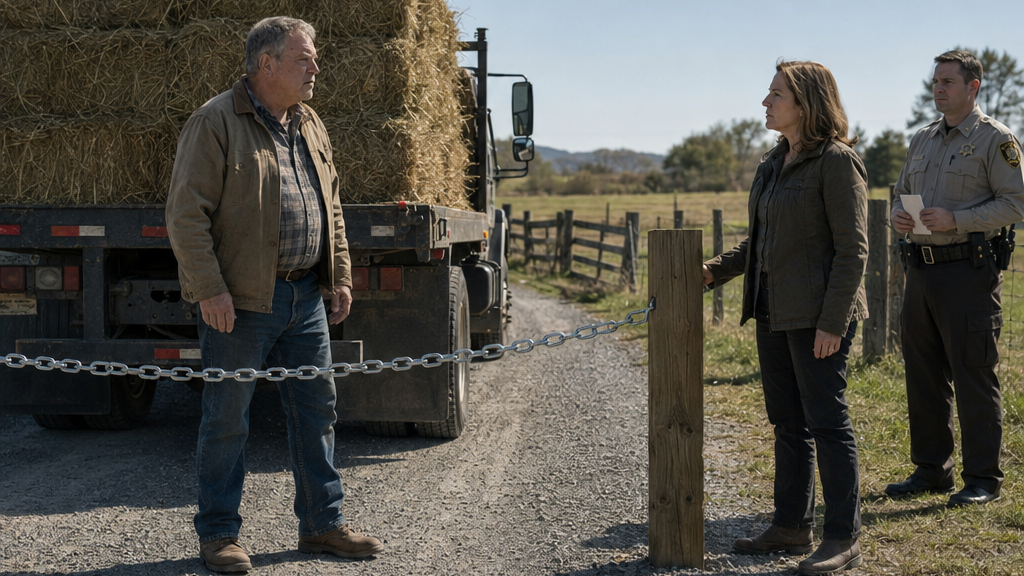
Charles Green saw the chain too late to stop without touching the brakes hard.
The hay truck lurched forward, the stacked square bales settling against their straps with a dry scrape. His metal coffee thermos rolled across the passenger-side floorboard and struck the door.
Twenty feet ahead, a new galvanized chain stretched across the gravel lane between two fresh wooden posts.
Charles sat behind the wheel with both hands resting on it.
He had driven this road since he was old enough to reach the pedals of his father’s pickup. It ran between a soybean field and a low pasture, crossed a shallow drainage cut, then split near the cedar fence. One branch continued toward neighboring acreage. The other dropped toward Charles’s lower hayfield.
There had never been a chain.
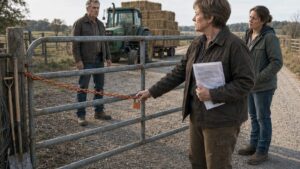
Catherine Taylor stood beside it.
She wore work boots and a light jacket, and she held a clipboard against one hip. Two road-association members waited several yards behind her near a pickup. None of them looked surprised to see him.
Charles killed the engine.
He climbed down slowly.
“You planning to move that?”
Catherine’s expression remained composed. “Not today.”
Charles looked past her at the road.
“My field’s down there.”
“I know.”
“Then what are we doing?”
Catherine shifted the clipboard under her arm. “The association voted to control access. Too many vehicles have been coming through that don’t belong here.”
Charles glanced at the two members. Elizabeth Hill was not among them.
“I belong here.”
“You don’t own this road.”
It was said plainly, not cruelly, which somehow made it worse.
Charles looked at the chain again. The metal was bright enough to catch the morning sun.
“My family’s used this lane for thirty years.”
Catherine shook her head. “Use doesn’t equal ownership.”
Charles felt anger rise fast enough to surprise him.
He could have told her about his father grading the lane with an old blade after spring washouts. He could have listed every harvest truck that had crossed this spot before Catherine ever chaired anything. He could have pointed to the lower field and asked how she imagined his equipment had reached it all those years.
Instead he said, “Who told you it was yours to close?”
“The road association has responsibility for it now.”
“That wasn’t my question.”
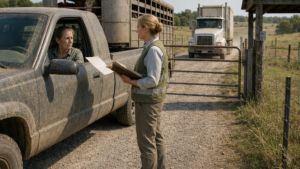
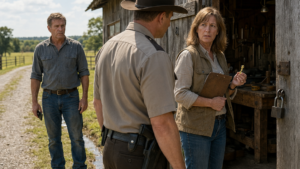
Before she answered, a sheriff’s cruiser came slowly up behind Charles’s truck.
The deputy stepped out carrying a folded sheet of paper.
Charles looked at Catherine.
“You called the sheriff?”
“I asked for the situation to be documented.”
The deputy approached with the careful expression of a man who already knew neither side would like what he had to say.
“Mr. Green?”
Charles nodded.
“This is civil. I’m not deciding ownership or access rights.” The deputy held out the sheet. “But the association has requested written notice that you not cross the barrier until the property issue is resolved.”
Charles did not take it immediately.
Behind him, his truck sat loaded with hay that should already have been headed toward the lower barn.
“How long you been using this road?” the deputy asked quietly.
“Most of my life.”
Catherine answered before Charles could say more. “And nobody is disputing that. But longstanding use doesn’t give someone authority to ignore a current access policy.”
Charles finally took the paper.
He read the first paragraph, then the second. The language was careful. No accusation of theft. No dramatic threat. Just a formal notice that entry beyond the barrier could result in further enforcement action if the association’s ownership claim proved valid.
He folded the page once.
Then again.
Catherine seemed to expect an argument.
Charles looked at her and asked, “Did anybody check the county corridor record before you put this chain up?”
Something changed in her face.
Not fear. Not recognition.
Just irritation at a question she had not expected.
“What corridor?”
Charles slipped the folded notice into his shirt pocket.
“That answers me.”
One of the association members muttered, “If you’ve got paperwork, bring it.”
Charles looked at him.
“I didn’t say I had paperwork.”
That was the problem.
For years there had been no reason to have any.
His father had called the lane the farm road. Neighbors called it the lower road. County graders had worked part of it when Charles was a boy. Nobody had needed a meeting to explain who could pass.
Charles climbed back into the cab.
The deputy stepped aside.
Catherine called after him. “Charles, this doesn’t have to turn into something bigger.”
He leaned toward the open window.
“You put a chain across a road I’m using to move hay.”
“I’m trying to keep it from getting worse.”
Charles glanced at the bright links.
“Looks worse from here.”
He started the engine.
There was room to reverse if he backed nearly a quarter mile to the old equipment opening. He did it without another word.
The longer route added almost forty minutes each way and ended at a secondary field entrance that had not been maintained for heavy loads. By the time he reached it, the ground beneath the wagon tires was already soft.
He stopped before turning in.
From that angle, across a low section of pasture, he could still see the new chain in the distance.
It looked absurdly small.
It had changed the whole morning.
That evening Charles went into the machine shed and opened the steel cabinet his father had used for farm records.
He told himself he was looking for maintenance receipts.
Instead he found an old spiral notebook.
The cover was stained with grease. Inside were dates, fence measurements, cattle counts, drainage repairs, and short notes written in his father’s blunt hand.
Charles turned pages until he found a reference to the lower road.
County grade—south access.
Then another entry several years later.
Check plat before moving cedar post.
Beside it was a number.
Charles stared at it.
The last two digits had been smeared by oil or water until they were unreadable.
He searched the cabinet for an hour.
There was no plat.
Chapter 2: When a Handshake Is No Longer Evidence
Rain was coming, and Charles had hay sitting where he could not efficiently move it.
By Monday morning the sky had turned the color of dirty aluminum. The weather radio gave him less than twenty-four hours before the first heavy band crossed the county.
He drove the tractor toward the secondary entrance with an empty wagon behind him.
The ground had softened since Saturday.
The right tire sank at the edge of the opening.
Charles felt it immediately.
He stopped, shifted down, and eased forward. Mud folded over the tread. The wagon tilted toward the ditch before climbing onto firmer ground.
He swore under his breath.
From the field ridge, the ordinary route was visible less than half a mile away.
So was the chain.
Bright metal across gray gravel.
Charles turned away from it and spent the morning hauling shorter loads.
By noon he had moved less than half of what he normally would.
Elizabeth Hill arrived in her pickup while he was tightening a wagon strap.
She stayed behind the wheel for several seconds before getting out.
“I heard about Saturday.”
Charles pulled the strap once more. “Most people have.”
“She shouldn’t have had the deputy there.”
“She wanted a witness.”
Elizabeth hesitated. “She wanted things clear.”
Charles looked at her.
“Clear for who?”
Elizabeth shoved her hands into her coat pockets.
“There was damage on the road earlier this summer. A truck cut the culvert edge. Somebody dumped tires near the creek. People got tired of not knowing who was coming through.”
“I didn’t do any of that.”
“I know.”
“Then why am I behind the chain?”
Elizabeth’s eyes moved toward the distant lane.
“Because Catherine thinks if there are exceptions, there’s no policy.”
Charles gave a short laugh without humor.
“I’m an exception now?”
“You know what I mean.”
“No. I don’t.”
She looked uncomfortable.
That gave him less satisfaction than he expected.
After she left, Charles finished another load, then drove to the county offices before closing.
The clerk pulled his parcel records first.
Charles stood on the public side of the counter while she enlarged the map on her monitor.
His farm boundaries appeared in thin colored lines.
The lower field was unmistakable.
So was the road.
The line stopped before it.
Charles frowned.
“Zoom in.”
The clerk did.
His deed description ran to the eastern edge of an older parcel and then turned south. No strip extended into the gravel lane.
“That can’t be right.”
“It can be right and still not answer your access question,” the clerk said.
“My father used that road his whole life.”
“I’m not disputing that.”
“County graded it.”
“Maybe.”
Charles looked at her sharply.
She raised one hand.
“I mean maybe the county graded part of it. Maintenance and ownership aren’t the same thing.”
It was almost exactly what Catherine had said about use.
Charles did not like hearing it from someone neutral.
The clerk searched older deed books.
Nothing in the Green chain of title transferred ownership of the road.
For the first time since seeing the chain, Charles felt something colder than anger.
Doubt.
His father had treated access as settled fact. Charles had done the same.
But facts remembered by families and facts recorded by counties were not always the same thing.
The clerk found an older maintenance index.
She ran her finger down a scanned page.
“Here.”
Charles leaned closer.
A county road crew had charged gravel and grading hours to a line item identified as “south agricultural access” decades earlier.
“That’s it.”
“Maybe.”
He exhaled.
“You like that word.”
“I like records that say what they actually say.”
Charles straightened.
“What does this say?”
“It says county labor was billed to an agricultural access route. It doesn’t say the county owned it. It doesn’t tell me exactly where it was. But it gives us something else to search.”
She wrote down an index reference and walked to a back room.
While Charles waited, his phone buzzed.
An email.
The road association had circulated a new access policy to affected landowners.
He read it standing beneath the fluorescent lights.
Vehicle access beyond association barriers would require prior authorization. Agricultural traffic could apply for scheduled entry. Unauthorized removal or bypassing of barriers would be considered a violation of association rules and potentially a trespass.
Charles read the phrase scheduled entry twice.
He imagined calling Catherine every time he needed to move a tractor between his own fields.
His jaw tightened.
The clerk returned with a thin folder.
“No plat attached here.”
Charles felt his patience break.
“So I’ve got a road the county worked on and nobody knows why?”
“I didn’t say nobody knows.”
A man at the next workstation had turned toward them.
Charles recognized him after a moment.
Thomas Nelson.
Years earlier, Thomas had worked with field crews before moving into land records full time.
Thomas took the index number from the clerk.
“Let me see that.”
He entered it into another database.
Charles waited.
Thomas tried a different format.
Then an older indexing system.
A result appeared.
Thomas leaned toward the screen.
“Well.”
Charles stepped closer.
“What?”
“There’s a plat reference.”
“Can you pull it?”
“Not from this system. It predates the digitized book.”
Charles looked at the reference number.
Part of it matched the smeared notation in his father’s notebook.
Thomas noticed his expression.
“You’ve seen this number?”
“Most of it.”
“Where?”
“My father wrote it down.”
Thomas sat back.
The caution in his face remained.
But now there was interest beneath it.
“The index calls it a subdivision-and-farm access plat.”
Charles felt a small lift of vindication.
Thomas immediately killed it.
“Don’t get excited.”
“Why?”
“Because an index title isn’t a boundary.”
Charles folded his arms.
“What is it?”
“A reason to open the old book.”
Thomas glanced toward the records vault.
“And hope the map inside is clearer than the title.”
Chapter 3: The Record That Helps Neither Side Enough
Thomas laid the old plat beside the modern parcel map and said, “Before you decide you’ve won, look at the road.”
Charles stood over the table.
The plat paper had yellowed around the edges, but the ink remained surprisingly dark. Parcel lines divided farms that no longer existed in the same shapes. A creek bent through the lower half. Near the western side, two parallel lines marked a narrow corridor.
Agricultural Access.
Charles put one finger beside the words.
“There.”
Thomas nodded.
“There.”
“That’s the road.”
Thomas moved Charles’s finger half an inch.
“That was a corridor.”
Charles looked at him.
“What’s the difference?”
“This was recorded more than eighty years ago. Roads move.”
“Not that much.”
Thomas gave him a level look.
“You’d be surprised.”
He placed the current aerial map beside the plat.
At first the alignments looked nearly identical. Then Charles saw it.
The modern gravel lane curved farther west around the creek than the older corridor appeared to.
Farther north, near Catherine’s property, it drifted east.
Thomas traced both lines without touching the paper.
“Fences get replaced. Creeks widen. Somebody avoids a wet spot. Another person spreads gravel where trucks are already running. Twenty years later everyone remembers the new road as the old road.”
Charles stared at the two versions.
“But the corridor exists.”
“Yes.”
“Recorded.”
“Yes.”
“So they can’t just shut it.”
Thomas did not answer.
Charles looked up.
“What?”
“I’m not your lawyer.”
“I’m not asking you to be.”
“You’re asking me to tell you what rights this gives you today.”
“It says agricultural access.”
“It does.”
“Then what exactly are we confused about?”
Thomas tapped the old scale notation.
“The width.”
Then he tapped several missing or vague monument references.
“And the location.”
Charles felt the earlier vindication leaking away.
Thomas continued. “If those monuments still exist, a licensed surveyor may be able to reestablish it. If they don’t, there are methods for reconstructing the line. But this paper by itself does not tell us whether Catherine’s chain is inside the corridor.”
Charles took out his phone.
He had photographed the chain Saturday.
He enlarged the picture and set it beside the map.
The bright links looked almost insulting against the old ink.
Thomas glanced at it.
“Good photograph.”
“It doesn’t help?”
“Not yet.”
Charles looked again at the map.
His father had known about this.
That knowledge should have made Charles feel stronger.
Instead it raised another question.
Why had nobody preserved it?
That evening Charles attended his first road-association meeting.
He almost did not go.
Catherine had sent notices for two earlier meetings. Charles had thrown both aside. He had told himself he was busy. The truth was simpler: he disliked sitting in rooms where people turned ordinary farm matters into motions, votes, and policies.
Now he walked into a converted equipment room with the old plat copied beneath his arm.
Catherine saw him immediately.
“So you came.”
Charles took a chair near the end of the table.
“You kept sending invitations.”
One of the members smiled.
Catherine did not.
She opened the meeting by reviewing the access policy.
Charles waited.
He let her discuss insurance, unauthorized vehicles, dumping, and road damage. Some of it was reasonable. That bothered him more than if it had all been nonsense.
Then she reached permanent access controls.
“We’re proposing fixed posts at the main entrance before harvest traffic increases.”
Charles looked up.
“Permanent posts?”
“With a controlled gate.”
“Where?”
“Where the temporary barrier is now.”
Charles set the plat copy on the table.
The room changed.
Not dramatically.
Nobody gasped.
But everyone looked.
Catherine’s eyes dropped to it.
“What’s that?”
“A recorded agricultural-access plat.”
She leaned forward.
Charles pushed it toward the center.
Thomas had advised him not to oversell it.
So he did not.
“This shows a corridor through the same area.”
Catherine studied the copy.
“Does it prove your road is in that corridor?”
“No.”
Her eyes lifted.
That answer surprised her.
Charles continued.
“It proves there was an access strip recorded. It doesn’t show exactly where the current gravel sits.”
One of the members asked, “Then what good is it?”
“It means we don’t know enough to put permanent posts in concrete.”
Catherine sat back.
“We already know the association maintains the road.”
“Maintenance isn’t ownership.”
The phrase landed between them.
It was hers from Saturday, turned around.
For the first time Catherine looked angry.
“Don’t do that.”
“Do what?”
“Pretend I’m claiming things I didn’t claim.”
“You told me I didn’t own the road.”
“You don’t.”
Charles paused.
“Looks like neither do you.”
Elizabeth Hill, seated across from him, spoke before Catherine could answer.
“Charles, if that old corridor is real, why didn’t you bring this up when the association formed?”
He looked at her.
“I didn’t think I had to.”
Elizabeth frowned.
“That’s not an answer.”
“It’s the one I’ve got.”
Catherine closed the folder in front of her.
“We’ve spent months trying to get people to participate. You ignored every meeting.”
“I was farming.”
“So were the rest of us.”
Charles felt heat rise into his face.
She continued, quieter now.
“You can’t refuse to be part of every decision and then show up after a decision you dislike and act like everybody should have known what was in your father’s notebook.”
The words struck harder because they were not entirely wrong.
Charles looked at the old plat.
He had expected the document to change the balance of the room.
Instead it had exposed something about him too.
Still, he pointed toward the map.
“Then we verify it before anybody pours concrete.”
Catherine looked around the table.
One member shrugged.
Elizabeth said, “That seems reasonable.”
Catherine’s mouth tightened.
“How long does verification take?”
“I don’t know.”
“Harvest traffic starts in weeks.”
Charles said nothing.
That silence, once his refuge, now felt like an empty space other people could fill.
Catherine gathered her papers.
“We’ll schedule the posts for the end of next week. If you can produce a licensed survey before then showing the barrier is inside a recorded corridor, we’ll reconsider the location.”
Charles stared at her.
“You’re going ahead anyway.”
“I’m not freezing the entire association because an eighty-year-old drawing might line up with the road.”
The meeting ended without shouting.
That almost made it worse.
Outside, Charles stood beside his pickup with the plat rolled under one arm.
The lane entrance was visible down the road.
So was the silver chain.
Ten days.
After thirty years of assuming the road would always be there, Charles had ten days to prove where it had actually been.
Chapter 4: Why Catherine Wanted the Road Closed
The crushed culvert was worse than Charles expected.
He saw it from the cab before Elizabeth Hill even pointed.
One end of the galvanized pipe had folded inward beneath the road, leaving a ragged crescent where water should have passed cleanly into the ditch. The gravel above it had sunk several inches. Tire marks, still visible in the hardened mud, showed where something heavy had climbed the shoulder instead of staying centered.
Elizabeth parked along the field edge.
“That’s what started all this.”
Charles got out.
He crouched beside the ditch and ran his hand over a length of bent metal.
“How long ago?”
“June.”
“You know who did it?”
“No.”
“Then how do you know it was somebody coming through?”
Elizabeth looked toward the lane.
“Because the truck came through here. White cab. Equipment trailer. Nobody recognized it. Catherine saw it from her place, but by the time she got down here it was gone.”
Charles stood.
“And that became me?”
“That’s not what I said.”
“No. It became everybody.”
Elizabeth sighed.
“The culvert collapsed two days later. We had standing water in three fields after the next storm.”
Charles had heard about the drainage trouble. He had assumed it was another neglected pipe.
He looked at the crushed mouth again.
“County pay for any of it?”
“No.”
“Insurance?”
Elizabeth gave him a tired smile.
“That’s the problem.”
The road association’s policy had a high deductible. The insurer argued the damage involved an unidentified vehicle and deferred most of the expense while the association tried to establish responsibility. One member refused to contribute. Another insisted the culvert was Catherine’s problem because the damaged section touched her frontage.
“So Catherine paid?” Charles asked.
“Most of the emergency work.”
“How much?”
Elizabeth told him.
Charles whistled softly.
It was enough to buy a decent used mower.
“She didn’t tell me that.”
“You didn’t ask.”
The answer irritated him.
Then he remembered Catherine at the meeting saying they had spent months trying to get people involved.
Elizabeth picked up a broken piece of plastic pipe marker from the ditch.
“She was wrong to put that chain across before checking everything.”
Charles glanced at her.
“But?”
“But she wasn’t sitting around thinking up ways to make your life miserable.”
“I never said she was.”
“You acted like it.”
Charles looked away.
Across the pasture, cattle stood along the fence watching them.
Elizabeth continued.
“After the culvert, there were tires dumped near the creek. Then somebody cut across the hay ground to turn around. Catherine kept asking for a gate plan. Half the people said yes. Half said they didn’t want to pay. You didn’t come.”
Charles put his hands on his hips.
“I had work.”
“We all had work.”
There it was again.
He had no answer he liked.
Elizabeth tossed the broken marker into her truck bed.
“Catherine figured if she waited until everybody agreed, nothing would happen.”
“So she did it anyway.”
“Yes.”
“That makes her right?”
“No.”
Elizabeth closed the tailgate.
“It makes her scared of getting stuck with the next bill.”
Charles looked at the culvert for another moment.
The chain had felt like arrogance from his side of the lane.
From here, he could see something else in it.
Fear made into hardware.
That did not give Catherine the right to block him.
But it changed the shape of what he thought he was fighting.
They walked back toward the trucks.
Elizabeth stopped near the fence.
“You know what everybody thought when you didn’t show up?”
Charles already knew he was not going to enjoy the answer.
“What?”
“That you didn’t care.”
He laughed once.
“I cared enough to stay out of it.”
“That doesn’t make any sense.”
“It does to me.”
“Well, nobody else can hear what you mean when you don’t say anything.”
Charles looked at her.
Elizabeth’s voice softened.
“When Catherine said you hadn’t challenged the road claim, people took that as you accepting it.”
“I challenged it Saturday.”
“After the chain was up.”
He stared at the ground.
His father had handled disputes quietly. Fence questions got settled at the gate. Drainage problems got discussed over coffee. Charles had spent years believing the best way to keep neighbors from becoming enemies was not to feed every disagreement.
But his father’s world had depended on everyone remembering the same unwritten arrangements.
That part Charles had not considered.
The next morning he called the county office and asked Thomas what it would take to establish the old corridor on the ground.
“A licensed survey,” Thomas said.
“Can the county do it?”
“No. You’ll need a private surveyor.”
“How long?”
“Depends who you get.”
“I’ve got permanent posts scheduled in eight days.”
Thomas was silent for a moment.
“I can give you the record references. That may save them some time.”
Charles wrote them down.
He spent most of the afternoon calling survey firms.
The first could not come for three weeks.
The second wanted a deposit large enough to make him pause.
The third had a cancellation.
The survey crew could be there Friday morning.
Charles nearly said he would think about it.
That was his habit.
Delay. Let the heat come out of things. Decide tomorrow.
He looked through the shed door toward the distant road.
The chain flashed between the posts.
“Book it,” he said.
After the call, he walked to the steel cabinet and took out the trespass notice.
For a moment he considered calling an attorney instead.
He could send a letter. Threaten an injunction. Force Catherine to stop until somebody else decided who was right.
Then he remembered the crushed culvert.
He remembered Elizabeth saying nobody else could hear what he meant when he said nothing.
Charles folded the notice and put it back.
This time he would not wait for somebody else to carry the argument.
He called Catherine.
She answered on the fourth ring.
“I’ve hired a surveyor.”
There was a pause.
“For the corridor?”
“Yes.”
“When?”
“Friday.”
Catherine exhaled.
“The permanent posts are scheduled Monday.”
“I know.”
“If the survey says the chain is outside the corridor—”
“I’ll live with what it says.”
Another pause.
That answer seemed to unsettle her more than a threat might have.
“And if it says the chain is inside?”
Charles looked toward the lane.
“Then you’ll have a decision to make.”
Chapter 5: The Iron Pin Beneath the Cedar Roots
The survey crew found the first iron pin under a cedar root.
Charles had watched the crew chief circle the old tree twice with a metal detector before the machine gave a sharp, clean tone.
They cleared leaves, then soil.
Six inches down, rusty metal appeared.
The crew chief crouched over it.
“That’s not fence wire.”
Charles stepped closer.
A narrow iron monument rose from the dirt, dark with age.
The surveyor checked the old plat, then the modern control points.
“Could be one of the originals.”
Catherine stood several yards away with her arms folded.
She had come without the clipboard.
Elizabeth was there too, along with one association member.
Nobody said much.
The crew worked north from the cedar, setting temporary flags and taking measurements. A survey rod appeared at one point along the fence line, then another closer to the creek.
Charles followed at a distance.
He wanted to ask what every number meant.
He made himself wait.
Near midday, the crew chief called everyone over.
He spread a field sketch across the hood of his truck.
“We’ve recovered enough control to begin reconstructing the recorded corridor.”
Charles looked immediately toward the chain.
The crew chief noticed.
“Not there yet.”
Catherine asked, “Do you know where the line is or not?”
“We know where part of it is.”
He pointed at the sketch.
“The original access corridor runs from this monument toward the creek, then follows a bearing established from the second reference point.”
Charles traced the present road with his eyes.
“So the gravel’s inside?”
“For this section.”
Relief moved through him.
Then the crew chief shifted his finger.
“Here, it isn’t.”
Charles frowned.
The present lane curved west around a wet hollow before reconnecting near his lower field.
“That curve’s been there forever.”
“How long is forever?”
“Since I was a kid.”
The surveyor shrugged.
“Long enough for people to forget it moved.”
Thomas had warned him.
Charles had not believed the difference would matter much.
It did.
The survey crew placed a flag nearly twenty feet east of the current gravel edge.
Charles stared at it.
“If that’s right, I’ve been driving outside the corridor through here for thirty years.”
“Looks that way.”
Catherine’s expression changed.
Not satisfaction exactly.
But something close.
Charles felt the temptation to argue.
The road could not possibly have shifted that far. Maybe the old monument had moved. Maybe the reconstruction was wrong.
Then he remembered what he had told Catherine.
I’ll live with what it says.
He looked at the crew chief.
“You confident?”
“We’ll verify before anything gets recorded.”
“That’s not what I asked.”
The man met his eyes.
“Yes.”
Charles nodded.
“All right.”
Catherine seemed surprised.
“You’re accepting that?”
Charles looked at her.
“I said I wanted the right line.”
He turned back to the sketch.
“I didn’t say I only wanted the parts that helped me.”
The crew continued toward the main entrance.
By early afternoon, the tension had shifted.
The old corridor was real.
But so was the fact that the modern road wandered in and out of it.
At the creek crossing, the surveyor stopped again.
“If access is restored on the recorded strip, this bend will need work.”
“How much?” Elizabeth asked.
“Depends whether you want to move the gravel or formalize an alternate easement.”
Catherine shook her head.
“An alternate easement means signatures from multiple owners.”
“Correct.”
Charles looked across the wet ground where the old alignment would run.
Moving the lane there would require grading, drainage work, and new gravel.
Victory was beginning to look expensive.
Then the crew reached the entrance.
The galvanized chain hung between the new posts exactly where it had on Saturday.
Charles stood beside his pickup as the crew chief set the survey rod near the western post.
The rod, the cedar monument farther down the line, and the chain seemed to form one hard sightline.
The crew chief checked his instrument.
Then checked again.
Catherine stepped closer.
“Well?”
He pointed at the chain.
“This barrier crosses the recorded corridor.”
Nobody spoke.
Charles felt the answer hit him physically.
Not triumph.
Something quieter.
For days he had wondered if memory had fooled him.
It had, in places.
But not here.
The chain that had turned him away from his own field had been installed directly across the old access strip.
Catherine looked at the post.
“How far inside?”
The surveyor gave her the measurement.
“Both posts?”
“One is near the edge. The other is clearly within.”
Elizabeth let out a breath.
Charles walked to the chain.
He touched one link with two fingers.
The metal was warm from the sun.
He could have said something cutting.
He could have asked whether Catherine wanted the deputy back.
Instead he looked toward the road’s crooked bend.
“We still have that problem.”
The surveyor nodded.
“Yes.”
Catherine stared at him.
“You’re worried about the bend?”
“I’m worried about knowing where the road belongs.”
She gave a short, disbelieving laugh.
“After everything, that’s what you’re saying?”
“What do you want me to say?”
“That you were right.”
Charles looked down the lane.
“I was right about this end.”
He pointed toward the flagged curve.
“I was wrong about that one.”
The words cost him more than he expected.
The crew chief began gathering equipment.
“We’ll calculate the full description tonight. Preliminary map tomorrow. Final record after review.”
Catherine walked back toward her truck.
Charles assumed she was leaving.
Instead she stopped beside him.
“Can we talk before you record it?”
He looked at her.
“About what?”
“Without the association.”
Charles glanced toward Elizabeth.
Catherine lowered her voice.
“I want to discuss a settlement before this becomes something none of us can take back.”
Charles looked at the chain again.
For the first time since Saturday, he had proof strong enough to use as a weapon.
Catherine knew it.
So did he.
“When?”
“Tomorrow evening.”
“Where?”
“Your place, if you prefer.”
Charles nodded.
As Catherine drove away, the crew chief pulled the last temporary rod.
Only the flags remained.
One marked the road Charles had always believed was right.
Another marked the road that actually was.
Charles stood between them, suddenly aware that winning the argument would be easier than deciding what to do with the truth.
Chapter 6: Being Right Was Not the Same as Repairing It
Catherine admitted she had ordered the chain before the title review was finished.
She said it standing at Charles’s machine-shed workbench with the trespass notice between them.
Charles did not answer immediately.
Beside the paper lay a spare length of galvanized chain he used for securing equipment.
Catherine looked at it, then away.
“The insurer wanted access controlled.”
“That isn’t what I asked.”
“No.”
“So why didn’t you wait?”
“Because every week we waited, somebody found another reason not to decide.”
Charles leaned against the bench.
“That still doesn’t explain why you blocked me.”
Catherine’s mouth tightened.
“You challenged me at the gate.”
“I asked if anybody checked the corridor.”
“After ignoring every meeting.”
He stared at her.
She continued.
“I knew you claimed some kind of old access. Elizabeth mentioned it months ago. I asked for documentation. Nothing came.”
“You never asked me.”
“I sent notices to every affected landowner.”
“That’s not the same.”
“No. It isn’t.”
The admission came without defense.
That stopped him.
Catherine rested both hands on the workbench.
“I should have called you directly.”
“Yes.”
“And I should have waited for the title review.”
“Yes.”
“But you need to hear the part you don’t like.”
Charles felt himself harden.
She noticed.
“You acted like none of this applied to you.”
“I was using a road I’d always used.”
“And whenever somebody tried to discuss how it should be managed, you disappeared.”
Charles looked toward the open shed door.
Outside, the temporary survey flags moved in a light breeze.
“My father handled neighbor problems without committees.”
Catherine’s tone softened.
“Your father knew all the neighbors.”
“So do I.”
“No, Charles. You know who used to own the farms.”
That landed harder than he expected.
Catherine looked tired rather than angry now.
“Properties changed hands. Families split acreage. Insurance changed. People started renting fields. Trucks show up that nobody recognizes. The old system depended on everybody already knowing the rules.”
Charles said nothing.
Catherine gave a small nod toward him.
“And when you stay silent, people don’t hear tradition. They hear agreement.”
The same idea Elizabeth had given him.
This time he could not dismiss it.
Charles picked up the trespass notice.
“I stayed out of the meetings because I figured if I started arguing over every road rule, we’d end up in court.”
“You nearly did anyway.”
“My father made me promise something a long time ago.”
Catherine waited.
“He said once neighbors start paying lawyers to talk to each other, they stop being neighbors.”
“That sounds nice.”
“It wasn’t meant to.”
Charles folded the notice along its existing crease.
“He’d watched two families fight over a fence line until neither one could remember what they originally wanted.”
Catherine studied him.
“So you decided never to argue.”
“I decided not to feed things.”
“And that worked until everybody else started making decisions while you were gone.”
Charles looked at the paper.
“Yes.”
It was the first time he had said it plainly.
Catherine sat on the edge of an old stool.
“The association’s insurer reviewed the preliminary survey.”
“That was quick.”
“I sent it this morning.”
Charles raised an eyebrow.
She almost smiled.
“I’m learning to verify things.”
“What did they say?”
“They’ll accept continued agricultural access.”
Charles waited.
“But?”
“They still require a controlled gate at the main entrance. They want a record of who has vehicle access, especially heavy trucks.”
“You’re telling me the gate stays.”
“A gate. Not that gate in that location.”
Charles looked toward the road.
“And the bend?”
“We can’t leave the gravel outside the corridor unless the owners grant a new easement.”
“Which they won’t.”
“One already told me no.”
That simplified things.
It also made them harder.
Charles took a pencil and pulled a scrap of cardboard toward him.
He sketched the lane roughly.
“The old corridor comes through here.”
Catherine moved closer.
“According to the preliminary map.”
“We shift the gravel east at the bend.”
“That means crossing the drainage.”
“We rebuild the crossing.”
“With whose money?”
Charles looked at her.
“The association pays for some.”
“And the rest?”
He tapped the cardboard.
“I’ve got a grader blade. I can move base.”
Catherine blinked.
“You’d do the work?”
“Some of it.”
“After I served you with a trespass notice?”
Charles glanced at the folded paper.
“I’m not offering because you were right.”
She accepted that.
He continued.
“If we fight, everybody spends money proving the same survey says what it says. Then somebody still has to move the road.”
Catherine looked at the sketch.
“You could demand we pay all of it.”
“I could.”
“You could probably force us to remove the posts immediately.”
“Probably.”
“Why aren’t you?”
Charles thought of the crushed culvert.
Of hay wheels sinking in mud.
Of his father’s notebook.
Of the line he had ignored because he assumed memory was permanent.
“Because I want the road open next year too.”
Catherine studied him for a long moment.
Then she said, “If I take this to the association, I have to tell them why.”
“Tell them the survey shows the barrier was wrong.”
“They won’t like that.”
“I didn’t like being handed a trespass notice.”
“That’s fair.”
Charles pointed at the sketch again.
“Move the entrance gate onto the verified line. Keep it controlled if insurance requires it. Agricultural users get access without asking permission every trip. We relocate the bend onto the corridor. I’ll bring equipment. The association pays gravel and pipe.”
Catherine considered it.
“And the damaged culvert?”
“We build it right while we’re there.”
“You’d help with that too?”
“It’s part of the road.”
Her shoulders lowered slightly.
For the first time since the chain went up, neither of them seemed to be guarding a position.
Catherine picked up the trespass notice.
“What about this?”
Charles took it from her.
“That gets withdrawn.”
“Yes.”
“In writing.”
“Yes.”
“And the survey gets recorded.”
She hesitated.
Charles saw it.
“That part isn’t negotiable.”
Catherine looked at the flags beyond the shed.
“No.”
Then she nodded.
“It shouldn’t be.”
Charles set the notice beside the spare chain again.
Catherine stood.
“I can’t promise the association will approve this.”
“I know.”
“They may say you’re asking them to admit fault publicly.”
“They are at fault.”
“So are you, apparently, for part of the road.”
Charles almost smiled.
“Then we can both practice.”
She shook her head, but the tension had changed.
At the door she stopped.
“What happens if they say no?”
Charles looked toward the old gravel lane.
For years his answer would have been nothing. Wait. Endure. Let people cool down.
Not now.
“Then I record the survey, challenge the barrier, and let the county records say what I should have said years ago.”
Catherine nodded once and left.
Charles stayed at the workbench.
On the cardboard, the old corridor was only two pencil lines.
Between them he had drawn a new curve.
Not the road his father remembered.
Not the road Catherine tried to close.
A road both sides would have to build.
The next morning Catherine placed Charles’s proposal on the association agenda, including one line she had resisted writing:
The existing barrier was installed before the recorded agricultural corridor was fully verified.
Chapter 7: The Gate Stayed, but the Road Opened Again
The first post came out crooked.
Charles watched the tractor pull against the chain wrapped around its base until the packed soil gave way with a dull crack. The post leaned, rose six inches, then came free in a clump of dirt and limestone.
Two weeks earlier, that post had held the barrier that turned his hay truck around.
Now it lay on its side beyond the survey flags.
Catherine Taylor stood near the shoulder with the association folder tucked under one arm. Elizabeth Hill was beside her. The survey crew had already marked the verified corridor with fresh stakes, and a load of gravel waited farther down the lane.
The old chain was coiled in the bed of Catherine’s pickup.
Charles looked at it once, then climbed down from the tractor.
The association had approved the plan by a narrow vote.
Not everyone had liked admitting the first barrier had been placed before the corridor was verified. One member had argued that moving the entrance would make the association look incompetent. Another had wanted Charles to sign a statement surrendering any claim beyond the surveyed strip.
Charles had refused.
He had also refused Catherine’s suggestion that they simply remove the gate and pretend the whole thing had been a misunderstanding.
“It wasn’t a misunderstanding,” he had said. “It was a decision made too early.”
That sentence had ended up in the meeting minutes almost word for word.
Now the permanent work was beginning.
The replacement gate would sit farther east, entirely outside the agricultural passage when open. Its chain and lock would control unauthorized vehicle entry without preventing recorded agricultural users from passing under the new access procedure.
The harder work was down the lane.
Charles drove the tractor toward the bend where the present gravel wandered outside the recorded corridor.
The survey stakes formed a straighter line through ground that had not carried regular traffic in decades.
Elizabeth walked beside him for a while.
“You really think this will hold up?”
Charles eased the tractor to a stop.
“The gravel?”
“The arrangement.”
He looked toward Catherine.
“She got it written down.”
Elizabeth laughed.
“That used to be the part you hated.”
“Still is.”
“But?”
Charles looked at the survey stakes.
“But I know where the road is now.”
He lowered the blade.
For most of the morning, the work was mechanical enough to quiet everyone.
Charles stripped sod from the new alignment. The association paid for base stone. A delivery driver spread the first load carefully between the flags. At the drainage crossing, they replaced the damaged pipe with a larger one and packed stone around both ends.
Catherine spent more time with the insurance representative than with Charles.
That suited him.
Near noon, the representative walked the entrance with her, checking clearances.
The new policy required a record of heavy commercial access, but regular agricultural users named in the corridor agreement would not need individual permission for ordinary farm traffic.
Charles had insisted on that language.
Permission was what Catherine had offered before.
Access was what the record established.
There was a difference.
When the insurance representative left, Catherine came over carrying the association folder.
“We have the final recorded survey.”
Charles wiped dust from his hands.
“Thomas filed it?”
“This morning.”
She handed him a copy.
The black lines were clean and modern now. No faded ink. No guesswork from a family notebook. The corridor ran across the page with bearings, monuments, and widths written beside it.
Charles traced the entrance with one finger.
Then he reached the bend.
The surveyed line confirmed what the crew had shown them: the road Charles had used for years wandered outside the corridor before returning.
Catherine watched him.
“You still all right with moving it?”
Charles folded the survey closed.
“I was wrong there.”
Elizabeth, standing nearby, looked at him.
Charles glanced at her.
“What?”
“Nothing.”
“You’ve got a face.”
She smiled.
“I’ve just never heard you volunteer that sentence before.”
Charles looked toward the tractor.
“Don’t get used to it.”
Catherine almost laughed.
Then her expression changed.
“There’s something I need to say before everybody leaves.”
Charles did not ask what.
By midafternoon, the main work was finished.
The association members gathered near the new gate while the last load of gravel was leveled.
Catherine stood in front of them with the folder in her hands.
No podium. No ceremony.
Just neighbors in work clothes near a road.
She looked uncomfortable.
Good, Charles thought.
Then he caught himself.
Catherine opened the folder.
“The recorded survey confirms that the agricultural-access corridor crosses the main entrance where the temporary barrier was installed.”
Nobody interrupted.
She continued.
“The association placed that barrier before the corridor had been fully verified.”
One of the members shifted his weight.
Catherine looked directly at Charles.
“That was our mistake.”
The statement was smaller than an apology speech and stronger because of it.
Charles nodded.
Catherine looked back at the group.
“The same survey also confirms that a portion of the existing gravel road drifted outside the recorded corridor over time. The corrected route will remain on the verified access strip.”
Charles spoke before anyone else could.
“That part was my mistake.”
The member who had argued hardest against the settlement looked surprised.
Charles continued.
“I thought the road I remembered was the road in the record. It wasn’t, all the way through.”
There was no applause.
He was glad.
Elizabeth said, “So we’re done fighting about whose memory is better?”
Charles looked at Catherine.
“That depends.”
Catherine raised an eyebrow.
“On what?”
“Whether anybody moves the stakes.”
That got the first easy laughter they had shared since the dispute began.
The new gate went on last.
The posts were set on the verified private side of the corridor. The gate itself swung wide enough for Charles’s largest wagon.
Catherine took the old galvanized chain from her pickup.
Charles recognized the links immediately.
She held it up.
“Still want to use this?”
Charles considered it.
The chain had stopped him.
It had made the dispute visible in a way letters and meetings never could.
But metal was only metal.
“Use it.”
Catherine threaded it through the gate latch.
This time, when the gate stood open, the chain hung loose against the post instead of stretching across the road.
Charles stared at it.
Same chain.
Different purpose.
The association members drifted away one by one.
Elizabeth left after checking the new drainage crossing.
Catherine stayed until the last equipment truck pulled out.
Charles climbed into his hay truck.
He had loaded it that morning on purpose.
Not for a demonstration.
He needed the hay moved.
That mattered to him.
He started the engine and eased toward the new entrance.
Catherine stood beside the gate.
For an instant the scene looked almost like that first Saturday.
Charles in the truck.
Catherine by the road.
Galvanized chain catching the light.
Then Catherine stepped backward and held the gate open.
Charles rolled through.
The truck tires crossed the line where the old barrier had been, followed the new gravel, and curved onto the corrected corridor.
At the drainage crossing, the wagon stayed level.
He continued to the lower field, unloaded, and came back near sunset.
Catherine was gone.
The gate remained open.
Charles stopped beside it.
He shut off the engine and reached for the metal thermos on the passenger floor.
The same thermos that had rolled against the door when he first saw the chain.
He climbed down and poured coffee into the cap.
The road was quiet.
New gravel ran pale between the survey stakes. Beyond the creek, the old curve was already beginning to look unnecessary.
Charles took a drink.
For years, he had believed keeping peace meant refusing to turn every disagreement into an argument.
He still believed part of that.
But he understood something his father’s notebook could not have told him.
A handshake worked only while everyone remembered the same promise.
Silence worked only while nobody mistook it for surrender.
Down the county road, another farm truck turned toward the entrance.
Charles heard the engine before he saw it.
He finished his coffee.
Then he reached for the gate.
For one second his hand rested on the galvanized chain.
He did not remove it.
He did not throw it aside.
He simply left it hanging loose where it belonged and swung the gate wider.
The approaching truck rolled toward the open road.
The story has ended.