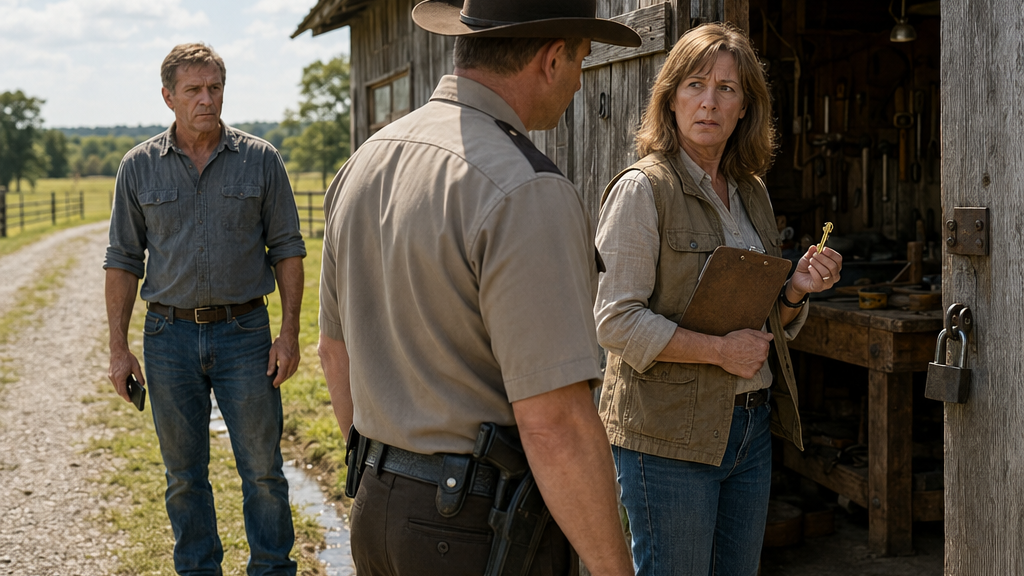
She Had a Key to His Locked Farm Shed—But the Easement Never Gave Her the Right to Enter
Chapter 1: The Key Turned in a Lock She Never Should Have Had
Thomas Mitchell’s phone vibrated against the tractor console, and the first thing he saw on the screen was his workshop door moving.
He stopped the tractor so abruptly that the rake behind him shuddered in the cut hay.
The alert was only three words.
WORKSHOP DOOR OPEN.
Thomas stared across half a mile of field toward the gravel lane. From where he sat, the workshop was no more than a gray roof beyond a line of fence posts. Nobody had permission to be there.
He wiped his thumb across the phone and opened the camera feed.
For two seconds the image showed nothing but the weathered door, the heavy brass-colored padlock, and the narrow strip of morning sun along the threshold.
Then Deborah Nelson stepped into frame.
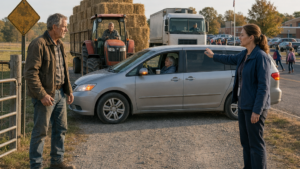
She wore jeans, work boots, and the khaki canvas vest she favored at road-association inspections. A clipboard rested under one arm. In her right hand was a key.
Thomas leaned closer.
Deborah inserted it into his lock.
It fit.
His first reaction was so simple it barely felt like thought.
No.
The key turned.
The shackle released.
Thomas’s hand tightened around the phone.
The workshop had been his father’s before it was his. Not in the ceremonial sense people used when they wanted ordinary objects to sound important. His father had actually built half of what was inside. The pegboard above the main bench still carried the dark outlines where tools had hung for thirty years. Two pipe wrenches, an old brace drill, fencing pliers with worn red handles, sockets accumulated one size at a time. Thomas had expensive equipment elsewhere on the farm, but those tools were the things he locked up.
Deborah lifted the padlock from the hasp.
Then she opened the door.
Thomas had expected her, if she came at all, to test the lock. Maybe photograph it. Maybe prove she had found some way to obtain a key.
He had not expected her to walk inside.
She disappeared beyond the doorway.
Thomas sat perfectly still for another second.
Then he called the sheriff’s office.
“I need a deputy at my workshop,” he said.
The dispatcher asked whether anyone was in danger.
“Not if she stays where she is.”
“Do you know who entered?”
“Yes.”
“Is she supposed to have access?”
“No.”
Thomas looked again at the live feed.
Deborah had reappeared near the doorway. She was photographing the back wall, then the side wall, then something near the floor. She behaved with the brisk certainty of someone inspecting her own property.
The dispatcher asked if Thomas intended to confront her.
“No.”
That answer surprised him.
Ten days earlier, he probably would have driven straight across the field.
He restarted the tractor instead and pulled the rake clear of the windrow before shutting it down properly. The habit irritated him even while he did it. His father had trained him never to leave machinery sitting half-finished in a field unless someone was bleeding.
When Thomas finally climbed down, the phone was still in his hand.
The trouble had begun with drainage.
The private gravel road serving four farms ran along the northern edge of Thomas’s property before curving toward the county road. Beside it lay a shallow drainage strip established decades earlier, long before the road association had acquired its present name or printed bylaws. Thomas’s workshop sat just south of that strip.
Deborah, as chair of the road-and-drainage association, had spent most of the summer asking for access around the workshop.
Thomas had told her she could inspect the ditch from outside.
She had told him that was not enough.
He had told her it had been enough for thirty years.
That was where most conversations between them ended.
Thomas had inherited the farm after his father died four years earlier. On the last night his father had been conscious enough to talk plainly, he had gripped Thomas’s wrist and said, “Keep the place ours.”
Thomas had.
At least that was how he understood it.
He kept the gates repaired. He paid the taxes before they were due. He refused offers from people who wanted to buy the road frontage. He kept the workshop locked.
Especially the workshop.
The deputy’s cruiser was turning onto the gravel road by the time Thomas reached the yard in his pickup.
Deborah stood outside the building again. The padlock hung open from the hasp. She had her clipboard against her hip.
The deputy parked between them.
Thomas got out but did not approach her.
The deputy looked first at Deborah, then at Thomas.
“Who owns the building?”
“I do,” Thomas said.
Deborah spoke at the same time. “It sits adjacent to the association easement.”
The deputy glanced at her.
“That wasn’t the question.”
Thomas saw the irritation flash across Deborah’s face before she controlled it.
“I’m the chair of the road-and-drainage association,” she said. “We’re responsible for maintaining the easement. We have an inspection issue behind this structure.”
The deputy looked toward the open door.
“Did Mr. Mitchell give you permission to enter?”
“The association has inspection rights.”
“That’s not what I asked.”
Deborah’s jaw tightened.
Thomas felt the satisfaction rise in him and pushed it down. Satisfaction was exactly the sort of feeling that made men say too much.
The deputy stepped closer to the door but did not enter.
“How did you open the lock?”
Deborah held up the key.
Thomas looked at it for the first time without a screen between them.
It was bright along the cut edges. Fresh metal.
His stomach went cold.
“That’s my lock,” he said.
Deborah turned toward him. “Thomas, we sent you two notices.”
“You sent me letters asking to inspect the drainage strip.”
“And you refused access.”
“I refused access to my building.”
“You cannot obstruct an easement and then refuse inspection of the obstruction.”
The deputy raised a hand.
“One thing at a time.”
He asked Thomas whether the camera had recorded the entry.
Thomas showed him.
The deputy watched Deborah approach, unlock the door, and walk inside. His expression did not change.
Then he looked at the physical key.
“Where did you get this?”
Deborah hesitated.
Only slightly.
“A locksmith.”
Thomas stared at her.
A locksmith had duplicated the key to his private workshop.
The deputy asked, “On whose authorization?”
“The association’s.”
Thomas almost interrupted.
The deputy did it for him.
“Whose name?”
Deborah looked from the deputy to Thomas, then toward the drainage strip running behind the building.
“I had authority to inspect.”
Thomas suddenly understood that the key was only half the problem.
The other half was the word authority.
The deputy pointed toward the open workshop.
“Are you saying the easement gives you the right to enter that building?”
Deborah straightened.
“Yes,” she said. “That is exactly what I’m saying.”
Chapter 2: The Scratches Thomas Had Chosen to Ignore
Ten days before Deborah opened the workshop, Thomas had found the padlock hanging backward.
He noticed because his father had always taught him to leave the keyway facing the building.
“Rain runs off better,” his father used to say.
Whether that had ever been true hardly mattered. Thomas had turned every padlock on the farm the same way for forty years.
That Monday morning, the keyway faced the road.
Thomas stopped with one hand on the door.
The lock was still closed.
Nothing else looked disturbed.
He turned it around, unlocked the workshop, and went inside.
The space smelled of dry lumber, metal filings, and the faint oiliness that had settled into the workbench long before Thomas owned it. A row of tools hung where they belonged. Spare hydraulic fittings sat in labeled drawers. Two chainsaws rested beneath the bench.
Nothing missing.
By lunchtime he had almost convinced himself he had left the lock backward himself.
Deborah arrived the next afternoon.
Thomas was replacing twine in the baler when her pickup came down the gravel lane and stopped near the workshop. She carried a white envelope.
“Another notice?” he asked.
“Second request.”
“I read the first one.”
“You didn’t answer it.”
“I answered you at the gate.”
Deborah held out the envelope anyway.
“We need access behind the shop to check the drainage grade and the culvert approach.”
“You can walk the ditch.”
“Not properly.”
Thomas wiped grease from his fingers onto a rag.
“There’s nothing behind that shop that wasn’t there when my father was alive.”
“That doesn’t mean nothing has changed.”
“The building hasn’t moved.”
“Water does.”
Thomas looked at the envelope without taking it.
Deborah lowered her hand.
“Last spring we had standing water all the way back toward the bend.”
“We had six inches of rain.”
“And the ditch didn’t clear.”
“It cleared.”
“Eventually.”
Thomas turned back to the baler.
“We’re done.”
“No, Thomas. We’re delayed.”
That line stayed with him longer than he wanted it to.
He found the second mark on the lock three mornings later.
This time it was not just backward.
There were bright scratches around the keyway.
He rubbed his thumbnail over one. Fresh.
Thomas unlocked the door and checked every shelf.
Nothing missing.
He walked around the outside of the workshop.
The drainage strip ran behind it, shallow and green except for a low spot near the corner where the grass grew darker. Stacked beside the exterior workbench were old steel fence panels and two lengths of corrugated pipe Thomas intended to use somewhere else eventually.
Deborah had complained about them too.
He stood there long enough to become angry at himself for checking.
That evening he finally opened her second letter.
The first page was ordinary association language: inspection, maintenance, shared costs, cooperation requested.
On the second page, one sentence had been underlined.
The association and its authorized agents retained reasonable access within the recorded drainage easement for purposes of inspection, maintenance, repair, and prevention of obstruction.
Thomas read it twice.
Then he folded the letter and put it in the kitchen drawer.
The next morning he moved cattle instead of calling anyone.
That was his mistake.
He knew it later.
At the time, refusing to engage felt like restraint.
Two days after that, the padlock was wrong again.
This time Thomas knew exactly how he had left it.
He had closed the workshop at 7:20 the previous evening after sharpening mower blades. He remembered pressing the shackle down, tugging once, and turning the body so the keyway faced the wood.
Now the lock was angled outward.
He crouched.
A thin, bright crescent marked the brass near the cylinder.
Somebody had touched it.
Maybe tried a key.
Maybe tried several.
Thomas stood and looked toward Deborah’s property beyond the trees.
His first impulse was to drive there.
Instead he went into the workshop and opened a cabinet where he kept electrical parts.
Years earlier he had installed a simple wireless contact sensor on the fuel shed after diesel started disappearing from farms in the area. He had an extra sensor, still boxed.
The small camera came from the calving barn.
By noon he had mounted it high enough in the workshop that anyone entering would be visible but the device itself would disappear into the shadows beneath a shelf.
The door sensor fit behind the jamb.
Thomas tested it twice.
His phone vibrated instantly.
WORKSHOP DOOR OPEN.
He closed the door.
WORKSHOP DOOR CLOSED.
He looked at the screen longer than necessary.
There was something unpleasant about preparing to catch someone.
It meant admitting that the ordinary rules between neighbors might already be gone.
He told nobody.
Not Laura White, though she had known his family for years.
Not the deputy he occasionally saw at the feed store.
Not Deborah.
Especially not Deborah.
That night Thomas finally retrieved the original easement file from the steel cabinet in his farmhouse office.
He had not read it in years.
His father had kept property papers in old manila folders labeled in block letters. ROAD. FENCE. WELL. DRAINAGE.
Thomas found DRAINAGE near the bottom.
The recorded easement was older than the association itself.
He expected simple language describing a strip of land.
Instead, page two included rights of entry for “inspection and maintenance of drainage works, appurtenances, and conditions affecting flow within the easement area.”
Thomas frowned.
Conditions affecting flow.
He read farther.
Nothing explicitly mentioned entering buildings.
Nothing explicitly forbade it either.
The document assumed a landscape that had existed decades ago, before his father expanded the workshop apron and built the exterior bench.
Thomas laid Deborah’s newer letter beside the old easement.
Her wording was broader.
But not invented from nothing.
For the first time since the argument began, Thomas felt something less comfortable than anger.
He might still be right about the building.
He was no longer certain he was right about everything around it.
Then his phone buzzed.
Not the alarm.
A text from Deborah.
We need access Tuesday morning. This cannot keep waiting.
Thomas looked toward the dark window above his desk.
He typed nothing back.
Three days later, sitting in the tractor, he would watch her key turn.
Chapter 3: The Badge, the Easement, and the Missing Permission
“Who authorized you to enter the building?”
The deputy asked it for the third time.
This time Deborah did not answer with the word easement.
They stood in the gravel beside Thomas’s workshop while the open padlock rested in an evidence bag on the hood of the cruiser. Deborah’s duplicate key lay in a second bag beside it.
Thomas had never thought of a key as something that could look guilty.
This one did.
Bright edges. New cut marks. No wear.
Deborah folded her arms.
“I acted under my responsibilities as chair.”
“That tells me your position,” the deputy said. “I’m asking about permission.”
“The association authorized an inspection.”
“Inside his building?”
Deborah looked toward Thomas.
He said nothing.
The deputy asked whether there were written minutes.
“There are minutes.”
“Then we should see them.”
By early afternoon, five people were sitting around the scarred table in the small room the road association used for meetings. Laura White had brought two binders and a laptop. One board member sat near the door. Another stood at the coffee counter and never poured any.
Thomas had expected the meeting to feel like vindication.
Instead he felt tired.
Laura adjusted her glasses and read from the minutes of the previous month.
“Motion to authorize inspection of drainage easement adjacent to Mitchell workshop, including measurement of grade, culvert approach, and visible obstructions.”
She stopped.
Deborah said, “Keep reading.”
Laura did.
“Inspection to be coordinated with property owner. Exterior access requested.”
The room went still.
Thomas looked at Deborah.
“Exterior.”
Deborah’s face hardened. “Because at that point we assumed you would cooperate.”
“That isn’t permission to enter my shop.”
“I never said the board voted on a locksmith.”
The deputy looked up.
“That matters.”
Deborah pressed her palm against the table.
“We have a legal obligation to maintain that drainage. Thomas ignored two requests.”
Thomas answered before he could stop himself.
“Two requests to walk around my building are not permission to make a key.”
“They weren’t requests to walk around it. They were requests to inspect an obstruction.”
“You decided there was an obstruction before you inspected anything.”
“I had photographs.”
That changed the room.
Deborah opened her clipboard and removed four printed photographs.
She slid them across the table.
Thomas saw his workshop from behind.
The first photograph showed the drainage strip after rain, water pooled dark against the grass.
The second showed mud near the stacked fence panels.
The third showed standing water stretching toward the bend in the road.
The fourth had been taken from farther back. It showed how close the exterior workbench and stacked materials sat to the shallow drainage course.
Thomas stared.
“When were these taken?”
“May.”
“That was after the storm.”
“Yes.”
“Everything was wet.”
“The pasture beyond the bend stayed wet for five days.”
Laura spoke quietly.
“That part is true.”
Thomas looked at her.
She did not look pleased to be saying it.
Deborah leaned back.
“I did not wake up one morning and decide I wanted inside your workshop.”
“You still went inside.”
“Yes.”
The directness surprised him.
“I believed I had authority to inspect anything affecting the easement.”
The deputy shook his head.
“Belief and authorization aren’t interchangeable.”
Deborah turned toward him. “Then what was I supposed to do? Wait another month while everyone argues over wording?”
“You had options that didn’t involve entering a locked private building.”
Thomas felt the old satisfaction returning.
This time it did not last.
Laura was scrolling through files on her laptop.
“There’s something else.”
She rotated the screen.
A scanned copy of the easement appeared.
Thomas recognized it immediately.
Laura pointed at the same phrase that had bothered him at home.
Conditions affecting flow within the easement area.
Deborah said, “Exactly.”
Laura raised a hand.
“I’m not saying the document authorized you to enter the building.”
“Then what are you saying?”
“I’m saying Thomas may be right about the building and still be wrong about the access strip.”
Thomas’s shoulders stiffened.
Laura continued.
“The association’s exterior inspection request was legitimate. We never authorized entry inside the workshop. Those are separate issues.”
For the first time all afternoon, nobody argued.
The deputy closed his notebook.
“That sounds like something you may need to sort out civilly. My concern is the entry and how the key was obtained.”
Thomas looked at the evidence bags.
“How was it obtained?”
Deborah’s gaze shifted.
“The locksmith believed I had authority.”
“That wasn’t my question.”
The deputy gave Thomas a brief look that said enough.
That question would wait.
The argument over the land would not.
Before leaving, Deborah gathered the photographs but paused at the one showing the pooled water.
“You think this is about my title,” she said to Thomas.
“I think it’s about my lock.”
“It’s about both.”
Thomas stood.
“No. The lock is simple. You didn’t have permission.”
“And the water?”
He had no answer ready.
That bothered him more than anything else she had said.
Two hours later the county drainage inspector arrived at the farm.
Thomas walked him behind the workshop.
The inspector did not care about Deborah’s key. He did not care about association personalities or who had ignored whose letter.
He looked at the ditch.
He looked at the stacked fence panels.
He looked at the old workbench bolted to the concrete apron.
Then he crouched near the low ground and studied the slope.
“Anybody surveyed this recently?”
Thomas said, “My father had it done years ago.”
“How many?”
“Maybe fifteen.”
The inspector stood.
“Then I wouldn’t guess.”
Deborah had remained near the road. Laura stood several yards away with the binder tucked against her side.
Thomas folded his arms.
“You saying the shop’s in the easement?”
“I’m saying I don’t know.”
“The building’s been there thirty years.”
“Water doesn’t care how old a building is.”
Thomas disliked the sentence because it sounded too much like something Deborah would say.
The inspector pointed toward the exterior bench.
“Get a surveyor. Establish the recorded line. Establish the inspection corridor. Then you’ll know what belongs in this argument and what doesn’t.”
Thomas looked at the bench.
His father had built it from thick oak planks salvaged from an equipment shed. One corner was polished dark where years of tools had been set down.
Thomas could see his father there without trying.
Then the inspector pointed at the stacked pipe.
“And until you know where the line is, I’d avoid moving anything that might confuse the existing conditions.”
Thomas nodded.
He knew who he would call.
Edward Lewis had surveyed the farm twice while Thomas’s father was alive.
Thomas found his number that evening.
Edward listened without interrupting.
When Thomas finished, there was a pause.
“I remember that workshop,” Edward said.
“You remember the drainage line?”
“I remember enough not to trust my memory.”
“Can you come out?”
“Thursday.”
Thomas almost ended the call.
Then Edward added, “Thomas?”
“Yeah?”
“There was some discussion about that area years ago.”
Thomas gripped the phone.
“What discussion?”
“I’d rather look at the old plat before I say something wrong.”
“Was my father involved?”
Another pause.
“Yes.”
Thomas looked through the farmhouse window toward the workshop.
The padlock was gone now, held temporarily as evidence. He had installed a spare lock from the equipment shed.
Its keyway faced the wood.
“What did he say?”
Edward exhaled.
“Let me find the records.”
Thomas heard paper shifting on the other end.
Then Edward said, “But don’t assume this survey is going to tell either side exactly what they want to hear.”
Chapter 4: The Survey Line Cut Through His Certainty
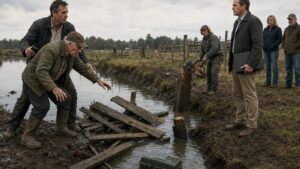
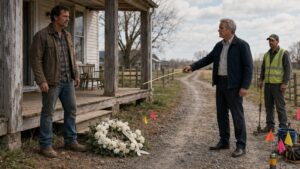
Edward Lewis drove a fluorescent survey flag into the ground three inches from the outside workbench.
Thomas stared at it.
“That can’t be right.”
Edward did not answer immediately. He checked the instrument mounted on the tripod, looked back toward the road, then at the small screen in his hand.
“It can be wrong,” he said. “But it won’t be wrong because we don’t like where it landed.”
The flag stood between two of the bench legs.
Thomas folded his arms.
The old bench ran along the workshop’s western wall beneath a shallow corrugated-metal awning. His father had built it from oak beams salvaged from a collapsed machine shed. One end carried a vise that had outlasted three pickup trucks. Beneath it sat lengths of pipe, a rusted jack stand, and a stack of fence panels Thomas kept meaning to move.
Edward stepped back and sighted down the edge of the drainage strip.
“This is the preliminary line.”
“Preliminary.”
“Yes.”
“You said that like it matters.”
“It does if you’re about to start an argument based on a flag.”
Thomas looked toward the shared road.
Deborah’s pickup was nowhere in sight. Laura had offered to attend but Thomas had told her there was no need. He wanted the survey without an audience.
Edward walked to the workshop corner and crouched beside a second flag.
“The easement itself is wider than the ditch.”
“I know that.”
“Do you?”
Thomas looked at him.
Edward stood.
“The ditch is what you can see. The easement is the legal strip. Those aren’t the same thing.”
Thomas’s jaw tightened.
“My father never had trouble with it.”
“That is not a measurement.”
Edward said it mildly, which made it harder to fight.
He carried the instrument farther down the lane and set another point. Thomas followed.
The drainage strip looked harmless that morning. Grass covered most of it. Only a faint brown seam showed where water had run after the last storm.
Edward pointed toward the concrete apron beside the workshop.
“Your father added that after the original building went up.”
“Years ago.”
“I know.”
“The association never objected.”
“I’m not the association.”
Thomas gave him a sharp look.
Edward met it without challenge.
“I’m here to tell you where the recorded line is.”
They worked another forty minutes before Edward opened a weatherproof map case and removed a copy of the old plat.
Thomas recognized his father’s handwriting in one corner.
A date.
A measurement.
A small arrow.
Nothing dramatic.
Edward laid the sheet across the hood of his truck.
“The recorded drainage-access strip comes through here.”
His finger moved along a narrow band parallel to the road.
Thomas watched it cross the edge of the concrete apron.
Then the bench.
Then the pile of fence panels.
“It doesn’t go through the building.”
“No.”
Relief came so quickly Thomas almost smiled.
Edward continued.
“But access to the strip is narrowed beside it.”
Thomas’s smile never formed.
“How much?”
“At the tightest point? Less than half what the old plat contemplated.”
“Contemplated?”
Edward looked at him.
“Thomas.”
“What?”
“You wanted a survey.”
“I wanted facts.”
“You’re getting them.”
Thomas walked to the bench.
The padlock on the workshop door remained closed. That mattered to him. Deborah’s easement claim did not reach through that door. Whatever else the survey showed, she had still crossed a line she had no right to cross.
He put a hand on the old vise.
“So she was right.”
Edward shook his head.
“That isn’t what I said.”
“She said access was blocked.”
“Restricted. Not blocked.”
“Same thing to her.”
“No. And you know it.”
Thomas looked at him.
Edward pointed toward the workshop door.
“She had no business going inside without permission.”
Then he pointed toward the bench.
“And you don’t get to use that fact to pretend this isn’t here.”
Thomas looked away.
The answer irritated him because it left him without a clean side to stand on.
Edward walked to the fence panels and nudged one with his boot.
“These could move in an hour.”
“They’re not the issue.”
“No. They’re just the easiest part.”
Thomas knew what he meant.
The bench was bolted to the apron.
His father had built it deliberately heavy because, as he used to say, anything light enough to steal was too light to trust.
Thomas remembered helping set the anchor bolts. He had been twenty-six. His father had made him redo one because it sat a quarter inch out of square.
Edward pulled a tape measure.
“If the bench stays, maintenance equipment has to come from the other direction.”
“So let it.”
“That route crosses softer ground.”
“Then use smaller equipment.”
“That may work.”
Thomas turned.
“You keep saying may.”
“Because I don’t run the drainage association.”
“No, you just keep finding reasons they need what they say they need.”
Edward’s expression changed.
Not anger.
Disappointment.
“You called me because you trusted me to measure.”
Thomas immediately regretted the sentence, but pride kept him from taking it back.
Edward folded the tape measure.
“I worked for your father because he didn’t ask me to tell him what he wanted.”
The words landed harder than Thomas expected.
For a moment, the only sound was a truck passing on the county road beyond the trees.
Thomas looked at the flag beside the bench.
“Did he know about this?”
Edward hesitated.
Thomas saw it.
“What?”
“I said I wanted to check records first.”
“You checked.”
“Yes.”
“And?”
Edward walked back to his truck and pulled out a second sheet.
It was not an official plat.
It was a field sketch.
Thomas could see old pencil marks, dimensions, and a note in Edward’s handwriting near the workshop corner.
He reached for it.
Edward held it a moment longer.
“This isn’t a recorded document.”
“I know what a field note is.”
“Then don’t turn it into something it isn’t.”
Thomas took it.
A line traced the drainage strip.
The bench location was penciled in.
Beside it were three words.
Shift after harvest.
Thomas stared.
“Your writing?”
“Yes.”
“Whose instruction?”
Edward took off his cap and rubbed the back of his head.
“Your father and I talked about it.”
Thomas looked up.
“When?”
“Seventeen years ago, give or take.”
“Why?”
“The road group had asked whether that side could be cleared a little. Nothing formal. Your father said the bench had ended up tighter to the drainage access than he liked.”
Thomas felt something close inside him.
“He built it.”
“Yes.”
“He knew where the ditch was.”
“Yes.”
“Then why would he—”
“Because people change their minds when they see something not working the way they expected.”
Thomas folded the sheet once.
Too sharply.
Edward watched him.
“He was going to move it?”
“He said after harvest.”
“Did he?”
“You’re standing here.”
Thomas looked at the bench again.
“No.”
“No.”
“Why didn’t you tell me this before?”
Edward’s face tightened.
“Because it was a conversation seventeen years ago. I didn’t think it mattered until I saw where the current line fell.”
“It mattered to him.”
“Maybe.”
Thomas looked at him sharply.
Edward continued.
“Or maybe it was one item on a list that never got done.”
Thomas disliked that even more.
His father’s unfinished promise felt worse than a hidden mistake. A mistake could be defended. An intention forced Thomas to consider that the man he had been preserving in place had not intended the place to remain frozen.
Edward gathered the tripod.
“You have choices.”
“Like tearing out the bench.”
“I didn’t say that.”
“You didn’t have to.”
“You can redesign access. You can move the stored material. You can challenge the easement interpretation. You can build a narrower bench inside. You can ask the association to approach from the other side.”
Thomas said nothing.
Edward closed the tailgate.
“But you should make those choices based on what’s here now.”
Thomas looked at the padlocked workshop door.
“And Deborah?”
“That’s a different problem.”
“She made it the same problem.”
“Then separate them.”
Edward opened his truck door.
Thomas unfolded the field note once more.
Shift after harvest.
Three small words.
His father had known.
Maybe not everything.
Enough.
Edward put one foot inside the truck, then stopped.
“There was more to that conversation.”
Thomas looked up.
“What more?”
Edward’s hand stayed on the door.
“Your father said he didn’t want anybody thinking access meant ownership.”
Thomas waited.
Edward looked toward the workshop.
“Then he said he also didn’t want stubbornness turning into an excuse for making somebody else’s problem worse.”
Thomas did not answer.
Edward started the engine.
The fluorescent flag beside the bench moved slightly in the air.
For the first time since Deborah’s key had turned in his lock, Thomas was no longer asking whether she had been wrong.
He knew she had.
Now he had to ask a harder question.
What had his father expected Thomas to do once being right was no longer enough?
Chapter 5: What His Father Had Promised but Never Finished
Edward returned Saturday morning carrying a yellowed field notebook in a plastic sleeve.
Thomas saw it before Edward reached the workshop.
“I thought you said the sketch was all you had.”
“I thought it was.”
Edward placed the notebook on the workbench.
“The office storage got reorganized last year. I found this in a box with old drainage jobs.”
Thomas did not touch it.
“What does it say?”
“You should read it.”
“I asked what it says.”
Edward looked at him for a moment, then opened the sleeve.
The page was dated seventeen years earlier.
Most of the writing was ordinary: benchmark elevations, culvert measurements, slope percentages.
Near the bottom was a short note.
Mitchell agrees bench/apron clutter too tight for access. Move loose material now. Shift bench after hay season. Maintain no-entry understanding for shop interior.
Thomas read it twice.
Then once more.
The final line held him.
No-entry understanding.
His father had drawn the same boundary Thomas had.
But not the same way.
He had intended to clear the outside while protecting the inside.
Thomas sat on the edge of the bench.
Edward said nothing.
“Why didn’t he move it?”
“I don’t know.”
“He had years.”
“Yes.”
Thomas shut the notebook.
He remembered that season differently.
His mother had needed surgery late that summer. His father had cut hay between trips to the hospital and meals eaten from vending machines. The following spring a tornado had damaged two barns three miles east, and half the neighborhood had spent weeks helping with cleanup.
Maybe the bench had simply slipped.
Maybe Thomas had been defending an omission as if it were a principle.
Edward placed the field notebook back in its sleeve.
“I’m sorry I didn’t find it sooner.”
Thomas shook his head.
“You didn’t owe me his memory.”
“No.”
Edward closed the case.
“But I owed you the record once it mattered.”
After he left, Thomas stayed by the bench.
A rusted bracket held one end of a lower shelf against the concrete wall.
He went inside and took down one of his father’s old combination wrenches.
The steel was smooth along the handle from decades of use.
Thomas fitted it over the first nut.
It resisted.
He leaned harder.
The nut moved with a sharp metallic snap.
Thomas stopped.
The bracket had not failed.
Nothing dramatic had happened.
But the bolt had turned.
He stood there with the wrench in his hand and felt suddenly disloyal.
He set it down.
An hour later Laura White pulled into the yard.
She did not come with a binder this time.
“I heard Edward was out.”
Thomas nodded.
“He found an old note.”
Laura looked toward the bench.
“Bad?”
“Depends what you mean.”
She waited.
Thomas handed her the copy Edward had left.
Laura read it.
Her expression softened.
“That sounds like your father.”
“You remember him promising this?”
“No.”
“Everybody else seems to know more about my property than I do.”
Laura handed the page back.
“That’s not fair.”
“I know.”
The admission came out before Thomas could decide whether to make it.
Laura leaned against the workshop wall.
“I need to tell you something about Deborah.”
Thomas looked at her.
“If this is supposed to make me forget the key—”
“It isn’t.”
He waited.
Laura glanced toward the drainage strip.
“Three years ago, before you were on the association board at all, the culvert near the bend plugged after a storm.”
“I remember the rain.”
“You didn’t see the pasture.”
Thomas said nothing.
“The neighbor had hay stacked low in the field. Water backed across that whole corner. Mud got into everything. Deborah and I were there most of one day dragging wet bales apart.”
Thomas looked at her.
“Why Deborah?”
“She was the first one who noticed water crossing the lane.”
“That doesn’t explain getting a locksmith.”
“No.”
Laura rubbed her thumb against the edge of her palm.
“The insurance question nearly turned ugly. Everybody blamed everybody. The association had no inspection records worth anything. No schedule. No photographs. No clear responsibility.”
Thomas had heard pieces of that, but never enough to care.
Laura continued.
“Deborah became chair the next year.”
“And decided she owned every ditch.”
“She decided nobody was ever going to be able to say she ignored a drainage problem.”
Thomas looked at the standing grass behind the workshop.
“That still doesn’t give her my key.”
“I know.”
“Does she?”
Laura was quiet.
“I think she knows now.”
Thomas gave a short humorless laugh.
“That’s convenient.”
“She was wrong.”
Laura’s voice hardened.
“I’m not asking you to excuse her.”
Thomas looked at her.
Laura held his gaze.
“I’m asking you not to make the same mistake she did.”
“What mistake?”
“Thinking your reason makes your action correct.”
Thomas looked away.
He disliked the precision of that.
Deborah had been afraid of another flood, so she enlarged her authority.
Thomas had been afraid of losing what his father left him, so he had shrunk everyone else’s rights.
Different acts.
Same temptation.
Laura stepped toward the road.
“The association has a meeting Monday.”
“I know.”
“You coming?”
“Maybe.”
“You should.”
Thomas looked toward the bench.
“Did the board know she was getting a key?”
“No.”
“You’re sure?”
“Yes.”
“That’s what you said Tuesday.”
“And I checked again.”
Laura opened her truck door.
“There’s something else.”
Thomas waited.
“The deputy called the locksmith.”
His attention sharpened.
“And?”
“They still have the paperwork.”
“What paperwork?”
“The authorization Deborah gave them.”
Thomas took one step forward.
“What does it say?”
“I don’t know.”
“You just told me they have it.”
“I know they have it. I haven’t seen it.”
“Why not?”
“Because it isn’t association paperwork.”
Thomas thought about the freshly cut key.
The bright edges.
Deborah standing beside the open door and saying the association had authority.
Laura got into the truck.
“The locksmith said they’d release a copy to the proper parties.”
Thomas put a hand on the door frame.
“Did Deborah sign it?”
Laura looked at him.
“The locksmith said her signature is on the form.”
After she left, Thomas went back to the bench.
The loosened nut was still sitting on the end of the bolt.
He picked up his father’s wrench.
This time he turned the nut another full rotation.
Then he stopped again.
Not because he had changed his mind about the bench.
Because Monday had become about something else.
The survey had shown Deborah might have been right about the drainage access.
The field note had shown Thomas’s father knew it.
But neither explained how Deborah had convinced a locksmith to cut a key to a building the board had never authorized her to enter.
Thomas set the wrench down.
On Monday, he intended to find out whether Deborah had misunderstood her authority—
or deliberately made it sound larger than it was.
Chapter 6: The Authorization Form Said More Than Deborah Could Defend
The locksmith laid a photocopy on the counter and tapped one sentence with his finger.
Thomas read it without touching the page.
Authorized representative confirms lawful authority to obtain access to structures located within the maintenance easement.
Below that was Deborah Nelson’s signature.
Thomas looked up.
“She signed this?”
The locksmith nodded.
“She showed identification and association paperwork.”
“What association paperwork?”
“A copy of the easement. A letter on association letterhead.”
“Signed by who?”
“She signed that too.”
Thomas’s mouth went dry.
The deputy stood beside him, not taking notes yet.
“Did she tell you she was the property manager?” Thomas asked.
The locksmith shook his head.
“Not those words.”
“What did she tell you?”
“That she was authorized by the road association to access structures interfering with the drainage easement.”
Thomas stared at the form again.
The distinction mattered.
This was not some forged title lifted from a television drama.
It was worse in a quieter way.
Deborah had taken a real position, a real easement, a real drainage concern—and stretched them until the locksmith heard authority she did not possess.
The locksmith pushed the copy toward the deputy.
“I asked specifically whether the owner had approved access. She said owner cooperation had been requested and refused, and the association had maintenance authority.”
Thomas felt heat rise behind his ears.
“She knew I refused entry.”
The locksmith looked uncomfortable.
“I can only tell you what she represented.”
The deputy finally opened his notebook.
“Did she provide a copy of any board resolution authorizing entry into a building?”
“No.”
“Did you ask?”
“I asked whether she had authority. She signed the statement.”
The deputy nodded.
The answer was plain enough.
By that evening the association meeting room was full without being crowded.
Thomas sat near the end of the table.
Deborah sat across from him.
Laura had placed copies of three documents in front of everyone: the easement, the meeting minutes, and the locksmith authorization form.
The three papers told three different versions of the same dispute.
The easement gave access rights.
The minutes limited the board’s inspection plan to coordinated exterior access.
The locksmith form claimed authority to access structures.
Deborah looked older than she had a week earlier.
Not defeated.
Tired.
One board member asked the question everyone had avoided.
“Did you know the board hadn’t authorized building entry when you signed this?”
Deborah looked at the paper.
“Yes.”
Thomas felt the room change.
Laura stopped moving her pen.
The other board member leaned back.
Deborah continued before anyone interrupted.
“I believed the easement itself gave us authority beyond the board motion.”
Thomas said, “Then why did you write it like the board had authorized you?”
“I didn’t.”
He tapped the page.
“Authorized representative.”
“I am an authorized representative.”
“To enter structures?”
Deborah’s jaw tightened.
“To inspect conditions affecting drainage.”
“That wasn’t the question.”
She looked at him.
The echo of the deputy’s words hung between them.
For the first time, Deborah seemed to hear it.
Laura spoke quietly.
“Deborah, did you think the locksmith would make the key if you told him the board had only approved exterior inspection?”
Deborah did not answer.
Thomas watched her hands.
They were clasped tightly enough that the knuckles had gone pale.
“Did you?” Laura asked again.
“No.”
The word barely carried across the table.
Thomas felt the anger he had been waiting for.
Strangely, it did not arrive whole.
Deborah looked at him.
“I thought we were running out of time.”
“For what?”
“For the next storm.”
Thomas started to speak.
She held up one hand.
“No. You asked. Let me answer.”
Her voice was steady, but the effort showed.
“Three years ago I stood in mud past my ankles cutting plastic off ruined hay because nobody had checked a culvert everyone assumed was somebody else’s responsibility. The neighbor was asking who would pay. The association had nothing. No inspections. No schedule. No record except people saying they thought it was fine.”
“That wasn’t my workshop.”
“No.”
“Wasn’t my culvert either.”
“No.”
“Then you don’t get to use it as permission.”
“I know that now.”
Thomas looked at her.
The sentence did not absolve her.
But it stripped away the last convenient version of her as someone who had simply wanted power.
Deborah looked down at the documents.
“When you ignored the letters, I thought you were doing what everybody had done before. Delay until the problem belonged to somebody else.”
Thomas felt that land.
He had ignored the letters.
Not because he intended harm.
Because he had already decided the answer before reading the question.
Deborah continued.
“I told myself the easement gave me enough authority. Then I wrote the locksmith statement broad enough that he would accept it.”
Laura said, “That’s the problem.”
“I know.”
“No,” Thomas said. “The problem is you knew it was broad.”
Deborah met his eyes.
“Yes.”
There it was.
No hidden document needed.
No witness arriving through the door.
She had made the choice.
The deputy had already explained to Thomas that any formal consequences over the unauthorized entry would proceed separately. The association could also remove Deborah from inspection responsibilities.
One board member turned toward Thomas.
“We need to know what you want from us.”
Thomas had expected that question to feel good.
It did not.
He looked at the three papers.
A week earlier he would have wanted Deborah removed from everything.
He might have wanted fines.
A public admission.
Maybe worse.
Then Edward’s fluorescent flag had landed beside his father’s bench.
Thomas said, “I want no association member entering a locked private structure without the owner’s written permission or a lawful order.”
Laura nodded.
“That can be adopted.”
“I want key duplication prohibited unless the owner authorizes it.”
Another nod.
“And I want Deborah removed from access and inspection authority.”
Deborah did not react.
The board member asked, “Anything else?”
Thomas thought about the attorney he had spoken with that morning.
He could pursue every available civil claim.
He could make the association pay lawyers until everyone hated the road more than the rain.
The option was real.
That was what made the decision matter.
“I want the lock replaced,” he said.
“Of course.”
“And I want the drainage issue surveyed and fixed properly.”
Deborah looked up.
Thomas continued.
“That means I’ll move the fence panels.”
Laura waited.
Thomas looked toward the window, though the workshop was too far away to see.
“And I’ll alter the bench frontage enough to restore the access strip.”
Deborah’s expression changed.
Not relief.
Something more cautious.
“You don’t have to do that tonight,” Laura said.
“I know.”
Thomas rubbed his thumb against the edge of the easement copy.
“My father meant to do it.”
Nobody spoke.
He looked at Deborah.
“That doesn’t make what you did right.”
“I know.”
“And you’re never getting a key to my shop again.”
“I understand.”
Thomas leaned back.
For the first time, the boundary felt clear without needing anger to hold it in place.
Laura began drafting the motion.
Exterior inspections by appointment.
No entry into private structures without express written consent or lawful authority.
No independent key duplication.
Deborah suspended from inspection duties pending formal association action.
Thomas listened.
Then he interrupted.
“One more thing.”
Laura looked up.
“The drainage access should be marked on the ground.”
Edward could establish permanent reference points. That way nobody would have to rely on memory, assumptions, or old arguments.
Laura wrote it down.
Deborah sat quietly.
When the meeting ended, she gathered none of the papers.
Thomas stood at the door.
She stopped beside him.
“I am sorry.”
He did not answer immediately.
He did not want to reward her simply for saying it.
Finally he said, “I believe you’re sorry it went this far.”
Deborah absorbed that.
“That’s fair.”
He looked at her.
“Maybe someday I’ll believe you’re sorry you made the choice before you knew where it would go.”
She nodded once.
Outside, the gravel road was dark between the headlights.
Thomas drove home.
He parked beside the workshop and walked to the bench.
The loosened nut was still there.
He picked up his father’s wrench.
This time he turned it until the nut came free.
The bracket sagged slightly.
Thomas caught the shelf with one hand.
Tomorrow he would call Edward.
Then Laura.
Then the county inspector.
He would not give away the workshop.
He would not pretend the easement owned what it did not.
But neither would he keep using his father’s unfinished work as a reason to leave the problem exactly where it was.
Thomas set the nut on the bench.
By morning, he intended to show the association a proposal nobody had expected from him.
Chapter 7: He Changed the Boundary Without Giving Away the Farm
The first bolt came loose just after seven on a Tuesday morning.
Thomas Mitchell held the head with his father’s old wrench while the ratchet in his other hand turned slowly against the nut beneath the workbench.
For half a second, nothing happened.
Then the rust gave.
The bolt shifted.
Thomas stopped.
The bench did not move. The workshop did not change shape. No memory left the farm.
Still, the sound of that first thread breaking free felt larger than it should have.
Edward Lewis stood several feet away beside the drainage strip, checking the permanent markers he had set the previous afternoon.
“You want help?” he asked.
“No.”
Edward nodded.
He understood the answer for what it was.
Thomas loosened the second bolt.
The bench had been built to stay where it was. Thick oak planks. Heavy frame. Steel angle braces under the lower shelf. His father had made things that way whenever he could.
Permanent, if possible.
Repairable, if not.
Thomas had spent years confusing those two ideas.
By midmorning the loose fence panels were stacked well clear of the marked access strip, and the lengths of corrugated pipe had been moved to the equipment barn. The county drainage inspector had approved the new exterior path on paper two days earlier. Edward’s stakes showed exactly where association access began and ended.
Nothing crossed the workshop threshold.
That detail had been Thomas’s condition.
Laura White arrived before noon carrying a folder.
Behind her came Deborah Nelson.
Thomas saw the second truck and set the wrench down.
For a moment he wished Laura had come alone.
Then he decided that would have been easier and therefore probably worse.
Deborah got out but did not approach the workshop door.
That was the first thing Thomas noticed.
She stopped near the outer edge of the drainage strip and waited.
Laura walked over.
“I have the final access agreement.”
Thomas wiped his hands on a rag.
“Board approved?”
“Yesterday.”
“Unanimous?”
Laura glanced at Deborah.
“Approved.”
Thomas almost asked again.
Instead he held out his hand for the folder.
The new protocol was only three pages.
Scheduled exterior inspections with reasonable notice.
Emergency access to the drainage easement when immediate property damage was likely.
No authority to enter locked private structures without written permission from the owner or lawful process.
No duplication of private keys.
Permanent ground markers to define the maintained strip.
Written records after each inspection.
Thomas read the last page twice.
At the bottom was a signature line for the association chair.
Not Deborah.
She had been removed from that role the previous week and from all inspection duties tied to the easement.
Laura had told Thomas the vote was not close.
He had not asked how Deborah took it.
Now he could see.
She looked tired, but not angry.
Laura handed her a second document.
“This one acknowledges the limits applying to former access personnel too.”
Deborah looked at the paper.
Then at Thomas.
“You want me to sign it here?”
“Laura does,” Thomas said.
A trace of embarrassment crossed her face.
“That’s fair.”
She rested the paper on Laura’s folder and signed.
No argument.
No explanation.
No attempt to remind anyone why she had done what she had done.
Thomas found that more difficult to resent than the speeches he had expected.
Laura took the document back.
“The locksmith confirmed the duplicate key was surrendered. The association reimbursed Thomas for the replacement lock.”
Deborah nodded.
Thomas looked toward the workshop.
A new heavy padlock sat on the open workbench inside its packaging.
He had not installed it yet.
The old lock from the evidence process had been returned, but he did not want it back on the door.
Too many meanings had attached themselves to it.
Edward called from the drainage strip.
“Thomas.”
He was pointing at the remaining section of the exterior bench.
Thomas walked over.
The plan did not require destroying the whole thing.
Only the outer section narrowed the maintenance corridor. Edward had helped him lay out a shorter configuration that would preserve most of the oak and move the working surface fully inside the private side of the marked line.
Thomas had agreed to it on paper.
Standing in front of the saw marks was different.
His father’s pencil line was still visible beneath one plank.
Probably thirty years old.
Thomas ran his thumb over it.
Deborah stayed where she was.
Laura came closer.
“You can still challenge the width if you want,” she said quietly.
Thomas shook his head.
“No.”
“You sure?”
“The measurements are right.”
Laura did not answer.
Thomas looked at her.
“That doesn’t mean Deborah was right.”
“I know.”
“And it doesn’t mean the association gets more than what’s written.”
“I know that too.”
Thomas picked up the circular saw.
He positioned the blade over the marked cut.
For a moment he remembered his father’s hand on the back of his neck in the hospital room.
Keep the place ours.
Thomas had heard the sentence for four years as an instruction to resist.
Now he wondered whether his father had meant something simpler.
Do not let it be taken from you.
That was not the same as refusing to change it.
Thomas squeezed the trigger.
The blade bit into oak.
The sound filled the space between the workshop and the lane.
When the cut was done, Thomas and Edward carried the shortened section inside.
Thomas could have burned the removed boards.
Instead he leaned them along the interior wall beneath the tools.
One plank still had the old pencil mark.
He kept that one intact.
By midafternoon the new access corridor was open.
The drainage inspector walked the strip once, checked the grade, then nodded.
“This works.”
Thomas looked at Deborah.
She was standing farther back now, near her truck.
She had not entered the strip without being asked.
Laura said, “We’ll schedule the first formal inspection next month.”
Thomas nodded.
“With notice.”
“With notice.”
“And exterior only.”
Laura smiled faintly.
“Yes, Thomas.”
Deborah spoke then.
“I won’t be part of it.”
Thomas looked at her.
“I know.”
She glanced toward the workshop.
“I’m glad the drainage issue got fixed.”
He almost rejected the sentence simply because it came from her.
Then he looked at the cleared strip.
“So am I.”
Deborah nodded.
She turned to leave, then stopped.
“I should have waited.”
Thomas said nothing.
She continued.
“I told myself waiting was the dangerous choice.”
“It can be.”
She looked back.
“That doesn’t mean every shortcut becomes authority.”
“No.”
Deborah gave a small, tired nod.
Then she got into her truck.
Thomas watched her drive away.
There was no reconciliation worth naming.
No handshake.
No sudden friendship.
That felt right.
Some boundaries, once crossed, did not disappear because the person who crossed them finally understood where they were.
But they could be redrawn clearly enough that nobody had to pretend again.
That evening Thomas installed the new lock.
He closed the workshop door, slid the hasp into place, and snapped the shackle down.
Then he turned the lock so the keyway faced the wood.
His father’s habit.
Thomas smiled despite himself.
He tugged once.
Secure.
Inside the workshop, he had mounted a narrow strip of salvaged oak above the workbench.
On it hung two things.
His father’s old wrench.
And the new key.
Thomas stood beneath them for a while.
Before, he would have hidden the key in the farmhouse and treated the lock as proof that the workshop was safe because nobody else could enter.
Now the marked easement lay outside, open and usable.
The drainage association had exactly the access it was entitled to.
No more.
The workshop remained his.
Not because nothing had changed.
Because he had decided what could change and what could not.
Thomas turned off the light and stepped outside.
The newly cleared strip ran clean beside the building toward the road.
The old bench boards rested inside.
The new lock clicked behind him.
He put the key in his pocket, then stopped.
After a moment, he reopened the door.
He returned the key to the hook beside his father’s wrench.
Then he shut the door again.
This time he left it there.
The story has ended.