The Severed Municipal Fire Main And The Flooded HOA Golf Cart
CHAPTER 2: THE STAMPED MANDATE ON THE GROUND
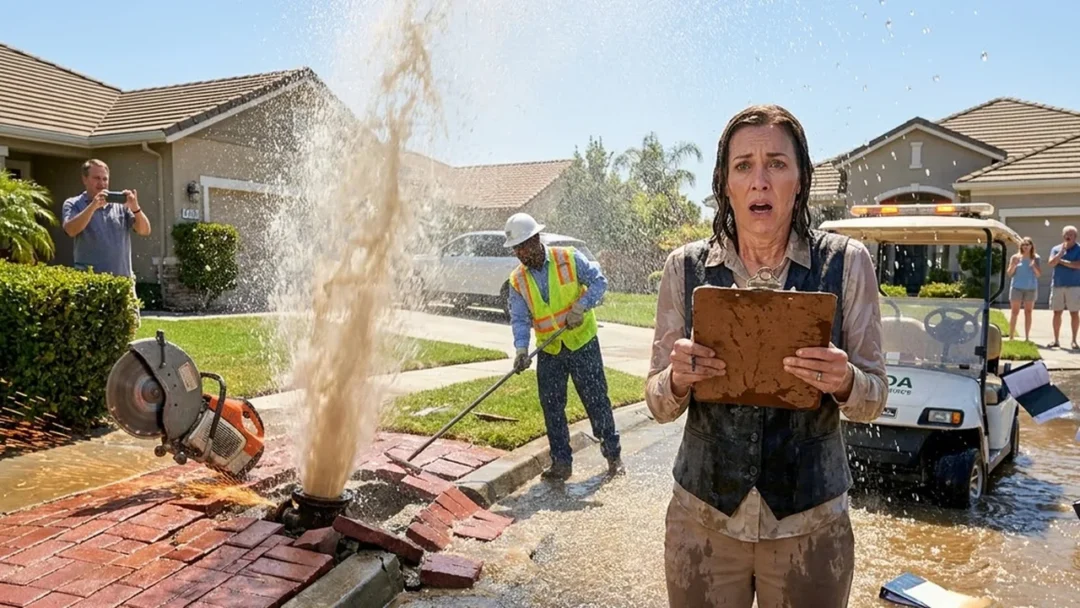
The heavy Husqvarna concrete saw clunked against the cart’s aluminum floorboard as Regina hefted it with both hands. Her forearms tensed beneath her designer tennis sweater, her lips pressed into a thin, merciless line. She was accustomed to seeing contractors pack their tools and leave the moment she invoked the association bylaws. For six years, she had ruled Magnolia Trace through intimidation and administrative attrition, and she had no intention of allowing a county utility technician to challenge her authority.
Gregory Hayes took a step forward, raising his smartphone to record the escalating confrontation. “Regina, stop this nonsense right now. You are holding an industrial demolition tool on a public utility easement. That valve protects the fire hydrants for our entire cul-de-sac. If there is a house fire on this block, the fire department needs immediate, unobstructed access to that gate.”
Regina didn’t even look at Gregory. Her gaze remained locked on Caleb Foster, her eyes blazing with stubborn, unyielding spite. “Hayes, you’ve been a thorn in this board’s side since the day you moved in. You think because you fly a passenger jet you can bypass the architectural review committee? I am the president of this association. I decide what structures exist on Magnolia Trace, and I say this curb comes down today.”
Caleb Foster stepped smoothly between Regina and the red paver curb, reaching into his clipboard to produce a laminated, double-sided document bearing the official embossed seal of Cobb County Public Works and the signature of the Chief Water Resources Engineer.
“Mrs. Vance, I am serving you with formal verbal and written notice,” Caleb said with quiet, unyielding authority, holding the document directly at eye level. “Under Georgia Code Section thirty-six-sixty-zero, municipal utility authorities retain statutory preemption over all private covenants, deed restrictions, and homeowners association bylaws regarding critical fire protection infrastructure. This document is a certified County Emergency Work Order. If you interfere with this protective barrier, you are committing a criminal act against public infrastructure.”
Regina didn’t take the paper. With a violent, dismissive slap of her leather-gloved hand, she struck the clipboard from Caleb’s grasp.
The certified work order fluttered through the air, tumbling across the asphalt before landing face-up on the pavement directly between Regina’s white tennis shoes. The official gold seal gleamed under the morning sun, completely unblemished, fully visible to the camera lens Gregory held steady from six feet away.
“Keep your bureaucratic garbage for county court, Foster!” Regina shouted, her voice rising in shrill defiance. “You’re in Magnolia Trace now!”
She planted her foot on the saw’s tubular steel base frame, set the choke lever to full, and yanked the heavy starter cord with savage force.
The two-stroke engine sputtered, coughed with a cloud of blue synthetic smoke, and roared to life with an aggressive, deafening howl that echoed across the quiet golf-course valley. The twelve-inch diamond blade spun into a shimmering silver disc, screaming at nine thousand revolutions per minute as Regina gripped the rubber throttle handles with white-knuckled fury.
Caleb Foster stepped back three paces to the safety curb, his face tightening into grim, solemn resolve. He pulled his heavy radio transceiver from his belt and keyed the primary dispatch channel. “Cobb County Dispatch, this is Unit Four-Twelve at 402 Magnolia Trace. We have an active, hostile interference with a municipal fire-main installation. Property owner is operating an unpermitted industrial cut-off saw against the protective valve sleeve. Request immediate law enforcement and battalion fire response.”
Regina sneered through the exhaust smoke, raised the screaming saw with both arms, and dropped the spinning diamond blade directly into the center of the red paver cap.
The legal framework governing public utility easements in Georgia is backed by over a century of established Supreme Court precedent. Under state law, dedicated public utility corridors possess sovereign immunity against private interference. A homeowners association covenant, regardless of how aggressively worded or ancient its recording date, holds zero legal authority to restrict, modify, or obstruct a municipal water or fire protection installation. When an emergency work order is stamped by a county authority, it carries the full police power of the state.
Regina Vance had spent three decades in commercial real estate, but her career had been spent in the speculative marketing side of residential developments, not in the civil engineering trenches. She was accustomed to using procedural delay tactics, aggressive legal bluster, and personal intimidation to force concessions from small subcontractors. In her mind, Caleb Foster was just another blue-collar county employee who would back down if confronted with sufficient fury. She had convinced herself that the gates of Magnolia Trace created an autonomous kingdom where county authority ended at the security shack. That delusion was about to collide with eighty pounds per square inch of pressurized municipal water.