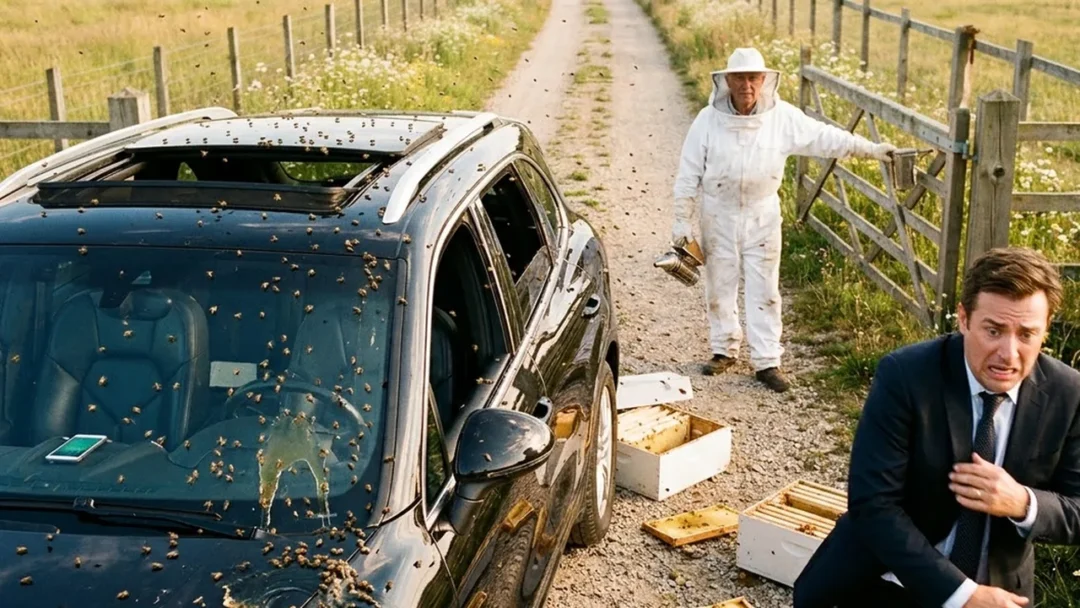
The Shattered Beehives On The Farm Lane And The Engulfed SUV
CHAPTER 2: THE FRACTURE OF LANGSTROTH BOX FOUR
The wooden sawhorse shattered with a loud crack as Trent’s heavy boot splintered the pine crossbeam, knocking the warning sign face-down into the gravel.
“Mr. Sterling, do not touch those boxes!” Amos warned, his voice rising with urgent, grave authority. “Those frames are full of brood and honey! If you break the seal, you will release the colony’s alarm pheromone!”
Trent didn’t listen. His mind was blinded by the arrogance of a man who had never faced a physical obstacle that money or muscle couldn’t sweep aside. To him, the white Langstroth boxes were just cheap pieces of scrap wood blocking his luxury truck. He planted his leather shoes in the loose stone, gripped the handles of the top two hive supers, and shoved them violently sideways off the steel handcart.
The heavy wooden boxes, weighing over sixty pounds each, tipped off the metal lip of the cart.
They did not fall into the grass. They crashed directly onto the gleaming black lacquer hood of Trent’s idling Cadillac Escalade.
The impact was explosive and catastrophic.
The ten-frame supers struck the curved aluminum hood with a concussive metallic crash that dented the sheet metal and chipped large flakes of black clear coat. The seasoned pine wood split along the corner dovetails, the bottom boards tore away, and the internal wax frames—heavy with six gallons of fresh, warm wildflower honey and capped brood comb—burst outward in all directions.
Golden, viscous honey splashed violently across the black hood, streaking down the chrome mesh grille and splattering across the front windshield. Broken pieces of golden honeycomb, dripping with sticky syrup, broke apart against the wiper arms. And worse, several fractured frames bounced across the hood, slid up the windshield glass, and tumbled directly through the open panoramic sunroof, landing with heavy, wet splatters on the perforated black leather console and front bucket seats.
Inside the shattered hives, sixty thousand Italian honeybees experienced what their evolutionary programming interpreted as a catastrophic apex-predator attack on their nest.
The queen had been jostled; the brood comb was exposed; the honey reserves were breached. Within less than half a second, thousands of guard bees released massive concentrations of isopentyl acetate—the chemical alarm pheromone that smells distinctly like artificial bananas. In the quiet, warm air of the valley, that chemical signal did not dissipate; it detonated an immediate, coordinated defensive mobilization.
A deep, deafening, metallic hum rose from the shattered frames—a sound that was not a buzz, but a low-frequency electrical roar that vibrated through the steel frame of the Escalade.
From the fractured boxes, a dense, dark cloud of bees erupted upward into the sunlight.
Trent Sterling froze. The smirk was stripped from his face in a fraction of a second. His eyes went wide with sudden, primal terror as he saw the sky darken above his hood with twenty thousand furious, swirling insects.
Amos Yoder stepped back smoothly, puffing his smoker once to shield his own perimeter, his voice cutting through the rising roar with chilling calm:
“That gate protected you, Mr. Sterling.”
In apiculture biology, the defense mechanism of Apis mellifera is one of the most sophisticated chemical signaling systems in the animal kingdom. Inside every worker bee’s stinging apparatus lies the Koschevnikov gland, which produces an alarm pheromone complex dominated by isopentyl acetate. When a colony’s structural envelope is fractured by external blunt force, the sudden release of this chemical acts like a broadcast radio alert across an entire frequency band. The aroma, resembling pungent artificial bananas, stimulates an immediate, reflexive fight-or-flight response in every guard bee within fifty yards, triggering rapid wing-fanning to disperse the scent and orient the defensive flight path toward the point of disturbance.
The mechanical destruction of the frames created a catastrophic chemical cascade. As the heavy pine supers struck the Escalade’s aluminum hood, the impact sheared the delicate wax foundations away from their supporting wire tensioners. Six gallons of raw, warm clover honey—viscous, sweet, and sticky—erupted across the black clear coat, mixing with powdered bee pollen and fragmented royal jelly. In automotive mechanics, high-fructose organic syrups pose an insidious threat to modern luxury electronics. Honey is naturally acidic, with a pH ranging between three and four; when introduced into heated engine bays, electronic throttle bodies, and high-voltage wiring harnesses, it creates corrosive conductivity paths while baking into an unyielding, caramelized glaze that permanently seizes mechanical linkages.
The physical shockwave of the impact sent deep ripples across the surface of the honey-filled frames. Within the cellular matrix of each comb, thousands of young nurse bees, entirely unaccustomed to flight or defense, were thrown into disarray as gallons of liquid nectar washed over their delicate wings. The elder guard bees, positioned along the bottom entrance reducers, responded instantly to the vibrational frequency of the crash. To a bee colony, a sudden mechanical blow accompanied by the destruction of comb is the unmistakable signature of a black bear or a badger tearing open a hive cavity.
The Escalade’s automated environmental sensors reacted with frantic digital confusion. The cabin climate control system, detecting sudden changes in ambient humidity and particulate matter, engaged its commercial air purification fans at maximum blower speed. Instead of filtering the air, the powerful intake vents located at the base of the windshield acted as high-volume suction ports, drawing thousands of airborne bees directly through the cabin filter housing and blasting them across the dashboard vents into the interior cabin. The interior of the luxury vehicle transformed into a high-speed aerodynamic vortex of angry, disoriented honeybees.