The White Luxury Convertible Impounded Across the Blue Access Ramp
CHAPTER 1: TWO DIAGONAL LINES IN BLUE
The pale morning sun reflected harshly off the fluted limestone portico of the Cumberland County Courthouse, casting long, angular shadows across the freshly sealed asphalt of the west municipal parking plaza. It was nine-forty on a crisp, crystalline Tuesday morning in Carlisle, Pennsylvania, precisely twenty minutes before the borough council’s monthly zoning board hearing was scheduled to convene. The autumn air was cool and brisk, biting through wool fabric with an early frost chill, carrying the faint scent of diesel exhaust from idling county maintenance vans, pungent coal-tar pavement sealant, and damp fallen oak leaves matted along the concrete gutters.
Master Sergeant Thomas Caldwell had left his small brick ranch house outside Boiling Springs at eight-fifteen, allowing forty-five minutes of buffer time to navigate the two-lane country roads and find accessible parking before the morning docket filled the square. His left leg, rebuilt with titanium pins and braided carbon fiber after a mortar blast outside Nasiriyah during the Gulf War, throbbed with a dull, familiar ache that always deepened when the barometer dropped. For thirty years, Caldwell had lived by the unbending military discipline of arriving fifteen minutes before the fifteen-minute muster. Today, that discipline was matters of life and community survival.
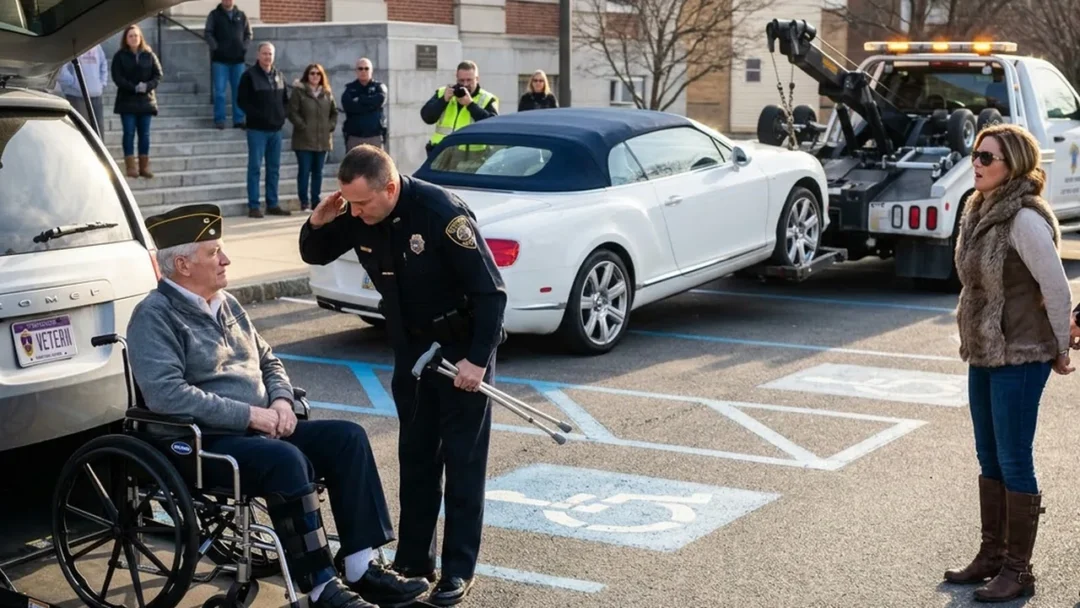
In the designated accessible parking row positioned directly in front of the courthouse’s primary ramped entrance, two wide stalls were freshly painted in brilliant ultramarine blue, demarcated by thick white diagonal stripes across an eight-foot hashed access aisle. A dark blue metal placard bolted to a heavy square steel post stood squarely at the head of the aisle, bearing the international wheelchair emblem and bold reflective lettering: DISABLED PARKING ONLY – KEEP AISLE CLEAR – MINIMUM FINE $250 – MANDATORY TOW-AWAY ZONE.
Resting lawfully inside the leftmost stall was Caldwell’s dark forest green modified Dodge Grand Caravan. The van bore a Pennsylvania specialty registration plate featuring a stamped Purple Heart combat medal emblem, registered to a retired military veteran. The vehicle was equipped with an aftermarket BraunAbility mobility conversion package funded through the Department of Veterans Affairs. Its heavy passenger-side slider door was fully retracted into its recess, and its motorized ribbed aluminum access ramp had deployed halfway outward, angling downward toward the pavement before its mechanical safety sensors suddenly engaged. Detecting an immovable physical obstruction less than six inches ahead, the electric drive motor automatically locked with a persistent, high-pitched electronic warning chirp.
Blocking the ramp entirely was a gleaming pearl-white Mercedes-Benz SL550 convertible. The luxury sports vehicle was parked diagonally across both accessible bays, its low front right Michelin performance tire resting squarely atop the painted blue handicap symbol of the adjacent empty stall. Its wide rear quarter panel sat barely five inches from the veteran’s deployed aluminum ramp, choking the hashed access aisle to less than ten inches of impassable clearance. The vehicle’s dual chrome exhaust tips were still ticking with residual engine heat, venting the sharp, metallic smell of premium unleaded fuel into the pedestrian walkway.
Sitting on the edge of the van’s front passenger bucket seat was Master Sergeant Caldwell. Sixty-eight years old, Caldwell wore a neatly pressed charcoal wool service blazer, a dark garrison cap pinned with the gilded ribbon bar of the 82nd Airborne Division, and a heavy carbon-composite articulated brace locking his left knee and calf. His silver hair was cut in a severe high-and-tight infantry fade, his weathered, leathery face etched with the deep lines of thirty years of active service across three overseas combat deployments. A jagged shrapnel scar ran from behind his left ear down into his collar, a permanent reminder of the blast that had severed his sciatic nerve. In his steady hands, he held an old olive-drab canvas satchel containing the legal land deeds and historic charter documents to the borough’s Veterans Memorial Park.
Standing beside the open driver’s door of the white convertible was a woman in her late forties. She wore a tailored camelhair overcoat richly trimmed with white arctic fox fur, oversized designer tortoiseshell sunglasses, and four-inch Italian leather stiletto boots that clicked sharply on the pavement. In her French-manicured right hand, she balanced an iced oat-milk latte in a clear plastic cup and an embossed calfskin handbag bearing a gold luxury logo.
“Ma’am,” Caldwell said. His voice was calm, low, and steady, carrying the quiet resonance of a senior non-commissioned officer who had spent decades commanding large formations without ever needing to shout to command absolute obedience. “You’ve parked diagonally across two disabled stalls and completely blocked my side wheelchair ramp. The mechanical sensor will not allow the ramp to lower to the pavement, and I cannot pivot my brace to stand up from the passenger seat. Please back your vehicle up six inches so I can deploy my walking aid and exit.”
The woman stopped in mid-stride, lowered her sunglasses to the bridge of her nose, and glared down at Caldwell with an expression of pinched, venomous disgust. She looked at his carbon leg brace, then at the half-extended metal ramp, and let out a sharp, mocking laugh that carried across the quiet parking plaza like breaking glass.
“I only need five minutes, cripple,” she snapped, her tone shrill, clipped, and dripping with rehearsed condescension. “I have an emergency filing in the zoning office on the second floor that cannot wait. My husband is Arthur Ross, and he sits on the Borough City Council. You can wait in your van until I’m finished. The world doesn’t stop turning just because you have a limp.”
“The Commonwealth motor vehicle code requires the access aisle to remain unobstructed at all times, ma’am,” Caldwell replied evenly, his steady gray eyes fixed on her face without blinking. “There are four open metered stalls thirty yards down the lane. This space is designated by state and federal statute for mobility-impaired citizens attending court proceedings.”
“Don’t quote the law to me, you old panhandler,” Victoria Ross sneered, stepping closer to the van’s open door until the overpowering scent of her expensive French floral perfume choked the morning air. “My husband’s committee pays for the pavement you’re parked on. If I want to leave my car here for ten minutes, I’ll leave it here. If you’re so desperate to get out, back your heap into the mud across the street. If you touch my paint with that ramp, I’ll have the borough solicitor sue you for every penny of your government pension.”
Caldwell did not answer with anger. He reached down beside his knees, retrieving a four-section folding aluminum walking cane from the door holster. The cane had a contoured black rubber grip and a heavy slip-resistant rubber ferrule at the tip. He gripped the textured shaft, intending to unfold the locking tension cord so he could bear his weight and pivot his boots to the curb.
Victoria saw the motion. With a sudden, vicious flick of her right foot, the sharp steel-tipped toe of her leather stiletto boot struck the aluminum cane straight out of Caldwell’s hands.
The cane flew three feet across the blue-striped access aisle, hit the asphalt with a hollow, echoing metallic clatter, and slid sideways under the low rocker panel of her white convertible, coming to rest directly behind the front tire against the oily suspension arm.
Victoria smirked, adjusting her fox-fur collar with theatrical satisfaction. She reached into her purse, pulled out a gold-plated smartphone, and looked up at the courthouse entrance portico.
“Security!” she shouted at the top of her lungs, waving her smartphone toward the limestone steps where two uniformed officers stood by the entrance doors. “Bailiff! Come down here right now and deal with this vagrant! He’s harassing a city councilman’s wife and refusing to move his vehicle!”
She turned back toward Caldwell with a triumphant, sneering grin. “Let’s see whose side the court takes, old man.”
Caldwell did not reach for the cane under the tire. He did not raise his voice. He sat straight on the passenger seat, adjusted his garrison cap, and watched as a courthouse security bailiff and a municipal traffic enforcement sergeant strode briskly down the limestone steps toward the blue stalls.
Behind the two officers, the deep, mechanical rumble of a Ford F-550 municipal wheel-lift tow truck rattled through the parking lane, its amber strobe lights already rotating against the pale autumn sky.