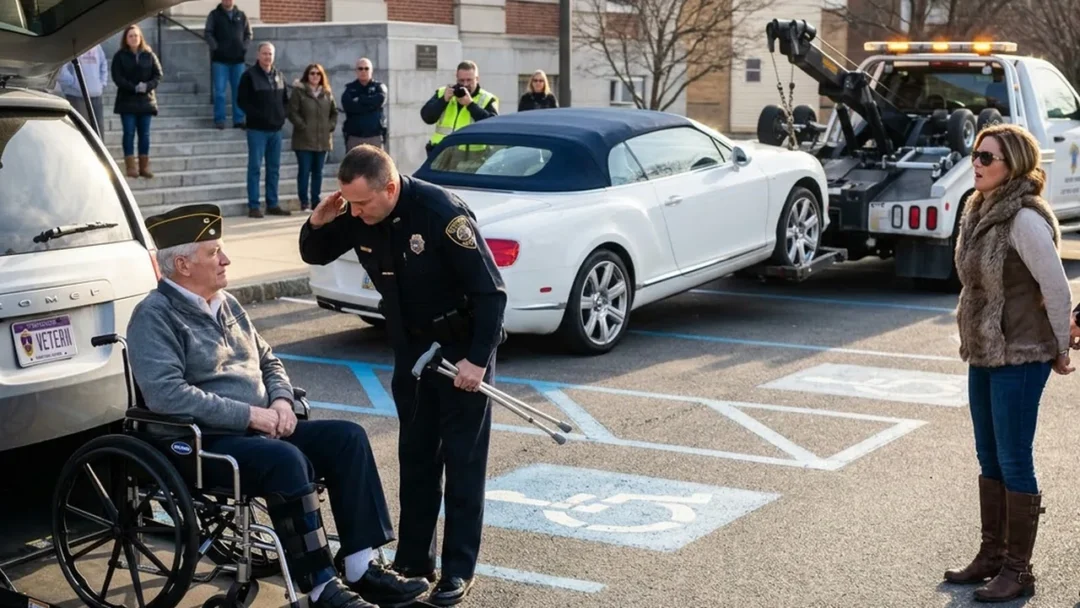
The White Luxury Convertible Impounded Across the Blue Access Ramp
CHAPTER 5: THE STANDOFF ON THE LIMESTONE STEPS
Judge Evelyn Vance walked down the steps with absolute judicial gravity. In her sixties, with steel-gray hair pulled back in an elegant chignon, she wore dark judicial robes over a tailored business suit, her spectacles resting on a gold chain around her neck. In her right hand, she held an official court docket folder.
Beside her, County Sheriff Marcus Thorne surveyed the scene with a sharp, professional eye. His deputies immediately moved to flank Arthur Ross, cutting off any possibility of the councilman retreating back into the building.
“Arthur Ross,” Judge Vance said, her voice cutting through the plaza with the weight of an iron gavel. “My clerk informed me twenty minutes ago that your administrative assistant attempted to file an emergency ex-parte petition to seal the doors of Council Chambers and declare the Veterans Memorial Park an eminent domain hazard without a public notice hearing.”
“Judge Vance, this is a municipal administrative matter,” Ross protested, his hands twitching at his sides. “The county judiciary has no supervisory jurisdiction over borough council zoning agendas.”
“The county judiciary has absolute jurisdiction over criminal fraud, perjury, and the forging of judicial notices,” Judge Vance replied, stopping on the bottom step and looking down at the councilman. “Your petition bore the facsimile signature stamp of Senior Judge Miller—who retired from this bench three months ago and currently resides in Florida. My administrative officer contacted Judge Miller in Sarasota ten minutes ago. He stated under penalty of perjury that he never saw your petition, never authorized the use of his signature stamp, and that his signature stamp was stolen from his former chambers last week.”
A collective gasp rippled through the gathered crowd on the plaza. Several court clerks whispered among themselves, shaking their heads in disgust.
Sergeant Miller stepped forward, handing the Tyvek envelope and the Apex binder across to Sheriff Thorne. “Sheriff, this packet dropped from Mrs. Ross’s vehicle during impound. It contains the fraudulent petition bearing the stolen stamp, along with two bank drafts totaling six hundred thousand dollars from a Cayman Islands escrow account tied to Apex Commercial Real Estate Development.”
Sheriff Thorne flipped through the Swiss bank drafts, his jaw hardening. “Six hundred thousand dollars in bearer drafts payable to Ross Heritage Holdings, dated last Friday. With a cover note from the Apex managing partner promising the remaining four hundred thousand once the park’s deed is nullified.”
Judge Vance looked at Victoria Ross, who was weeping against the side of the tow truck in her handcuffs, then looked at Arthur Ross, whose skin had turned the color of damp parchment.
“Arthur,” Judge Vance said quietly, “did you really believe you could sell the graves of Carlisle’s veterans to a condo syndicate and keep the proceeds in an offshore shell?”
“I… I acted in the best economic interests of the borough,” Ross whispered, his gaze dropping to his polished shoes. “The park is underutilized. We were going to build a new memorial plaza across from the sewer authority…”
“The charter of 1948 does not permit a new memorial plaza across from the sewer authority, Councilman,” Master Sergeant Caldwell’s voice rose, clear and steady as a bugle call.
Caldwell took three deliberate steps forward, his cane clicking firmly against the pavement. He unbuckled the brass clasp on his olive canvas satchel and pulled out a large, heavy leather portfolio tied with faded silk ribbon. He untied the knot and opened the cover, revealing a pristine, heavy parchment deed inscribed with ornate calligraphy and preserved under archival mylar.
“This is the original dedication charter of the Veterans Memorial Park, dated November 11, 1948,” Caldwell said, his eyes meeting Judge Vance’s. “Signed by Borough Burgess Harold Jenkins, the entire seven-member town council, and thirty-four surviving combat veterans of the Second World War. Section Four, Paragraph Two: ‘Said four acres of white oak timber and meadow shall remain a perpetual, unencumbered public sanctuary to honor the sacrifices of Cumberland County’s fallen sons. No commercial structure, municipal building, or private roadway shall ever be erected upon this soil, and any attempt by municipal authorities to alienate, rezone, or convey this land shall cause legal title to revert instantly to the Commonwealth of Pennsylvania under the stewardship of the American Legion.'”
Caldwell turned the page, pointing to the bottom of the parchment. “It carries the permanent seal of the Commonwealth Land Office, recorded in Deed Book 412, Page 88. It cannot be overridden by a zoning variance, an eminent domain decree, or a six-hundred-thousand-dollar developer kickback.”
Judge Vance took the charter in her hands, her fingers tracing the faded gold seal of the Commonwealth. Her grandfather had been a country doctor in Carlisle who treated the wounded men returning from Normandy; she recognized several of the thirty-four veteran signatures at the bottom of the vellum sheet.
“This charter is valid, binding, and supreme,” Judge Vance declared, her voice ringing across the plaza so that every spectator on the sidewalk heard each word. “It was drafted specifically to prevent corrupt politicians from desecrating memorial land for private gain.”
Judge Vance handed the charter back to Caldwell with deep reverence, then looked down at Arthur Ross with cold contempt.
“Sheriff Thorne,” Judge Vance said. “Place Councilman Ross under arrest for forgery of judicial process, commercial bribery, and violation of the Pennsylvania Public Official Ethics Act.”