They Blocked His Family Logging Road, but the Old Easement Hid a Harder Truth
Chapter 1: Three Concrete Blocks Across the Only Road
Samuel Wright came around the last bend before the property line and took his foot off the accelerator.
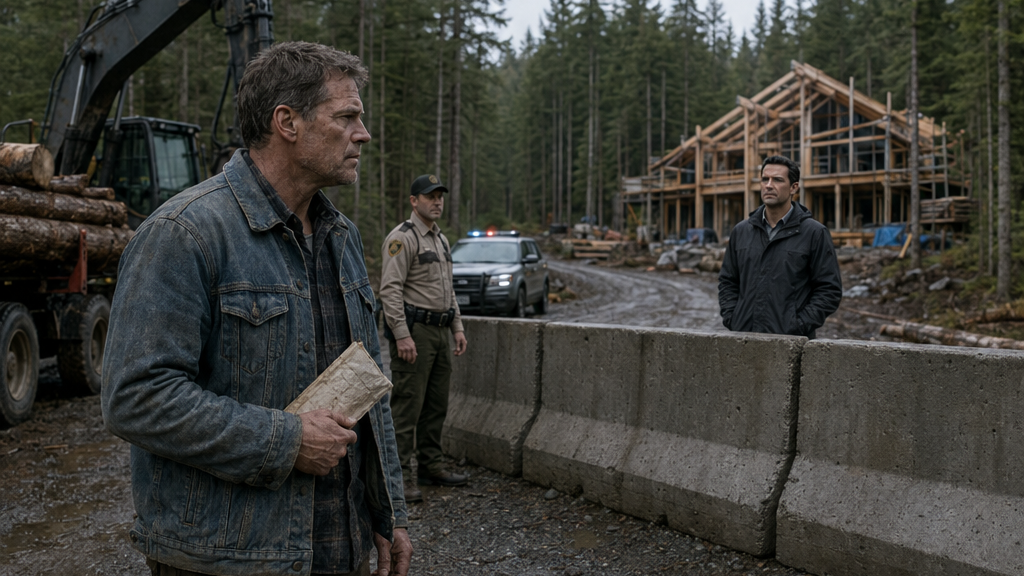
Three concrete blocks sat across the logging road.
They had not been there yesterday.
Each one was taller than the hood of his pickup and wide enough that, placed end to end, they sealed the road from ditch to ditch. Fresh scrape marks showed where machinery had dragged them into position. Damp gray dust still clung to the gravel around their bases.
Samuel stopped twenty yards short.
For several seconds he did nothing.
Behind the barriers, the road climbed through second-growth fir toward the back timber. His crew had spent most of the previous week preparing that tract for harvest. A loader was already staged above the ridge. Two truckloads were supposed to come out before noon.
He killed the engine and stepped down.
The morning was quiet enough for him to hear water moving through the culvert beneath the road.
Samuel walked to the first barrier and laid a hand against the cold concrete.
No warning ribbon. No county notice. No construction sign.
Just three blocks.
A compact excavator sat on the neighboring parcel farther down the slope, beside fresh grading for what had begun, over the summer, to look less like a house site and more like a commercial development. Survey stakes ran toward a stand of cedar. Beyond them stood the timber-framed shell of a large building.
Samuel knew who owned it.
Jason Clark had bought the parcel the previous winter.
At first, Jason had described the project as a small lodge. Then the plans grew. Cabins appeared on the hillside. A parking area was cleared. Contractors began calling it an eco-lodge.
Samuel had not cared much until now.
His phone rang.
Rachel.
He answered without taking his eyes off the blocks.
“You at the upper road?”
“Yes.”
“The hauler called me. He said you stopped.”
“I did.”
“Mechanical?”
Samuel looked at the barrier.
“No.”
There was a pause.
“What is it?”
“Concrete.”
“What?”
“Somebody blocked the road.”
Rachel went quiet for half a second.
“How blocked?”
“Completely.”
Samuel heard paper moving on her end.
“Send me a picture.”
He took one and sent it.
The phone stayed silent longer this time.
Finally Rachel said, “Those aren’t temporary barricades.”
“No.”
“Can you get around them?”
Samuel looked at the ditch to his right, steep and soft from recent rain. On the left, the ground dropped toward the creek.
“Not with a log truck.”
“Can you move them?”
“Not with anything I’ve got sitting here.”
Rachel exhaled.
Samuel knew that sound. She made it whenever numbers were getting worse faster than she could organize them.
“We were supposed to load today,” she said.
“I know.”
“The contract clock is already running.”
“I know that too.”
The timber buyer had given them thirty days to deliver two hundred thousand board feet from the back tract. The schedule was tight but ordinary for that time of year. What made it dangerous was the penalty clause.
Miss the daily volume badly enough and the charge started accumulating.
Rachel had argued against signing it.
Samuel had signed anyway.
He had told her they could make the schedule in their sleep.
Now Rachel said, “If we lose today, that’s eighteen hundred dollars.”
Samuel stared past the concrete at the road beyond it.
“Then we don’t lose today.”
“With what road?”
“I’ll find out who put them here.”
He hung up.
A pickup came down the new gravel drive on the neighboring parcel ten minutes later.
Jason Clark was behind the wheel.
He parked on his side of the barriers and got out wearing clean work boots, dark jeans, and a rain shell that looked new enough not to have seen much rain.
Samuel waited.
Jason glanced at the blocks before looking at him.
“I figured you’d be here early.”
Samuel’s jaw tightened.
“You put these in?”
“I had the contractor place them.”
“Move them.”
Jason shook his head.
“No.”
Samuel had expected denial. Maybe an excuse about construction safety.
The flatness of the answer caught him harder.
“That’s my access road.”
“It crosses my property.”
“It has crossed that property longer than either one of us has been alive.”
Jason stepped closer but stayed behind the concrete.
“And that’s what we need to sort out.”
“There’s nothing to sort out.”
“There is from where I’m standing.”
Samuel pointed toward the timber above them.
“My equipment is up there. My contract is running. You don’t get to close this road because you bought the dirt underneath it.”
Jason’s expression tightened.
“I bought a parcel with a road running through the center of a project that is now under construction. Heavy trucks are not coming through the lodge entrance until the access question is resolved.”
Samuel gave a short, humorless laugh.
“Access question.”
“Yes.”
“It’s an easement.”
“You say it’s an easement.”
“My family has used it for fifty years.”
“That isn’t the same thing.”
Samuel felt the first real surge of anger then.
He took one step toward the barrier.
Jason did not move.
“You bought that land knowing the road was here.”
“I bought it knowing there was an old recorded access reference. What I did not buy was unlimited modern logging traffic through the middle of a hospitality project.”
Samuel looked at the new building behind him.
“So that’s what this is. Your guests don’t want to see trucks.”
“That’s not what I said.”
“It’s close enough.”
Jason folded his arms.
“No, Samuel. It isn’t.”
Samuel disliked the use of his first name.
Jason went on.
“There are construction crews here. There will be guests here. There are insurance requirements and financing conditions. You’re running equipment through a corridor nobody has properly surveyed in decades.”
Samuel stared at him.
“You could’ve called.”
Jason’s face changed, but only slightly.
“I tried to deal with this before today.”
Samuel caught the phrase, but anger moved faster than curiosity.
“Move the blocks.”
“I’m not doing that.”
“Then I will.”
“With what?”
Samuel looked at the concrete again.
Jason said, “I’m telling you plainly. You do not have permission to cross my parcel until we settle where your legal access actually is.”
Samuel turned back.
“I don’t need your permission.”
Jason held his gaze.
“Then bring me something that proves it.”
For the first time that morning, Samuel felt uncertainty under the anger.
Not about the road.
He knew the road.
He had ridden beside his grandfather on it as a boy. He had learned to shift an old logging truck on its grade. His father had graded the washboard every spring. Samuel had hauled timber over it for more than twenty years.
But knowing a road and proving a right were not the same thing.
Jason got back into his pickup.
Before closing the door, he said, “Don’t try to move those yourself.”
Samuel said nothing.
The pickup disappeared toward the construction site.
Samuel remained beside the barriers until Rachel called again.
“The hauler wants to know what to do.”
“Hold him.”
“For how long?”
Samuel did not answer immediately.
He looked at the road disappearing behind the concrete.
The same road had always seemed permanent precisely because nobody had ever needed to explain it.
Now three blocks had turned fifty years of habit into a question.
“Give me an hour,” he said.
Back at the family office, Samuel went straight past Rachel’s desk.
She looked up.
“Where are you going?”
“The safe.”
He crouched beside the old steel cabinet in the back room and spun the dial.
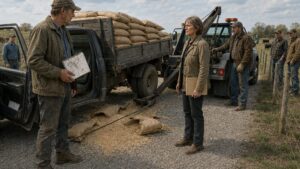
Inside were property records, timber contracts, tax files, and a brown envelope his father had told him never to lose.
Samuel took it out.
The paper inside was yellowed at the folds.
Near the top was the date.
His grandfather’s name appeared twice.
Samuel unfolded the final page and found the paragraph he remembered seeing years ago.
For the first time in decades, he read every word.
Chapter 2: The Paper Right Nobody Expected Him to Produce
The county clerk placed the recorded copy beside Samuel’s family document and aligned the corners.
Same date.
Same signatures.
Same recording number.
Samuel felt his shoulders loosen.
“There,” he said.
The clerk did not answer the implication. She simply rotated the county copy toward him.
The language was old-fashioned but readable.
The neighboring parcel had been conveyed subject to a permanent right of ingress and egress benefiting the timber property behind it.
Samuel read the paragraph twice.
Rachel stood beside him.
“So it’s real.”
“It was always real.”
“That’s not what I meant.”
Samuel ignored her.
For most of the drive to the county office, he had been thinking about Jason’s expression when he put the document in front of him.
Bring me something that proves it.
Samuel had brought something better than proof from a filing cabinet. He had brought the county’s own recorded copy.
The clerk slid another page across the counter.
“There’s a sketch referenced here.”
Samuel leaned closer.
It was barely a map. A few property lines, an old creek mark, a handwritten notation for access, and a rough line running through the parcel.
“Can I get a certified copy of all of it?”
“Yes.”
“Today?”
“Yes.”
Rachel touched the edge of the sketch.
“Does this show exactly where the road goes?”
The clerk hesitated.
“You’d need someone from roads or surveying to answer that.”
Samuel frowned.
“It’s the road.”
“I’m not saying it isn’t. I’m saying I certify records. I don’t interpret legal descriptions.”
She gave them a name.
Anthony Ramirez.
They found him twenty minutes later in a county office with rolled maps standing upright in a corner.
Anthony read the recorded easement without speaking.
Then he studied the sketch.
Samuel waited.
Finally Anthony said, “The access right is not imaginary.”
Samuel leaned back.
“That’s what I’ve been saying.”
Anthony held up one finger.
“I didn’t say you win every argument that follows.”
Samuel’s relief cooled.
“What argument follows?”
“The easement clearly reserves access to the back parcel. That’s important.”
“Permanent access.”
“Yes.”
“So the blocks have to go.”
Anthony looked at him.
“I’m not a judge.”
Samuel’s jaw tightened.
Anthony continued.
“The problem is location.”
He turned the sketch around.
“This was recorded in 1971. The description identifies the benefited land and the burdened parcel. It refers to an existing road. But it doesn’t give me a modern surveyed centerline.”
“It doesn’t need to. The road is still there.”
“Maybe.”
Samuel stared at him.
Anthony tapped the map.
“Roads move.”
“This one hasn’t.”
“Have you surveyed it against this?”
“No.”
“Then you don’t know that.”
Samuel almost laughed.
“My family built it.”
“That helps with history. It doesn’t make the paper more precise.”
Rachel leaned forward.
“What would make it precise?”
“Old surveys. Aerial photographs. road-maintenance records. Physical evidence. Maybe a new survey tied to historical features.”
Samuel crossed his arms.
“So while everybody studies old photographs, I lose eighteen hundred dollars a day.”
Anthony looked at him for a moment.
“That sounds like a separate problem you need to address quickly.”
Samuel disliked the calmness of the answer because it was reasonable.
He gathered the certified copies.
“What you can tell me,” he said, “is Jason Clark cannot erase this easement because he bought the parcel.”
Anthony nodded.
“That much is straightforward. A recorded easement generally isn’t extinguished just because the burdened property changes hands.”
Samuel looked at Rachel.
“That’s enough.”
Anthony spoke before they reached the door.
“Enough for what?”
“To get my road open.”
Anthony’s expression remained neutral.
“Maybe enough to stop someone from claiming no access right exists. Not necessarily enough to establish that every foot of the road you use today lies where the protected route belongs.”
Samuel turned back.
“The road goes where it goes.”
Anthony glanced once more at the faded sketch.
“That’s what people usually say before they survey an old road.”
By noon, Samuel had his skidder positioned behind the stopped log truck at the road entrance.
He had not brought it to move the barriers.
Not yet.
He wanted Jason to see that the harvest was waiting.
Three concrete blocks separated them when Jason walked down from the construction site.
Samuel held up the certified county copy.
“You wanted proof.”
Jason did not reach for it.
Samuel extended it farther.
“Recorded 1971. Permanent ingress and egress. Same document in county records.”
Jason finally took the pages.
He read the relevant section.
Something shifted in his face.
Not defeat.
Calculation.
“You talked to the county?”
“Yes.”
“And?”
“They confirmed the easement.”
Jason looked up.
“They confirmed there’s an easement.”
“That’s what I just said.”
“Did they confirm this road is the exact route?”
Samuel’s temper moved again.
“You’ve been talking to somebody too.”
“I had a title report before I bought the property.”
“Then you knew about the easement before you put three concrete blocks across it.”
“I knew there was an access right. I also knew the recorded sketch was vague.”
“You decided vague meant you could shut it.”
“I decided heavy logging traffic was not coming through an active construction entrance while the alignment was disputed.”
Samuel stepped to the barrier.
“You decided because your project matters more to you than my business.”
Jason’s voice sharpened.
“My project has employees, contracts, lenders, and deadlines too.”
“And that gives you permission to stop mine?”
“No. It gives me a reason not to pretend this is simple.”
Samuel reached for the paper.
Jason handed it back.
“The blocks stay until we know where the lawful route is.”
Samuel looked past him.
A crew was framing part of the lodge. A concrete truck idled farther up the drive. Men moved between stacks of lumber.
Everything on Jason’s side was moving.
Nothing on Samuel’s was.
He climbed into the skidder.
Rachel, standing beside the pickup, called his name.
Samuel started the engine.
Jason stepped backward.
Samuel drove forward until the skidder was less than ten feet from the first barrier.
Then he stopped.
The engine settled into a deep idle.
Samuel climbed down with the certified easement in his hand.
Jason’s face had gone hard.
“You trying to make a point?”
“I’m showing you exactly what you blocked.”
“I can see it.”
“Good.”
A vehicle appeared at the lower bend.
Then another.
Both were white sheriff’s department SUVs.
Rachel looked toward Samuel.
Jason did not.
That told Samuel who had called.
The first SUV stopped behind his pickup.
A deputy stepped out and looked from Samuel’s machine to the barriers to the two men facing each other across them.
Samuel tightened his grip on the easement.
For the first time all day, the paper felt lighter than the concrete.
Chapter 3: When a Property Dispute Became a Trespass Call
“Shut the machine down and step away from it.”
Samuel stared at the deputy.
“My machine is shut down.”
“Then step away from it, please.”
Samuel looked across the barrier at Jason.
Jason’s arms were at his sides now. He said nothing.
Samuel walked three paces away from the skidder.
The second deputy moved toward the edge of the road, studying the property markers.
“Who owns this parcel?” the first asked.
Jason raised a hand.
“I do.”
Samuel held up the certified copy.
“And I have recorded access across it.”
The deputy looked at the pages but did not take them.
“Okay.”
“Not okay. That’s why we’re standing here.”
The deputy’s tone stayed level.
“We received a complaint that you were attempting to enter private property after being told not to.”
“I was attempting to use my logging road.”
Jason said, “It crosses my land.”
Samuel turned on him.
“With an easement.”
The deputy put a hand up.
“One at a time.”
Samuel forced himself to stop.
It was harder than he expected.
He had spent the morning believing the county copy would change the shape of the argument. Instead, the blocks were still there, his equipment was still stopped, and now two sheriff’s vehicles sat behind him as if he were the problem.
He extended the document again.
“Read it.”
The deputy accepted it this time.
He scanned the first page and then the easement paragraph.
“This is recorded?”
“I just got the certified copy from the county.”
The deputy looked toward Jason.
“Were you aware of this?”
“I’m aware there’s a recorded easement. The route is disputed.”
Samuel laughed once.
“Funny how it became disputed after he designed a lodge on top of it.”
Jason’s expression hardened.
“That’s not what happened.”
The deputy handed the paper back.
“I’m not deciding an easement boundary on the side of a road.”
“You don’t have to decide it. It says permanent access.”
“It also doesn’t give me enough information to determine whether this exact road surface is the protected route.”
Samuel looked at him.
“So he can block it.”
“I didn’t say that.”
“That’s what’s happening.”
“What I’m saying is this looks like a civil property dispute, and I’m not going to resolve it here.”
Samuel pointed toward the concrete.
“But you’ll enforce his side of it.”
The deputy paused.
“I will enforce a direct instruction to avoid escalating a disputed entry while ownership and access are being sorted out.”
Samuel felt heat move into his face.
“My timber is up there.”
“I understand.”
“No, you don’t. I have trucks scheduled. I have a delivery contract.”
“I’m not saying it doesn’t matter.”
“Then tell him to move the blocks.”
“I can’t order that based on what I have here.”
Samuel looked at Jason.
“This is what you wanted?”
Jason’s answer came slowly.
“I wanted you to deal with the access issue.”
“You put three tons of concrete in the road.”
“Three blocks.”
Samuel stared at him.
“That’s your correction?”
Jason looked away.
The deputy stepped between their lines of sight.
“Mr. Wright, I need you to take the equipment back from the barrier and leave the disputed section alone for today.”
Samuel’s fingers closed around the folded easement.
“And if I don’t?”
Rachel said quietly, “Samuel.”
He did not look at her.
The deputy answered.
“If you knowingly proceed after being told the property owner objects and the route is unresolved, this can become something neither of you needs.”
The words were careful.
That made them worse.
Samuel imagined climbing back into the skidder.
He could pull to the barrier. He could hook a chain. He could make Jason decide how far he wanted to take it.
He also imagined the arrest report.
The contract.
The crew waiting above the ridge.
Rachel trying to keep the business alive while he proved a point.
Samuel looked at the old paper in his hand.
Then he folded it once.
“I’m leaving under protest.”
The deputy nodded.
“That’s your right.”
Samuel almost answered, but there were too many meanings in the sentence.
He climbed into the skidder and backed it down the road.
The concrete blocks remained exactly where they were.
By the time he reached the timber yard, one of the hauling contractor’s trucks was gone.
Samuel found the contractor beside the remaining rig.
“Where’s the other truck?”
“I sent it south.”
“You what?”
“I’ve got another job that can load.”
“I told you to hold.”
“You told me that three hours ago.”
“I’ll have this cleared.”
“When?”
Samuel did not answer.
The contractor shook his head.
“I can’t park drivers because two landowners are arguing over a road.”
“It’s not an argument.”
“It looks like one from here.”
Samuel watched the remaining truck pull out twenty minutes later.
That afternoon Rachel put the timber buyer on speakerphone.
Samuel stood at the office window.
The buyer representative did not threaten him. That somehow made the situation more serious.
“We can work with a short interruption,” the representative said. “But the contract schedule remains in force.”
“How short?”
“That depends on your cumulative delivery.”
“And the penalty?”
“If you fall outside the agreed tolerance, it applies.”
Rachel asked, “At the full daily amount?”
“Yes.”
Eighteen hundred dollars.
Samuel saw Rachel write the number on a yellow pad.
Then another number beneath it.
Three days.
Five thousand four hundred.
The representative said, “I need to know whether we should expect volume this week.”
Samuel answered before Rachel could.
“Yes.”
She looked at him.
After the call ended, Rachel said, “You don’t know that.”
“I’ll get the road open.”
“How?”
“Temporary order. Survey. Whatever it takes.”
“With what money?”
Samuel turned from the window.
“We have money.”
“We have operating cash.”
“Same difference right now.”
“No, it isn’t.”
She pushed the yellow pad across the desk.
Fuel. Payroll. Equipment loan. Contract penalties.
Samuel barely looked.
“We’ve had worse months.”
“We’ve had bad markets. We’ve had breakdowns. We have not had our only access blocked during a delivery window.”
“I know what happened.”
“Then stop acting like saying you’re right fixes it.”
Samuel looked at her.
“I am right.”
Rachel leaned back.
“I hope so.”
He hated those three words.
The next morning he drove to the sheriff’s office to obtain the incident number.
Nobody arrested him. Nobody treated him badly. Nobody apologized either.
The report described a disputed access route, a property owner’s complaint, a recorded easement presented by Samuel, and voluntary compliance with the deputies’ instruction to withdraw.
It was technically accurate.
Reading it made him feel humiliated all over again.
On the way back, he stopped at the blocked road.
Jason was nowhere in sight.
Construction continued behind the barriers.
Samuel stood on his side, close enough to see the tire impressions from years of logging traffic pressed into the gravel.
His grandfather had driven there.
His father had driven there.
Samuel had driven there hundreds of times.
Now he could stand five feet away from it and still be told not to cross.
When he returned to the office, Rachel was waiting beside his desk.
There was an envelope in front of her.
Certified mail.
Unopened.
Samuel recognized Jason Clark’s return address.
Rachel put one finger on the postmark.
“Six weeks ago.”
Samuel did not touch it.
She looked at him.
“You knew this came.”
He said nothing.
Rachel’s expression changed.
Not anger at first.
Recognition.
“What did he ask you for, Samuel?”
The envelope lay between them, still sealed.
Chapter 4: The Letter Samuel Chose Not to Answer
Rachel slid the unopened envelope closer to him.
Samuel kept his hands flat on the desk.
“What did he ask you for?” she said again.
“I knew what he wanted.”
“That isn’t what I asked.”
The postmark was six weeks old. Samuel remembered the morning it had arrived. He had seen Jason Clark’s name in the corner, turned the envelope over once, and dropped it beside a stack of fuel receipts.
A week later, he had moved it into a drawer without opening it.
Rachel picked up a letter opener.
Samuel said, “Don’t.”
She stopped.
“Why?”
“Because it was addressed to me.”
“And now his concrete is costing both of us eighteen hundred dollars a day.”
Samuel took the envelope from her.
The paper tore unevenly.
Inside were three pages and a rough site plan.
The first page was brief.
Jason had written that the existing logging-road traffic appeared to cross the planned lodge entrance and that he wanted to discuss relocating part of the access before grading began. He offered to pay for surveying, gravel, drainage work, and construction of an alternate segment if Samuel agreed that the new route would preserve the existing easement rights.
Samuel read the paragraph again.
Rachel watched him.
“He offered to pay.”
“I can read.”
“Six weeks ago.”
Samuel set the letter down.
“The answer would’ve been no.”
“You didn’t give him an answer.”
“Same result.”
“No.”
Rachel’s voice stayed quiet.
“That’s not the same result.”
Samuel pushed back from the desk.
“He bought land with a road across it. Then he decided the road was inconvenient.”
“And he asked to move it.”
“Which starts with me agreeing he gets to decide where my access belongs.”
“It starts with a meeting.”
Samuel looked toward the office window.
Beyond the yard, a parked loader sat where it should have been working.
Rachel said, “You didn’t even hear him out.”
Samuel turned.
“My father heard people out.”
She knew what he meant.
Years earlier, their father had allowed a neighboring rancher to move a fence temporarily so equipment could pass. The temporary fence stayed. Years of informal use followed. By the time the families argued about the strip, proving what had been intended cost more than the land itself.
Their father had settled.
Samuel had never forgotten him standing by the kitchen sink afterward, saying, “I should’ve never given away a foot without paper.”
Rachel said, “Jason wasn’t asking for a handshake.”
“You don’t know that.”
“It’s in writing.”
Samuel looked at the site plan.
A dotted line curved away from the future lodge entrance and joined the existing logging road farther uphill.
He folded the plan in half.
Rachel said, “You saw his name on the envelope and decided the rest.”
Samuel did not answer.
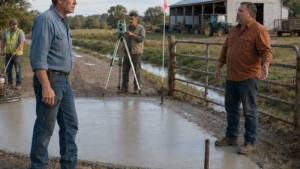
Two days later, Samuel stood at the edge of Jason’s construction site while a survey crew drove bright stakes into the ground.
Jason had agreed to meet only after Samuel’s temporary-access request was filed and both sides began exchanging records through their respective advisers.
The lodge structure rose behind them, unfinished but large enough now to show Jason’s concern. The current logging road ran directly past what would become the main arrival area. Loaded trucks would pass within yards of parked guest vehicles.
Samuel still did not believe that justified the barriers.
But for the first time, he could see the problem without Jason describing it.
Jason walked over carrying a rolled plan.
“You read my letter.”
Samuel glanced at him.
“Eventually.”
Jason almost smiled, then thought better of it.
“You could’ve saved us both some trouble.”
“You could’ve left the road open.”
“I asked you for six weeks.”
“And then you blocked it.”
“Yes.”
The answer was blunt.
Samuel looked at him.
Jason continued.
“My construction lender did a site inspection. They flagged the uncontrolled heavy-truck route through the entrance area.”
“Uncontrolled.”
“That’s their word.”
“My trucks aren’t running people over.”
“That isn’t what they’re worried about. They’re worried about liability, road damage, guest circulation, and whether I actually control the site I told them I control.”
Samuel gave him a hard look.
“You don’t control my access.”
“I know that now.”
“You knew there was an easement before you bought.”
“I knew there was an easement. I didn’t know whether the road you’re using today is exactly where the easement was established.”
“That’s convenient.”
Jason’s jaw tightened.
“It’s also true.”
A survey worker called them over.
A line had been flagged through the trees.
The surveyor pointed toward the modern gravel road.
“We’re still preliminary,” he said. “But based on the old sketch and some physical features, the historic route may not follow the current surface the whole way.”
Samuel stared at him.
“How far off?”
“Depends where. Ten feet in one section. Maybe more in another.”
Samuel folded his arms.
“That road has been there my whole life.”
“I’m not saying it hasn’t.”
“Then what are you saying?”
“That the road may have shifted over time.”
Jason said nothing.
Samuel looked from the survey flags to the gravel beneath his boots.
The idea irritated him because it sounded ridiculous.
Roads did not walk.
But washouts happened. Ditches widened. Trucks cut new corners. A bad winter could move a route several feet without anybody naming the change.
The surveyor walked into the trees.
Samuel followed.
Twenty yards from the modern road, brush covered a shallow bench in the hillside.
The surveyor kicked aside wet leaves.
Under them was compacted stone.
Not much.
Just enough.
Samuel crouched.
A rusted piece of culvert pipe protruded from the bank.
He recognized the style.
His grandfather had used the same ribbed metal on another section of the property.
Samuel stood slowly.
Jason said, “That’s what I was trying to talk about.”
Samuel turned on him.
“No. You were trying to move the road.”
“I was trying to solve this before I poured foundations.”
“With a route that suited you.”
“Of course it suited me. I was also offering to build it for you.”
Samuel stepped closer.
“And when I didn’t answer, you decided that meant you could shut me out?”
Jason’s face changed.
“For weeks, I heard nothing. Contractors were mobilized. The lender was pushing. I had to make a decision.”
“You made the wrong one.”
Jason looked toward the barriers downhill.
“I’m beginning to understand that.”
The admission should have satisfied Samuel.
It did not.
The surveyor moved farther through the timber and drove another stake.
Samuel watched the fluorescent ribbon flick in the wind.
It stood twenty feet from the gravel track his family had treated as fixed for decades.
Twenty feet.
Not far enough to erase the easement.
Far enough to complicate everything.
Rachel arrived from the office carrying a folder.
She stopped beside Samuel and followed his gaze.
“That the old line?”
“Maybe.”
She looked at him.
Samuel did not need her to say anything.
The road was still theirs to use in some form.
But for the first time, he could no longer honestly say he knew exactly where that form belonged.
Chapter 5: The Easement Was Real, but the Road Had Moved
The survey crew found the old road by following what looked like nothing.
A shallow depression beneath salal.
A line of stones too evenly spaced to be natural.
A crushed section of rusted culvert almost hidden beneath sword fern.
Samuel walked behind them while one crew member probed the ground with a steel rod.
Every few yards, the earth answered differently.
Soft soil.
Then gravel.
Then soft soil again.
A road buried under fifty years of repairs, washouts, rerouting, and forest growth.
Samuel stopped beside a cedar stump.
“This doesn’t make sense.”
The surveyor looked back.
“What part?”
“My grandfather used the same road we use now.”
“Probably most of it.”
“Not probably.”
The surveyor did not argue.
Samuel hated that more than disagreement.
By the end of the morning, the flagged historic corridor diverged from the modern road in three places.
The largest shift happened near the creek, where the old route had once taken a sharper turn downhill before crossing at a narrower point.
Samuel remembered his father talking about a washout there.
He had been young then.
The story had never sounded important.
A winter storm had taken part of the bank. His father and two neighbors had cut a wider curve higher on the slope because it was easier than rebuilding the old crossing.
Nobody filed anything.
Nobody hired a surveyor.
They fixed the road and kept working.
At the county archive that afternoon, Anthony Ramirez pulled an aerial photograph from a flat file.
The image was grainy, taken decades earlier.
He placed tracing paper over it.
“Here’s the parcel boundary.”
Samuel leaned over the table.
Anthony marked the creek.
Then the old road.
The line was faint but visible.
Rachel stood on Samuel’s other side.
“That does bend lower.”
Anthony nodded.
A later aerial showed the new curve.
Another, taken years after that, showed the present alignment.
Samuel rubbed his thumb against the edge of the table.
“So we moved it.”
Anthony looked at him.
“Your family adjusted it.”
“Without changing the easement.”
“That’s the central question.”
Samuel’s head came up.
“You said the easement survives.”
“It does.”
“Then what are we arguing about?”
“Location and use.”
Anthony slid the recorded document toward him.
“The right itself is strong. The record says the rear parcel gets permanent access. Nothing we’ve found suggests the benefited land was meant to become landlocked.”
Rachel said, “So Jason can’t close it.”
“I would be very reluctant to interpret these records as allowing the burdened owner to eliminate access altogether.”
Samuel leaned back.
There it was.
The sentence he had wanted.
Not absolute.
Not dramatic.
But enough.
Jason could argue about where.
He could not simply argue that Samuel had nowhere to go.
Anthony tapped the aerial.
“But the modern track isn’t identical to the oldest physical route. That matters if both sides insist on treating one exact line as sacred.”
Samuel looked at the photograph.
His grandfather had never talked about sacred lines.
He had talked about getting logs out before the rains.
Samuel said, “What happens if I insist on the historic corridor?”
Anthony hesitated.
“That’s a legal question beyond what I can decide. But from a surveying standpoint, you now have evidence for a corridor that predates the modern road.”
Rachel looked at Samuel.
He knew what she was thinking before she said it.
“Where does that corridor go through Jason’s plan?”
They returned to the site before dark.
The survey stakes answered the question.
The modern logging road already passed close to the proposed lodge entrance.
The historic corridor was worse.
It cut across the edge of the planned arrival court, clipped part of a landscaped slope, and passed nearer the main building before rejoining the modern route uphill.
Jason stood over the project plans on the hood of his pickup.
“This can’t be right.”
The surveyor said, “It’s preliminary, but the physical evidence lines up.”
Jason pointed.
“You’re telling me the older road went through here?”
“The evidence suggests it.”
“That puts loaded trucks nearly against the front turnaround.”
Samuel watched him.
For the first time since the barriers appeared, Jason looked genuinely rattled.
Not angry.
Afraid.
Samuel felt something inside him settle.
The power between them had changed.
Jason noticed.
“You’re enjoying this.”
“No.”
“You look like you are.”
Samuel folded his arms.
“I’m looking at the road you wanted defined.”
Jason stared at him.
“If you insist on this alignment, you know what it does to the project.”
“You insisted alignment mattered.”
“Don’t play with me.”
Samuel’s expression hardened.
“Three concrete blocks are still sitting across my access.”
Jason looked away.
Behind him, construction workers were wrapping up for the day. A forklift beeped while reversing. The lodge walls stood pale against the dark timber.
Jason said, “I can move the blocks once there’s an interim agreement.”
Samuel laughed softly.
“Now you want an agreement.”
“I wanted one from the beginning.”
“You wanted one on your terms.”
“I offered to pay for a new road.”
“And when I didn’t answer, you decided force would improve the conversation.”
Jason’s mouth tightened.
“I’ve already told you that was a decision I made under pressure.”
“Pressure doesn’t make concrete lighter.”
“No. It doesn’t.”
The answer stopped Samuel for a moment.
Jason leaned against the pickup.
“My lender releases funds in stages. The next release depends on site control and progress. If this access cuts through the entrance exactly where that old line shows, I have a serious problem.”
Samuel looked at the plan.
“How serious?”
Jason did not answer directly.
“Serious enough.”
Rachel joined them carrying copies from the archive.
She handed Samuel one of the aerials.
He held it beside the site plan.
Two histories on two pieces of paper.
His family’s road.
Jason’s development.
Neither one imaginary.
Samuel walked away from the pickup and followed the survey ribbon uphill.
The old corridor descended through brush, crossed the proposed entrance, and then climbed toward his timber.
At one bend he stopped.
From there he could see both alignments.
The modern road curved farther away from the lodge.
Jason’s proposed reroute curved farther still, avoiding the entrance entirely before reconnecting near Samuel’s boundary.
Samuel had rejected that proposal without opening the envelope.
Now he could see it.
Not as surrender.
As geometry.
Rachel came up behind him.
“What are you thinking?”
Samuel looked down toward Jason.
“I’m thinking he picked the worst possible way to make a point.”
“That isn’t what I asked.”
Samuel folded the aerial.
“If I demand the old road, he’s in trouble.”
Rachel was quiet.
“You could.”
“He blocked me.”
“Yes.”
“He called the sheriff.”
“Yes.”
“He’s costing us money every day.”
“Yes.”
Samuel turned.
Rachel met his eyes.
Then she said, “And now you get to decide whether being right is the same thing as making him pay.”
Samuel looked again at the fluorescent stakes running directly toward the unfinished lodge.
For the first time since the barriers appeared, he had more leverage than Jason.
The question was what he intended to do with it.
Chapter 6: He Finally Had the Leverage to Hurt Back
Samuel entered the county meeting room carrying a map that could make Jason’s project nearly unworkable.
He knew Jason understood that the moment he saw it.
The room was plain: long table, plastic water pitcher, fluorescent lights. Anthony Ramirez sat near one end as a technical resource, not a decision-maker. Rachel sat beside Samuel with the contract-loss calculations.
Jason arrived with a thick binder.
He looked tired.
Nobody shook hands.
The mediator asked Samuel to begin with what he wanted.
Samuel placed the historic aerial, the recorded easement, and the preliminary survey on the table.
“Access.”
Jason said, “We’ve never disputed that some access exists.”
Samuel looked at him.
“You put barriers across all of it.”
Jason leaned back.
The mediator raised a hand.
“Let’s keep this useful.”
Samuel continued.
“I need a road that will handle loaded log trucks year-round. I need it recorded, surveyed, and protected from another unilateral closure.”
Jason nodded once.
“That part is workable.”
“And I need the barriers moved.”
“They can be moved.”
“Today.”
Jason’s eyes narrowed.
“If we reach interim terms.”
Samuel almost answered sharply.
Instead he looked at Rachel.
She gave no signal.
That was deliberate.
The mediator asked Jason to explain his position.
Jason opened the binder but did not immediately look at it.
“The current route crosses the lodge arrival zone. My lender flagged it. My insurer flagged it. The project design assumed we could relocate the traffic.”
Samuel said, “Assumed.”
“Yes.”
“Without my agreement.”
Jason looked at him.
“I sent you a proposal.”
“And when I ignored it?”
Jason was silent.
The mediator waited.
Samuel said, “Say it.”
Jason’s jaw worked once.
“I decided the barriers would force the issue.”
Rachel’s pen stopped moving.
Anthony looked down at his notes.
Samuel felt the sentence land in the room.
There was no excuse wrapped around it this time.
Jason continued.
“I believed you would show up angry, we would confirm the easement location, and then you would finally negotiate.”
“You used my business as leverage.”
“Yes.”
“And called law enforcement when I didn’t cooperate.”
“I called because you brought heavy equipment to the barrier after I told you not to enter.”
“That doesn’t change why the barrier was there.”
“No.”
Samuel had imagined this admission more than once.
In his imagination, it felt like victory.
In the room, it felt smaller.
Jason had done exactly what Samuel thought he had done.
That knowledge did not reopen the road by itself.
The mediator asked about damages.
Rachel turned her figures around.
Lost hauling availability. Penalties. Idle equipment. Survey expense. Legal preparation.
Jason studied the total.
“I can’t cover all of that.”
Samuel said, “Can’t or won’t?”
“Can’t.”
“You’re building a lodge.”
“With borrowed money.”
Jason’s voice sharpened for the first time.
“You keep looking at that construction site like it means I have unlimited cash. I have a lender who can freeze the next draw if this access dispute stays unresolved. I have contractors who still get paid. I have deposits committed. If I lose the financing schedule, the whole project can stall.”
Samuel said, “That sounds like pressure.”
Jason looked at him.
“It is.”
“And pressure made you block my road.”
Jason did not flinch.
“Yes.”
There it was again.
Responsibility without self-pity.
Samuel hated how much easier it would have been if Jason had remained arrogant.
The mediator shifted to alternatives.
Jason offered again to fund the reroute shown in his original letter.
Samuel rejected the first version.
Too narrow.
Too steep at one curve.
Insufficient drainage.
No guaranteed maintenance.
No protection if the property changed hands.
They worked through each issue.
Then Jason’s representative proposed that Samuel waive most of the accumulated business losses in exchange for full road construction.
Rachel leaned toward Samuel.
“We can’t eat all of that.”
“I know.”
Jason said, “I can cover a portion, not everything.”
Samuel looked at the old aerial.
The historic corridor was highlighted in red.
If he insisted on it, Jason would face redesign, possible lender review, and months of disruption.
Samuel had enough evidence now to make that threat credible.
Maybe more than credible.
The mediator called a short break.
Samuel walked outside.
Rachel followed.
“You could push him harder,” she said.
“I know.”
“He deserves some of it.”
Samuel looked toward the forested ridge beyond the county parking lot.
“My father would’ve told me not to give away a foot.”
Rachel stood beside him.
“Dad also spent twelve thousand dollars fighting over a fence line worth less than half that because he couldn’t stand the idea of backing down.”
Samuel glanced at her.
“You remember that part.”
“I remember all of it.”
He looked at the maps through the meeting-room window.
The old road.
The current road.
The proposed road.
Three versions of the same purpose.
“I thought the road was the promise,” Samuel said.
Rachel did not answer.
He continued.
“Granddad sold the front parcel because he needed cash. He kept the easement because otherwise the timber behind it was useless.”
“That sounds right.”
“He wasn’t protecting gravel.”
“No.”
“He was protecting access.”
Rachel looked at him.
Samuel went back inside.
He did not sit.
He spread Jason’s proposed route over the table, then placed the survey beside it.
“This curve is wrong.”
Jason frowned.
Samuel pointed farther uphill.
“Move it west here. Keep the grade under what a loaded truck can safely handle. Wider turn at this corner. Proper base. Culvert sized for winter runoff.”
Jason leaned over the map.
“That moves it closer to the property edge.”
“Yes.”
“It costs more.”
“Yes.”
Jason looked up.
“What else?”
Samuel answered one item at a time.
The new easement had to be recorded against the parcel.
Permanent commercial timber access.
No gates without mutual agreement.
No seasonal closure except genuine safety emergencies.
Maintenance split by use, with extraordinary damage assigned to the party causing it.
Jason would pay most construction and survey costs.
He would compensate an agreed portion of Samuel’s documented losses.
And the concrete blocks would be removed immediately once the interim agreement was signed.
Jason listened without interrupting.
Then he said, “And the historic corridor?”
Samuel looked at the red line crossing the lodge entrance.
“I won’t insist on it if the new route is built and recorded exactly as agreed.”
Jason sat back.
Rachel watched Samuel.
The mediator asked, “You’re offering to relinquish a claim to the historic alignment in exchange for a formally protected replacement?”
Samuel shook his head.
“Not relinquish access. Relocate it.”
The distinction mattered.
Jason knew it too.
He studied the maps for a long moment.
“You’d accept the reroute?”
“If it works for my trucks and survives you selling that property someday.”
Jason looked at him.
Samuel continued.
“I’m not doing this because the barriers were acceptable. They weren’t. I’m doing it because I need a road, not a monument.”
Nobody spoke.
Then Jason asked, “How much of the losses?”
Rachel slid a revised number across the table.
Jason looked at it and winced.
But he did not push it back.
Samuel sat down.
The old route remained highlighted beneath his hand.
For weeks, he had thought protecting his grandfather’s promise meant refusing to let the road move.
Now he drew one line through the proposed agreement and wrote a condition beside it.
Jason read it.
His eyebrows lifted.
“You want completion security.”
“Yes.”
“You think I’m going to block you again?”
Samuel capped the pen.
“I think we’re done relying on what either of us thinks the other one intends.”
Jason stared at him for several seconds.
Then he reached for the map.
“Show me exactly where you want the new curve.”
Chapter 7: The Road Stayed Open Without Staying the Same
The loader’s forks slid beneath the first concrete barrier just after seven in the morning.
Samuel stood beside his pickup with both hands in his jacket pockets and watched six weeks of anger rise slowly off the ground.
The block tilted once.
Gravel spilled from the shallow trench it had pressed into the road.
Then the loader backed away and set it beside the construction entrance.
The second barrier followed.
Then the third.
For the first time since the dispute began, nothing stood between Samuel and the timber road.
He did not drive through.
Not yet.
A temporary route had already been graded along the line they had negotiated, farther from Jason’s lodge entrance and wider through the first curve. Fresh crushed rock lay pale against the darker forest soil. New drainage pipe crossed beneath it. Survey stakes marked the permanent edges.
The agreement had been signed two days earlier.
Recorded access.
Commercial timber use.
Maintenance obligations.
No unilateral gates or closures.
Completion security held until the permanent road passed inspection.
The words mattered because this time nobody was relying on memory.
Rachel stood beside him holding a folder.
“You’re staring.”
“I’m checking.”
“For what?”
“Something they missed.”
She looked at the open road.
“They removed three six-thousand-pound blocks. I think we would notice if they missed one.”
Samuel glanced at her.
She smiled.
It was the first joke either of them had made about the barriers.
A truck engine sounded from below.
The hauling contractor had returned with one rig after Rachel convinced him they could begin moving timber again before the buyer’s grace period expired.
The truck stopped near Samuel.
The driver leaned out.
“This actually open?”
Samuel looked up the new curve.
“Yes.”
“Good answer.”
The truck rolled forward.
Samuel followed in his pickup.
The new road felt wrong beneath the tires.
Not bad.
Wrong.
It curved west sooner than the road he had known. The old track remained visible through the trees in places, packed gravel fading beneath brush and tire marks. For several hundred yards the two routes ran close enough that Samuel could see one from the other.
Then the new road bent away.
The lodge disappeared behind timber.
Samuel slowed at the widest turn.
He had insisted on that radius during mediation. Jason had argued it added cost. Samuel had brought the truck specifications and made the surveyor lay out the turning path.
Now the loaded rig behind him came around cleanly without touching the ditch.
Samuel watched it in the mirror.
That mattered more than winning the argument had.
At the back tract, the loader crew was already waiting.
The first logs went onto the trailer before nine.
Samuel checked the straps himself.
His phone rang while the driver secured the load.
Rachel.
“You still up there?”
“Yes.”
“The buyer called.”
Samuel stopped tightening the last binder.
“And?”
“They’ll accept today’s shipment against the grace period.”
He waited.
“That means?”
“It means if we keep volume up, we avoid the full penalty schedule.”
Samuel looked at the loaded trailer.
“How much did we lose?”
Rachel was quiet for a moment.
“Enough.”
He understood.
Jason’s settlement payment covered an agreed portion of the idle equipment costs, survey expense, and documented contract losses.
Not all of them.
Samuel had pushed for more.
Jason had shown him the project accounts and financing limits during the final negotiation. There had been room for compensation, but not unlimited room. Samuel could have kept fighting.
He had chosen the road instead.
Rachel said, “We’ll absorb the rest.”
“We can?”
“Yes.”
“That doesn’t sound like the answer you gave me two weeks ago.”
“Two weeks ago we didn’t have access.”
Samuel looked down the new road.
“No. We didn’t.”
The first loaded truck started toward the county highway.
Samuel stood aside and watched it go.
It crossed the rebuilt curve, passed the spot where the barriers had been, and disappeared downhill without slowing.
For the first time since the dispute started, money was moving in the right direction.
That afternoon Jason walked down from the construction site.
He stopped at the edge of the new route.
Samuel was checking the depth of gravel near a drainage ditch.
Jason said, “Contractor says the permanent surface goes down Monday.”
Samuel nodded.
“And the culvert?”
“Upgraded size. Like you asked.”
“Like the agreement requires.”
Jason gave him a tired look.
“Yes. Like the agreement requires.”
Samuel tamped the gravel with his boot.
Jason stared toward the old road.
Part of it was already being scarified near the lodge entrance so future guests would not mistake it for an active lane.
“I never expected it to get this far,” Jason said.
Samuel looked up.
“The barriers or the agreement?”
“The whole thing.”
“You put concrete across a working road.”
“I know.”
Samuel waited.
Jason rubbed the back of his neck.
“I thought you’d show up, get angry, and finally sit down with me.”
“That was your plan?”
“It wasn’t a good plan.”
“No.”
“I had lenders asking whether I controlled my own site. You wouldn’t answer me. Construction was moving. I convinced myself you were using silence as leverage.”
Samuel looked at him.
“I was.”
Jason’s eyebrows lifted.
Samuel continued.
“Just not the way you thought.”
Jason waited.
Samuel rested the shovel against the ditch.
“My father made informal concessions on land. Spent years regretting them. I decided if anybody wanted anything involving our property, the answer was no until they proved they could force something else.”
Jason nodded slowly.
“That explains a few conversations.”
“It doesn’t excuse yours.”
“No.”
“Doesn’t excuse mine either.”
They stood without speaking.
The unfinished lodge was visible through the trees, but the new road no longer passed directly in front of it.
Jason said, “For what it’s worth, your new route is better for trucks.”
Samuel looked at him.
“It was designed for trucks.”
“That wasn’t praise for me.”
“I know.”
Jason almost smiled.
Then he looked toward the old alignment again.
“My original proposal wasn’t this good.”
“No.”
“You could’ve opened the letter and told me that.”
Samuel said nothing.
Jason nodded.
“Fair enough.”
There was no handshake.
Samuel did not need one.
Several weeks later, the permanent road was finished.
The agreement was recorded with the county.
Anthony Ramirez sent both parties the final survey package showing the relocated easement corridor, maintenance terms, reference monuments, and access width.
Rachel printed a copy and placed it on Samuel’s desk.
Beside it lay his grandfather’s 1971 easement.
The old document looked smaller than he remembered.
Its folds had nearly worn through. The hand-drawn sketch showed a road that no longer existed exactly as drawn.
For most of his life, Samuel had treated that sheet of paper as proof that nothing should change.
Now he understood something his grandfather had never needed to write.
The road had never been the inheritance.
The ability to reach the timber was.
Samuel opened the office safe.
He placed the old easement inside its brown envelope and returned it to the shelf.
He did not throw it away.
He did not frame it either.
Rachel appeared in the doorway.
“You heading up?”
“Yes.”
She looked at the new survey map in his hand.
“You taking that?”
Samuel folded it once.
“Probably should know where my road is.”
Rachel smiled.
“Novel idea.”
He carried the map outside.
A loaded truck waited near the yard entrance.
Samuel climbed into his pickup and led it toward the forest.
At the old junction, he slowed.
The abandoned track continued straight for a few yards before disappearing into disturbed soil and young brush. Beyond it, the eco-lodge entrance was nearly complete.
The new road curved west.
Samuel turned onto it.
The truck followed.
Fresh gravel clicked beneath his tires as the road climbed toward the timber his grandfather had once worried might become inaccessible after selling the front parcel.
The route was not where it had been in 1971.
It was not even where it had been six months earlier.
But it was open.
It was recorded.
And it would still be there after Jason sold, after Samuel retired, after neither man was around to argue about what either of them had meant.
At the ridge, Samuel stopped and looked back.
The truck emerged around the new curve without hesitation.
He unfolded the survey map across the steering wheel.
For years, he had believed protecting a promise meant refusing to let anything move.
Now the line on the page bent around a problem his grandfather could never have imagined and still arrived exactly where it needed to go.
Samuel folded the map, set it on the passenger seat, and drove on.
The story has ended.