The Crushed Vintage Show Car And The Ruthless HOA Tow Lift
CHAPTER 1: THE TURQUOISE NOMAD ON CORAL PAVERS
The golden morning sun washed over the sparkling coral-stone driveway at 314 Whispering Oaks Boulevard, casting crystalline reflections against the polished exterior of an American masterpiece. Situated along the manicured saltwater canals of Sarasota County, Florida, Whispering Oaks Country Club Estates was an enclave of multimillion-dollar Mediterranean villas where banyan trees arched over limestone curbs and neighborhood aesthetic rules were enforced with religious zeal. Here, driveways were intended solely as temporary transition zones, and any vehicle parked outside an enclosed garage for more than thirty minutes was treated by the property management syndicate as an eyesore requiring immediate eradication.
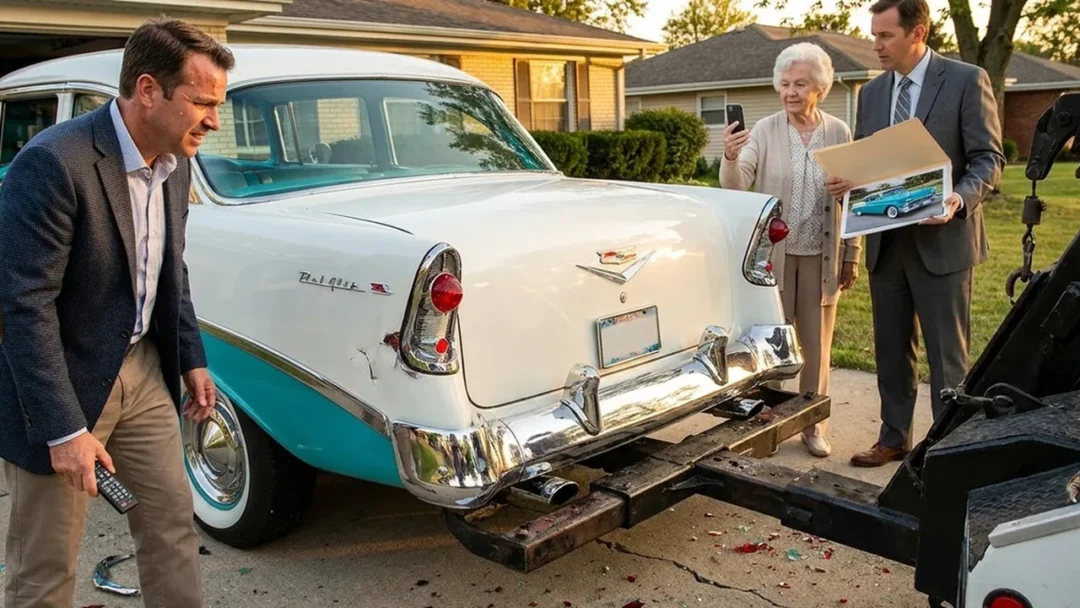
Standing beside the open rear tailgate of his vehicle, Arthur Pendelton gently wiped down the chrome trim with a microfiber cloth dipped in deionized water. At seventy-six, Arthur was a retired aerospace tooling engineer who had spent thirty-eight years designing structural airframe components for NASA and commercial aircraft manufacturers. He carried himself with the quiet, meticulous precision of a master craftsman. For twelve years following his retirement, Arthur had devoted over five thousand hours of patient, hand-filed labor to the complete ground-up restoration of a 1956 Chevrolet Bel Air Nomad two-door sport wagon.
The car was nothing short of breathtaking. Finished in a flawless, mirror-smooth two-tone coat of India Ivory over Tropical Turquoise nitrocellulose lacquer, the vehicle retained every original factory specification down to the date-stamped glass panes and the zinc-dichromate finish on the carburetor linkages. Affixed beneath the rear bumper was a Florida permanent registration plate stamped with embossed navy lettering: “HISTORIC VEHICLE.” Tied proudly to the driver’s side sun visor was a prestigious blue rosette ribbon from the Amelia Island Concours d’Elegance, where the vehicle had earned a ninety-nine-point-eight score out of a possible one hundred points in the Master Restored Class.
Beside Arthur stood Marcus Sterling, fifty-two, the Senior Master Appraiser for the International Specialty Vehicle Appraisal Guild and a senior valuation consultant for Hagerty Classic Car Insurance. Marcus wore a crisp khaki linen suit, carrying a heavy leather-bound valuation portfolio stuffed with paint-meter readings, metal thickness diagnostics, and certified provenance documentation. Every five years, Hagerty required a comprehensive, on-site physical appraisal to verify the guaranteed replacement value of the vehicle for its agreed-value policy. The car had been parked in the morning sun for exactly twenty-five minutes while Marcus photographed the chassis serial numbers and tested the depth of the clear coat.
The serene morning was brutally shattered by the aggressive, diesel-throbbing roar of a commercial heavy-duty tow truck rumbling into the cul-de-sac.
The truck was a customized Dodge Ram 5500 flatbed wrecker, outfitted with an industrial hydraulic wheel-lift assembly mounted to its rear stanchions. The wrecker accelerated up the paver driveway without braking, its dual rear tires leaving dirty black tire scuffs across Arthur’s spotless coral pavers before coming to a stop barely three feet from the Nomad’s gleaming rear bumper.
The passenger door of the tow truck swung open, and Julian Vance jumped down onto the pavement. At forty-four, Julian was the newly appointed regional general manager of Apex Community Association Management, a corporate property management firm that oversaw thirty-two homeowner associations across southwest Florida. Dressed in a tight-fitting polo shirt embroidered with the corporate logo, tailored slacks, and narrow leather loafers, Julian carried a heavy aluminum citation clipboard in his left hand and a magnetic wireless hydraulic winch remote in his right. Julian was infamous across the county for his predatory towing quotas, earning a twenty-percent kickback on every vehicle removed from residential subdivisions.
Julian marched aggressively between the tow truck and the vintage Chevrolet, his face fixed in a sneer of petty, bureaucratic hostility.
“Pendelton!” Julian barked, waving his clipboard like an executioner’s warrant. “Section Four-B of the Whispering Oaks Master Covenant explicitly states that no vehicle exceeding ten years of age may be kept or displayed on an exterior driveway apron! You’ve had this vintage eyesore sitting outside for over twenty minutes. This junker is being impounded immediately!”
Arthur Pendelton did not raise his voice. He folded his microfiber cloth with slow, deliberate precision, laid it on the garage workbench, and took his phone from his pocket, smoothly initiating a high-definition 4K video recording.
“Good morning, Mr. Vance,” Arthur replied, his voice calm, firm, and carrying the quiet weight of seventy-six years of integrity. “This vehicle is not an abandoned car. It is a certified historic museum specimen, currently undergoing its mandatory five-year insurance appraisal by an accredited Hagerty senior appraiser. Under Florida Statute section seven-hundred-and-twenty, homeowners associations are explicitly prohibited from towing licensed historic vehicles during temporary daylight maintenance windows.”
Julian laughed, a loud, grating bark of contempt. “I don’t give a damn about state statutes or classic car insurance, Pendelton! Our HOA board voted last month to give Apex full unilateral towing authority. Old cars get towed. If you want it back, you can pay four hundred dollars in cash at the impound lot in Bradenton.”
Julian stepped past Marcus Sterling, grabbed the tow truck’s wireless hydraulic remote, and flipped the safety toggle to active.
The Chevrolet Bel Air Nomad was an icon of postwar American industrial optimism. Originally unveiled as a concept vehicle at the 1954 General Motors Motorama at the Waldorf-Astoria in New York City, the Nomad was engineered by legendary styling chief Harley Earl as a radical two-door sport wagon with forward-sloping B-pillars, grooved roof ribs, and wraparound rear glass. In 1956, only 7,886 units were manufactured, making surviving specimens extraordinarily rare. Arthur Pendelton had spent his entire career in aerospace tooling, where tolerances were measured in ten-thousandths of an inch; when he undertook the restoration of this specific chassis, he approached the vehicle not as a hobbyist, but as a conservator preserving a piece of American industrial heritage. Every bolt was head-marked to match factory assembly-line codes, the interior was upholstered in authentic reproduction waffle-grain vinyl, and the 265-cubic-inch small-block V8 hummed with the smooth, rhythmic precision of a watch.
In contrast, the management philosophy of Apex Community Association Management was built on high-velocity revenue extraction. Under Florida law, homeowners associations possess broad statutory authority to regulate private roads and community parking, but this authority has increasingly been outsourced to third-party management conglomerates that monetize enforcement. Julian Vance operated on a quota-driven performance bonus system where his regional office received fifty dollars for every formal violation notice and a direct hundred-dollar referral fee for every vehicle impounded by contracted towing partners. Julian viewed the clean, quiet streets of Whispering Oaks not as a neighborhood of retired citizens, but as an enforcement grid primed for daily revenue harvesting. He carried a digital tablet loaded with real-time GPS logging, pre-written impound orders, and automated lien filings designed to overwhelm homeowners before they could seek legal counsel.
The morning air in the Whispering Oaks community was heavy with the fragrance of blooming gardenias and the distant salt draft from Sarasota Bay. Arthur Pendelton took a slow, deep breath, his cloth gliding effortlessly along the seamless contour of the Nomad’s roofline. Every curve of this car was familiar to his touch; he had hand-sanded the primer coats through eight progressive grits of wet-and-dry paper, spending months in his garage ensuring that the reflection in the lacquer showed zero orange peel or surface distortion. To Arthur, this wagon was a living bridge to an era when American design dared to be bold, graceful, and permanent.
Across the boulevard, neighbors had begun pausing on their morning walks, watching the arrival of the aggressive commercial wrecker with uneasy concern. For months, residents had complained about Apex Management’s aggressive enforcement tactics, but few had the legal knowledge or financial resources to fight the corporate management company. Julian Vance had exploited that fear, using the threat of five-thousand-dollar legal fees to compel compliance with arbitrary aesthetic edicts. But in Arthur Pendelton, Julian had encountered a man whose life had been dedicated to structural precision—a man who understood that truth, like engineering, does not yield to bullies.