The Crushed Vintage Show Car And The Ruthless HOA Tow Lift
CHAPTER 2: THE FRACTURE OF THE HAND-CAST CHROME
“Julian, put that remote down!” Marcus Sterling shouted, stepping forward with his hands raised in a clear, universal gesture of professional authority. “I am Marcus Sterling, Senior Appraiser for Hagerty Insurance! That vehicle is under active certified appraisal! You are standing behind a one-of-a-kind hand-formed bumper! If you touch that car with a hydraulic crossbar, you will cause catastrophic, irreparable damage!”
Julian didn’t even look at the appraiser. His eyes were glazed with the stubborn, arrogant tunnel vision of a corporate bureaucrat who had never been told no by a homeowner. To Julian, Arthur was just another stubborn retiree trying to bluff his way out of an HOA citation, and the appraiser was just an annoying spectator. He had ordered over six hundred vehicles towed in his career, and he lived by the corporate motto that possession of the vehicle was absolute leverage.
“I don’t need advice from a car salesman!” Julian sneered over the rumble of the diesel exhaust. “Stand clear of the recovery zone!”
The contracted tow truck driver, a young man named Tommy sitting behind the steering wheel, leaned out of the cab with a look of extreme alarm. “Hey, Mr. Vance! Hold on a second! We’re supposed to verify the registration and check the axle clearance before we drop the lift! That car sits low on its leaf springs!”
“Shut up and let me handle the remote, Tommy!” Julian snapped back, refusing to relinquish control. “I’m clearing this driveway right now!”
Julian pressed the hydraulic lower toggle on the wireless remote.
On a commercial Ram 5500 wrecker, the hydraulic wheel-lift is powered by an engine-driven pump that operates at three thousand pounds per square inch. The heavy steel crossbar, weighing over three hundred pounds, is engineered with dual extendable steel L-arms designed to scoop beneath modern steel wheels. But when operated by an untrained amateur who fails to feather the proportional valve, the hydraulic cylinders drop with brutal, unpadded speed.
The heavy steel crossbar plunged downward.
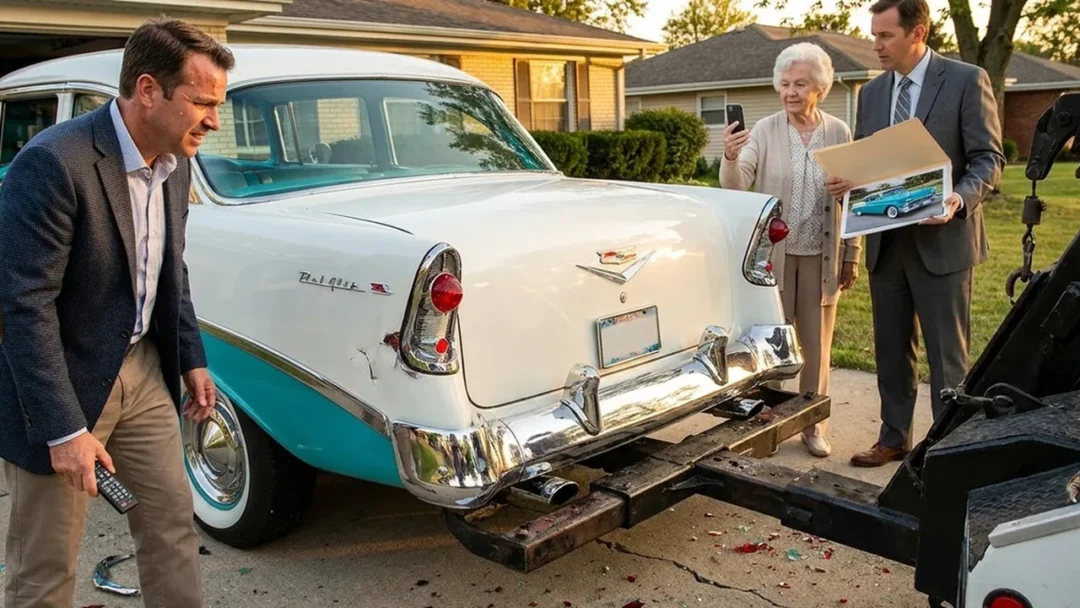
Instead of sliding smoothly beneath the tires, the sharp, hardened steel leading edge of the crossbar slammed directly into the center of the Nomad’s sculpted rear bumper.
The collision was accompanied by an agonizing, concussive metallic crunch that echoed off the stucco walls of the villa like a car crash on a highway.
The rear bumper of a 1956 Chevrolet Bel Air Nomad was not a stamped sheet-metal aftermarket replacement. It was an original, factory-correct, three-piece hand-cast California-style bumper, forged from heavy structural carbon steel and finished in three separate stages of copper, nickel, and triple-chrome plating. Because the Nomad was a specialized two-door station wagon, the rear bumper featured custom-formed outer corners and twin integrated exhaust ports designed to vent exhaust gases beneath the bodywork.
Under the sudden, three-thousand-pound hydraulic impact, the irreplaceable bumper folded backward like a crushed aluminum can.
The heavy steel crossbar crushed the delicate, mirror-polished twin exhaust tips, flattening them against the fuel tank shield. The mounting brackets sheared their grade-eight carriage bolts, driving the jagged, torn edge of the heavy chrome bumper upward into the pristine bodywork. The razor-sharp edge of the crumpled metal carved a ten-inch-long, half-inch-deep gouge through the Tropical Turquoise lacquer, peeling the paint away down to the bare galvanized steel.
And then came the sound of breaking glass.
Mounted into the passenger-side chrome fin was an original, date-coded 1956 Guide-brand red glass taillight lens. The crushing impact flexed the rear quarter panel, putting the rare glass lens under severe torsional stress.
With a sharp, crystalline POP, the sixty-eight-year-old glass lens shattered into hundreds of faceted red gems that rained down across the white coral pavers like scattered rubies.
Arthur Pendelton did not flinch. His phone remained rock-steady, recording every second of the destruction in ultra-high-definition 4K resolution, capturing Julian’s finger holding the toggle switch, the descending hydraulic piston, and the shower of red glass hitting the driveway.
“You should’ve read the plate, Mr. Vance,” Arthur said, his voice as cold and steady as winter frost.
In automotive conservation, the metallurgy of mid-century chrome plating represents a lost industrial art. In 1956, General Motors utilized a labor-intensive triple-plate electroplating process that has been largely banned in modern manufacturing due to environmental regulations. The raw stamped steel was first hand-polished to a mirror finish, submerged in an alkaline copper bath to fill microscopic pores, coated in a ductile semi-bright nickel layer for corrosion resistance, and finally sealed with a micro-thin layer of hexavalent chromium that produced the deep, blue-tinted brilliance characteristic of the golden era of Detroit styling. When an unyielding three-thousand-pound hydraulic crossbar impacts such a bumper, the failure is not merely cosmetic; the shock breaks the inter-metallic bond between the nickel and the underlying steel, causing the chrome to peel away in razor-sharp ribbons like shattered glass.
The mechanical leverage exerted by the Ram 5500’s hydraulic lift was devastating. Commercial wheel-lifts are engineered with dual double-acting hydraulic cylinders operating off a high-pressure power take-off pump, capable of lifting an eight-thousand-pound commercial truck without hesitation. When Julian slammed the controls down without verifying the ride height of the low-slung vintage wagon, the hydraulic crossbar acted as an unyielding steel guillotine. The force drove the exhaust tips upward with enough energy to buckle the rear floor pan, cracking the factory seam-sealer and splitting the hand-rubbed Tropical Turquoise lacquer along the body contour lines. To any experienced automotive restorer, that sickening sound was the destruction of a work of art that could never be recreated with modern stamping machines.
The physical shock of the hydraulic impact vibrated through the entire unibody architecture of the classic wagon. Inside the passenger cabin, the original porcelain-faced dashboard clock—still ticking with its mechanical escapement—skipped a beat as the concussive force rattled the instrument cluster. The rear tailgate, with its polished stainless-steel vertical spears, shuddered on its hidden hinges, its factory gap tolerances compromised by the violent upward torque. It was not merely a broken bumper; it was the violation of an integrated mechanical system that had remained preserved in museum condition for nearly seven decades.
The tow truck driver, Tommy, leaped from his cab in a blind panic, his eyes wide as he realized the magnitude of the disaster unfolding before him. “Mr. Vance, what did you do?” Tommy cried out, his voice cracking with fear. “That’s an irreplaceable classic! You don’t ever drop a wheel-lift on a car that sits less than eight inches off the ground! You just totaled my company’s clean safety record!” Tommy knew that commercial towing licenses were subject to strict state oversight; being associated with an intentional property destruction felony could result in his own commercial driving privileges being revoked permanently.