The Abandoned Rainwater Cistern And The Swallowed Skid Steer Loader
CHAPTER 1: THE RED BRICKS ON THE CORNER
The crisp autumn breeze carried the rich scent of cured tobacco and damp fallen oak leaves across the gently rolling hills of Lancaster County, Pennsylvania. Here in Oakridge Estates, a mature residential neighborhood developed in the mid-nineteen-fifties on the fertile agricultural limestone plain of Manheim Township, sprawling brick ranch homes sat back from wide curvilinear streets lined with fifty-year-old pin oaks and sugar maples. Every lawn was a lush carpet of Kentucky bluegrass, meticulously maintained by families who took pride in the quiet, generational dignity of their community.
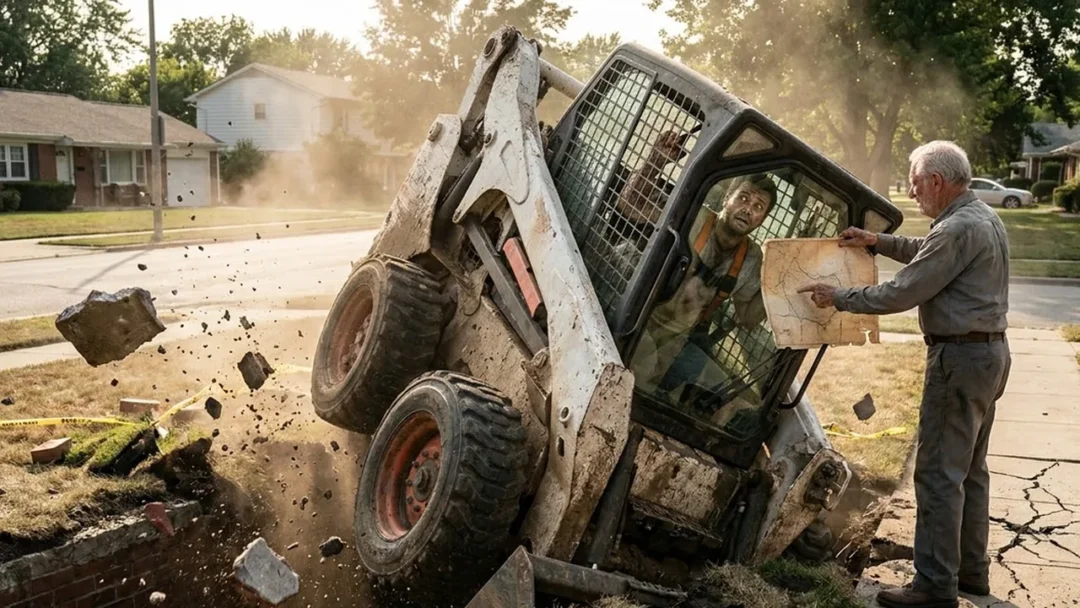
Tobias Miller stood on the corner of his front lawn where Valley Brook Lane met Orchard View Drive. At seventy-two, Tobias was a retired master bricklayer and stone conservator who possessed the quiet, deliberate patience of a Pennsylvania Dutch craftsman. His hands were weathered and calloused from half a century of handling mortar trowels, plumb lines, and hand-struck red clay bricks. In the pocket of his heavy flannel chore jacket, he carried an archival linen surveyor’s map drawn in 1938 by the county civil engineer.
Across a twenty-foot expanse of lush green turf on the corner, Tobias had carefully placed a double row of salvaged red clay bricks, forming a neat six-inch barrier. Behind the bricks, he had driven three fluorescent wooden survey lathe stakes into the dirt, stringing two-inch-wide yellow safety tape between them. The tape bore bold black stencils that fluttered softly in the morning draft: “DANGER: SUBTERRANEAN VOID — DO NOT ENTER — CISTERN CAP.”
The tranquil morning quiet was abruptly shattered by the deafening, guttural clatter of a heavy four-cylinder turbocharged diesel engine echoing between the suburban homes.
Rumbling up Valley Brook Lane at high speed was a massive Bobcat T770 compact track loader. Weighing over ten thousand pounds and equipped with wide rubber tracks, high-flow auxiliary hydraulics, and a heavy-duty, eighty-four-inch toothed steel excavation bucket, the machine was an industrial monster designed to move five tons of earth in a single scoop. Painted on the loader’s lift arms in aggressive neon green lettering was the contractor’s logo: “APEX PRECISION POOLS & SPAS — WE DIG FASTER.”
Inside the climate-controlled safety cage of the loader sat Brock Kowalski. Thirty-six years old, thickset, with close-cropped hair and wearing wraparound polarized safety glasses, Brock was the managing owner of the excavation firm. He was currently subcontracted to dig a sixty-thousand-gallon in-ground swimming pool in the backyard of a home situated at the end of the cul-de-sac. Rather than loading the heavy tracked loader onto a commercial equipment trailer to transport it two blocks around the paved neighborhood loop—a process that would require chaining the machine and adhering to fifteen-mile-an-hour residential transit limits—Brock had decided to take a direct shortcut across Tobias Miller’s open corner lawn.
Brock stopped the idling five-ton machine two feet from the curb, letting the heavy diesel engine rattle the glass in Tobias’s living room windows. He kicked open the glass cabin door and leaned out of the steel safety cage, scowling down at the elderly stonemason.
“Miller!” Brock shouted over the engine’s deafening roar, his voice rough and abrasive with impatience. “Pick up those loose bricks! I’m hauling this loader across your corner to get down to the Henderson pool dig! I’ve got three dump trucks waiting on Sweetwater Drive, and I’m not wasting twenty minutes creeping around the paved loop!”
Tobias Miller did not move from his stance on the grass. He held the rolled 1938 linen survey map in his left hand, pointing with his right toward the paved public roadway.
“Good morning, Brock,” Tobias said, his voice calm, firm, and unyielding against the mechanical din. “You will not be driving that machine across this grass. As you can see from the markers and the warning tape, this corner contains an active subsurface void. You must stay on the asphalt street where the weight of your vehicle is engineered to be supported.”
Brock sneered down from the high cab, his face contorting in arrogant amusement. “Active void? Give me a break, old man! It’s lawn! It’s dirt! I drive ten-thousand-pound machines over residential turf every single day! Move your bricks, or I’ll push them into your flower beds!”
Tobias unrolled the archival map, holding it up so the bold red wax seal of the county surveyor was clearly visible. “In 1890, this corner was the site of the original dairy homestead’s rainwater collection cistern. It is twelve feet deep, ten feet wide, and walled with unreinforced lime-mortar brick. In 1954, when the subdivision was paved, they poured an unreinforced two-inch mortar cap over the top and covered it with eight inches of topsoil. That cap will not hold a ten-thousand-pound tracked loader.”
Brock laughed loudly, a dismissive, mocking sound. “A brick well from the eighteen-hundreds? You’ve been watching too many ghost stories, Miller. I have forty thousand dollars on the line with this pool contract. I’m taking the shortcut.”
Brock pulled the cab door shut with a heavy latch, engaged the hydraulic joystick controls, and lowered the eighty-four-inch toothed steel bucket until its hardened teeth hovered three inches above the red brick barrier.
The agricultural history of Lancaster County was written in the soil, the limestone quarries, and the ingenious hydrologic systems constructed by early German and Swiss settlers. Before the suburban expansion of the mid-twentieth century transformed Manheim Township into residential subdivisions, the land had been occupied by thriving multi-generational dairy farms. In the eighteen-eighties, without municipal water mains or electric deep-well pumps, farmers relied on massive underground cisterns excavated into the natural limestone shelves to capture rainwater runoff from barn roofs. These cisterns were critical infrastructure, storing thousands of gallons of soft water needed to sustain livestock through dry summer spells and provide emergency firefighting reserves during harvest blazes.
Tobias Miller knew every subterranean secret of Oakridge Estates because his own father had worked as a grading superintendent when the farm fields were subdivided in 1954. Back then, rural building regulations were rudimentary; developers frequently covered old stone wells and brick cisterns with wooden timbers or thin concrete lids rather than expending the heavy capital required to excavate and backfill twelve-foot masonry voids. Tobias had spent decades documenting these hidden hazards, preserving old surveys and advising neighbors whenever new additions or swimming pools were planned. He understood that while the suburban turf appeared solid, the earth beneath it was honeycombed with the forgotten engineering of a vanished rural world.