The Abandoned Rainwater Cistern And The Swallowed Skid Steer Loader
CHAPTER 2: THE PULVERIZED THRESHOLD
Inside the enclosed cab of the Bobcat T770, the digital engine tachometer glowed green, indicating the diesel engine was operating at twenty-four hundred revolutions per minute. Brock Kowalski gripped the dual electronic joysticks with aggressive familiarity, a reckless grin spreading across his face. In his mind, old men who worried about dirt and historical maps were relics of an obsolete era. Modern hydraulic power could conquer any slope, bridge any ditch, and crush any obstacle.
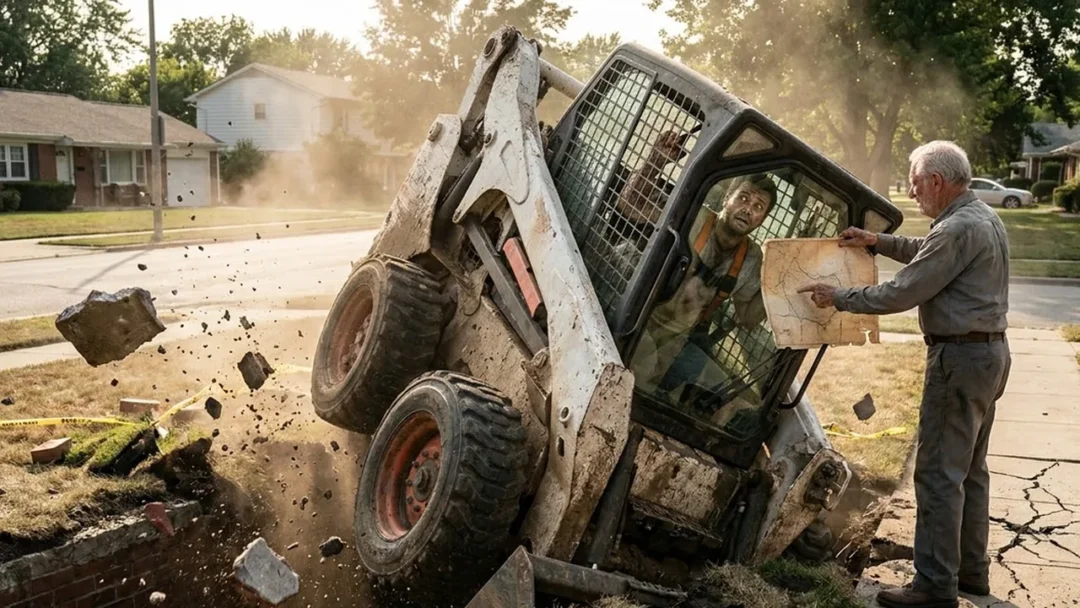
Across the lawn, Tobias Miller did not yell, nor did he wave his arms in futile panic. As a master mason who understood the catastrophic mechanics of brittle materials under dynamic loads, he recognized the moment a human boundary transitioned into an immovable law of physics. He took three deliberate, steady steps backward, clearing the lawn entirely and planting his work boots safely on the concrete sidewalk bordering Valley Brook Lane.
From the adjacent driveway of 108 Valley Brook, David Campbell—a retired civil engineer and longtime neighborhood resident—stepped out onto his porch, his phone raised in both hands, recording the entire scene in crystalline 4K video resolution. The camera framed the heavy tracked loader, the bright yellow warning tape, the red brick barrier, and the calm figure of Tobias Miller holding the open county survey.
Brock Kowalski did not hesitate.
With an aggressive forward thrust of his left joystick, Brock dropped the heavy steel bucket flat against the grade and buried the throttle.
The heavy steel cutting edge of the bucket slammed into the double-stacked red brick barrier. The hand-pressed colonial clay bricks, set by Tobias to mark the perimeter of the danger zone, were crushed into a shower of pulverized red dust and mortar fragments. The wooden survey lathe snapped with sharp, rifle-shot cracks, and the yellow warning tape became tangled in the loader’s left rubber track drive sprockets.
The massive rubber tracks bit into the pristine Kentucky bluegrass, tearing two deep, ragged black trenches through the turf as the five-ton machine rolled forward off the street curb and onto the corner lawn.
“Look at that!” Brock yelled to himself inside the cab, laughing aloud as the machine trampled the grass. “Smooth as a highway! Ten thousand pounds of steel doesn’t care about your little bricks!”
The loader traveled twelve feet onto the lawn, its heavy steel frame pitching gently over the soft topsoil.
Then, the ground beneath the machine began to change.
Through the glass floor of the cab, Brock did not see dirt compacting under his tracks. Instead, he saw a horrifying geometric pattern emerging across the green lawn. A series of deep, spiderweb fractures tore through the topsoil in a perfect ten-foot concentric circle centered directly beneath the loader’s rear engine compartment.
A hollow, resonant boom—like the sound of a subterranean bass drum echoing from the depths of a cavern—reverberated through the chassis.
The topsoil, stripped of its structural sub-base, began to sag downward like a stretched rubber membrane.
Tobias Miller stood on the sidewalk, his linen map resting against his chest, his voice carrying clearly through the crisp autumn air:
“Those bricks marked a void, Brock.”
In geotechnical engineering, the failure mechanism of a buried concrete slab over an unreinforced masonry void follows the laws of punching shear. When a rubber-tracked machine moves across turf, its weight is distributed across the track contact area, creating surface ground pressure of roughly four to five pounds per square inch. While this pressure is low enough to prevent the tracks from sinking into firm soil, the total concentrated axle load remains immense. A five-ton compact track loader carries over ten thousand pounds of steel, cast-iron counterweights, and heavy diesel machinery. As the loader crossed the boundary of the subterranean cistern, the entire ten-thousand-pound live load was transferred through eight inches of topsoil directly onto the center of an unreinforced, unengineered concrete dome.
The micro-fracturing of the concrete cap was exacerbated by the aggressive vibration of the loader’s hydrostatic drive system. The dual hydraulic drive motors, operating under high pressure, transmitted continuous low-frequency acoustic vibrations through the rubber tracks into the soil matrix. The seventy-year-old concrete cap, weakened by decades of subsurface moisture leaching away its calcium silicate hydrates, possessed almost zero tensile strength. Like an eggshell pressed by a hydraulic ram, the center of the dome suffered instantaneous shear failure, radiating concentric fracture lines that unzipped the perimeter mortar joints in a matter of seconds.