The Abandoned Rainwater Cistern And The Swallowed Skid Steer Loader
CHAPTER 5: THE TECHNICAL EXTRACTION AT OAKRIDGE
Within five minutes of David Campbell’s 911 call, the quiet intersection of Valley Brook and Orchard View was transformed into an active technical rescue incident zone.
Lancaster County Fire and Rescue Engine Seven and Rescue Tender Four pulled to a halt at the curb, their red and white strobe bars reflecting off the wet pavement. Battalion Chief Martin Vance jumped down from the command cab, his yellow turnout coat rustling as he assessed the scene with the practiced eye of a veteran structural collapse coordinator.
“Lock down this entire corner!” Chief Vance ordered his crew, unrolling a heavy spool of red barrier tape. “Deploy the collapse rescue trailer! We have a heavy commercial vehicle trapped in an unreinforced subterranean masonry vault! Nobody approaches within twenty feet of that lip without a safety harness and a retrieval line!”
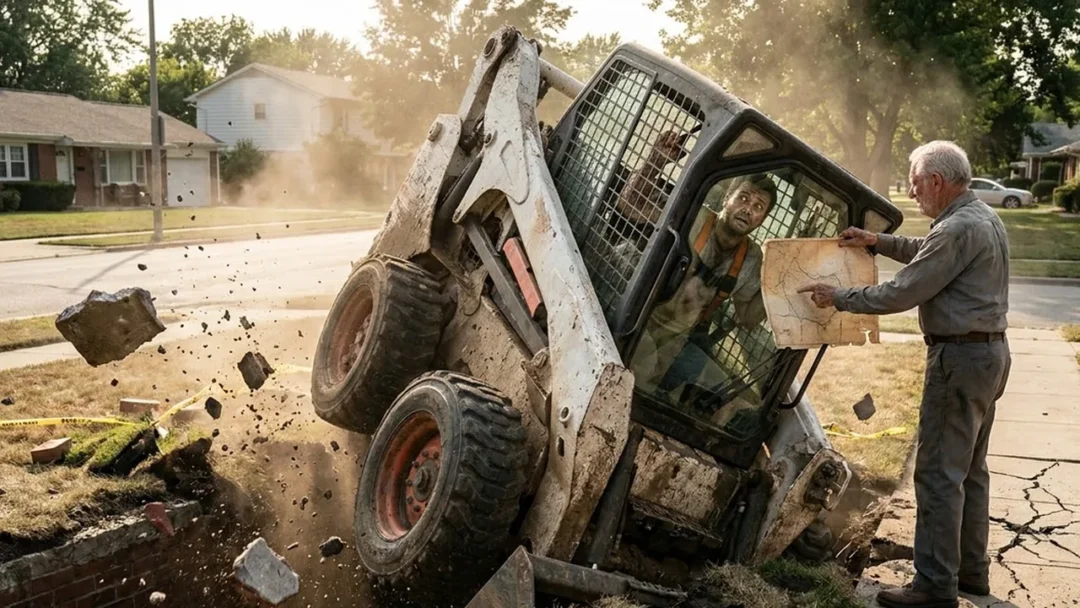
Firefighters moved with military speed. Two rescue technicians in heavy helmets and full turnout gear deployed four sixty-ton Paratech pneumatic structural shoring struts around the edge of the pit. The aluminum struts were wedged firmly beneath the Bobcat’s front tracks and pressurized with compressed air, locking the five-ton loader in place to prevent it from shifting deeper into the void or rolling completely upside down into the twelve-foot-deep chamber.
A third firefighter lowered an atmospheric gas monitor into the hole on a nylon lanyard. The device immediately chirped, reporting safe oxygen levels but detecting high concentrations of methane and hydrogen sulfide from the century-old stagnant sludge.
“Driver! Keep your hands off the joysticks!” Chief Vance commanded through a loudhailer. “Do not attempt to restart that engine! If your hydraulic pump engages, the torque could collapse the remaining brick corbel and drop that cab under water!”
Two rescue specialists climbed carefully along the elevated shoring struts, positioning themselves above the tilted cab. Using a heavy pneumatic extrication spreader, they forced the jammed door latch, popping the armored glass door open with a sharp metallic snap.
Working with delicate precision, they reached inside the cabin, cut Brock free from his four-point harness with a trauma shear, and hoisted the shivering, mud-soaked contractor out of the cab using a technical rescue harness and a tripod winch.
Brock was lowered safely onto the concrete sidewalk. His expensive work trousers were soaked in foul-smelling black silt, his face was pale and smeared with mud and dried blood, and he was shaking violently from shock and cold. A paramedic immediately wrapped him in a yellow thermal foil blanket, sitting him on the rear bumper of the ambulance to check his vitals.
Brock sat clutching the blanket, his eyes fixed on the rear half of his eighty-five-thousand-dollar Bobcat loader, which sat half-submerged in the dark water like a sunken ship.
A white Ford F-250 pickup bearing the gold emblem of the Lancaster County Department of Building Safety and Code Enforcement pulled up to the curb, its amber rooftop light bar flashing slowly.
The driver’s door opened, and Eugene Stauffer stepped out onto the sidewalk, carrying a heavy black binder of municipal transit permits.
The technical rescue protocol for structural collapse and confined space emergencies is governed by National Fire Protection Association standard sixteen-seventy. When a heavy commercial vehicle is trapped within an unstable masonry void, standard firefighting tactics are immediately suspended in favor of specialized civil engineering shoring. Battalion Chief Martin Vance had overseen dozens of trench rescues and structural cave-ins across central Pennsylvania; he knew that approaching an unreinforced brick pit without proper load-redistribution pads could trigger a secondary collapse that would swallow both the machine and the rescue personnel.
The deployment of the pneumatic Paratech struts was executed with surgical discipline. The sixty-ton struts were fitted with swivel-base footings that distributed the load across heavy oak ground pads laid outside the zone of collapse. High-pressure air lines fed each cylinder, pressurizing the aluminum sleeves until mechanical locking collars engaged with sharp clicks. By creating an artificial structural bridge over the pit, the rescue technicians ensured that even if the remaining brickwork gave way, the ten-thousand-pound loader would remain suspended on the shoring frame, allowing them to extract Brock without risking an uncontrolled roll-over.