The Abandoned Rainwater Cistern And The Swallowed Skid Steer Loader
CHAPTER 7: THE BILL FOR THE SUBTERRANEAN RECOVERY
A massive, four-axle, seventy-ton rotator crane from Lancaster Heavy Towing rumbled onto Orchard View Drive, accompanied by two flatbed recovery support trucks loaded with heavy steel outrigger pads, rigging chains, and spill-containment booms.
The crane operator, an experienced rigger named Donald with thirty years of heavy recovery experience, walked over to the edge of the pit with Chief Vance and Inspector Stauffer.
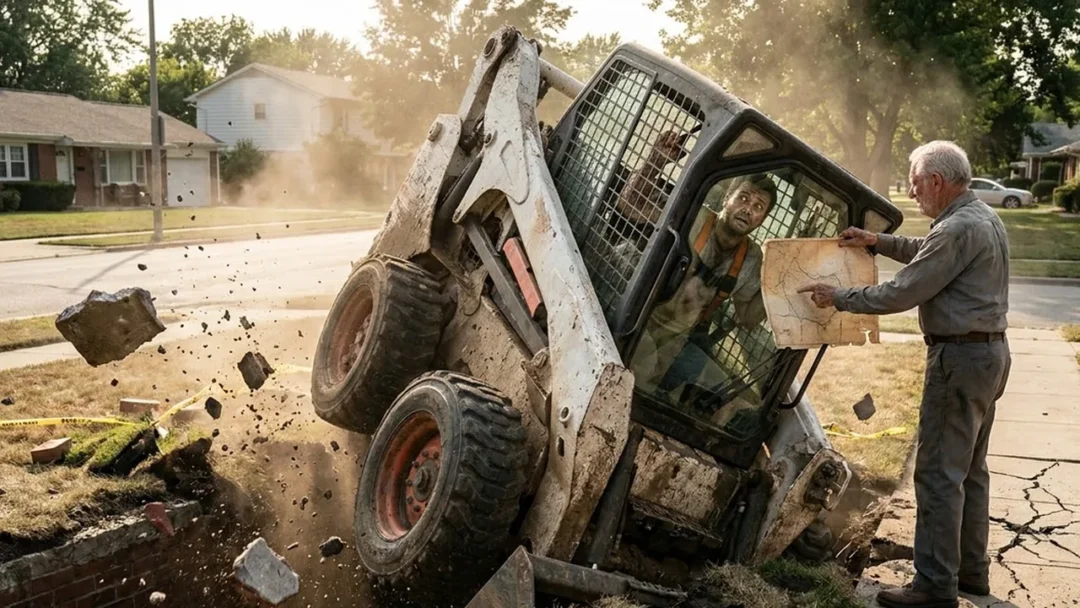
“All right, folks,” Donald said, inspecting the fifty-degree angle of the trapped loader. “This is a blind subterranean pick from an active collapse crater. To rig that ten-thousand-pound machine without pulling down the rest of that brick arch, I have to deploy four eighty-ton hydraulic outriggers on steel spreader plates, run heavy synthetic tree-saver straps through the lift arms, and use dual winches to counter-rotate the chassis while we hoist.”
Donald turned and looked directly at Brock Kowalski. “The emergency mobilization rate for this seventy-ton rotator is eighteen hundred dollars an hour, portal-to-portal, with a six-hour minimum. And because your machine has ruptured its hydraulic oil lines into an active historic aquifer, my company requires an upfront certified deposit of twenty-five thousand dollars before I drop a single hook.”
Brock stared at the crane operator in stunned, paralyzed horror. “Twenty-five thousand dollars? Just to pull it out?”
“That’s just the crane, Mr. Kowalski,” Inspector Stauffer added, consulting his digital calculation sheet. “Let’s review the municipal restitution ledger.”
Stauffer read the items with surgical, bureaucratic precision: “Lancaster County Fire and Rescue technical extraction mobilization: fourteen thousand dollars. Emergency hazmat containment and water pumping: eight thousand five hundred dollars. Structural stabilization and backfilling of the twelve-foot cistern with certified self-compacting gravel: twenty-two thousand dollars. Municipal engineering re-inspection and roadway sub-base testing: six thousand dollars. Total municipal restitution: fifty thousand five hundred dollars.”
“And your Bobcat T770 is a total constructive loss,” Donald the rigger added bluntly. “The engine ingested eight feet of stagnant water through the exhaust valves while it was running. The hydraulic system is contaminated with silt and grit. The electronic control modules are submerged, and the cab frame has suffered severe torsional twist. That eighty-five-thousand-dollar machine is worth about eight hundred dollars in scrap metal.”
Inspector Stauffer closed his binder with a sharp snap. “Under Pennsylvania insurance case law, when an operator is recorded on high-definition video deliberately driving a five-ton commercial vehicle across an explicitly marked hazard barrier after being verbally warned by a licensed mason, the loss is legally classified as an intentional tort. Your insurance carrier, Travelers Specialty, will invoke the intentional-act exclusion clause within ten minutes of reviewing Officer Hess’s incident report. You are personally, individually liable for every dollar of this recovery.”
Brock Kowalski sank back down onto the ambulance bumper, burying his face in his hands, weeping openly. His pool excavation company was ruined. His eighty-five-thousand-dollar machine was scrap. He was facing fifty thousand dollars in municipal recovery costs, twenty-five thousand dollars in crane fees, and felony criminal charges that could put him in county jail.
Across the street, neighbors who had endured Brock’s bullying and reckless speeding for weeks watched in quiet, solemn vindication. The law had not failed. Mathematics, physics, and historical truth had balanced the scales.
The physical logistics of extracting a ten-thousand-pound track loader from an active subterranean collapse pit require immense mechanical leverage. The four-axle Peterbilt rotator crane brought by Lancaster Heavy Towing was a state-of-the-art emergency recovery apparatus, capable of lifting one hundred and forty thousand pounds with its hydraulic telescoping boom. But a heavy pick from an unstable void requires complex rigging geometry. The rigger had to ensure that the lifting straps pulled at an angle that relieved the friction between the machine’s tracks and the century-old brick walls without exerting lateral side-loads that could topple the crane’s boom.
The financial reality of intentional tort liability in construction insurance is absolute. In Pennsylvania case law, comprehensive general liability policies explicitly exclude coverage for damages resulting from intentional violations of safety statutes or reckless disregard of known property hazards. Because Brock Kowalski had been recorded on clear 4K video verbally acknowledging the historical survey map before deliberately dropping his bucket to crush the warning bricks, his insurance underwriter had an open-and-shut basis to deny indemnification. The sixty-thousand-dollar swimming pool contract that Brock had been rushing to excavate had resulted in over one hundred and fifty thousand dollars in personal civil and criminal liabilities.