She Tore Out the Old Farm Bench, Then the Valley Learned What It Had Been Guarding
Chapter 1: The Bench Patricia Wanted Gone Before Friday
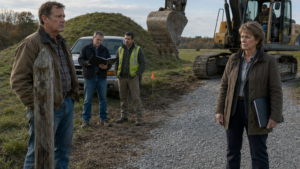
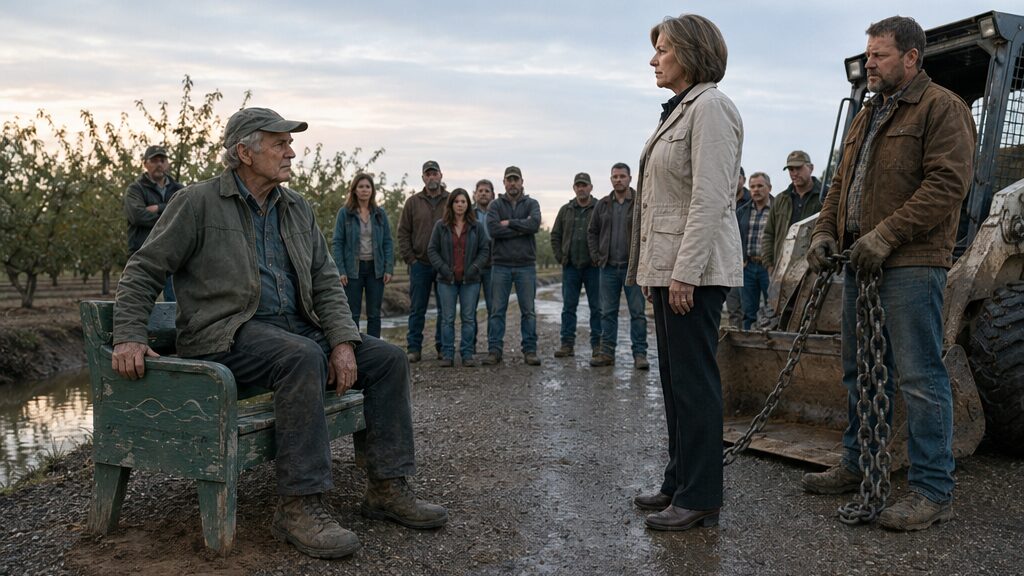
The loader chain struck the gravel beside Timothy Harris’s boots with enough force to scatter dust across his jeans.
He looked down at the heavy links, then up at the yellow bucket suspended over the roadside turnout. Michael Brown sat behind the controls, one hand resting on the lever, his face arranged into the blank expression of a man who had accepted a job he did not want to discuss.
Behind the loader stood the bench.
Its green paint had faded almost gray along the seat. One armrest leaned slightly outward, and the lowest boards were darkened by years of irrigation spray. Three shallow lines had been carved into the wood long ago, each one worn smooth by weather and hands.
Patricia Campbell stepped around the loader in clean work boots.
“We’re not doing this again, Timothy.”
He bent, lifted the chain, and laid it across the loader bucket.
“Then don’t.”
Patricia’s mouth tightened. She wore the cooperative’s green vest over a white shirt, as if the meeting had already begun and he was the only person who had failed to dress for it.
“The grant assessor comes Friday,” she said. “The entrance has to be graded, the sign base has to be poured, and that thing has to be gone.”
Timothy glanced past her. Survey flags ran in a neat curve from the county road toward the farm-tour route. Patricia’s plan would widen the turnout, add a gravel pull-off, and place a painted welcome sign where the bench now stood.
“That thing,” he said, “has been here longer than your farm shop.”
“So have three broken fence posts and a dead pear tree. Age isn’t a permit.”
Michael shifted in the loader seat.
Along the road, two orchard workers had stopped stacking irrigation pipe. A produce truck slowed, then continued. In the valley, arguments rarely remained private once machinery was involved.
Patricia pointed to the bench. “Visitors see peeling paint, weeds, and a place nobody maintains. We’re asking the county for money to keep farms open. We cannot look like we’ve given up.”
Timothy stepped between her and the bench.
“It stays.”
Her gaze moved over him, not cruelly, but with an impatience sharpened by years of unfinished conversations.
“You said that at the board meeting.”
“I meant it there too.”
“And you gave no reason there either.”
He could have told her.
He could have said the bench was not placed for visitors, that the turnout was wider than it appeared, that the old lines on the armrest were not decoration. He could have said Virginia’s name, and watched the argument change shape.
Instead, he put his hands in his jacket pockets.
Patricia let out a short breath. “This is why nothing gets done. Someone asks a plain question and you answer like the rest of us should already know.”
“Some of you did know.”
“That is not an answer.”
Michael shut off the loader. The sudden quiet made the water in the roadside ditch seem louder.
Patricia turned toward him. “Show him the plan.”
Michael climbed down and took a folded sheet from the cab. He opened it across the loader’s tire. The drawing showed the turnout as a clean wedge of gravel bordered by low timber rails. The bench was represented by a small rectangle marked REMOVE.
Timothy tapped the edge of the drawing.
“Whose ground?”
Patricia stared at him.
“The turnout,” he said. “Whose ground is it?”
“The cooperative maintains it.”
“That wasn’t what I asked.”
Michael looked from the paper to the fence lines. Timothy’s orchard began to the east. Patricia’s farm-shop parcel lay across the road. The ditch cut along the southern edge before disappearing under the county culvert.
Patricia folded the plan sharply. “The county right-of-way covers the road shoulder. The cooperative has a maintenance agreement for the entrance.”
“And the bench?”
“No one has produced a deed, dedication, easement, or current record that says it belongs there.”
“It doesn’t belong to me.”
The words quieted her more effectively than his refusal had.
Patricia had spent the last week telling board members that Timothy was protecting his wife’s memorial. He had heard the phrase from Michael, who had heard it from a packing-shed owner, who had probably heard it from Patricia.
She looked at the bench again.
“Then who owns it?”
Timothy ran his thumb over a split in the top rail. “That’s the wrong question.”
A board member’s pickup pulled into the turnout. Another followed. Patricia had scheduled a site review without telling him, or perhaps she had told him and assumed his silence meant consent.
Within minutes, six people stood near the loader. Patricia explained the grant deadline, the entrance design, and the missing county documentation. Timothy listened while the bench became an obstruction, then an eyesore, then a private keepsake blocking public progress.
When she finished, one board member asked Timothy whether he had paperwork.
“No.”
“Did your family place it?”
“No.”
“Was it donated to the county?”
“Not exactly.”
Patricia spread her hands. “This is what we have been dealing with.”
Timothy looked toward the ditch. Water slid beneath mats of grass, clear enough to show the dark stones below. He remembered the same channel broad and brown, carrying fence rails, feed sacks, and pieces of somebody’s porch.
He turned back.
“You pull that bench before you know what’s under it, you’ll regret it.”
A few people glanced down at the gravel.
Patricia’s expression changed—not to fear, but to embarrassment. His warning had sounded theatrical, exactly the sort of vague old-man threat she believed he used when facts failed him.
“What is under it?” she asked.
Timothy said nothing.
The silence lasted too long.
Patricia nodded once, as if he had answered.
She took out her phone and called the county planning desk on speaker. After three transfers, a clerk confirmed that the oldest turnout map had not been digitized and the current parcel layer showed no protected structure at the site. A paper-file request could take several days.
“Friday is three days away,” Patricia said after ending the call.
“The ground will still be here next week.”
“The grant may not.”
For the first time, strain showed beneath her anger. The farm shop had doubled in size the previous year. New refrigeration units hummed behind the building, and everyone in the valley knew the expansion had cost more than expected. The grant was not merely a sign and some gravel. It would help fund drainage, shared marketing, and road improvements the cooperative could not afford alone.
Timothy understood the pressure.
He also understood what pressure made people excuse.
Patricia gathered the board members beside the loader. They voted by raised hands. Four supported removal pending later review. One abstained. Michael kept his hands at his sides because he was not on the board.
Patricia wrote something on the back of the site plan, signed it, and held it out to him.
“Dawn tomorrow,” she said. “Before traffic starts.”
Michael did not take the paper.
“Patricia.”
“You submitted the equipment bid. The board approved the work.”
“I bid on grading.”
“And removal necessary for grading.”
Michael’s jaw moved. Then he accepted the authorization.
Timothy watched the page disappear into Michael’s jacket.
Patricia faced him. “You have until then to bring me something more useful than a warning.”
She walked toward her truck with the board members following.
Michael remained beside the silent loader.
“You could tell us,” he said.
Timothy looked at the green bench, at the carved lines on its armrest and the darkened earth beneath its rear legs.
“I should’ve told you years ago.”
Michael waited.
But Timothy turned toward his orchard.
Behind him, paper crackled as Michael unfolded the authorization again.
At dawn, the bench would be moved whether Timothy found the courage to explain it or not.
Chapter 2: The Marker Hidden Under Green Paint
By the time Timothy reached the turnout Tuesday morning, the bench was already hanging crooked above the ground.
One rear leg remained planted in the soil. The other three were suspended by a chain looped beneath the seat, and the loader’s bucket trembled under the uneven weight.
Michael stood beside the machine, signaling the operator to hold.
Patricia had brought an audience.
Two cooperative board members watched from the road. Orchard workers clustered near a stack of pipe, and several farm families had stopped on their way to the packing sheds. Patricia stood in the center of them with the signed authorization rolled in one hand.
“You said dawn,” Timothy called.
Michael looked at his watch. “It is dawn.”
Timothy crossed the gravel. Fresh gouges ran beneath the bench where the legs had resisted. Green paint had flaked onto the pale dirt.
Patricia stepped in front of him. “Do not touch the equipment.”
He walked around her.
The loader operator lowered the bucket a few inches, uncertain. The bench groaned as one loose board shifted.
Timothy reached under the seat, unhooked the chain from the front brace, and let it fall.
“Timothy,” Patricia said sharply.
He sat down.
The remaining leg sank half an inch under his weight. The bench tilted, but held.
No one laughed. The sight was too strange: an old man seated calmly on a half-lifted bench beneath a raised loader bucket.
Patricia’s voice dropped. “Get up.”
“You can move it.”
“That is what we are doing.”
“Soon as you tell me what’s beneath the rear leg.”
She looked at the leg still embedded in the ground. “Dirt.”
“Then you won’t mind checking.”
One board member rubbed his forehead. “Timothy, this is unnecessary.”
“So was voting before the file came back.”
Patricia’s cheeks reddened. “We checked the current records.”
“You checked the records that were easy to find.”
She took a step closer. “You have had every chance to explain yourself.”
He met her eyes.
She was right, and that made him less willing to answer.
Michael came around the loader. “Let’s lower it.”
Patricia turned on him. “The chain’s off because he interfered. Put it back.”
“No.”
The single word shifted the watching crowd.
Michael crouched beside the planted leg. He brushed away loose dirt and examined the cracked lower brace. “This board’s been replaced.”
Timothy said, “Lift it.”
“With what?”
“Your hands. It’s loose.”
Michael slid his fingers beneath the rear seat board. At first it did not move. Then the warped wood released with a dry snap, scattering flakes of green paint.
A narrow brass plate lay recessed into the support below.
Michael wiped it with his glove.
A stamped symbol emerged: three wavy lines beneath a small county crest. Below it were letters almost black with age.
WATERSHED ACCESS.
The crowd drew closer.
Patricia stared at the plate. “That could have come from anywhere.”
“It was bolted to the frame,” Michael said.
“An old marker does not make the bench protected.”
“No,” Timothy said. “But it should make you wonder why somebody built the bench over it.”
A board member knelt and touched the brass. “Is this county property?”
“Not the bench.”
“What, then?”
Timothy looked toward the ditch.
Memory came as fragments he had spent years keeping separate: Virginia’s soaked hair against her face; headlights trapped across brown water; a school bus turning around in the dark; men carrying lumber after the creek dropped.
He could have joined those fragments into an answer.
Instead he said, “The turnout was marked for access.”
“To what?” Patricia asked.
Timothy stood. The bench shifted as his weight left it.
“You should have found that out before bringing a loader.”
Patricia’s surprise hardened into anger. “There it is again. You know something, but instead of helping, you stand back and wait for everyone else to fail.”
Timothy felt the accusation land because it was closer to truth than she understood.
The loader operator shut down the engine. The raised bucket settled slightly on its hydraulics.
Michael straightened. “I’m not dragging it.”
Patricia looked at the authorization in her hand. “You accepted the job.”
“I accepted site work. This isn’t site work anymore.”
“It is a bench with an old plaque.”
“It’s enough for me to stop until the county checks.”
The board member who had abstained the day before nodded. Another avoided Patricia’s eyes.
For a moment, Timothy thought the marker had done what his silence could not. The bench would remain. The file would arrive. The argument would slow long enough for memory to catch up.
Then Patricia walked to the loader operator.
“Set it by my farm shop.”
Michael stepped toward her. “You can’t keep grading.”
“We are not grading over the marker. We are clearing the approved entrance while the county determines whether that plate means anything.”
“You don’t know what it marks.”
“And neither, apparently, does anyone willing to say.”
Her gaze settled on Timothy.
He hated the triumph in it. He hated more that he had supplied it.
The chain was attached again, this time under Michael’s supervision so the old frame would not split. Timothy stood aside as the last leg rose from the ground with a sucking sound.
Beneath it was a round depression no wider than a dinner plate, packed with roots and rust-colored soil.
The bench swung toward the road.
As it passed Timothy, the carved water lines on the armrest caught the early light. The highest line sat near the top, faded but still visible.
Patricia’s truck led the loader to her farm shop, where the bench was lowered beside stacked crates and a display of refinished milk cans. It looked more worn there than it had beside the ditch.
Timothy remained at the turnout.
Michael returned with the grader near noon. He worked slowly, cutting shallow passes through the rise where the sign base would stand. Patricia had marked a square around the brass plate and ordered him to avoid it.
Timothy watched from the orchard fence.
The first pass removed weeds and gravel. The second exposed pale clay. On the third, the grader blade struck something beneath the soil.
The sound was deep and hollow.
Michael stopped immediately.
He climbed down and scraped at the cut with a shovel. A curved edge of corroded metal appeared beneath the blade.
Patricia came from the farm shop carrying her phone.
“What did you hit?”
“Some kind of housing.”
“Is it inside the marked square?”
“Barely outside.”
She crouched, touched the metal, and checked the plan. “Old culvert hardware?”
Michael shook his head. “Too thick.”
Timothy pushed through the fence opening.
“Leave it exposed.”
Patricia stood. “You are not directing this site.”
“That housing opens.”
“You know that now?”
“I know enough.”
Michael dug along one side. The soil collapsed inward, revealing a seam and the edge of what might have been a lid.
Water seeped into the hole.
Patricia looked toward the road, where the grant entrance remained half-cut and visibly unfinished.
“Cover it until the county comes,” she said.
Michael stared at her. “That’s not the same as leaving it alone.”
“It’s a hole beside a public road. We cannot leave it open.”
“We can plate it.”
“The steel plate is at the lower farm.”
Timothy stepped closer. “Then stop.”
Patricia’s eyes stayed on the unfinished entrance.
“We stabilize it,” she said. “Nothing more.”
Michael spread loose soil around the housing, intending only to support the edges. But the wet clay gave way beneath his shovel. One side of the hole collapsed, folding over the metal seam.
The housing disappeared under a heavy slab of mud.
A low gurgle came from beneath the ground.
Then the sound stopped.
Timothy looked at Patricia.
She no longer appeared certain that they had struck obsolete hardware.
“What did we just cover?” Michael asked.
Timothy watched a thin ribbon of water rise through the fresh soil.
“That,” he said, “is what you should have asked before you moved the bench.”
Chapter 3: The Empty Ground Began Holding Water
On Wednesday morning, irrigation water ran uphill across Timothy’s access road.
It came in a shallow brown sheet from the turnout, crossed the wheel ruts, and spread beneath the first row of pear trees. Fallen leaves floated backward toward the orchard.
Water did not move that way unless something had forced it.
Timothy shut off the nearest field gate, but the flow continued. By the time he reached the turnout, the bench-shaped patch of bare earth had filled like a shallow grave.
Patricia stood beside it in rubber boots, talking into her phone.
“This started before sunrise,” Timothy said.
She ended the call. “The upper ditch is running high.”
“The upper ditch always runs high on Wednesday.”
“So it may not be connected to the grading.”
He pointed to the water bubbling through the soil where the metal housing had vanished.
Patricia followed his hand. Her face tightened.
Michael arrived in his pickup with two shovels and a coil of hose. He stepped out, looked once at the flooded footprint, and opened the truck bed without speaking.
“County watershed is coming,” Patricia said.
“When?” Timothy asked.
“They said this morning.”
“That means before lunch if we’re lucky.”
Michael pushed a shovel into the collapsed clay. Water filled the cut as quickly as he opened it.
“We need a pump.”
Timothy shook his head. “You need to stop the pressure.”
“From where?”
He looked at the empty place where the bench had stood.
The answer had once been simple. Rear leg to valve cap. Armrest toward the ditch. Seven paces to the old fence corner. Virginia had designed the bench so anyone could follow the alignment even in muddy water.
But the old fence had been replaced. The turnout had been widened. And Timothy had never shown Michael.
“Timothy?” Michael said.
“I need the county map.”
Patricia folded her arms. “Yesterday you knew enough.”
“Yesterday the ground hadn’t moved.”
Her expression sharpened, but before she could answer, a county truck turned off the road.
Cynthia Davis stepped down carrying a hard case and a rolled map tube. She wore a reflective vest over a blue work shirt and moved directly to the flooded patch.
“Who authorized excavation?”
Patricia answered. “The cooperative board.”
“Who checked utility and watershed records?”
“We requested them.”
“That is not what I asked.”
Patricia looked toward the half-graded entrance.
Cynthia knelt, tested the water with a handheld meter, then followed the flow toward Timothy’s orchard. “This is not groundwater. It’s irrigation return under pressure.”
Timothy said, “The housing had a lid.”
“Shape?”
“Round. Cast metal. About thirty inches across.”
Cynthia stood. “That sounds like a valve vault.”
Patricia’s voice lowered. “For what?”
“Possibly the emergency bypass. Possibly nothing still connected. I’ll know when I see the legacy map.”
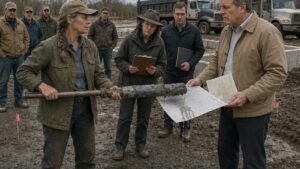
She unrolled the map across Michael’s truck hood. The paper was a county reproduction, its lines pale and interrupted by handwritten corrections. The road was narrower. Property boundaries shifted at angles that no longer matched the fences.
Near the turnout was the same symbol stamped into the brass marker: three wavy lines beneath the county crest.
Cynthia traced it with one finger.
“There should be an operating note.”
She searched the lower margin, then turned the map over.
Nothing.
Michael leaned over her shoulder. “Could it be on another sheet?”
“It should be referenced here.”
Timothy saw a notation beside the symbol, faint enough that the others missed it.
VH—ACCESS CONTACT.
His chest tightened.
Cynthia took a photograph of the map and called the county office. While she waited, Michael and the road foreman set a small pump at the flooded patch. It cleared the water for less than a minute before the hole filled again.
Cynthia ended the call.
“The bypass is still listed as active.”
Patricia went still. “Active for what?”
“To isolate the lower irrigation branch during a washout or culvert failure. If the valve is obstructed or partly shifted, it can force water back through the turnout.”
Timothy looked at the sheet moving across his road.
“How much pressure?”
“Enough to damage roots if it sits. Enough to wash the shoulder if the ditch rises.”
The small payoff brought no relief. He had been right about the danger, but being right did not uncover the valve.
Cynthia pointed to the map. “The vault should be within six feet of the marker.”
Michael looked at the churned ground. “We moved the marker twenty yards.”
“The plate was fixed to the bench,” Patricia said.
Cynthia turned slowly toward her. “You moved the physical access marker before locating the infrastructure?”
Patricia lifted her chin. “No current record identified the bench as a marker.”
“Did someone warn you it covered something?”
Silence settled over the turnout.
Timothy could have let Patricia carry it alone.
He had warned her. She had signed the authorization. She had ordered the work continued after the brass plate appeared.
But the valley had not forgotten by accident.
“I warned her,” he said. “I didn’t explain.”
Cynthia studied him. “Why not?”
He looked toward Patricia’s farm shop. The bench was visible beside the loading bay, its green frame surrounded by polished signs, fresh lumber, and rows of sealed preserves.
“I thought the people who needed to know already knew.”
Michael drove his shovel into the mud harder than necessary. “I’ve worked this road twelve years.”
Timothy said nothing.
“And you never told me.”
“You never asked.”
Michael turned on him. “I didn’t know there was a question.”
The words left Timothy with nowhere to place his anger.
Cynthia returned to the map. “We can excavate by measurement, but the turnout dimensions have changed. The original fence corner is gone. The road shoulder is wider. Without the operating note, we may be digging blind.”
Patricia said, “Can the county shut the water upstream?”
“Not without cutting service to most of the western orchards. And if rain arrives before we restore the bypass, the creek may overtop the lower road.”
“The forecast said scattered rain.”
“The updated forecast says heavy rain tomorrow evening.”
Patricia looked toward the bare entrance, then toward Timothy’s flooded pears. For the first time since the argument began, she seemed to understand that the grant inspection might become the smallest consequence of the week.
Cynthia lifted the map closer to the truck window, trying to catch the light.
“What is this?” she asked.
Her finger rested beside the turnout symbol.
Timothy already knew.
The initials had been written in blue ink, the letters narrow and upright.
Cynthia read them aloud. “Virginia Hill.”
Michael stopped digging.
Patricia’s face changed. She had known Virginia. Everyone over forty in the valley had.
Cynthia looked at Timothy. “Why is your wife listed as the access contact on a county watershed map?”
The pump coughed behind them. Muddy water climbed again into the rectangular space where the bench had stood.
Timothy watched it reach the lowest carved line that was no longer there.
For eleven years, he had kept Virginia’s box sealed in the farmhouse closet.
Now the valley was flooding around a promise only he still remembered.
Chapter 4: What Virginia Asked the Valley to Remember
Timothy opened the box at the kitchen table with a pocketknife he had sharpened every winter and used for everything except this.
The tape had yellowed across the cardboard seam. When the blade passed through it, the sound was small, but it seemed to carry through the empty farmhouse.
Inside lay a folded wool blanket, a stack of school newsletters tied with twine, and a photograph of Virginia standing beside the bench before anyone had painted it green. The wood was pale and raw. Her sleeves were rolled to her elbows, and one hand rested on the unfinished armrest as if she were steadying it against the wind.
Behind her, the valley was mud.
Timothy set the photograph facedown.
He had come for the operating notes. He did not need the rest.
Beneath the newsletters was a thin ledger with a blue cloth cover. Virginia’s handwriting filled the first pages in narrow columns: names of families, donated lumber, fuel receipts, sandwiches delivered to volunteers, hours worked after the flood.
At the center of one page she had written:
TURNOUT MUST REMAIN OPEN TO ALL FARMS AND EMERGENCY VEHICLES.
The sentence was underlined twice.
Timothy sat back.
Eleven years had not changed her handwriting. It still leaned forward as though each word had somewhere urgent to be.
A truck door closed outside.
He slid the ledger beneath the blanket before remembering there was no reason to hide it now.
Cynthia entered after knocking once. Mud streaked her boots, and she carried a plastic folder sealed against rain.
“The county suspended Patricia’s site work,” she said. “The road foreman is placing barriers around the turnout.”
“That stop the water?”
“No.”
She remained standing until Timothy gestured toward the other chair.
Cynthia saw the photograph facedown on the table but did not touch it.
“The archive clerk found a reference to a flood-access agreement,” she said. “Not the agreement itself. It may have been filed with emergency management instead of watershed.”
“It wasn’t much of an agreement.”
“You’ve seen it?”
“Virginia wrote it.”
Cynthia waited.
Timothy turned the photograph over.
Virginia was forty-six in the picture. Her hair was tied back with a strip of cloth because every proper hair tie in the house had disappeared during the week of the flood. The bench frame stood on sawhorses behind her. Two farm families were visible in the distance, carrying boards toward the turnout.
“The creek rose after midnight,” Timothy said. “Not where the county model said it would. It came over the lower road first.”
Cynthia did not interrupt.
“A family at the west end tried to leave. Their truck stalled where the water crossed the culvert. By the time the volunteer crew reached them, the road shoulder was gone.”
He looked at Virginia’s hand on the unfinished bench.
“There were four people in the truck. Two made it out.”
Cynthia lowered her eyes.
“The county improved the culvert afterward,” Timothy continued. “But Virginia said concrete wasn’t enough. She wanted a place everybody knew. A meeting point. An access marker. Somewhere a fire truck could turn around and farmers could find the bypass valve in the dark.”
“The bench.”
“The rear leg lined up with the vault. The armrest pointed toward the old fence corner. The water marks showed when the road became unsafe.”
Cynthia picked up the photograph carefully. “Why a bench instead of a sign?”
“Signs got stolen. Posts washed out. A bench gave people a reason to keep the weeds down.”
“And the families donated it?”
“Lumber, bolts, paint. Virginia kept track of every piece.”
He opened the ledger and pushed it across the table.
Cynthia read several lines, then stopped at the underlined sentence.
“This should have gone into the county record.”
“It did, sort of.”
“Sort of is how we ended up digging blind.”
The words were not unkind, which made them harder to resist.
Timothy looked toward the dark window above the sink. “She kept copies at the fire station. Told every family what the marks meant. For years, people knew.”
“And after she died?”
“I kept the bench repaired.”
“That wasn’t my question.”
He closed the ledger.
The movement was sharper than he intended. Cynthia leaned back but did not look away.
“I didn’t want meetings,” he said. “Didn’t want people turning her into a plaque and a speech once a year. The turnout worked. The bench stayed. I thought that was enough.”
Cynthia placed the photograph beside him. “It was enough while everyone who remembered was still here.”
By eight the next morning, Timothy stood in the volunteer fire station beneath fluorescent lights that made every face look tired.
The fire chief spread Virginia’s copied notes across a folding table. Some pages were stained along the edges. One had been used years earlier to level a cabinet.
“I remember the access drill,” the chief said. “We walked families from the turnout to the upper road.”
Michael stood near the equipment lockers with his arms folded. Patricia had not come.
“How many current volunteers know the valve location?” Cynthia asked.
The chief looked toward the younger crew members.
No one raised a hand.
“We stopped running that drill,” he admitted. “County installed better warning gauges. People assumed the old plan was retired.”
“Who decided that?” Timothy asked.
“No one. That’s the problem.”
A younger volunteer lifted Virginia’s diagram. “This fence corner isn’t there anymore.”
“It was replaced after the orchard expansion,” Michael said. “The new line sits farther east.”
The fire chief rubbed his jaw. “Then the bench was the only fixed marker left.”
Silence followed.
Timothy had expected anger at Patricia. Instead, every person in the room seemed to be measuring the distance between what had once been common knowledge and what remained.
Michael broke the silence.
“You let me move it.”
“I told you not to.”
“You told me there was something underneath. You never told me that two families downstream might depend on it.”
Timothy’s first impulse was to answer that Michael had followed Patricia’s paper instead of his warning.
He looked at Virginia’s notes.
“I should have.”
Michael’s arms dropped slightly.
The admission did not repair anything, but it changed the room. Timothy was no longer the keeper of a secret everyone else had failed to respect. He was a man who had allowed a shared duty to narrow into personal memory.
Cynthia’s phone sounded.
She read the weather update and placed it on the table.
“Rain begins this afternoon. Heavy cells expected by evening. We need the vault exposed before then.”
The fire chief began assigning pumps, shovels, and traffic control.
A diesel engine rumbled outside.
Through the open bay door, Timothy saw Patricia’s truck pulling a flatbed trailer.
The green bench was strapped upright behind the cab.
Patricia climbed out alone. Her cooperative vest was gone. Mud covered the knees of her work pants, and the bench’s loose board lay on the trailer beside a box of salvaged bolts.
She entered the station without looking at the others.
“I brought it back,” she said.
Timothy glanced at the bench, then at the weather notice on the table.
“Bringing it back isn’t the same as putting the ground back.”
“I know.”
For once, she did not defend herself.
She set the folded site plan beside Virginia’s ledger.
“Tell me what has to happen before the storm.”
Chapter 5: The Woman Who Needed the Valley to Look New
The grant assessor arrived one day early, while Patricia was still washing mud from the bench’s brass marker.
A county sedan stopped outside the farm shop at eleven forty-three. Patricia knew the time because she had been watching the office clock, counting the hours until the rain and the minutes she no longer had to prepare an explanation.
The assessor entered carrying a tablet and a weatherproof folder.
“I was nearby,” he said. “With tomorrow’s forecast, I thought it best to complete the site review today.”
Behind him, the green bench stood beside the loading bay.
Patricia had planned for it to be gone.
Now it looked worse than ever. One leg was caked with clay. A board had been removed from the seat, exposing the dark support beneath. The faded flood marks on the armrest appeared almost black where she had rinsed them.
The shop around it was everything she had worked to make the valley look like: sealed jars aligned by label, restored farm tools mounted against white walls, refrigerated cases humming behind clean glass. Even the old milk cans had been sanded and repainted.
The bench refused improvement.
The assessor glanced at it. “Is that part of the entrance project?”
“Not exactly.”
He opened the folder. “I received notice of a county work suspension.”
Patricia led him into the cooperative office before the customers near the produce display could hear.
On her desk lay the approved project packet. The land-review line contained a handwritten notation: PENDING LEGACY FILE SEARCH.
She had signed beneath it anyway.
At the time, the decision had felt defensible. The county had missed two promised response dates. The cooperative board had voted. The grant required visible progress before inspection. Every week of delay increased labor costs.
And the farm shop’s expansion loan came due whether visitors arrived or not.
The assessor sat across from her. “Walk me through the contractor authorization.”
Patricia described the board vote, the current parcel map, and the absence of any recorded structure at the turnout.
“Who operated the equipment?”
“Michael Brown’s crew.”
“Did the contractor identify the buried housing?”
“After the bench was moved.”
“Did he continue work after identification?”
The opening was there.
She could say Michael had misjudged the excavation. She could describe the collapse as an equipment error. The written authorization did not explicitly direct him to disturb buried infrastructure.
The assessor’s pen waited above the form.
Patricia looked through the office window.
Michael stood outside beneath the shop awning, checking straps on the trailer. He had refused to drag the bench away. He had questioned the grading. She had used the board’s authority to push past him.
“The contractor stopped,” she said. “I instructed him to stabilize the site and continue the entrance cut.”
The assessor wrote something.
“Were you warned that the bench marked access?”
“Not in terms I understood.”
It was technically true and morally thin.
She heard Timothy’s voice from Monday: You pull that bench before you know what’s under it, you’ll regret it.
“Were you warned there might be something beneath it?” the assessor asked.
“Yes.”
The word cost more than she expected.
The assessor closed the folder. “The cooperative may remain eligible, but any funds connected to the entrance component will be frozen pending review. Restoration costs will not be reimbursable.”
“How long?”
“Depends on damage and responsibility.”
Patricia looked at the refrigeration payment notice clipped beneath her calendar. If the entrance funding vanished, the cooperative would lose drainage work, shared signs, and part of the visitor-route paving. Several farms had ordered packaging based on projected autumn traffic.
“You understand what that does here,” she said.
“I understand why deadlines matter. They do not replace review.”
After he left, Patricia stood beside the bench.
Virginia had once sat at Patricia’s kitchen table helping her fill out the first farm-stand permit. She had corrected three mistakes without making Patricia feel foolish. At the time, Patricia had thought Virginia belonged to a generation that knew how to ask for help.
Now she understood that Virginia had also belonged to a generation that trusted memory too much.
Timothy entered through the loading bay with Cynthia behind him.
“We need the bench at the turnout,” Cynthia said. “Not installed. We’ll use it for alignment.”
Patricia wiped her hands on a rag. “The assessor froze the entrance funds.”
Timothy looked around the polished shop. “That why you’re telling me?”
“I’m telling you because six farms lose improvements if the review goes against us.”
“Two farms may lose road access tonight.”
“I know that.”
His eyes rested on her for a moment, testing whether she did.
Patricia picked up the old site plan and turned it over. Michael’s authorization remained in her handwriting.
“I could have said he continued on his own,” she said.
Michael had come inside behind them. He stopped near the door.
Patricia faced him. “I didn’t.”
He gave one short nod.
It was not forgiveness.
Cynthia spread a waterproof map across the counter. “The county crew can bring a compact excavator, but the ground may be too soft by evening. We need the original bench orientation and any surviving reference point.”
“The fence corner is gone,” Michael said.
Timothy touched the highest carved line on the armrest. “The ditch bend may still match.”
Patricia looked at the mark. “Those were flood levels?”
“Yes.”
“I thought children had carved them.”
“You never asked.”
The answer stung because it mirrored every accusation she had made against him.
Produce-stand customers moved quietly past the office window, pretending not to listen. Patricia had spent years trying to prove the valley could present itself professionally. She had imagined neat signs, planned parking, clean photographs, and visitors who saw thriving businesses rather than patched equipment and faded paint.
She had not imagined herself standing beside the object she had called an embarrassment, asking it to help save the road.
A radio crackled on Cynthia’s vest.
The volunteer fire chief’s voice broke through static.
“Creek is over the first marker at the lower crossing. Water has started across the west lane.”
Cynthia seized the map.
“How long before it reaches the lower farms?” Patricia asked.
“Less if the bypass stays blocked.”
Timothy headed for the trailer.
Patricia remained beside the desk for half a second, looking at the grant folder, the payment notice, and the authorization bearing her signature.
Then she took the keys from the hook.
Outside, rain began striking the shop’s metal awning.
She climbed into the truck that carried the bench she had removed and followed Timothy toward the rising creek.
Chapter 6: The Shutoff Beneath the Rising Mud
Water reached the lowest carved line on the bench before they finished unloading it.
Patricia’s truck stood at an angle on the turnout, its tires sinking into softened gravel. Michael and two volunteers lowered the green frame from the trailer while rain ran from the seat in thin curtains.
Timothy placed his hand on the armrest.
The first line meant water had entered the lower road ditch. The second meant the culvert was losing capacity. The third—the highest—meant no vehicle should attempt the crossing.
The water was already above the first.
“Turn it clockwise,” he said. “Rear leg toward the orchard.”
Michael and Patricia rotated the bench through the mud.
Cynthia held Virginia’s diagram inside a clear plastic sleeve. “The original note says the valve lies six feet, four inches from the rear-right anchor.”
“The turnout was narrower then,” Michael said.
“We start with what we have,” Timothy replied.
They lowered the bench where he remembered it standing. Fresh rain struck the empty bolt holes and filled them immediately.
Timothy sighted along the armrest toward the ditch bend. The bend was wider than it had been eleven years earlier, but an old cottonwood stump remained on the far bank.
“There,” he said, pointing to a patch of churned clay.
The county excavator could not reach the site without blocking the road, so Michael used the loader. He peeled away soil in shallow passes while volunteers pumped water from the cut.
At three feet, they found nothing.
At four, the hole filled faster.
Cynthia checked the diagram again. “Are you sure of the orientation?”
“The back faced east.”
Michael looked toward the orchard. “East is that way.”
Timothy stared at the bench.
The rear-right leg now pointed toward Patricia’s shop. In his memory, Virginia sat at the uphill end with her boots tucked beneath the seat. He had assumed the armrest marks faced the ditch because that was how he had seen them for years.
But the bench had been turned during repairs.
“When?” he asked aloud.
Michael shut off the loader. “When what?”
Timothy ran both hands over the frame. One leg carried newer bolts. He had replaced that brace seven years earlier after a delivery truck clipped the bench.
He remembered moving it onto blocks. Remembered Michael’s father helping him lift. Remembered setting it back before dark.
Had they rotated it?
“The alignment’s wrong,” Timothy said.
Patricia’s face went pale. “How wrong?”
“Could be eight feet. Could be more.”
Water spread across the lower edge of the turnout. The fire-service radio reported that one family had moved livestock uphill. Another was preparing to leave but could not bring a loaded trailer across the western lane.
Cynthia stepped close to Timothy. “We need another reference.”
“The fence corner.”
“Gone.”
“The old gatepost?”
“Removed during the orchard expansion.”
Timothy stared at the muddy ground he had guarded for decades.
He had believed keeping the bench in place meant preserving the system. Yet he had repaired it, shifted it, and told no one enough to correct him.
“I did this,” he said.
Patricia shook her head. “I ordered the grading.”
“I let a measuring point become a memory.”
The volunteers continued pumping, but their hose discharged almost as much water as the hole gained.
Michael walked toward the road, studying the fence line. Rain flattened his shirt against his shoulders.
“My father put in that replacement fence,” he called. “He didn’t follow the old line.”
Timothy joined him.
Michael pointed across the ditch. “But he left one thing.”
Half buried in blackberry canes was a short concrete footing, the remains of a gate hinge. The wooden post was gone, but the footing had not moved.
Michael returned to Virginia’s diagram.
“This crossmark,” he said. “That’s the gate.”
Cynthia measured the angle between the hinge footing and the county culvert.
Timothy repositioned the bench. This time the loose rear board faced the old gate point.
“Seven paces,” he said.
“Your paces or Virginia’s?” Michael asked.
The question might once have sounded disrespectful. Now it was exactly the question Timothy should have taught someone to ask.
“Virginia’s stride was twenty-six inches.”
Michael measured with a tape.
The line ended two feet north of their first excavation.
He drove a steel probe into the mud. At eighteen inches, it struck metal.
The sound was faint but unmistakable.
“There.”
The loader opened a new cut. Mud sloughed into the bucket in heavy slabs. The volunteers placed timber along the edge to keep the walls from collapsing.
A curved iron lid emerged.
The vault was deeper than Timothy remembered. Grading fill had covered it, and the collapse from Tuesday had packed clay against the seam.
Michael climbed into the cut with a pry bar.
“Careful,” Cynthia said. “If the stem is damaged, forcing it could make this worse.”
They cleared the lid by hand.
Timothy knelt at the edge, reaching into the mud to brush soil from the lifting ring. His fingers found the iron loop. He pulled.
The lid shifted, then dropped.
His hand struck the rim.
Pain shot through his palm, sharp and immediate. He drew back to find blood mixing with rainwater along the base of his thumb.
Patricia crouched beside him. “You’re done.”
“It’s nothing.”
“You can’t grip.”
Michael looked up from the vault. “She’s right.”
Timothy wrapped his hand in a rag and reached again. His fingers failed to close.
For years, he had believed responsibility meant being the last person who could be trusted with the task.
Now the valve sat beneath them, and he could not even lift the lid.
He looked at Michael.
“Put the bar through the ring. Lift toward the orchard, not the road.”
Michael obeyed. The lid rose with a grinding sound.
Inside the vault, muddy water swirled around a vertical stem capped by a square iron head.
Cynthia lowered a flashlight. “Stem appears intact.”
Patricia took the valve key from the county case.
Timothy shook his head. “Not yet. If you turn against pressure too fast, you can shear it.”
“How far?”
“Quarter turn. Wait. Then another.”
Patricia climbed into the cut.
Rainwater ran from her hair onto the valve key. She fitted it over the square head.
Around them, people waited—volunteers, Michael, Cynthia, the road foreman, two farmers from the lower branch. No one cheered. The creek continued rising while the decision narrowed to iron, mud, and a woman’s hands.
“Clockwise,” Timothy said.
Patricia pulled.
The key resisted.
“Use your weight. Steady.”
It moved with a low groan.
“Stop.”
She stopped.
A vibration passed through the valve stem. Somewhere beneath the ground, water changed direction.
Timothy counted to ten.
“Again.”
Patricia turned another quarter.
The muddy pool around the vault shuddered. Water in the turnout stopped climbing.
One of the volunteers shouted from the ditch. “Flow’s dropping!”
Michael watched the bench-shaped depression. Its surface lowered slowly, exposing the first bolt hole.
Patricia looked up at Timothy. “Another quarter?”
He studied the current, then nodded.
She turned the key.
The backed-up sheet across his orchard road thinned. Leaves that had floated uphill began drifting toward the ditch again.
Cynthia spoke into her radio, confirming the bypass response. The lower farms reported that water had stopped crossing the western lane.
Only then did Timothy allow himself to sit on the bench.
His injured hand pulsed beneath the muddy rag. Michael sat at the opposite end, breathing hard.
Patricia climbed from the vault. Mud covered her boots and sleeves. She set the valve key beside Timothy instead of returning it to the county case.
“I should have listened,” she said.
Timothy looked at the exposed flood marks.
“I should have told you what you were listening for.”
She lowered herself onto the bench between him and Michael.
The water continued falling, leaving a dark line across the gravel.
The valley had not been saved by the bench alone, or Virginia’s notes, or Timothy’s memory. It had been saved because, at the last moment, the knowledge stopped belonging to one person.
Across the turnout, Cynthia watched the level gauge and then raised her hand.
“The bypass is holding.”
Patricia placed both hands on the iron key.
Timothy guided her through the final turn, and beneath the mud the old valve opened fully.
Chapter 7: A Seat No One Owned Alone
The cooperative unveiled three replacement benches Timothy had never asked for.
They stood beneath canvas covers at the restored turnout, lined up beside the original as though waiting for judgment. One was made of dark composite boards that would never rot. One carried a polished brass plaque large enough to be read from the county road. The third had curved iron arms and Virginia’s name cut into the backrest.
Timothy stopped at the edge of the new gravel.
Fresh bolts held the old green bench to a concrete pad above the repaired valve vault. Michael had replaced the cracked lower brace and tightened the loose seat board, but he had left the faded paint alone. The three flood lines remained visible on the armrest.
Patricia stood beside a folding table with the cooperative board. Cynthia had spread updated access maps beneath clear plastic covers. The volunteer fire chief was showing two younger members how to remove the vault lid without standing downhill from it.
The turnout no longer looked neglected.
It also did not look new.
Patricia approached Timothy before anyone could begin.
“The board wanted options,” she said.
“I see that.”
“The composite one has a thirty-year warranty.”
“So does a culvert, until somebody forgets what it’s for.”
She accepted the remark without flinching.
Two weeks had changed the way she carried herself. She no longer wore the cooperative vest. Her boots were the same mud-stained pair she had worn at the valve, cleaned but not polished.
“The grant review is finished,” she said. “Mostly.”
Timothy waited.
“They removed funding for the entrance feature and reduced the road-improvement award. We keep the drainage portion and the shared marketing program.”
“How much did the valley lose?”
“Enough to postpone the west parking area and two farm signs.”
“And the repair?”
“I signed responsibility for it.”
He looked toward the restored vault. New concrete surrounded the lid, and a yellow-painted access boundary marked the ground where no grading would be permitted.
“The cooperative signed,” he said.
“No. I did.”
That distinction mattered. Patricia had not spread the cost among farmers who had never seen the authorization. She had refinanced equipment at the shop and sold one of the new refrigeration units.
Timothy knew because people in the valley talked even when they claimed not to.
Patricia glanced toward the covered benches. “I thought replacing it might be part of making this right.”
“You can’t replace what you didn’t understand.”
“I understand more now.”
“Enough to leave it alone?”
Her gaze moved to the old bench.
“Maybe enough to ask.”
The board meeting began without a microphone or formal introduction. Folding chairs faced the turnout, though most people remained standing. Farm families, orchard workers, produce-stand customers, and county employees formed a loose half circle around the benches.
Patricia read the proposed restoration plan.
The turnout would remain a permanent shared-access site. The valve vault would be inspected each spring and autumn. The volunteer fire service would include the bypass in annual flood training. Updated maps would be kept at the station, the cooperative office, and every farm connected to the lower branch.
Then she reached the question of the bench.
“The board recommends retiring the original structure to a protected display at the farm shop,” she said. “A replacement would be installed here.”
Timothy looked at the three covered shapes.
One board member pulled away the first canvas. The composite bench appeared beneath it, smooth and brown.
“It requires almost no maintenance,” the board member said.
“That’s the trouble,” Timothy replied.
Several people turned toward him.
The second cover came off, revealing the plaque. Its engraved wording described the flood, the emergency access, and Virginia’s organizing work in carefully arranged lines.
The language was accurate.
It also made the place feel finished.
The third bench was uncovered last. Virginia Hill’s name curved across the backrest.
Timothy walked past all three and placed his good hand on the original bench. The cut in his other palm had closed, though the skin remained stiff when he bent his thumb.
“What do you want?” Patricia asked.
He looked at the people gathered around the turnout.
For years, that question would have angered him. What he wanted had seemed obvious: leave the bench where Virginia put it, keep the access open, stop changing what worked.
But he had preserved the wood and failed the promise.
“I don’t want it put behind glass,” he said. “And I don’t want her name turned into something people photograph without learning what happened here.”
The fire chief lowered Virginia’s old diagram.
Timothy tapped the highest water mark.
“These lines have to stay.”
Michael stepped forward. “We can seal the armrest without covering them.”
“The old paint stays too.”
A board member frowned. “It will continue peeling.”
“Then someone will have to maintain it.”
Timothy faced the younger farmers near the back.
“Not me alone.”
That was the sentence he had avoided for eleven years.
He drew Virginia’s blue ledger from beneath his jacket and placed it on the folding table.
“She wrote down who gave lumber, who brought food, who drove people uphill, who checked on families after the flood. She never wrote that the bench belonged to us.”
His fingers rested on the cover.
“She wrote that the turnout had to remain open to all farms and emergency vehicles. I kept the bench like it was mine to defend. It wasn’t. The work wasn’t either.”
Patricia looked at the three replacements.
“What do we do with those?”
“Put one at the farm shop if you need a bench.”
A quiet laugh moved through the group, brief and uneasy but genuine.
The board amended the plan.
The original bench would remain at the turnout. No memorial plaque would be attached to it. Instead, a small weatherproof instruction panel would stand near the road, showing the valve location, flood marks, and evacuation route in plain language.
Maintenance would rotate among participating farms. Each season, one family would inspect the bench, clear the access boundary, and attend the bypass drill. The schedule would be posted publicly.
Michael volunteered for the first repair period.
A younger orchard worker took the second before anyone assigned it.
Cynthia added a county inspection date to the map. “And if a record changes, it gets distributed. Not placed in one office drawer.”
The fire chief nodded. “Training starts next month.”
Patricia signed last.
When the meeting ended, people remained around the turnout instead of leaving immediately. Some studied the vault. Others traced the route on the new map. A few older residents stood near Virginia’s ledger, recognizing names and dates they had not spoken about in years.
No one applauded.
The valley had lost grant money. Patricia still carried the repair debt. Timothy’s orchard would need two damaged pear trees removed, and the western road shoulder remained patched rather than fully rebuilt.
The cost did not disappear because the lesson was clear.
Michael tightened the final bolt beneath the bench. Its silver head stood bright against the old green leg.
“Too shiny?” he asked.
“It’ll dull.”
Patricia sat at the far end of the bench.
For a moment, Timothy remained standing. The last time they had faced each other there, she had held removal papers and he had guarded an explanation.
Now the valve key hung in a locked box nearby, with copies assigned to the fire station and cooperative office.
Timothy sat beside her.
Patricia rested both hands on her knees. “I wanted visitors to see that we weren’t dying out here.”
“I know.”
“I looked at that bench and saw everything I was afraid they’d think.”
“Old?”
“Left behind.”
Timothy ran his fingers over a patch where the green paint had worn down to wood.
“Old isn’t the same as abandoned.”
“No,” she said. “But sometimes it’s hard to tell when nobody explains the difference.”
He looked at her.
She did not apologize again. He did not tell her everything was forgiven.
They watched Michael show two volunteers how the bench aligned with the vault, using the concrete hinge footing instead of anyone’s memory. He made them repeat the measurement until both could find the lid without guidance.
A farm child wandered away from the group and stopped at Timothy’s knee.
The child touched the highest carved line on the armrest.
“What’s this one for?”
Timothy looked toward the lower road. The creek had returned to its ordinary channel, narrow and brown between the banks. Beyond it, the orchards climbed in measured rows toward the hills.
For eleven years, he had answered that question with silence, repair work, and the belief that keeping something in place was the same as keeping it alive.
He shifted on the bench so the child could see all three marks.
“That one,” Timothy said, “is where the water reached the night this valley learned it needed a place everyone could find.”
The child waited.
Around them, conversations quieted—not because Timothy had demanded attention, but because the story no longer belonged only to him.
He placed his hand beside the highest mark and began at the beginning.
The story has ended.