The Abandoned Rainwater Cistern And The Swallowed Skid Steer Loader
CHAPTER 4: THE SURVEY AT THE GLASS
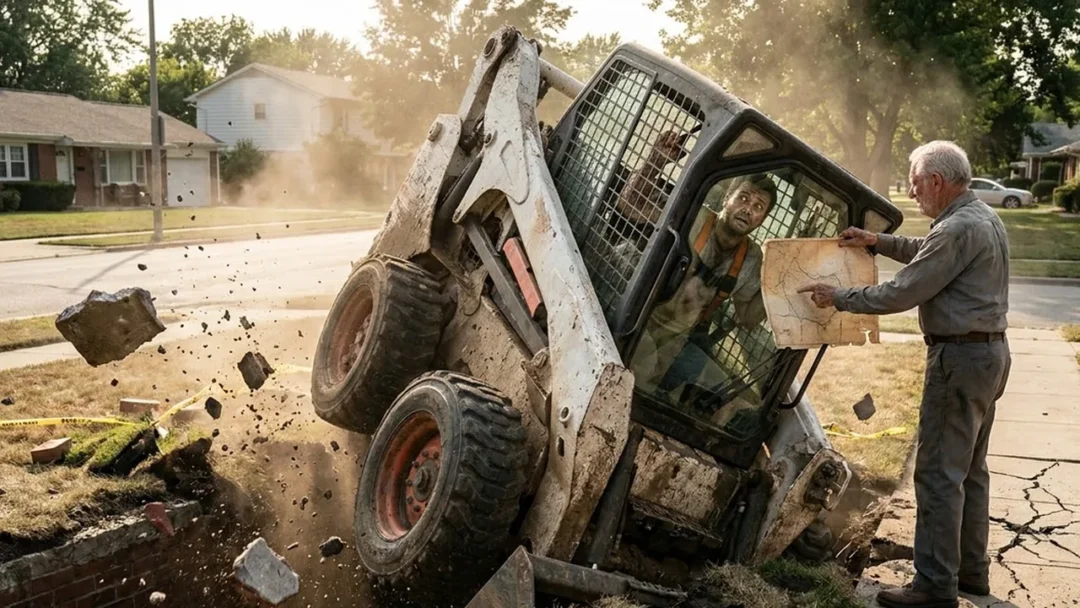
Brock Kowalski hung suspended sideways inside the steel safety cage, held only by the tight nylon webbing of his four-point chest harness. His boots were dangling in three feet of freezing, foul-smelling cistern water that was rapidly filling the lower footwell of the cab. His forehead throbbed with a sharp, burning pain where he had struck the mesh, and a thin trickle of blood was running into his left eyebrow.
He reached frantically for the hydraulic door release lever on the front glass door.
The heavy door would not budge.
Because the rear half of the machine was wedged tightly between the collapsed edges of the nineteenth-century brick walls, the loader’s tubular steel roll-cage had suffered slight torsional deflection, binding the door latch tightly in its frame. Worse, because the nose of the loader was tilted at a fifty-degree upward angle, the heavy armored glass door was facing the sky, requiring Brock to push the eighty-pound door straight up against gravity—an impossible feat from his awkward, suspended position.
Panic, cold and suffocating, seized Brock’s throat.
“Help!” Brock screamed, his voice cracking into a high-pitched, hysterical shriek that echoed off the damp brick walls of the pit. “Somebody get me out of here! The machine is sinking! I’m trapped!”
Through the mud-splattered glass canopy above him, a shadow crossed the light.
Tobias Miller walked deliberately across the intact section of the lawn, stepping with the practiced care of an old stonemason who knew exactly where the limestone shelf ended and the void began. He stopped at the edge of the collapsed pit, looking down into the twelve-foot-deep brick chamber.
Below him, the subterranean cistern was an architectural marvel of nineteenth-century engineering. The circular walls, laid in double-course red brick with hydraulic lime mortar, were twelve feet in diameter, curving upward into an elegant corbelled arch that had supported the soil for over a century until a five-ton machine had trampled it. The rear tracks of the Bobcat were wedged tightly against the submerged brick floor, surrounded by floating century-old barrel staves, rusted iron hoops, and thick black silt.
Tobias leaned down, holding the unfolded 1938 county surveyor’s map in both hands. He pressed the heavy linen document flat against the clear safety glass of the loader’s side canopy, right in front of Brock Kowalski’s terrified, blood-smeared face.
Centered on the linen map was a bold, hand-drawn red circle stamped with the county engineer’s official wax seal: “1890 RAINWATER CISTERN — CAPACITY 12,000 GALLONS — DO NOT BUILD OR EXCAVATE.”
Tobias tapped the glass with his weathered knuckle, his voice calm, clear, and perfectly audible through the steel mesh:
“You found it, Brock.”
Brock stared through the glass at the red wax seal, his eyes dilated with terror, his chest heaving with ragged sobs as the freezing cistern water rose another inch around his ankles.
From two miles down Valley Brook Lane, the low, pulsing wail of an approaching fire department rescue siren rose above the trees, growing louder with every second.
The corbelled brick arch of the 1890 cistern was an exceptional artifact of historical industrial masonry. Constructed by master masons who understood compressive arch geometry, each course of hand-struck red clay brick projected slightly inward from the tier below, forming a self-supporting dome that relied entirely on gravity and horizontal thrust to remain stable. For over a century, the dome had maintained equilibrium because the lateral earth pressure around the perimeter was perfectly balanced. But when the five-ton tracked loader punched through the center, it broke the keystones of the arch, leaving the remaining perimeter brickwork in an unstable, cantilevered state that threatened to crumble under the slightest disturbance.
Hanging trapped in the tilted cab, Brock Kowalski’s panic was intensified by the eerie acoustic resonance of the subterranean pit. The water surrounding the tracks was black, thick, and rancid, smelling of century-old stagnant decay, sulfur, and petroleum lubricants. Above him, through the cracked side window, the ancient brick corbels hung like jagged teeth, dripping with black slime. Every time Brock shifted his weight in the harness, the machine groaned, its steel belly pan scraping against the fractured bricks below, sending terrifying vibrations through the cab floor.