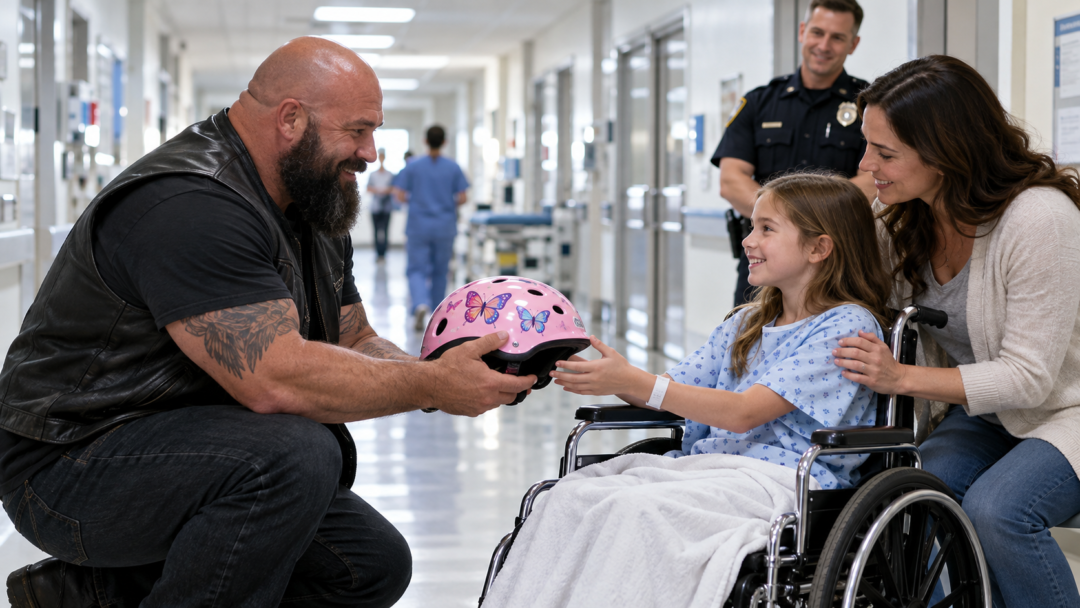
The Injured Little Girl In The Wheelchair And Her Rescuer
CHAPTER 1: THE MARCH DOWN CORRIDOR B
The sterile, high-gloss white linoleum tiles of Comal Memorial Hospital gleamed under the harsh glare of fluorescent ceiling tubes. The air was thick with the sharp, clinical scents of iodine, industrial floor bleach, and alcohol sanitizer. In Trauma Corridor B on the second floor, the rhythmic beep of distant heart monitors and the hurried footsteps of nursing staff in rubber-soled clogs created a tense, continuous hum.
Down the long, immaculate hallway, a heavy, echoing cadence shattered the quiet hospital atmosphere.
Thud. Thud. Thud.
Marching with the deliberate, unhurried stride of a soldier clearing a breach was Cole ‘Ironhead’ Briggs.
Cole was forty-seven years old, an imposing, broad-shouldered monolith of a man standing six feet three inches tall and weighing nearly two hundred and fifty pounds. His scalp was clean-shaven and tanned dark by decades under the Texas sun, his jaw dominated by a thick, midnight-black beard that framed a battle-scarred, square face. His forearms, thick as fence posts and corded with vascular muscle, were covered in faded Navy Seabee tattoos. Over a plain charcoal t-shirt, Cole wore a heavy, road-scuffed black leather cut bearing the three-piece rocker patches of the Iron Talons Motorcycle Club, with an embroidered silver patch reading ROAD CAPTAIN above his left pocket.
Cradled delicately in the crook of his massive, tattooed left arm, looking astonishingly frail against his scuffed leather armor, was a small pink child’s bicycle helmet adorned with glittery butterfly stickers. The left side of the plastic visor was blackened with soot, but the straps had been wiped clean.
Halfway down the corridor, stationed outside the trauma observation suite, Officer Ramirez looked up from his clipboard.
Ramirez was thirty-two years old, a municipal patrol officer with a crisp tan uniform and a defensive, cautious posture. Seeing the massive, leather-clad biker marching down the restricted hallway without an identification badge, Ramirez felt a spike of adrenaline. He dropped his clipboard onto the intake desk, stepped directly into the center of the corridor, and extended a stiff, open palm toward Cole’s chest.
His right hand dropped instinctively toward the retention holster of his service pistol.
‘Hold it right there, sir!’ Officer Ramirez barked in a sharp, authoritative command that caused two nurses at the medication cart to flinch. ‘This is a restricted pediatric trauma corridor. Visitors are not permitted past the double doors. You need to turn around and return to the main lobby immediately.’
Cole Briggs didn’t slow his stride until he stood four feet from the officer’s extended hand. The biker towered half a foot over the patrolman, his broad shoulders blocking out the fluorescent lights behind him.
Cole looked down at the officer, his deep-set hazel eyes burning with a cold, unyielding intensity that refused to surrender an inch of floor space. He didn’t raise his voice, but the deep rumble that resonated from his chest was thick with the weight of unbending purpose.
‘I’m here to see the little girl from the River Road wreck, Officer,’ Cole said, his gravelly baritone vibrating off the stainless-steel door frames. ‘I’m returning her helmet.’
‘I don’t care what you’re returning, sir,’ Ramirez said firmly, his fingers tightening against his holster strap. ‘We have an active criminal hit-and-run investigation involving that crash, and dispatch has issued an alert regarding suspicious persons in the area. I’m ordering you to step back to the elevators right now, or you will be placed under arrest for criminal trespass.’
Cole took a half-step closer, his heavy combat boots squeaking on the polished wax. The tension in Corridor B coiled like an overwound spring, so tight that the nurses at the station froze in breathless anticipation of violence.
Suddenly, the automated stainless-steel double doors of Pediatric Trauma Room Four slid open with a sharp, pneumatic hiss.
Rolling through the threshold, pushed by an anxious, tearful mother in her mid-thirties, was eight-year-old Piper Hayes.
The little girl looked tiny in the oversized hospital wheelchair. She wore a faded blue patient gown, a heavy white plaster cast immobilizing her fractured left forearm, and clean surgical butterfly bandages covering a jagged row of stitches across her right cheekbone and temple. Her eyes were red, swollen from hours of agonizing pain and terror.
The moment the wheelchair crossed the threshold, Piper’s gaze swept across the hallway.
Her eyes landed squarely on the towering bald biker in the leather cut holding the pink butterfly helmet.
Piper’s breath caught in her throat in a sharp, ecstatic gasp that shattered the sterile silence of the ward.
‘Stop! Mommy, stop!’ Piper shrieked, her high-pitched voice ringing down the corridor.
Before her mother or the officer could react, the little girl leaned forward in the wheelchair, ignoring the throbbing pain in her bandaged arm, and pointed an urgent, trembling index finger directly at Cole Briggs.
‘That’s him!’ Piper screamed through a fresh torrent of bursting tears. ‘Officer, don’t touch him! That’s him! He’s the one who pulled me out of the fire! He saved my life!’
Cole’s heavy boots continued their measured advance until his belt buckle was inches from the officer’s outstretched fingers. He had seen young men like Ramirez in the service—junior sentries following orders without understanding the tactical context, relying on procedure to hide their mounting uncertainty. But Cole had not survived twenty years of combat deployments and highway brotherhood to be turned away by a municipal badge when a promise to a child hung in the balance. The air in Corridor B felt suddenly charged, as if a summer squall had materialized inside the sterile hospital wing.