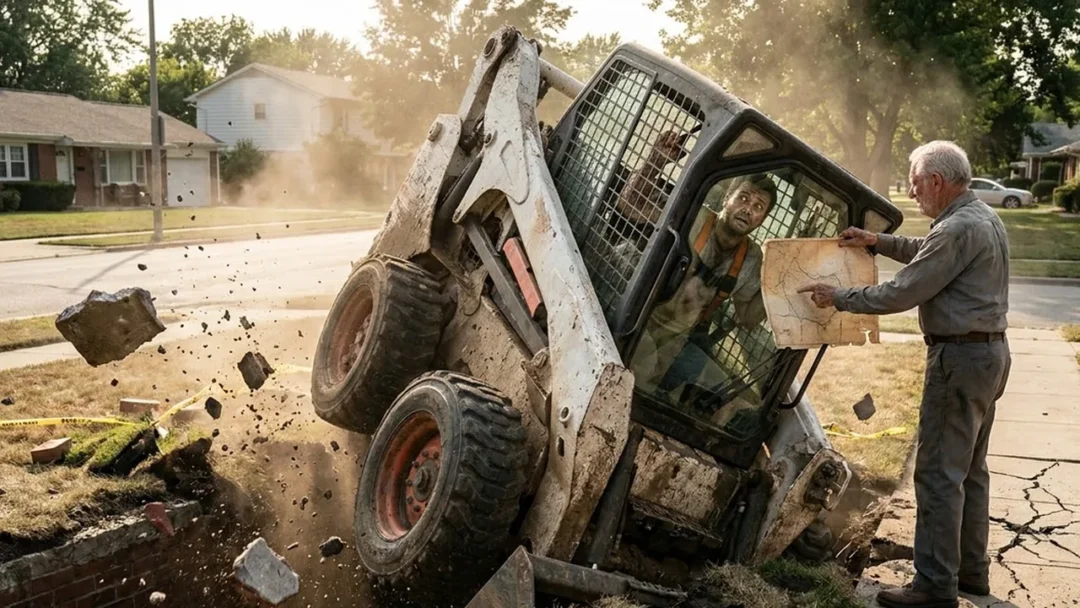
The Abandoned Rainwater Cistern And The Swallowed Skid Steer Loader
CHAPTER 6: THE FORENSIC LEDGER OF EUGENE STAUFFER
At sixty-one, Eugene Stauffer was the senior structural safety and geotechnical inspector for Lancaster County. He was a licensed professional engineer who carried himself with the quiet, formidable authority of a man who dealt exclusively in building codes, soil shear strengths, and municipal transit regulations. He walked over to where Chief Vance and Tobias Miller were standing at the edge of the shored pit, his eyes taking in the crushed red bricks, the shattered concrete cap, and the submerged loader.
“Eugene, glad you’re here,” Chief Vance said, wiping sweat from his forehead. “We have the vehicle stabilized, but the subterranean void is twelve feet deep and extends under the sidewalk. The entire corner is structurally compromised.”
Inspector Stauffer opened his binder, pulling out an official county GIS parcel map. “Mr. Kowalski,” Stauffer said, turning his stern gaze toward the shivering contractor wrapped in the foil blanket. “Did you submit a heavy equipment residential transit permit to the township before attempting to move a ten-thousand-pound tracked vehicle through Oakridge Estates?”
Brock swallowed hard, his voice trembling and weak. “No… I didn’t think I needed one. I was just taking a quick shortcut to the Henderson job site.”
“Under Lancaster County Municipal Code Chapter eighty-four, any commercial vehicle exceeding five tons operating off designated heavy-haul truck routes is required to obtain an approved route transit permit with certified axle-weight distribution analysis,” Stauffer stated with absolute clarity. “Furthermore, operating heavy construction equipment across private residential property without a certified boundary easement constitutes an active Class One violation of the Pennsylvania Building Safety Act.”
David Campbell walked over from his driveway, handing his smartphone to Inspector Stauffer. “Inspector, I recorded the entire incident from the moment he stopped his machine at the curb. The audio and video are timestamped.”
Inspector Stauffer watched the high-definition 4K playback.
The video captured Brock Kowalski sneering at Tobias Miller, the clear display of the 1938 survey map, and Brock’s explicit verbal declaration: “A brick well from the eighteen-hundreds? You’ve been watching too many ghost stories, Miller… I’m taking the shortcut!”
The recording then showed Brock deliberately dropping the eighty-four-inch steel bucket, pulverizing the red brick barrier, and accelerating onto the lawn until the ground collapsed.
Inspector Stauffer’s expression hardened into granite. “Thank you, Mr. Campbell. This recording constitutes undeniable evidence of willful, premeditated property destruction and reckless endangerment.”
Officer Rachel Hess of the Manheim Township Police Department stepped forward, holding a legal carbon-copy citation book. At thirty-nine, Officer Hess was a seasoned patrol officer with specialized certification in commercial vehicle enforcement and property crimes.
“Brock Kowalski,” Officer Hess said, her voice cutting through the autumn air with formal authority. “Stand up, please.”
Brock struggled to his feet, clutching the yellow foil blanket around his shoulders like a shroud.
“You are receiving an immediate criminal citation for Reckless Endangerment under Title Eighteen, Section twenty-seven-oh-five of the Pennsylvania Crimes Code,” Officer Hess announced, tearing off the yellow summons slip. “You are receiving a second citation for Criminal Mischief over five thousand dollars, which is classified as a third-degree felony due to the catastrophic destruction of structural property. And you are receiving three municipal code citations for illegal excavation, unpermitted commercial transit, and hazardous property trespass.”
Brock stared at the yellow citations, his hands shaking so violently the paper fluttered in the breeze. “Felony? But… it was an accident! My equipment insurance will cover the damage!”
“Your equipment insurance will not cover a single dime of this, Mr. Kowalski,” Inspector Stauffer interjected coldly. “And neither will your commercial liability policy.”
The administrative regulatory framework governing municipal right-of-way transit is designed specifically to prevent the destruction of public and private utility infrastructure. Under Pennsylvania Department of Transportation guidelines and local municipal ordinances, heavy construction equipment must be transported on specialized low-boy trailers equipped with proper weight distribution axles and safety chains. Bypassing designated transit routes to drive a ten-thousand-pound tracked machine across residential sidewalks and lawns is a severe statutory violation that bypasses every legal protection afforded to licensed contractors.
Inspector Eugene Stauffer’s digital terminal was connected directly to the county’s unified GIS infrastructure database. As he reviewed the site history, he noted that the corner of Valley Brook Lane sat directly above a shallow high-pressure gas distribution feeder line running parallel to the sidewalk barely ten feet from the cistern collapse. Had Brock Kowalski’s loader veered three yards further to the south, the concentrated track load would have severed the four-inch plastic gas main, triggering a catastrophic neighborhood explosion and an immediate emergency evacuation of three hundred residents. The gravity of Brock’s reckless shortcut was staggering in its potential for mass casualties.