The Counterfeit Homeowners Association Fine For The Colonial Blue Shutters
CHAPTER 1: THE BLUE ON THE PORCH
The midday autumn sun beat down through the fragrant canopy of mature longleaf pines in Wake County, North Carolina, casting crisp, geometric shadows across the pristine brick facades and manicured lawns of Whispering Pines. Established twelve years earlier as an elite master-planned enclave just outside the booming research and technology corridors of Raleigh, the neighborhood was an architectural showcase of grand Georgian and Federal-style brick colonials, expansive wraparound white porches, black hand-forged wrought-iron carriage lamps, and clipped English boxwood parterres. It was the kind of neighborhood where the manicured bermudagrass turf was measured with wooden calipers by retired corporate executives, where every exterior home modification required a six-page application supported by certified landscape architecture renderings, and where social standing was intimately tied to the unwavering preservation of strict community aesthetics.
Under the neighborhood’s recorded Master Declaration of Covenants, Conditions, and Restrictions—a hundred-and-forty-page legal covenant binding upon every deed—every square foot of visible exterior space was subject to the absolute architectural jurisdiction of the Homeowners Association. For over a decade, this rigid governance had successfully protected property values and insulated the quiet streets from visual clutter. But in recent months, under the creeping influence of new leadership, this orderly stewardship had curdled into an oppressive, suffocating regime of bureaucratic harassment. The neighborhood had become quiet in an unnatural, tense way. Neighbors who had once shared evening barbecues and weekend strolls now spoke in hushed, guarded tones over fence lines, constantly checking their mailboxes in dread of which minor aesthetic deviation might trigger an official reprimand, an unexpected fine, or a formal notice of legal action from the board.
David Sterling stood on the second rung of a heavy-duty aluminum stepladder positioned along the wide, covered front porch of his two-story red-brick colonial. David was forty-six years old, a senior forensic data architect and financial systems analyst who spent his professional working hours dissecting complex money-laundering networks, unauthorized electronic wire routings, and shell corporate structures for international banking conglomerates and federal regulatory authorities. Tall, composed, with observant steel-gray eyes, neatly parted dark hair, and the quiet, calculating demeanor of an experienced cryptographer, David wore a pair of broken-in denim jeans, a breathable cotton work shirt with rolled-up cuffs, and thin latex painting gloves. He was a man who believed in documentation, verifiable facts, cryptographic proofs, and mathematical certitude. In his world, emotional posturing was merely white noise; the only reality that mattered was the integrity of the underlying ledger.
Resting on a small cedar utility stool beside his ladder was an aluminum paint roller tray filled with a freshly stirred pool of vivid, velvety blue exterior acrylic latex paint. In his right hand, David held a premium two-inch angled sash brush, using delicate, practiced strokes to apply the final coat of satin trim to the louvered raised panels of his front window shutters. The color was a rich, elegant shade known in the historical architectural lexicon as Williamsburg Colonial Blue—a timeless, dignified hue developed in eighteenth-century Virginia that perfectly complemented the warm crimson tones of the kiln-fired Carolina brick and the bright white trim of the porch columns.
David had lived in Whispering Pines for seven years, respecting its rules while quietly observing its evolving power dynamics. Three weeks earlier, he had formally submitted a detailed Architectural Review Committee application, complete with manufacturer paint swatch cards, light-reflectance values, spectral color codes, and historical documentation, seeking approval to refresh his weathered, sun-bleached shutters. The application had been formally approved by the review committee, countersigned by the association property manager, stamped with the official embossed seal of the board, and returned to him with full, unconditional legal authorization.
The architecture of Whispering Pines had been conceived by renowned regional planners to evoke the stately plantations and colonial capitals of the American South. Every facade featured oversized double-hung sash windows, dental crown moldings, copper gutters that developed a soft verdigris patina with age, and slate-style architectural shingles. To ensure that this visual pedigree remained untarnished, the initial developer had drafted covenants that prohibited exterior clotheslines, visible trash receptacles, unapproved storm doors, and deviations in driveway paver patterns. For nearly a decade, this covenant structure functioned with admirable restraint under the guidance of retired jurists and civic leaders who understood that community rules were intended to foster neighborly harmony, not to serve as instruments of petty tyranny.
However, when the original developer relinquished control of the homeowners association and turned governance over to the residents, a subtle yet destructive shift occurred. Garrett Ross had campaigned aggressively for the board, promising fiscal discipline and aggressive property value enhancement. Once elected as treasurer, Garrett quickly formed an unholy alliance with compliant committee members, gradually concentrating administrative enforcement within his personal purview. He argued that routine visual violations required immediate, decisive intervention rather than prolonged committee hearings. In doing so, he laid the groundwork for an unchecked personal fiefdom, utilizing intimidation and legal threats to silence dissent while engineering an extortion scheme disguised as architectural compliance.
The historical significance of colonial blue dated back to the mid-eighteenth century, when indigo dyes imported from the coastal lowlands of South Carolina and Georgia were prized by master builders for exterior woodwork. In colonial Williamsburg, Alexandria, and Charleston, the vibrant pigment was considered a hallmark of architectural refinement, chosen by prominent civic leaders to adorn pediments, raised-panel entrance doors, and operable louvered shutters. David had spent hours reviewing regional architectural archives, selecting a specialized historical preservation formulation manufactured by a certified heritage paint purveyor. The paint contained micro-ground mineral pigments and high-solids acrylic resins designed to withstand the harsh humidity and intense ultraviolet exposure of North Carolina summers without fading or chalking. Every brush stroke applied that morning was an homage to historical authenticity, executed with the patience of an artisan who respected traditional American craftsmanship.
Yet as David carefully laid down a smooth brush stroke along the center stile of the upper shutter, the quiet afternoon was punctured by the aggressive slam of a car door down at the curb.
Walking briskly up the herringbone brick walkway was Garrett Ross. Garrett was forty-three years old, the self-appointed treasurer of the Whispering Pines Homeowners Association and an aggressive commercial real estate speculator who treated the neighborhood like his personal feudal estate. Dressed in a tailored charcoal pinstripe suit vest over a stiff French-cuffed dress shirt, sharply creased slacks, and handmade Italian leather dress loafers buffed to a mirror finish, Garrett projected an aura of unearned authority and theatrical self-importance. In his left hand, he clutched a heavy, leather-bound municipal citation binder; in his right, he waved a laminated, full-color document printed with bold red borders and official-looking crests.
Garrett had spent the last two years systematically consolidating power within the neighborhood association, muscling aside milder board members and positioning himself as the sole enforcer of architectural purity. To Garrett, community rules were not safeguards for mutual enjoyment; they were levers of intimidation, tools to generate compliance and extract unearned leverage from his neighbors.
“Sterling!” Garrett shouted as his leather soles clattered loudly across the wooden porch stairs. “Put that brush down right now! Cease and desist! Step down off that ladder immediately!”
David did not drop the brush. He finished his stroke with deliberate precision, rested the brush across the grooved rim of the metal paint tray, and stepped down from the stepladder onto the polished white deck boards. He peeled off his latex gloves, placed them on the utility stool, and turned to face the agitated treasurer with an expression of calm, measured curiosity.
“Good afternoon, Garrett,” David said, his voice quiet, steady, and devoid of any emotional hostility. “It’s a pleasant day. What seems to be the emergency?”
“The emergency is that you are actively vandalizing the historical aesthetic harmony of this entire cul-de-sac!” Garrett bellowed, his face turning an angry shade of beet red as he jabbed a manicured index finger toward the freshly painted colonial-blue shutters. “Look at that garish, clownish blue! It looks like a beach shack in the Outer Banks! The Whispering Pines Architectural Guidelines clearly restrict exterior accents to approved historical neutrals: Charleston Green, Essex Black, and Heritage Cream! You are in direct, willful contempt of Section Seven of the Master Declaration!”
“Garrett, Williamsburg Colonial Blue is an officially designated historic colonial palette color,” David replied calmly, pointing toward the documentation folder resting on a nearby wicker porch table. “I submitted a formal modification petition to the Architectural Review Committee on the fourth of this month. Property management approved the color, stamped the application, and filed it in the registry.”
“The management company works for the board, Sterling, and I am the treasurer of the board!” Garrett snarled, stepping within three feet of David and thrusting the laminated document directly in front of his face.
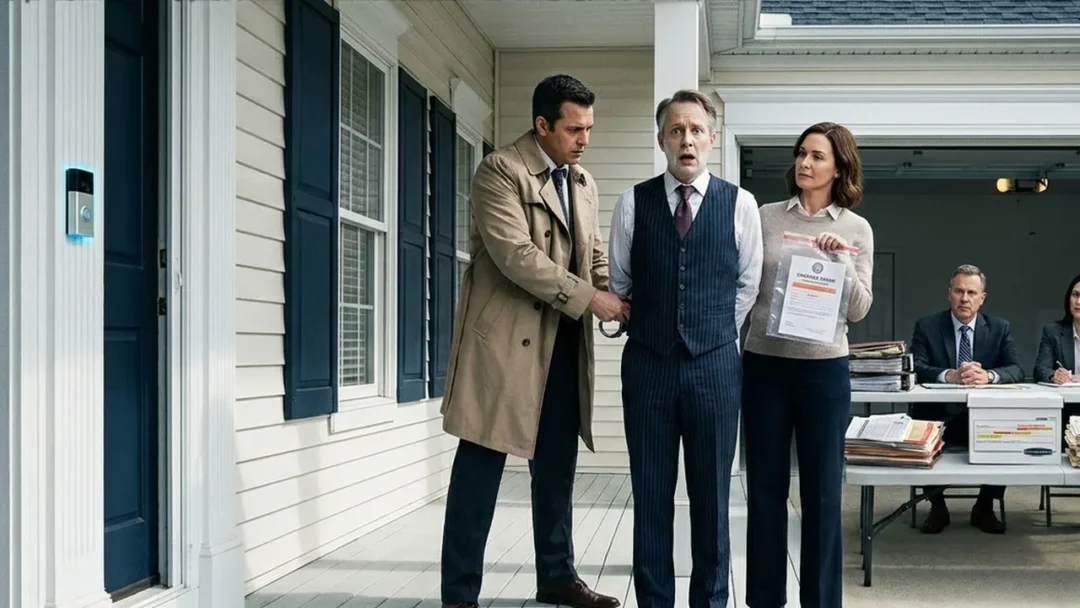
The document was titled: EMERGENCY ARCHITECTURAL INJUNCTION & SUMMARY FINE. In the center of the sheet was a prominent, high-density black-and-white QR code, beneath which was printed: DIRECT ADMINISTRATIVE PENALTY PAYMENT PORTAL — RE: AESTHETIC COMPLIANCE LLC.
Garrett tapped his diamond pinky ring against the laminated code with a sharp, demanding click.
“Two thousand dollars to this account today—or I lien your house tomorrow.”