The Poisoned Heritage Oak Tree Along The Suburban Boundary Driveway
CHAPTER 1: THE SHADOW OF THE WHITE OAK
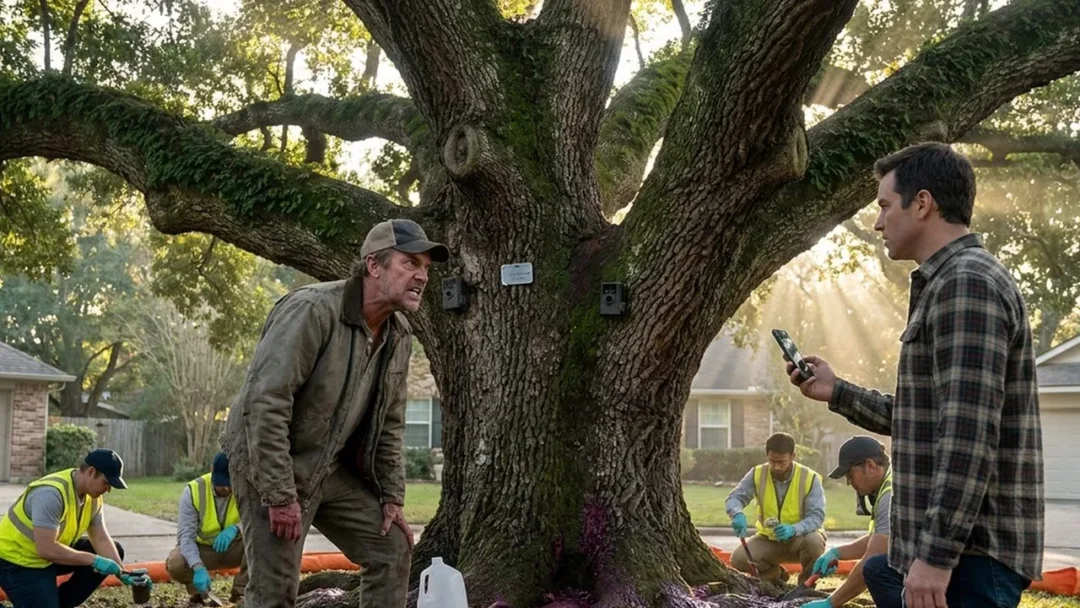
The crisp October morning air across the rolling wooded hills of Chester County, Pennsylvania, was filled with the sharp, earthy scent of damp fallen leaves, rich forest humus, and wood smoke drifting lazily from historic stone chimneys. Nestled along the meandering country lanes of Oakwood Estates, the residential properties were defined by deep half-acre parcels, historic fieldstone manor houses, and mature native hardwood canopies that had stood undisturbed since before the American Civil War. Dominating the boundary line between two sprawling stone colonials was an enormous, magnificent specimen of a northern white oak—Quercus alba—whose majestic crown soared more than eighty-five feet into the autumn sky, casting a broad, protective canopy of golden-amber boughs over the adjacent yards.
The ancient tree’s trunk was an awe-inspiring pillar of living botanical history, measuring nearly five feet in diameter with deep, furrowed ash-gray bark that twisted in muscular spirals. Its massive lower buttress roots surged outward from the root flare like the sinewy fingers of a slumbering titan, anchoring the eighty-ton hardwood into the fertile Pennsylvania clay before slipping beneath a thick carpet of emerald moss and native forest loam. Affixed to the northern face of the trunk, seated firmly into the bark at eye level with an anti-girdling bronze expansion nail, was an official municipal round medallion: a silver-plated heritage tree tag embossed with the municipal seal of Chester County and the registration designation: CHESTER COUNTY HISTORIC FLORA REGISTRY — SPECIMEN #HO-1864 — PROTECTED HERITAGE LANDMARK.
Arthur Pendelton stood beneath the sprawling golden-amber canopy, wearing a faded flannel work shirt, a heavy fleece vest, and broken-in leather work gloves. Arthur was fifty-eight years old, a retired botanical researcher who had spent three decades working with the state forestry extension service before devoting his retirement to custom artisanal furniture making and historic tree conservation. Beside him sat a neatly stacked cord of seasoned sugar maple firewood, his splitting maul resting against a heavy cedar chopping block. Arthur loved the majestic white oak with the quiet reverence of a man who understood tree biology from the inside out; the tree had provided shade, structural wind protection, soil stabilization, and nesting habitat for red-tailed hawks and screech owls since his grandfather had first purchased the wooded parcel in the late nineteen-forties. Over eight decades, three generations of Pendeltons had climbed its massive lower scaffold limbs, read books beneath its tranquil shade, and watched the seasons turn through its changing leaves.
On the other side of the surveyed property boundary, however, a loud, high-pitched mechanical shriek shattered the peaceful woodland silence, sending jays and sparrows scattering in all directions.
Dennis Vance, a forty-four-year-old corporate logistics director with a shaved head, wraparound sports sunglasses, and an athletic fleece jacket, was marching up and down his newly resurfaced exposed-aggregate concrete driveway brandishing an industrial-grade backpack leaf blower. Dennis was a man possessed by an obsessive, pathological need for sterile suburban order. To Dennis, nature was an untamed adversary—an unpredictable nuisance that existed solely to deposit organic filth, pollen, and debris across his meticulously manicured property. His driveway was a polished expanse of sealed quartz aggregate, upon which sat his ultimate status symbol: a brand-new, metallic-charcoal Porsche Cayenne GTS that Dennis washed and hand-waxed with imported carnauba paste every single Wednesday and Saturday morning without fail.
For the past three weeks, the ancient white oak had been undergoing its natural triennial mast year—a prolific biological reproductive cycle during which the mature canopy dropped thousands of plump, brown acorns onto the surrounding ground to ensure the propagation of the species. While dozens of gray squirrels and chipmunks harvested the protein-rich bounty across Arthur’s lawn, several hundred acorns had bounced off the overhanging branches and landed across Dennis’s polished driveway. To Dennis, every falling nut was an intolerable personal insult, an airborne projectile capable of leaving a microscopic smudge or clear-coat scuff on his ceramic-coated luxury SUV.
Dennis killed the leaf blower’s throttle with a violent flick of his thumb. The screaming two-stroke motor died down into an idling sputter, and Dennis ripped off his plastic safety glasses, glaring across the surveyor’s wooden boundary stakes at Arthur with veins bulging along his neck.
“Pendelton!” Dennis barked, his face flushed red with physical exertion and simmering hostility. “Get over here right now! Look at this mess! Just look at it!”
Arthur placed his work gloves on the firewood stack, walked slowly across his lawn, and stopped two feet behind the bright orange surveyor’s flags that clearly marked the surveyed property line.
“Good morning, Dennis,” Arthur said calmly, his voice steady and polite. “It’s a beautiful crisp morning. How can I help you?”
“Don’t give me that calm folksy routine, Arthur!” Dennis shouted, pointing his leaf blower nozzle toward the driveway like a weapon. “I spent twelve thousand dollars having this quartz aggregate resurfaced and sealed with industrial urethane last month! Look at the glossy finish—or what’s left of it! For the last three weeks, your damn overgrown weed has been raining hard-shelled biological garbage all over my cars! Yesterday, an acorn bounced off my hood at twenty miles an hour and nearly chipped the custom ceramic clear coat! My wife can’t even walk to her car in heels without rolling her ankle on these damn nuts! It’s a continuous, unmitigated nuisance, and I refuse to tolerate it on my property!”
“Dennis, white oaks undergo mast seeding every three to five years,” Arthur replied patiently, gesturing gently to the towering, wind-rustled branches above. “It is an ancient biological rhythm that lasts approximately three weeks in mid-autumn, feeding local fauna and naturally renewing the hardwood canopy. I understand that organic debris can be frustrating when you desire a sterile surface, which is why I’ve already offered to come over every single evening with my rolling rubber-tined acorn collector and clear your driveway myself at no charge to you.”
“I don’t want you on my driveway with a metal rake, I don’t want your charity, and I don’t want your damn nuts!” Dennis snarled, stepping directly to the surveyed boundary line, his eyes bulging with irrational, hyper-fixated fury. “I want that hazard eradicated! It blocks my morning sunlight, drops sap on my hedges, and clogs my gutters every November! I had a commercial tree removal service quote me four thousand dollars to drop it with cranes, chip the timber, and grind the stump two feet beneath grade! I told you last week to split the bill with me like a civilized neighbor, and you refused!”
“I refused because the tree is one hundred percent healthy, structurally sound, and legally designated as a registered municipal heritage landmark,” Arthur said firmly, his eyes unwavering. “That tree was a sapling when Abraham Lincoln gave the Gettysburg Address. It survived the Great Blizzard of 1888 and Hurricane Hazel. It has stood on this ridge long before our subdivision was mapped, and it will be standing here long after both of us are gone. It stays exactly where it is.”
Dennis’s hands shook with violent, uncontrollable rage. He leaned across the boundary line, his face inches from Arthur’s, his voice dropping into a sinister, venomous hiss.
“Your tree litters my driveway. If you won’t cut it down, I’ll kill it.”