The Luxury Sedans Blocking The Fire Hydrant At The Yacht Party
CHAPTER 1: THE BARRICADE AT BEACON POINT
The late Saturday morning sun burned through the clinging coastal marine layer over Newport Harbor, bathing the secluded hillside cul-de-sac of Beacon Point in blinding, crystalline California light. Perched high along the dry, scrub-covered coastal bluffs of Orange County, the narrow dead-end asphalt street was one of the most exclusive and geographically precarious enclaves in the region. Comprising five expansive contemporary custom estates, the neighborhood was defined by whitewashed stucco facades, polished floor-to-ceiling glass balconies, cantilevered infinity decks, and meticulously sculpted drought-tolerant agave gardens that swept downward toward the shimmering blue expanse of the Pacific Ocean. Because Beacon Point sat within a designated high-severity wildland-urban interface fire zone, the road itself was narrow—barely twenty-six feet of passable asphalt width terminating in a tight turning radius designed strictly to accommodate emergency municipal service vehicles.
At the very terminus of the cul-de-sac sat two adjacent properties that presented a study in stark architectural and philosophical contrast. On the left sat an immaculate, single-story mid-century modern home constructed from natural fieldstone, polished cedar siding, and sandblasted glass, flanked by an attached two-car garage. It belonged to Marcus Vance. On the right, dominating the ridge with aggressive vertical scale, sat an eight-thousand-square-foot ultra-modern cubic mansion clad in imported Italian porcelain panels and stainless steel, currently leased by Julian Mercer.
Marcus Vance was fifty-two years old, a retired civil engineer who had spent twenty-eight dedicated years overseeing water distribution networks, hydraulic conveyance lines, and high-pressure emergency infrastructure for the Orange County Public Works Department. Tall, lean, with neatly trimmed steel-gray hair and calm, observant hazel eyes, Marcus carried the quiet, methodical discipline of a professional who measured life in exact mechanical tolerances, static flow pressures, and legally binding municipal easements. He possessed an intimate, granular knowledge of the subterranean utilities that kept the affluent coastal bluffs from collapsing into the sea, and he respected the delicate balance between civil safety and suburban comfort. Wearing a faded blue chambray work shirt with rolled-up sleeves, dark canvas work trousers, and broken-in Red Wing leather boots, Marcus stood inside his pristine garage workshop, finishing his second cup of black coffee while preparing to back his meticulously maintained 1998 Toyota Land Cruiser down the driveway to attend a scheduled regional disaster-preparedness committee conference in Irvine.
When Marcus reached for the wall-mounted commercial keypad and pressed the toggle switch, the heavy cedar-slat garage door rolled smoothly upward along its greased ceiling tracks. Marcus took two steps toward his truck, then stopped dead in his tracks, his hazel eyes narrowing as the view beyond the threshold came into sharp focus.
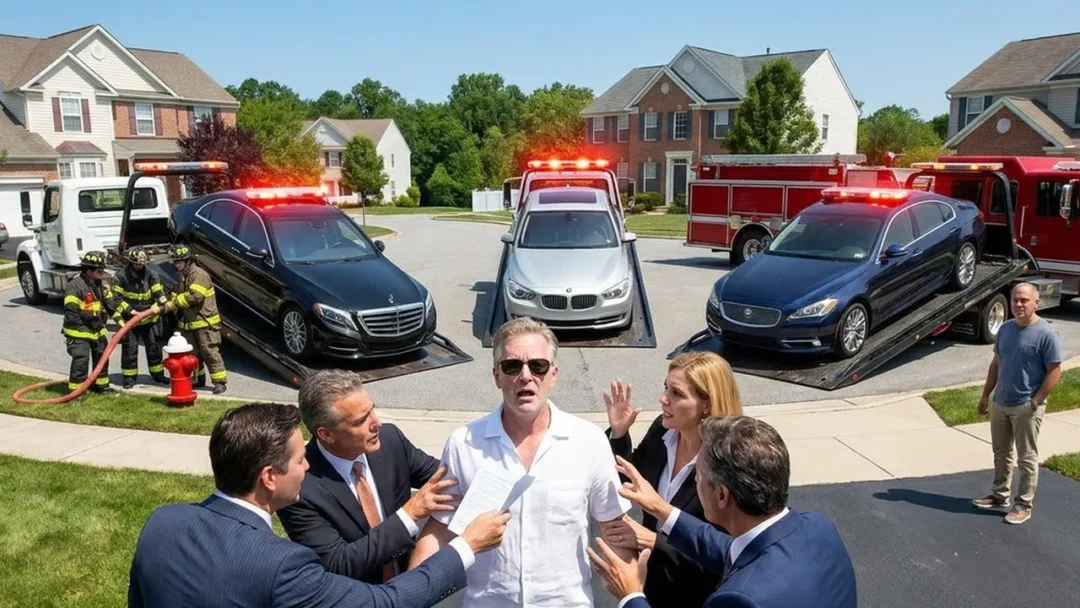
Directly across the wide aggregate concrete apron of his private driveway, completely sealing him off from the roadway, were three pristine European luxury automobiles parked nose-to-tail in an impenetrable, defiant metallic barricade.
The lead vehicle was a two-hundred-thousand-dollar Mercedes-AMG S63 sedan finished in glistening obsidian black metallic paint. It sat angled sharply across the dropped concrete apron, its flared rear wheel arch and chrome quad-exhaust tips protruding four feet into Marcus’s marked private right-of-way, slicing his exit angle in half. Tightly tucked behind the Mercedes’s rear bumper, with barely four inches of clearance between their carbon-fiber trim pieces, was a chalk-gray Porsche Panamera Turbo. The driver of the Porsche had not even bothered to align the car with the curb; instead, its passenger-side low-profile Michelin Pilot Sport tires were resting brazenly across Marcus’s manicured Saint Augustine turf, crushing an entire perimeter line of hand-cast brass low-voltage landscape lighting fixtures into the damp soil.
The third automobile was the most flagrant, dangerous violation of all. A matte-frozen-blue BMW M8 Competition coupe was parked flush against the curb on the southern radius of Marcus’s driveway apron. Its massive twenty-inch rear Michelin tire was jammed violently against the curb face, centered squarely in front of a heavy cast-iron municipal fire hydrant. The hydrant was a specialized Mueller Super Centurion high-pressure urban unit, painted brilliant safety red with an industrial-grade reflective yellow bonnet indicating direct connection to the regional hilltop water reservoir. The asphalt curb beneath the German coupe had been stenciled by the city works department with six-inch white reflective block lettering over bright red safety enamel: “FIRE HYDRANT — NO PARKING — MINIMUM 15 FT CLEARANCE.”
Yet the BMW’s owner had parked with such callous disregard for public safety that the car’s aggressive front carbon-fiber air splitter was resting less than two inches from the hydrant’s primary four-and-a-half-inch front steamer nozzle, completely boxing in the brass discharge cap and making it physically impossible to thread a standard fire-engine suction hose onto the threads.
From the expansive travertine terrace of the neighboring modern mansion, the thumping bass of tropical deep house music pulsed through the warm coastal air, reverberating against the glass panels of Marcus’s home. Over fifty guests in high-end nautical resort attire—men in tailored linen trousers, cream cashmere sweaters tied casually over sun-tanned shoulders, and gold-trimmed yachting caps, alongside women in pastel silk sundresses and oversized designer sunglasses—mingled around a three-tier infinity swimming pool holding crystal flutes of vintage champagne. Caterers in white linen jackets moved among the crowd carrying silver trays loaded with raw oysters, beluga caviar tartlets, and chilled artisanal cocktails.
Standing near the perimeter glass railing at the edge of the lawn, holding an oversized acrylic tumbler filled with premium botanical gin, fresh mint, and craft tonic, was Julian Mercer. Julian was thirty-nine years old, the founder of a boutique yacht charter brokerage operating out of Newport Harbor, with slicked-back dark hair, porcelain-veneered teeth, a tailored white linen sport coat, and Italian leather boat shoes worn without socks. He had spent the last six months aggressively marketing himself as the rising star of the coastal social scene, desperate to secure an elusive board membership at the historic Balboa Yacht Club.
Marcus stepped out of his garage, walking down the smooth aggregate surface of his driveway with steady, deliberate strides. He stopped three feet short of the chalk-gray Porsche, folded his arms across his chest, and looked across the glossy painted hood toward Julian, who was grinning smugly at the sight of his neighbor’s trapped vehicle.
“Good morning, Julian,” Marcus said, his voice quiet, calm, and perfectly carrying through the ambient pulse of the music. “Your party guests have blocked my garage exit completely, and that blue coupe on the end has parked directly over the municipal fire plug. I have an important municipal disaster briefing in Irvine at noon. I need these three vehicles moved off my apron and away from the hydrant immediately.”
Julian threw his head back and let out a sharp, theatrical bark of laughter that drew the amused attention of three nearby guests standing beside a teak champagne ice bucket. He took a long, exaggerated sip from his tumbler, swirled the ice cubes with a clatter of acrylic, and stepped across the boundary line onto the edge of Marcus’s stone walkway with an insolent, condescending sneer.
“Is that right, Marcus?” Julian said, his voice dripping with theatrical mockery. “You have an important little city meeting? Well, take a good look around you, my friend. This is the official Newport Regatta Kickoff Gala. Those three cars belong to some of the most influential venture capital partners, commercial developers, and private equity managers in Southern California. The valet team had to stack cars because my private motor court was completely filled twenty minutes ago, and I personally instructed them to park along this curb.”
“Julian, you have no legal authority to authorize parking on public rights-of-way, let alone across a private citizen’s driveway apron,” Marcus replied without a trace of irritation. “And far more importantly, that red curb is a dedicated high-pressure municipal fire easement. It is a severe misdemeanor and a dangerous fire hazard to obstruct that hydrant for even five minutes in this canyon.”
Julian took two aggressive steps forward, jabbing a manicured finger within inches of Marcus’s face.
“Listen to me very carefully, old man,” Julian sneered, his breath hot with alcohol. “My guests park wherever I say. Stay in your garage until the party ends.”
Marcus did not flinch, nor did his expression waver. But as the silence hung heavy between them, a deep, rhythmic mechanical rumble began to vibrate through the bedrock beneath their feet, echoing from the base of the canyon road.