The Poisoned Heritage Oak Tree Along The Suburban Boundary Driveway
CHAPTER 7: THE CHARCOAL SHIELD
While Officer Briggs completed the criminal citations on the driveway, Dr. Evelyn Reed and Tyler Collins executed their rapid-response chemical neutralization protocol with clinical precision.
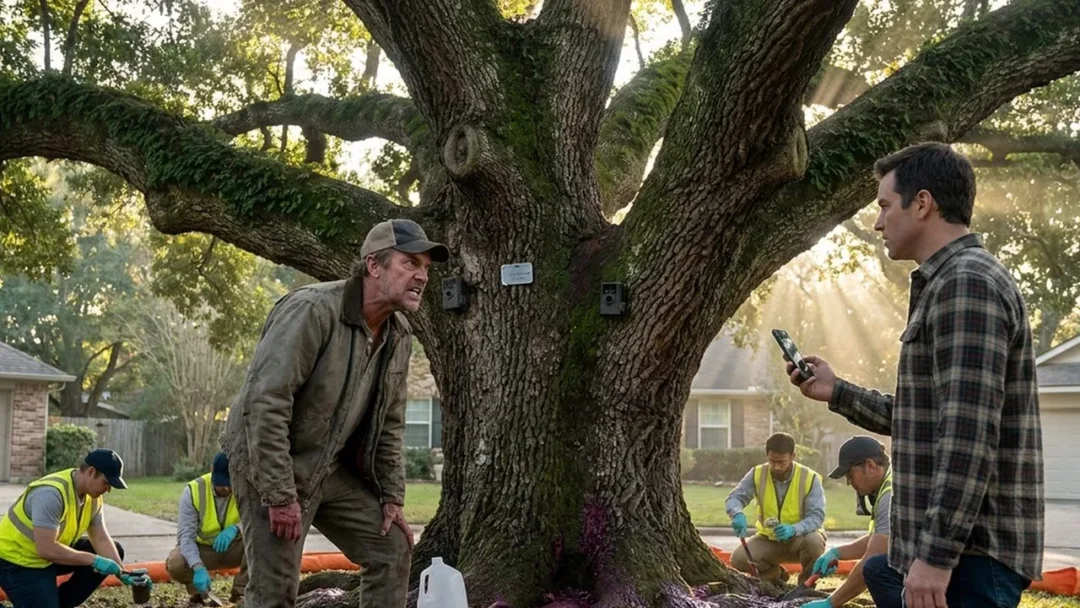
Tyler fired up the specialized auxiliary hydraulic pump inside the GreenShield remediation van. Working swiftly, the crew rolled out two fifty-foot sections of high-pressure chemical transfer hose. Tyler clamped a stainless-steel injection lance into the quick-connect fitting, while Dr. Reed prepared a three-hundred-gallon baffled mixing tank filled with a specialized, proprietary botanical slurry: activated horticultural biochar, pulverized humic acids, agricultural liquid carbon, and liquid calcium polysulfide.
“Activated biochar possesses an immense internal surface area—over five hundred square meters per gram,” Dr. Reed explained aloud as she calibrated the injection pressure. “When injected at ninety pounds per square inch directly into the root zone, the porous carbon particles adsorb the triclopyr ester molecules before they can cross the semi-permeable membranes of the mycorrhizal root hairs and enter the vascular cambium.”
With rhythmic, mechanical precision, Tyler drove the hardened stainless-steel injection probe eighteen inches into the soil surrounding the perimeter of the white oak’s root flare. Working in a meticulous radial grid pattern, he penetrated the soil every twelve inches along the drip line. Every time the tip reached the feeder root stratum, he squeezed the pneumatic trigger on the metering manifold.
THWUMP-HISS! THWUMP-HISS!
The hydraulic pump whined under high mechanical load as hundreds of gallons of dark, viscous biochar suspension were forced through the lateral soil fissures under ninety pounds per square inch of hydrostatic pressure. The microscopic carbon pores acted like millions of molecular magnets, attracting the hydrophobic pyridine rings of the triclopyr molecules and binding them irreversibly through physical chemisorption before they could penetrate the cambial layer. Tyler pulled repeated soil core samples with a hollow brass auger, inspecting the dark core layers under a portable ultraviolet field light to ensure complete subsurface saturation around every major taproot. Deep underground, hundreds of gallons of jet-black activated carbon slurry surged through the saturated loam, creating an impenetrable chemical barrier that bonded with the toxic purple herbicide, neutralizing its systemic herbicidal potency on contact. Next, the team erected a heavy, high-visibility orange containment barrier completely surrounding the four-hundred-square-foot root zone, staking warning placards that read: HAZARDOUS BOTANICAL REMEDIATION ZONE — AUTHORIZED PERSONNEL ONLY.
The front door of Dennis Vance’s luxury stone home flew open, and his wife, Karen, hurried down the aggregate driveway wearing a designer sweater and house slippers. Her eyes were red-rimmed and frantic as she took in the scene: the hazardous materials van, the containment fencing, the police cruiser, and her husband sitting on the front bumper of his Porsche with his head buried in his hands.
“Dennis, what have you done?” Karen cried out, her voice trembling as she approached the driveway. “The law firm just called my cell phone! They said our deed is being encumbered by an emergency lis pendens lien! What is going on?”
Dennis looked up, his face hollow, gaunt, and completely shattered. “Karen… I tried to kill the oak tree.”
Officer Raymond Briggs stepped forward, tearing three carbon-copy citation slips from his clipboard and handing them directly to Dennis, who accepted them with trembling, limp fingers.
“Here are your mandatory criminal court summonses, Mr. Vance,” Officer Briggs said firmly. “Court appearance is scheduled for next Thursday at the Chester County Municipal Courtroom. Do not miss it.”
Dr. Evelyn Reed stepped beside the officer, holding an official, itemized emergency remediation invoice generated by GreenShield Ecological Services. She handed the clipboard to Dennis.
“This is the preliminary invoice for emergency hazmat containment, soil vacuum extraction, activated biochar subsurface injection, and continuous chromatographic laboratory monitoring for the next ninety days,” Dr. Reed said calmly. “The total current balance is fourteen thousand six hundred and eighty dollars, due within thirty calendar days. Failure to pay will result in an immediate contractor’s mechanic lien filed against your residential title.”
Karen let out a strangled sob, covering her face with her hands, while Dennis stared blankly at the five-figure sum, his world collapsing around him in a tidal wave of self-inflicted financial ruin.