The Beeping Heart Beneath The Leather: The St. Louis Cartel Trial Exposed
CHAPTER 1: THE CODE RED IN AISLE 4
The fluorescent lighting inside the Central West End supermarket hummed with a sterile, flickering vibration that made the eyes ache. Outside the double automatic glass doors, a sleet storm was rolling off the Mississippi River, coating the parked sedans on Lindell Boulevard in a skin of grey river ice. Inside the brightly lit pharmacy aisle, the air smelled of floor disinfectant, ground coffee, and the faint, sweet chemical scent of cough syrup.
Hank “Grizzly” Kowalski was leaning heavily against the handle of a chrome wire shopping cart.
At forty-eight, the road captain of the Iron Disciples stood six feet four inches tall, a mountain of dense, two-hundred-and-eighty-pound muscle. His shaved bald skull was covered in faded blue nautical ink, his thick beard graying at the jaw, his scarred arms mapped with tactical tattoos from his service with the combat engineers. He wore heavy denim trousers, scuffed combat boots, and his black leather club vest zipped over a dark thermal shirt.
Inside the shopping cart lay three items: a box of oatmeal, a bottle of electrolyte water, and a ten-pound sack of ice.
Suddenly, Hank’s knees buckled.
A sharp, searing spike of white-hot agony tore through the center of his sternum, as if an iron railroad spike had been driven straight between his ribs. His massive tattooed hands flew to his chest, his fingers digging into the heavy steerhide leather of his cut, his breath tearing from his throat in a choked, agonized gasp.
From beneath the left lapel of his leather vest, a high-pitched, rhythmic electronic alarm began to pulse:
Beep… beep… beep…
Hank stumbled sideways, his heavy shoulder slamming into the metal shelves of the analgesics section, sending dozens of plastic bottles clattering across the polished white linoleum.
Ten feet away, examining a box of herbal peppermint tea, stood Dr. Evelyn Mercer.
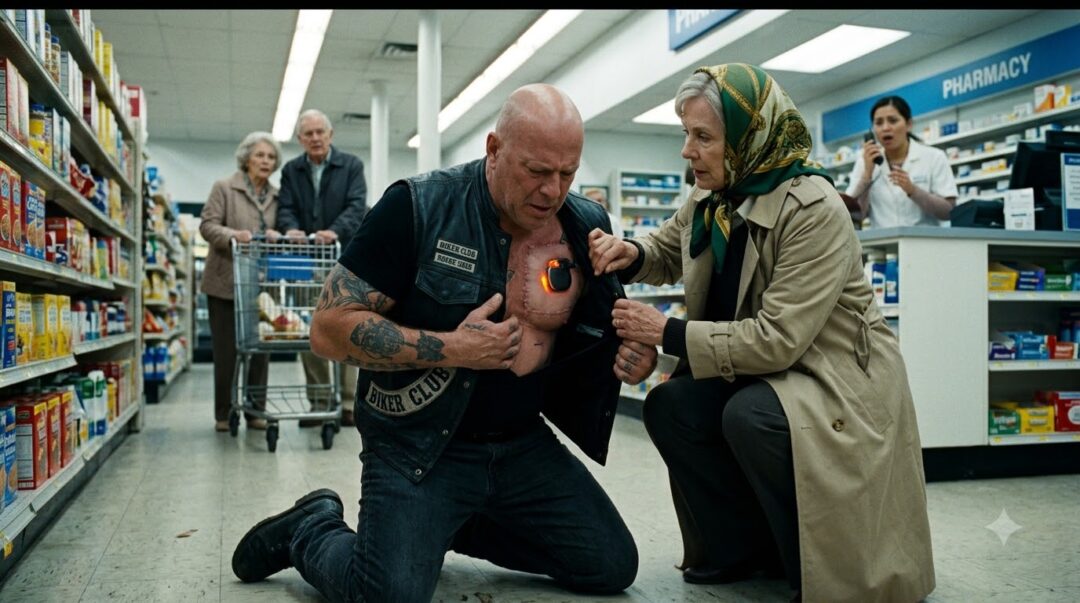
At seventy-one, the retired chief of thoracic trauma surgery at Barnes-Jewish Hospital was petite, dignified, and possessed an eye that could spot arterial failure from across a football stadium. She wore a tailored beige wool trench coat, leather driving gloves, and an emerald-green patterned silk headscarf tied neatly beneath her chin.
The moment the electronic alarm sounded, Evelyn’s head snapped around.
She did not flinch from the massive, tattooed biker writhing in pain. She dropped her tea box, stepped across the scattered pill bottles with brisk, clinical strides, and reached directly for the zipper of Hank’s leather vest.
Hank’s right hand shot out with instinctive, defensive violence, his thick fingers clamping around Evelyn’s wrist with enough force to bruise.
“Ma’am… don’t…” Hank wheezed, cold sweat pouring down his pale face, his jaw clenched so hard his teeth clicked. “I’m fine… just… indigestion…”
Evelyn didn’t pull her arm away. She looked straight up into his bloodshot eyes with an unshakeable, commanding authority that had silenced screaming surgical residents for forty years.
“You aren’t having indigestion, young man,” Evelyn said, her voice like steel wrapped in silk. “How long has that monitor been beeping at ninety cycles a minute?”
Hank’s fingers weakened, slipping from her wrist.
Evelyn reached forward, unzipping his heavy leather vest and yanking open the front of his thermal shirt.
The two pharmacy clerks and three surrounding shoppers gasped in collective, horrified shock.
Running down the center of Hank’s massive chest was a fresh, angry ten-inch sternotomy incision closed with heavy titanium surgical staples. Mounted over his left ribcage, sutured directly through the skin with braided Dacron anchors, was a compact black polymer electronic controller the size of a cigarette pack.
The unit was flashing a violent, rhythmic amber-and-red LED warning strobe, accompanied by the rapid electronic chime:
ERROR: LOW PERFUSION INDEX — MECHANICAL IMPELLER ROTOR STALL.
Evelyn leaned down, her gloved fingers pressing firmly against Hank’s carotid artery.
There was no pulse.
Not a weak pulse; there was absolutely no physiological cardiac pulsation whatsoever. Instead, beneath the tattooed skin of his neck, she felt only the continuous, high-rpm whir of an axial-flow centrifugal mechanical blood pump.
“He’s running on an LVAD,” Evelyn shouted, her voice cutting through the supermarket like a siren. “You! In the blue bandana! Call 911 right now! Tell the dispatcher you have a code-red mechanical ventricular assist device failure! We need an emergency thoracotomy tray and a specialized titanium programmer at this location in under four minutes!”
Hank’s eyes rolled back into his head. His massive frame shuddered as his legs completely gave out.
He crashed heavily to his knees on the linoleum, his shopping cart flying across the aisle, his heavy bald head slumping forward toward the floor.
A young store clerk in a blue bandana rushed behind him, grabbing Hank beneath the armpits with both hands to keep his skull from striking the concrete.
Evelyn dropped to her knees directly in front of him, taking his bearded face in her hands, holding his eyelids open.
“Stay with me!” Evelyn commanded fiercely. “Do not close your eyes! Keep your lungs moving!”
As she stabilized his head, Evelyn’s eyes dropped to the serial number laser-etched into the black casing of the malfunctioning pump controller:
PROTOTYPE APEX-7: PAT. US-6,842,109 — MERCER BIOMEDICAL.
Evelyn froze.
The air vanished from her lungs as if she had been struck by a sledgehammer.
It was her patent.
It was the revolutionary wireless transcutaneous axial blood pump she had spent fifteen years inventing at Washington University—the proprietary medical technology that had been stolen from her private laboratory twenty years ago by a venture capital subsidiary that had erased her name from the medical registry.
CHAPTER 2: THE BARNES-JEWISH TRAUMA BAY
The sirens of the St. Louis Fire Department ambulance screamed with deafening urgency as the heavy emergency rig careened through the south ambulance entrance of Barnes-Jewish Hospital, skidding across the sleet-slick asphalt into Trauma Bay 1.
The double automatic glass doors flew open with a pressurized whoosh. Four paramedics in high-visibility orange gear burst through the threshold, pushing the heavy motorized gurney with frantic, coordinated velocity, their rubber work boots squeaking frantically against the polished gray epoxy floor.
Pacing stride-for-stride beside the gurney, still wearing her blood-splattered beige trench coat and emerald-green patterned silk headscarf, was Dr. Evelyn Mercer. Her small frame seemed to expand in the clinical glare of the emergency department, radiating the terrifying, absolute command of a veteran surgeon returning to her rightful domain.
“Trauma team, listen to me carefully!” Evelyn barked, her voice commanding instant, paralyzed obedience from the six young surgical residents, trauma nurses, and respiratory therapists waiting in the resuscitation bay. “We have a 48-year-old male with an unapproved, fifth-generation continuous-flow axial LVAD in acute electrical decoupling! Do not administer external defibrillation under any circumstances! If you hit him with paddles or a biphasic shock, you will fry the induction coils and seize his mechanical impeller permanently!”
A young attending surgeon in dark blue surgical scrubs—Dr. Nathan Vance, the hospital’s recently appointed chief of cardiovascular surgery—rushed forward from the scrub sinks, his brow furrowed in utter disbelief.
“Dr. Mercer?” Vance stammered, freezing in his tracks as his jaw went slack. “Good God almighty… Evelyn? You retired five years ago—”
“And you were my second-best thoracic resident, Nathan, so stop staring like an intern and listen,” Evelyn interrupted without breaking her forward momentum. “Now prep the telemetry programmer for an unlisted 433-megahertz carrier wave immediately. We need an intravenous infusion of ten thousand units of heparin, an arterial line in the left radial, and an external magnetic inductive power pad positioned over his left flank right this second!”
The trauma bay exploded into frantic, coordinated chaos.
They transferred Hank’s massive, motionless two-hundred-and-eighty-pound body from the transport gurney to the primary trauma table. His face was an ashen, deathly gray, his thick beard damp with cold perspiration, his lips tinged with deep cyanotic blue. His massive chest barely moved, his breathing coming in shallow, agonal rasps as the mechanical monitor stitched to his ribs screamed with continuous, piercing alarm tones that rattled the stainless-steel instrument trays.
Evelyn stripped off her trench coat, threw on a sterile blue surgical gown, and snapped latex gloves onto her hands with a sharp, practiced snap. She grabbed the hospital’s universal ventricular programmer—a ruggedized tablet-sized electronic diagnostic tool—and held the inductive programming wand directly over Hank’s left chest.
The programmer screen flickered erratically, struggling to synchronize with the proprietary, military-grade encryption of the black polymer implant.
Suddenly, with a sharp electronic chime, the screen flashed bright green.
The live telemetry readouts exploded across the monitor in high-definition diagnostic curves:
PATIENT DESIGNATION: SUBJECT 44-BRAVO.
IMPLANT DATE: OCTOBER 24 (CHESTERFIELD BIO-SURGICAL SUITE).
PUMP SPEED: 2,100 RPM (CRITICAL DROP FROM 9,000 RPM NOMINAL).
FLOW RATE: 1.2 LITERS/MIN (CRITICAL ISCHEMIC THRESHOLD).
ERROR TRIGGER: REMOTE FIRMWARE OVERRIDE — EXECUTED 11:14 PM.
Evelyn’s eyes narrowed into sharp, dangerous slits of pure forensic fury. “This wasn’t a battery failure, Nathan. The impeller didn’t seize from a thromboembolic blood clot.”
Dr. Vance leaned over the display, adjusting his surgical glasses, his face draining of color. “What do you mean, Evelyn? Look at that pressure gradient.”
“Look at the command string below the log,” Evelyn said, pointing a gloved finger at the bottom lines of the encrypted register. “The controller received an encrypted cellular kill-command via a localized GSM broadcast twenty minutes ago while this man was standing in the supermarket on Lindell. Someone deliberately throttled his pump speed from a remote laptop to induce fatal cerebral hypoxia and simulate natural mechanical failure.”
“That’s insane,” Vance whispered, looking down at Hank’s tattooed torso. “Who on earth has the technical capability to broadcast an external kill-switch to a subcutaneous cardiovascular device?”
“The corporate vultures who stole my university patents twenty years ago,” Evelyn replied coldly.
She reached for the manual bypass toggle on the programming tablet, entering her private master override cipher—a seven-digit mathematical constant derived from the fluid dynamics of her original prototype that she had designed into the architecture two decades ago.
OVERRIDE ACCEPTED: MASTER EMERGENCY MANUAL SPEED RESTORED TO 8,500 RPM.
Within three seconds, the high-frequency electronic whine inside Hank’s chest rose from a dying hum to a smooth, powerful turbine whir.
Hank’s eyes flew wide open with an explosive, violent gasp.
His massive back arched off the surgical table like a drawn bow. His tattooed arms shot out with terrifying kinetic power, grabbing Dr. Vance by the collar of his blue scrubs, lifting the one-hundred-and-seventy-pound surgeon six inches off the linoleum floor in a blind, animalistic surge of survival reflex.
“Hank! Stand down right now!” Evelyn’s voice rang out, sharp and commanding as a rifle shot.
Hank froze in mid-motion. He turned his bald, tattooed head, his wild, bloodshot eyes locking onto the small elderly woman in the green headscarf standing beside his table with her hands held out in calm reassurance.
“Doc…?” Hank rasped, his voice rough as broken concrete, his throat dry as desert sand. “Where… where the hell am I?”
“You’re in Barnes-Jewish Hospital, Hank,” Evelyn said softly, stepping forward and placing her warm hand over his trembling fist until he slowly released Dr. Vance’s scrubs. “And someone just tried to murder you with a cellular antenna.”
A charge nurse suddenly burst into the trauma bay through the rear corridor, her face chalk-white, holding a desk telephone receiver in her trembling hand.
“Dr. Vance,” the nurse whispered, her chest heaving with alarm. “There are four armed men in dark tactical overcoats at the security desk. They’re claiming to be United States Marshals with an emergency federal protective custody order for the patient on Table One. They’re demanding immediate access to the bay.”
Evelyn walked quickly to the trauma bay window overlooking the ambulance turnaround bay below.
Parked in the falling snow beneath the yellow sodium emergency lights were two black Cadillac Escalades with heavily tinted windows, their big V8 engines idling with rhythmic plumes of white exhaust.
Standing on the passenger side was Dr. Victor Sterling—the multi-millionaire chairman of Sterling Bio-Systems and Evelyn’s former corporate research partner who had claimed sole credit for her artificial heart invention two decades ago.
In his hand, Sterling held a ruggedized military spectrum analyzer, its blue directional antenna aimed straight at the third-floor trauma windows, monitoring the revived wireless telemetry signal from Hank’s chest.
CHAPTER 3: THE IRON DISCIPLES CONVOY
The heavy rumble of forty high-displacement V-twin motorcycles shook the concrete foundation of the Barnes-Jewish parking structure like an earthquake.
Outside the emergency ambulance bay, the falling sleet was sliced by the glare of sixty halogen headlamps. A wall of roaring iron rolled down South Kingshighway Boulevard—forty brothers of the Iron Disciples Motorcycle Club, their leather cuts plastered with road grit, their faces covered in neoprene masks, surrounding the two black Cadillac Escalades like a pack of wolves encircling an armored wagon.
Preacher, the club president, cut his engine five feet from Dr. Victor Sterling’s front bumper, throwing his kickstand down with a loud, ringing clatter.
He didn’t draw a weapon. He simply stepped off his custom Road Glide, his six-foot-four frame towering over the physician, his shotgun resting across his forearm.
“Dr. Sterling,” Preacher said, his voice deep as thunder rolling across the river. “I believe you have some property that belongs to our club.”
Inside the third-floor trauma bay, Evelyn Mercer had already disconnected Hank from the stationary hospital monitors, plugging his chest harness into a portable battery pack she had secured to a tactical sling.
“Nathan,” Evelyn said, looking at Dr. Vance. “If I leave him here, Sterling’s lawyers will have a court order signed by a bought county judge before sunrise. Hank will disappear into a private psychiatric wing and die of ‘device complications’ before tomorrow night.”
Dr. Vance swallowed hard, looking at Hank, then looking at his former mentor. He reached into his coat pocket and pulled out his private administrative keycard.
“Take the freight elevator behind the blood bank,” Vance whispered, pressing the keycard into Evelyn’s hand. “It opens directly onto the subterranean steam tunnels leading to the medical school loading dock. My car is parked by the boiler plant.”
“Thank you, Nathan,” Evelyn said.
Ten minutes later, the hydraulic steel doors of the underground loading dock opened into the freezing night air.
Sammy Cross—who had ridden five hundred miles from Cleveland on his custom shovelhead the moment he received Preacher’s emergency call—was waiting with a heavy-duty Ford F-250 diesel crew-cab truck idling in the shadows.
“Doc Mercer?” Sammy asked, stepping down from the cab on heavy boots.
“I am Dr. Mercer,” Evelyn replied, holding Hank upright as the massive biker stepped onto the wet asphalt. “And your road captain needs forty-eight hours of uninterrupted cryptographic telemetry decoding.”
They loaded Hank into the back of the heated crew-cab, wrapped him in heavy wool blankets, and accelerated through the south gates of the medical complex, heading east toward the abandoned industrial rail yards along the Mississippi River.
Their sanctuary was an old railroad engine maintenance roundhouse in the shadow of the MacArthur Bridge.
The brick building was cavernous, heated by two fifty-five-gallon wood drums, surrounded by rusted boxcars and twenty-foot stacks of railroad ties. Inside the machine shop, club members had set up a military-grade satellite uplink terminal connected to high-gain antennas mounted on the water tower.
Hank sat in an antique oak armchair beside the stove, holding a tin cup of dark coffee, his color returning as the pump whirred steadily beneath his leather cut.
Evelyn sat at the workbench, her emerald headscarf draped over her shoulders, her reading glasses perched on her nose as she connected a specialized data tap from the implant’s auxiliary port into her laptop.
The terminal screen flooded with raw hexadecimal code.
“Evelyn,” Hank rasped, his deep voice carrying a lifetime of hard labor and combat. “What did they put inside me?”
“They put my life’s work inside you, Hank,” Evelyn said softly, her fingers clicking across the keys. “In 2004, I designed the Apex pump to save patients who were dying on heart transplant waiting lists. But Victor Sterling saw it as a multi-billion-dollar military application. He wanted to sell wireless biometric surveillance pumps to the Department of Defense.”
She opened the internal storage sector of the implant’s black box.
A high-definition digital video file loaded onto the screen.
The video was stamped with a timestamp from three weeks ago inside a private surgical suite in Chesterfield, Missouri.
On the screen, Hank lay unconscious under general anesthesia on an operating table. Standing over his open chest was Dr. Victor Sterling, holding the gleaming titanium pump.
Beside Sterling stood a man in a tailored three-piece charcoal suit: United States Senator Donald Vance of the Senate Armed Services Committee.
On the recorded audio, Sterling’s voice was chillingly clear:
“The Apex-7 prototype is performing within ninety-eight percent efficiency, Senator. Kowalski’s cardiovascular capacity will increase by forty percent. But the thirty-day cellular obsolescence timer is active. Once the DOD demonstration is verified on November 20th, the firmware triggers ventricular fibrillation. No foreign bodies, no surgical witnesses, no regulatory paper trail.”
Senator Vance smiled on the screen, tapping a gold pen against the table. “Perfect, Victor. The 1.2 billion-dollar defense procurement bill clears the Senate floor on Friday. Make sure the body is cremated before the family asks questions.”
The silence in the railroad roundhouse was absolute.
Preacher stared at the glowing monitor, his knuckles white as bone against the stock of his shotgun.
“They used our brother as a disposable guinea pig for a government defense contract,” Preacher growled, his voice trembling with terrifying rage.
Hank looked down at his chest, feeling the steady mechanical vibration of the stolen machine keeping him alive, his jaw setting in iron.
“When does that timer hit zero, Doc?” Hank asked quietly.
Evelyn looked at the digital countdown displayed in the corner of the black box log:
OBSOLESCENCE COUNTDOWN: 05 HOURS, 14 MINUTES, 22 SECONDS.
CHAPTER 4: THE CHESTERFIELD WAREHOUSE LAB
The rain had turned into a driving, needle-like sleet as the Iron Disciples convoy rolled west on Interstate 64 toward the wealthy commercial corridor of Chesterfield.
The digital timer on Evelyn’s laptop was ticking down with mechanical indifference:
04:18:11… 04:18:10… 04:18:09…
“The master firmware kill-switch cannot be disarmed through the wireless programmer, Hank,” Evelyn explained from the front passenger seat of the Ford truck, her eyes fixed on the circuit diagrams glowing on her screen. “Sterling hard-coded the self-destruct subroutine into a physical EEPROM microchip located inside the master programming console at his private clinic. If we don’t physically bridge that chip with an optical programmer within four hours, your heart pump will lock its impeller permanently.”
“Then we kick his door off its hinges,” Hank said from the back seat, racking the slide of his customized Colt .45 automatic with a heavy, metallic click.
The Chesterfield Bio-Surgical Center sat isolated at the end of a private corporate park, surrounded by manicured berms, towering cedar trees, and an eight-foot wrought-iron security perimeter.
The two-story steel-and-glass facility was dark, save for the blue ambient glow of ultraviolet sterilization lamps shining through the high clerestory windows of the rear surgical bay.
Sammy Cross killed the truck’s headlights two hundred yards from the entrance, rolling silently onto the access lane.
Behind them, twelve brothers of the Iron Disciples cut their motorcycle engines, coasting in neutral into the shadows of the tree line.
Preacher took a pair of heavy hydraulic rescue shears from the truck bed. With two swift, silent bites, he cut through the hinges of the perimeter service gate, swinging the steel panel into the wet grass.
They moved across the frozen lawn like shadows, their combat boots silent in the sleet.
Hank led the assault, his massive shoulders driving forward, his senses heightened by the surging adrenaline pumped through his veins by the titanium turbine.
They reached the rear reinforced glass delivery entrance.
Hank didn’t use bolt cutters. He grabbed a heavy steel oxygen tank from the loading dock rack and swung it like a battering ram into the tempered glass door.
The glass exploded inward in a shower of ten thousand sparkling safety pellets.
Alarms began to shriek instantly—high-pitched electronic warbles that echoed off the polished terrazzo floors of the clinical corridors.
Hank stepped through the shattered frame, leveling his Colt, with Preacher and Sammy clearing the rooms behind him with shotguns raised.
The interior of the clinic was an opulent monument to illicit medical wealth: Italian leather waiting sofas, original oil paintings of cardiovascular anatomy, and private recovery suites equipped with five-star hotel amenities.
At the end of the main hallway, the double magnetic airlock doors of Surgical Suite Alpha were sealed shut with illuminated biometric touchpads.
Evelyn stepped forward. She pulled a miniature veterinary scalpel from her pocket, pried the faceplate off the digital keypad in three seconds, and shorted the magnetic relay using a pair of stainless-steel surgical forceps.
The heavy doors hissed open with a pneumatic release.
Inside, the operating theater was a nightmare of cutting-edge biomedical horror.
Lined along the tiled walls were eight industrial cryo-preservation cylinders filled with liquid nitrogen, their glass viewports frosted white.
Inside the cylinders, suspended in sterile nutrient gel, were human anatomical heart-lung tissue matrices awaiting mechanical integration—each labeled with military identification tags belonging to veterans who had disappeared from VA hospitals across the Midwest over the past eighteen months.
In the center of the room, standing beside the master titanium programming console, was Dr. Victor Sterling.
He was wearing sterile surgical scrubs, his face pale and sweating under the harsh surgical floodlights, frantically pulling fiber-optic cables from the terminal, feeding hard drives into an industrial desktop degausser that hummed with electromagnetic power.
Flanking Sterling were two armed private security contractors in tactical body armor, leveling short-barreled submachine guns toward the doorway.
“Drop your weapons!” one of the guards shouted, his finger tightening on the trigger shoe.
Hank didn’t give them the chance.
He lunged across the surgical floor with terrifying, inhuman speed, his two-hundred-and-eighty-pound frame slamming into the lead guard before the man could bring his weapon to bear.
The impact drove the guard violently against the edge of a stainless-steel instrument cart, scattering scalpels, clamps, and rib-spreaders across the tile with a deafening clatter. Hank ripped the submachine gun from the man’s grip with one hand, striking him across the jaw with the heavy steel receiver, knocking him unconscious instantly.
The second guard swung his barrel toward Evelyn.
BANG.
Sammy Cross fired a single round from his 12-gauge shotgun, the heavy slug tearing through the guard’s weapon stock, shattering the polymer receiver and sending the man crashing into the wall, clutching his broken hand.
Dr. Sterling dropped his hard drives, backing away against the surgical table, his hands trembling violently in the air.
“Evelyn…” Sterling stammered, his eyes bulging in terror as he looked from the armed bikers to the elderly surgeon. “Evelyn, please… this wasn’t personal! It was a defense contract! The government needed live combat testing—”
Evelyn walked to the master console, brushing past him with cold, absolute disgust.
“You were never a surgeon, Victor,” Evelyn said, her voice freezing the room. “You were just a butcher with a corporate charter.”
She looked at the digital terminal.
The screen was locked behind an administrative master key string:
FIRMWARE DESTRUCTION SEQUENCE: 01 HOUR, 12 MINUTES REMAINING.
ENTER 32-BYTE CIPHER TO ABORT.
Evelyn turned to Sterling, her blue eyes blazing with righteous fury. “Enter the cipher, Victor.”
Sterling laughed—a shrill, manic chuckle that made his surgical mask flutter. “I don’t have the cipher, Evelyn! Senator Vance controls the master key from his private security terminal! The meeting is set for midnight under the Gateway Arch! If I don’t confirm the subject’s termination by twelve o’clock, the sensor triggers an automatic EMP surge through his chest harness anyway!”
CHAPTER 5: THE ARCH AT MIDNIGHT
The Gateway Arch rose into the black St. Louis night like a silver colossus, its six-hundred-foot stainless-steel catenary curve vanishing into the low, freezing clouds drifting off the dark waters of the Mississippi River.
Below the monument, the national park grounds were a deserted, silent expanse of snow-covered concrete plazas, leafless white oaks, and frozen granite retaining walls overlooking the churning black current of the river. The bitter wind swept across the open pavement, driving icy pellets of sleet that stung the face and froze the breath.
The digital timer mounted on Hank’s chest harness was glowing in the dark with menacing crimson digits:
00:28:44… 00:28:43… 00:28:42…
The sleet had turned into a howling winter gale that whipped off the river, freezing the perspiration on Hank’s forehead into brittle crystals. He walked slowly, methodically across the concrete plaza, his heavy black leather vest zipped tight, his heavy combat boots leaving dark prints in the virgin white snow. Each step was accompanied by the rhythmic mechanical whir of the titanium pump inside his chest, its internal motor fighting the bitter ambient cold.
Walking five paces behind him, wearing her beige trench coat and green patterned silk headscarf with her emergency medical bag clutched in her gloved hands, was Dr. Evelyn Mercer. Her face was set in iron, her eyes scanning the dark shadows cast by the massive stainless-steel monument.
Waiting beneath the south leg of the Arch were three black government-issue Chevrolet Suburbans, their big engines idling with pale plumes of exhaust rising into the night.
Standing on the salt-stained pavement, surrounded by six armed private security contractors in black tactical parkas with short-barreled automatic weapons held at low ready, was United States Senator Donald Vance. At fifty-eight, the senior politician was the very picture of untouchable federal power: silver hair immaculate beneath the wind, a tailored cashmere overcoat, and a heavy gold signet ring gleaming on his right hand.
Beside Vance stood Agent Rachel Cole of the FDA Office of Criminal Investigations, her wrists secured behind her back in heavy steel handcuffs, her lip split and bleeding from a tactical pistol-whipping, her eyes blazing with fierce defiance.
“Good evening, Sergeant Kowalski,” Senator Vance said, his smooth baritone carrying easily across the wind-swept plaza. “And Dr. Mercer. I must admit, I never anticipated that the brilliant creator of the original patent would be the one to escort our primary asset to his final extraction.”
Hank stopped ten paces from the senator, his hands resting loose at his sides, his cold blue eyes locked on the politician with lethal calm.
“Let the federal agent go, Vance,” Hank rasped, his voice cutting through the gale like a file on iron. “You have the black box telemetry. You have the clinical logs from Chesterfield. Leave her out of this.”
Senator Vance chuckled—a smooth, patronizing sound of pure political sociopathy. He pulled a high-powered military radio transmitter from his coat pocket, its digital display glowing with encrypted frequencies.
“You misunderstand the situation, Sergeant,” Vance said with theatrical regret. “There is no extraction. The Department of Defense cannot award a 1.2 billion-dollar procurement contract to a bio-systems contractor that leaves living, breathing evidence of non-consensual human trials. In twenty-five minutes, your heart pump will suffer a catastrophic electrical decoupling. Agent Cole will be found in the river with a fatal gunshot wound from an unregistered firearm, and Dr. Mercer will be remembered as an unstable, retired academic who orchestrated a tragic hostage incident.”
Vance raised the transmitter, his thumb pressing the master authorization switch.
“Initiate localized high-frequency microwave pulse,” Vance commanded into the microphone. “Kill the pump right now.”
A high-pitched, agonizing electronic screech tore through the speakers of Hank’s chest harness.
The internal centrifugal turbine inside Hank’s chest screamed—a high-rpm whine that instantly seized with the sickening acoustic crunch of grinding titanium.
Hank let out a choked, strangled roar of agony, his knees slamming violently into the snow-covered concrete plaza, his tattooed hands clawing desperately at his chest as his vision turned black. His heart stopped pumping blood to his brain, his cardiovascular system collapsing in an instant.
“Hank!” Evelyn screamed, dropping to her knees beside him in the snow.
“Goodbye, Sergeant,” Vance sneered, turning casually toward his suburban. “Clear the plaza. Dump the bodies over the river railing.”
The two armed guards raised their submachine guns to fire.
A deafening, rolling roar of thirty unmuffled motorcycle engines shattered the night.
From the north plaza, from the river levee, and from the highway overpass, thirty custom choppers of the Iron Disciples tore across the concrete at eighty miles an hour, their high-beams blinding the security contractors.
Sammy Cross launched his heavy Ford F-250 truck over the granite retaining wall, smashing through the lead Suburban in an explosive collision of sheet metal, radiator coolant, and spinning tires.
Preacher vaulted from his moving motorcycle, swinging his 12-gauge shotgun like a club, striking the first contractor across the helmet, knocking him cold into the snow.
The plaza erupted into a chaotic battlefield of gunfire, roaring engines, and shattering glass.
Agent Cole threw herself onto the concrete, kicking the legs out from under the guard holding her, while Sammy Cross tackled Senator Vance onto the icy pavement, pinning the screaming politician beneath his heavy work boots.
Evelyn didn’t look at the gunfire or the flying glass.
She ripped open Hank’s vest, pulling a portable medical battery pack and a manual pneumatic syringe from her bag.
Hank lay motionless on his back in the snow, his eyes fixed and dilated, his skin turning a terrible, mottled gray.
“He’s in full mechanical arrest!” Evelyn shouted to Preacher over the gunfire. “The electronic impeller is completely dead! We have three minutes before permanent brain death occurs!”
She looked toward the dark waters of the Mississippi River fifty yards below.
Tied to the commercial pier was an old diesel fuel barge—equipped with industrial generator stations and heavy mechanical machine shops.
“Carry him to the barge!” Evelyn ordered with fierce, desperate resolve. “I’m going to perform an emergency manual bypass on that pump right now!”
CHAPTER 6: THE MANUAL BYPASS ON THE RIVER
The hold of the industrial fuel barge was freezing, smelling of stale river diesel, cutting oil, and damp oxidized iron. Overhead, the sleet drummed against the corrugated steel deck plates with the deafening roar of a machine gun barrage. The Mississippi River surged beneath the hull, the dark water slapping against the steel pilings with violent, rhythmic thuds.
Sammy Cross and Preacher carried Hank’s massive, lifeless body down the steep iron ladder, their boots slipping on the grease-stained rungs. They slammed him onto a heavy oak workbench beneath an industrial swing-arm halogen work light that flickered in the cold draft.
Evelyn Mercer followed them down the rungs with the agile, desperate speed of a woman half her age, her emerald headscarf torn, her beige trench coat discarded on the deck, her white silk blouse soaked with freezing rain and motor oil.
“Doc, he’s got no air moving!” Preacher shouted, his tattooed hands performing violent, rhythmic chest compressions on Hank’s scarred sternum. “His pupils are completely blown! We’re losing him right now!”
“Stop compressions immediately!” Evelyn commanded, her voice cutting through the hold like a surgical knife. “If you compress over that titanium housing with that much force, you will tear the Dacron aortic graft and he will bleed out into his pericardium in ten seconds!”
She ripped open her field medical kit on the oil-stained wooden bench.
From her bag, she pulled a sterile scalpel, two titanium vascular clamps, a spool of sterile silicone surgical tubing, and a set of heavy twelve-volt alligator jumper cables connected to a high-output lithium motorcycle battery Sammy had ripped from his custom shovelhead.
“Sammy, pin his shoulders to the bench!” Evelyn ordered, her voice dead-calm, settling into that terrifying, serene focus that had carried her through hundreds of open-heart emergencies. “Preacher, keep that halogen beam locked on his left fifth intercostal space! Don’t let it waver by an inch!”
With hands as steady as surgical steel, Evelyn drove the scalpel through the fresh scar tissue between Hank’s fifth and sixth ribs, opening a four-inch surgical window directly into the pericardial cavity.
Dark, un-oxygenated blood welled from the incision, steaming in the freezing air of the barge hold.
Evelyn reached her gloved fingers directly into the chest cavity, finding the seized titanium pump housing nestled against the apex of Hank’s left ventricle.
The internal magnetic impeller was locked solid, jammed by the high-frequency microwave pulse Vance had broadcast from the plaza.
“The digital controller and firmware chips are fried,” Evelyn announced, her fingers working with breathtaking anatomical speed. “I have to bypass the electronic governor completely and wire the motor coils directly to the twelve-volt motorcycle battery.”
She pulled the two insulated copper lead wires from the pump’s subcutaneous harness, stripping the plastic insulation with her teeth, exposing the raw copper filaments.
“Preacher, connect the red clamp to the positive terminal!” Evelyn shouted. “Sammy, on my mark, tap the black lead to the negative post! If we give it too much voltage, the motor coils will melt into slag! If we give it too little, the impeller won’t break the magnetic seizure!”
“Ready, Doc!” Sammy yelled, holding the black clamp hovering two millimeters above the battery post, his knuckles white.
Evelyn positioned the titanium clamps inside Hank’s chest, seating the bypass leads directly into the motor housing.
“Mark!” she screamed.
Sammy slapped the black clamp onto the terminal.
A shower of bright blue electrical sparks exploded across the oak workbench, illuminating the hold in a blinding flash.
Inside Hank’s open chest, the titanium pump motor shuddered with a violent, metallic shriek:
Whirrrrrrrrrrr-CLACK-Whirrrrrrrrrrrrrrrrrrrrr!
The centrifugal impeller broke free of its magnetic seizure, spinning to life at an incredible, deafening ten thousand revolutions per minute.
A high-pressure jet of bright red, oxygenated arterial blood surged through the clear Dacron graft into Hank’s ascending aorta.
Hank’s entire two-hundred-and-eighty-pound body convulsed violently on the wooden bench.
His chest heaved with a massive, desperate intake of air, his mouth opening in a ragged, animalistic roar of resurrected life:
“HUURRRRRRRRGH!”
His eyes snapped open, his vision clearing, his tattooed hands instantly reaching up to grab the iron edge of the workbench, his knuckles whitening as his brain was flooded with warm, life-giving blood.
“He’s back!” Preacher roared, tears streaming down his gray beard as he slammed his heavy fist onto the iron table. “By God, she brought him back from the dead!”
Evelyn quickly placed sterile surgical packing into the chest incision, securing the temporary leads with heavy waterproof medical tape, monitoring the steady, mechanical whine of the battery-powered pump.
She collapsed back against an iron stanchion, her breath coming in heavy, exhausted gasps, tears of overwhelming relief cutting through the soot on her wrinkled cheeks.
“Hank Kowalski,” Evelyn whispered, a weak, triumphant smile breaking across her face. “You are officially the stubbornest man in the state of Missouri.”
Hank pushed himself up onto his elbows on the workbench, looking at the wires running from his chest to the motorcycle battery, then looking at the elderly woman who had twice saved his life.
“Doc Mercer,” Hank rasped, his voice trembling with profound reverence. “Whatever you need… for the rest of my days… it’s yours.”
Suddenly, the heavy steel hatch of the barge hold was kicked open from above.
Agent Rachel Cole came down the iron ladder, holding a pair of smoking handcuffs, accompanied by six armed federal agents from the Department of Justice and the FBI.
“Dr. Mercer! Sergeant Kowalski!” Agent Cole called down into the hold. “Senator Donald Vance and Dr. Victor Sterling are in federal custody! We seized the master servers, the corporate ledgers, and the duplicate firmware ciphers from their command vehicle!”
Agent Cole looked at Hank sitting upright on the workbench with the motorcycle battery humming at his side, her eyes widening in stunned disbelief.
“The federal court has issued an emergency protective order,” Cole said, her voice filled with deep respect. “You’re safe, Sergeant. The trial begins on Monday.”
CHAPTER 7: THE UNBROKEN RHYTHM
Four months later, the sweet warmth of a Missouri spring washed over the blooming dogwoods and redbuds of Forest Park in the heart of St. Louis.
The sprawling medical campus of Washington University gleamed under a cloudless sapphire sky, the grand limestone facade of the newly dedicated Evelyn Mercer Cardiovascular Research Pavilion standing tall above the green lawns. The historic park was alive with the laughter of children, the scent of fresh clover, and the bright morning sun reflecting off the waters of the Grand Basin.
Standing at the podium on the sunlit pavilion terrace, dressed in a formal black silk suit with her signature emerald-green scarf pinned with a gold stethoscope brooch, was Dr. Evelyn Mercer.
A crowd of four hundred physicians, biomedical researchers, federal officials, and military veterans stood cheering, their applause rolling across the park like thunder.
“Twenty years ago,” Evelyn spoke into the microphone, her voice carrying the quiet, unshakeable strength of a pioneer who had outlasted every predator, “this university laid the groundwork for an artificial heart that was meant to heal the afflicted, not to be weaponized for corporate profit. Today, under the permanent charter of this foundation, the Mercer-Apex Heart is fully approved by the Federal Drug Administration, manufactured as an open-source, non-profit medical utility, and distributed free of charge to any veteran or uninsured patient in need.”
She paused, looking toward the front row of the audience.
Sitting in the place of honor, wearing a clean, tailored dark suit over his massive frame with his beard neatly trimmed, was Hank Kowalski.
Beside him sat Sammy Cross, Preacher, and eight brothers of the Iron Disciples, their leather cuts resting proudly across their laps, their faces beaming with unvarnished pride.
Three weeks after the raid on the barge, Hank had undergone a successful, eight-hour corrective procedure at Barnes-Jewish Hospital, where Evelyn herself had supervised the replacement of the experimental prototype with an approved, permanent titanium centrifugal pump powered by an internal wireless transcutaneous inductive battery.
Hank’s heart beat with a silent, continuous rhythm—smooth, powerful, and completely free of digital kill-switches or obsolescence codes.
United States Senator Donald Vance and Dr. Victor Sterling had both entered formal guilty pleas in federal district court in Washington D.C. to charges of human medical experimentation, attempted murder, treason, and public corruption, each receiving thirty-five-year mandatory federal prison sentences without parole. The 1.2 billion-dollar defense procurement fund had been seized and redirected to establish a permanent national care fund for the surviving victims of their illicit trials.
As the ceremony concluded, Hank stood up, walking across the marble stage to the podium.
At two hundred and eighty pounds, his physical presence was commanding, but as he reached Dr. Mercer, he gently dropped to both knees before her, taking her small, delicate hand into his massive tattooed palm.
“Doctor Mercer,” Hank said softly, his deep baritone carrying clearly to every person on the terrace. “Four months ago, I was a dead man pushing a grocery cart in an aisle on Lindell Boulevard. You gave me back my breath. You gave me back my brothers. And you gave me back my life.”
He reached into his suit pocket and pulled out a small velvet box.
Inside was an exact replica of his original military combat engineer medal, hand-engraved with the insignia of the Iron Disciples and the words: TO OUR GUARDIAN ANGEL — LIFE MEMBER.
Evelyn looked at the medal, tears of deep, radiant joy glistening in her blue eyes. She pinned the medal beside her stethoscope brooch, then leaned down and wrapped both arms around Hank’s broad neck, kissing his scarred cheek with grandmotherly affection.
“Ride safe, Sergeant Kowalski,” Evelyn whispered warmly into his ear. “And keep your batteries charged.”
Hank smiled—a broad, magnificent grin that lit up his weathered face.
He stood up, walking down the terrace steps to join his brothers.
A moment later, thirty heavy Harley-Davidsons fired to life in the park turnaround, their thunderous exhaust shaking the spring air in a glorious, triumphant roar of brotherhood and freedom.
As the engines settled into a steady, synchronized rhythm, the long line of motorcycles formed an escort around Hank’s bike, rolling out through the grand arched gates of Forest Park onto Lindell Boulevard. The supermarket where his heart had almost stopped four months ago was just five blocks down the avenue, its glass windows reflecting the clear blue Midwestern sky. Shoppers paused on the sidewalk, watching the convoy of leather and chrome rumble past, their faces breaking into smiles at the sound of the throbbing engines.
Hank glanced up at the rearview mirror, watching the reflection of the new research pavilion fade into the spring canopy of green trees. The titanium pump nestled against his ribs carried no expiration date, no remote cellular kill-switches, no corrupt corporate masters, and no dark political secrets—only the honest, compassionate engineering of a woman who believed that every veteran and every working man was worth fighting for with everything science could offer. Beside him on the road, Preacher and Sammy rode in perfect tactical lockstep, their roaring machines echoing against the limestone bluffs, their headlights cutting bright, radiant paths across the warm asphalt as the city of St. Louis faded peacefully behind them.
He tapped his chest with a gloved fist, feeling the smooth, unbreakable rhythm humming steady, powerful, and true beneath his leather cut, twisted the throttle wide open, and rolled out toward the open Missouri highway under an endless American sky.