The Counterfeit Homeowners Association Fine For The Colonial Blue Shutters
CHAPTER 2: THE SPLASH AND THE LEDGER
David Sterling looked down at the laminated violation notice, his trained analytical mind processing every typographical irregularity, every misaligned seal, and every legal phrasing on the paper. For six months, Whispering Pines had been gripped by a creeping atmosphere of anxiety, suspicion, and whispered dread. Several elderly residents, retired teachers, and busy dual-income families had received sudden, threatening violation letters for minor, fabricated infractions—a mailbox flag that was slightly oxidized, driveway sealant that was allegedly too glossy, or flower pots that deviated from the approved summer directory. In every single instance, the letters bypassed regular community channels and demanded immediate digital settlement via this exact QR payment portal under threat of immediate statutory property encumbrance and home foreclosure.
The psychological toll of Garrett’s campaign on Whispering Pines had been devastating. For months, residents lived under the constant threat of financial ambush. Retirees on fixed pensions spent sleepless nights worrying that minor landscaping imperfections would result in catastrophic legal costs. Young families who had stretched their budgets to buy into the prestigious school district found themselves intimidated into paying five-hundred-dollar ‘administrative correction fees’ simply because their children had left bicycles on the driveway for an afternoon. Garrett understood the psychology of suburban fear: most homeowners would rather pay an unexpected fine than risk hiring an attorney or facing public embarrassment. He had weaponized the community’s desire for peace of mind, turning neighborly vulnerability into a lucrative personal revenue stream.
Garrett mistook David’s quiet, methodical scrutiny for paralyzed terror. In Garrett’s experience, affluent homeowners panicked at the mere mention of a property lien; they feared credit score damage, mortgage escrow freezes, title clouds, and public humiliation at the annual neighborhood meeting. He leaned in, relishing what he believed was his total dominance over another cornered neighbor.
“You have until five o’clock this afternoon, Sterling,” Garrett sneered, leaning his face forward until David could smell the expensive tobacco and cinnamon mints on his breath. “If this two-thousand-dollar compliance fine is not transferred to this administrative processing portal by the close of business, I will file an expedited statutory assessment lien with the Wake County Register of Deeds tomorrow morning at eight-thirty. Once the lien is recorded, it will trigger an automatic sixty-day notice of non-judicial foreclosure. You’ll be paying ten thousand dollars in association legal fees just to keep the sheriff from putting an auction sticker on your front door!”
The contrast between David’s quiet composure and Garrett’s explosive agitation was palpable on the sunny porch. While Garrett paced back and forth like an enraged predator, his eyes wild and his gestures erratic, David stood balanced and centered, his respiration steady and his pulse calm. Over his decades analyzing financial crimes, David had interrogated dozens of corporate fraudsters, embezzlers, and con artists. He recognized the unmistakable psychological tells of a cornered swindler: the defensive posturing, the inflated sense of personal entitlement, the rapid escalation to threats, and the desperate attempt to manufacture urgency. Garrett was not merely enforcing a rule; he was experiencing the terrifying realization that his illicit revenue stream was slipping from his grasp.
David did not retreat. He maintained his steady, upright posture, observing the rapid pulse beating visibly against Garrett’s temple and the restless agitation in his fingers.
“Garrett, let’s look at the bylaws for a moment,” David said, keeping his hands comfortably in his pockets. “Under North Carolina General Statutes Chapter 47F, the Planned Community Act explicitly mandates that any proposed architectural fine requires a formal written notice of violation, a mandatory fourteen-day cure period, and a scheduled hearing before an impartial judicial panel of the association before a single dollar in penalties can be levied. Furthermore, all fines must be deposited into the association’s general operating treasury.”
David’s precise citation of state statutes did not deter Garrett; instead, it inflamed his arrogance. Garrett had spent months intimidating suburban residents who had neither the time nor the legal acumen to challenge his fabricated authority, and David’s refusal to cower felt like an insufferable challenge to his sovereignty.
“Don’t quote the statutes to me, Sterling!” Garrett roared, his patience snapping completely at David’s calm defiance. “I run this board! I handle the compliance audits! I am the one who decides who pays and who stays! The board gave me full discretionary executive authority to handle immediate visual nuisances without bureaucratic delays! If I say your shutters are an illegal blight, they are an illegal blight, and you will pay the penalty!”
“There is no provision in the North Carolina corporate code for unilateral summary fines levied by an individual officer without board quorum,” David pointed out softly. “And the association has never authorized a private merchant portal for fines. Fines belong to the association general fund, not an external entity.”
In a blind spasm of frustrated rage, Garrett drew back his right leg and kicked the heavy aluminum paint roller tray resting on the cedar stool.
CLANG-CRASH!
The metal tray flew off the stool, flipping through the air and crashing violently across the white wooden porch deck. A massive wave of thick, wet Williamsburg Colonial Blue paint erupted across the floor, splashing in broad, vibrant blue streaks across twelve feet of spotless white paint. A heavy spray of the blue latex coated the toes and leather welts of Garrett’s thousand-dollar Italian loafers, soaking into the pristine suede stitching and spattering his sharp charcoal trousers.
Garrett looked down at his ruined shoes in momentary horror, his eyes bulging as blue paint dripped from his cuffs onto the white deck. But instead of apologizing or stepping back, he shoved the laminated QR code within two inches of David’s nose, his voice shaking with venomous, uncontrolled fury.
“Look what you made me do!” Garrett screamed, spitting flecks of saliva onto David’s shirt. “Scan this code and send the two thousand dollars right now, or I swear to God I will take this house from you!”
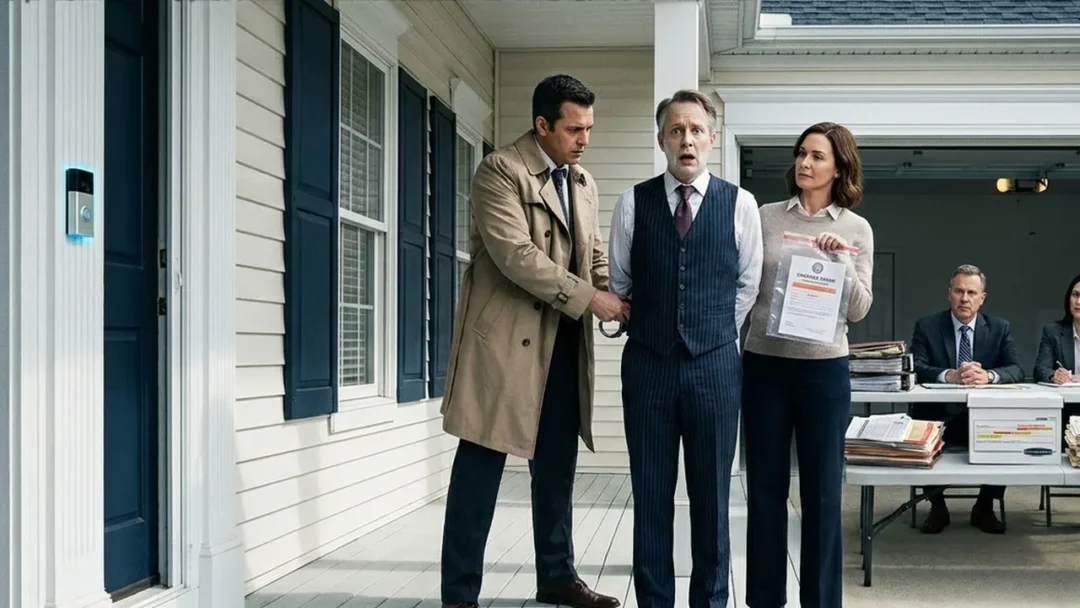
Above the front door frame, the miniature optical lens of David’s 4K smart doorbell camera glowed with an active blue ring, recording high-fidelity audio and uncompressed video at sixty frames per second. David glanced subtly up at the lens, then looked back at Garrett, speaking in a loud, perfectly articulated, neutral voice.
“So HOA fines go directly to your private company?”
Garrett did not hesitate for a fraction of a second. Puffed up with absolute arrogance and intoxicated by the illusion of his own untouchable power, he sneered directly into the air between them.
“Every dollar. Pay now.”
David smiled faintly—a cool, serene smile of complete mathematical victory. He reached into his pocket, retrieved his smartphone, and tapped an encrypted mobile macro sequence.
Inside the quiet front hallway of the house, a low electronic relay clicked. A split second later, the heavy chain-drive electric motor of the attached two-car garage engaged with a deep mechanical hum.