He Kept Cutting Across the Hay Field—Then the Bright Tire Tracks Led Straight to His Equipment Shed
Chapter 1: The Tracks That Should Not Be There
The tire tracks were fresh enough that dew still clung to the crushed stems.
Scott Harris stopped halfway through the lower hay field and stared at them in the blue light before sunrise. Two parallel bands ran from the narrow opening near the county road, cut diagonally through the new growth, and disappeared toward the back fence that divided his acreage from Andrew Campbell’s.
Scott had dragged an old pipe gate across that opening the evening before.
He had not chained it. He had not needed to, or at least he had thought he hadn’t. He had set the gate there because Andrew had been told plainly two days earlier that the field was closed to traffic until after cutting.
Now the gate stood six feet out of place.
Scott crouched and pressed two fingers against a flattened clump of orchard grass. The stalks were bent at the crown. Not dead yet, but another few crossings over wet ground would leave a track that would show through the first cutting.
He straightened and looked toward the neighboring property.
Beyond the fence line, Andrew’s equipment shed was still dark.
Scott pulled a small weathered notebook from the pocket of his work shirt. He wrote the date, the time, and one short line.
Fresh crossing before 5:40.
He had been keeping the notebook for years, though never for this. Most pages held seed rates, fertilizer dates, machinery hours, calf treatments, rainfall. Things that mattered because memory got loose once seasons began piling on top of each other.
Three days ago he had written the first entry about the tracks.
Yesterday he had written the second.
This morning made three.
He walked the full length of the marks instead of taking the tractor back toward the barn. The vehicle had entered where the ground was firm near the road, crossed the new seeding, then turned onto the old gravel strip along the fence. Its tires were not wide enough for a tractor. Too narrow for Andrew’s pickup, too aggressive in the corners for a road tire.
Utility vehicle, Scott thought.
He took out his phone and photographed the tread where the soil was exposed.
The route itself bothered him more than the damage.
Years earlier, before Scott had taken over the farm, there had been a faint path there. He remembered hay wagons sitting along it once or twice when he was younger, but not enough to call it a road. His father had never marked it on any field map Scott knew of. When Scott reseeded the lower acreage that spring, he had worked straight across the old path until there was no reason anyone could mistake it for an active lane.
Andrew had crossed anyway.
Scott walked back toward the entrance and examined the small trail camera he had fastened to a fence post the previous afternoon.
He opened the housing and scrolled through the images.
A raccoon.
Scott’s own pickup at 7:12 the previous evening.
A doe at 2:04.
Then daylight.
No vehicle.
He looked from the camera to the lower opening and felt his irritation sharpen.
The camera faced the gate.
Whoever had crossed had moved the gate from the side, entered below its field of view, and put it back close enough that Scott had not noticed from the house.
That was no wrong turn.
By seven-thirty, the farm was fully awake. Scott fed the cattle, checked a leaking coupler on the haybine, and tried to give the morning back to ordinary work.
It did not work.
Every time he passed the lower field, the two dark tracks pulled his attention toward them.
Around nine, he saw Andrew driving slowly down the gravel road in a side-by-side.
Scott stepped into the lane and raised one hand.
Andrew stopped beside him, engine idling.
He was a few years younger than Scott, broad through the shoulders, with a ball cap faded almost white at the crown.
“You been through my lower field this morning?” Scott asked.
Andrew looked past him toward the grass.
“I’ve been around.”
“That wasn’t the question.”
Andrew rested one forearm on the steering wheel. “You talking about that little crossing?”
“I’m talking about my field.”
A brief change came over Andrew’s face. Not guilt exactly. Annoyance at having to explain something he did not believe required explanation.
“We’ve always gone through there.”
Scott waited.
Andrew gave a small shrug.
“When we need to get around back.”
“We haven’t.”
“Your dad never cared.”
There it was.
Scott kept his voice flat. “I care.”
“It’s twenty yards of grass.”
“It’s new hay.”
“It’ll stand back up.”
Scott looked at the side-by-side’s tires.
The width was close.
He could not see enough of the tread with the vehicle sitting on gravel.
“I told you Monday not to cross it.”
Andrew’s jaw moved once.
“And I heard you.”
“Then why are there fresh tracks?”
Andrew glanced toward the field again, longer this time.
“You got a lot of people moving around this time of year.”
“Across that opening?”
Andrew started to smile, but the expression never fully formed.
“Scott, this isn’t something that started yesterday.”
“No. The damage didn’t.”
Andrew shook his head.
“You’re making a fence-line argument out of something that never used to be an argument.”
Scott felt the old instinct rise in him—to close the conversation by making the boundary harder, louder, less negotiable.
Instead he stepped back.
“Don’t use the field.”
Andrew pushed the side-by-side into gear.
“You ought to ask yourself why nobody had to say that before.”
He drove on.
Scott watched him disappear around the bend.
By noon, Scott had measured the track width twice. Fifty-six inches outside to outside. The side-by-side he had just seen looked close enough that he wrote the number down.
He moved the trail camera to a lower post and angled it toward the opening.
Then he drove two bright survey stakes into the edge of the field where no one could miss them. He tied fluorescent ribbon between them and left the pipe gate squared across the entrance.
It was more marking than he wanted.
His father had disliked signs, locks, and arguments carried out with objects. “If a man knows where he is,” he used to say, “you shouldn’t need to decorate it for him.”
Scott heard the line now and disliked how clearly he remembered it.
Before supper, he walked down one last time to check the stakes.
Everything was untouched.
At ten, from the kitchen window, he could see the faint orange ribbons at the edge of his headlights when he pointed the truck down the lane.
He went to bed irritated with Andrew and slightly more irritated with himself for thinking about it.
At five the next morning, he was back in the field.
The gate was still in place.
The ribbons were still tied.
But ten feet below them, where the ground dipped enough to clear the fence corner, two fresh tire tracks ran across the young hay.
They passed inside the bright stakes, cut the same diagonal line as before, and vanished toward Andrew Campbell’s property.
Scott stood there with the notebook in his hand.
This time, whoever had crossed had not misunderstood anything.
Chapter 2: Bright Tracks Across the Morning Field
Scott poured the fluorescent marker in a strip so narrow that, in daylight, it barely changed the color of the grass.
The product had been sitting on a shelf in his machine shed since the previous fall. He used it to mark application passes and wet spots when spraying certain fields, because a missed strip could cost more than the dye.
It was washable, agricultural, and made for turf.
He read the label twice anyway.
Then he walked the lower opening from one fence post to the other and applied a light band across his own ground.
He did not spread it down the route.
He did not put it on Andrew’s property.
He marked only the place a vehicle would have to cross if it entered where the tracks kept appearing.
After that he moved the trail camera again.
Then he waited.
Waiting turned out to be harder than arguing.
Scott ate supper, checked the cattle, sharpened two sections for the mower, and looked toward the field every time an engine sounded on the county road.
At nine-thirty he shut off the yard light.
At eleven, he looked from the bedroom window.
Nothing.
At four-forty the next morning, he woke before the alarm.
The sky had just begun to gray.
He dressed without turning on the kitchen light, pulled on his boots, and walked down the lane.
For the first fifty yards, he saw nothing unusual.
Then the dew caught the color.
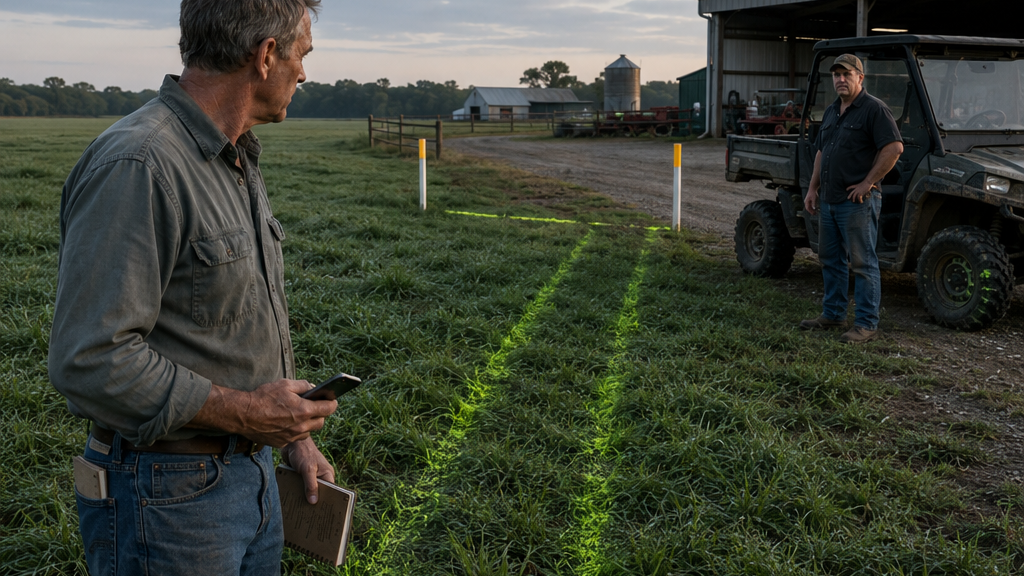
Two luminous green tracks crossed the lower opening.
Scott stopped.
The marks were brighter in the wet grass than he had expected, almost artificial against the dark field. The tread pattern repeated cleanly every few feet, each block edged in green where the tires had carried the marker forward.
For several seconds he felt no triumph.
Only relief.
There it was.
Something that could not be shrugged into a misunderstanding.
He took out his phone.
The first photographs were wide: the marked entrance, the field, the tracks.
Then closer ones: tread blocks, wheel spacing, crushed seedlings.
He followed the line toward the fence.
The marks crossed the new hay exactly where the older tracks had been. They reached the gravel strip along the property edge, turned north, and continued toward the back corner.
Scott stayed on his side.
At the fence, he stopped.
Beyond it, the green marks showed intermittently along the dirt margin until they disappeared behind Andrew’s machine shed.
Scott zoomed in with the camera.
He could not see the tires from where he stood.
He did not need to.
The route was enough to settle the question of direction.
He was photographing the turn when something else caught his eye.
Beside the narrow green tire marks was a second track.
Wider.
Deeper.
It had come through after the first vehicle.
The tread blocks were larger, and one rut had broken the soil enough to expose dark clay beneath the grass.
Scott crouched.
This was not a side-by-side.
A compact tractor, maybe. Small loader. Something heavier than what Andrew had used earlier.
He looked back toward the entrance.
The second vehicle had not merely flattened the hay. Its right rear tire had slipped on the slope and torn a strip nearly three feet long.
Scott closed his eyes for a moment.
The proof had answered one question and created another.
The crossing was no longer just a neighbor taking an old shortcut for convenience.
Somebody was beginning to move equipment through.
He wrote both tread widths in the notebook.
At six-fifteen, sunlight reached the lower field.
By then, the green marks looked even stranger.
A clean fluorescent path across ordinary grass.
Scott photographed everything again in better light and then went back to the house.
He transferred the pictures to his laptop and made a folder by date.
He had never thought of himself as someone who kept evidence against a neighbor. The phrase itself felt ridiculous.
Evidence.
Over tire tracks.
But the photographs did something memory could not.
They held still.
At eight, he drove to the machinery shed and compared the images with the tires on his own utility vehicle. Wrong pattern.
He checked the small tractor. Wrong width.
He wrote both down.
At nine-twenty, he heard an engine coming hard down the lane.
Andrew’s side-by-side stopped in front of the shed fast enough to throw gravel.
He stepped out before shutting it off.
There were green smears around the tread of all four tires.
Scott noticed that first.
Andrew noticed where Scott was looking.
“What did you put down there?”
His voice was louder than it needed to be.
Scott leaned against the workbench.
“Marker.”
“What kind of marker?”
“Agricultural turf marker.”
“You put something on my tires.”
“No. I put it on my field.”
Andrew stepped closer.
“My boy got that stuff on his boots.”
Scott’s expression changed.
“Your boy was through there?”
Andrew hesitated.
It lasted no more than a second, but it was enough.
“He was helping me move something.”
“Across my field.”
“Across the crossing.”
Scott held his gaze.
“You told me yesterday you didn’t know who was making the tracks.”
“I told you we’ve always used that way.”
“That isn’t what I asked.”
Andrew pointed toward the lower field.
“You think painting tires makes you right?”
“No.”
Scott turned his laptop around.
“It makes the route clear.”
The screen showed one of the photographs: glowing tracks entering Scott’s grass, crossing the field, turning at the fence.
Andrew stared at it.
His mouth tightened.
Scott clicked to the next image.
The heavier tread.
“That yours too?”
Andrew did not answer immediately.
Then he said, “We moved the small loader.”
“Why?”
“Because I needed it at the back pasture.”
“So now it’s equipment.”
“It’s a farm, Scott.”
“So is mine.”
Andrew exhaled hard through his nose.
“You know what your problem is?”
Scott waited.
“You decided this farm started the day you took it over.”
Scott’s shoulders stiffened.
Andrew saw it and kept going.
“You see a strip of hay. I see a route that’s been used longer than you’ve been making notes about it.”
“You still need permission.”
“For something we’ve always done?”
“Yes.”
Andrew looked at the notebook beside Scott’s hand.
Then at the laptop.
His anger thinned into something more complicated.
“You really don’t know, do you?”
“Know what?”
Andrew gave a short, disbelieving laugh.
“Ask somebody who was here before you started locking everything up.”
He turned and walked back toward the side-by-side.
Scott followed him out far enough to look at the rear tires.
Green residue still clung between the tread blocks.
Andrew saw him taking another photograph.
“That better be the last time you put that stuff down.”
Scott lowered the phone.
“Then stay out of the field.”
Andrew climbed in.
Before he drove away, he looked back.
“My dad went through there. Your dad knew it. Half the equipment on both places has gone through there at one time or another.”
Scott said nothing.
Andrew’s next words were quieter.
“You’re not proving what you think you’re proving.”
Then he left.
Scott remained beside the shed until the engine faded.
On the laptop screen, the fluorescent tracks were undeniable.
For the first time since the trouble started, that certainty did not feel like enough.
Chapter 3: The Shortcut Andrew Said Was His
Andrew was back before breakfast.
Scott saw him through the kitchen window, standing beside the same side-by-side, one hand on his hip and the other holding a paper shop towel streaked faintly green.
Scott carried his coffee outside.
Andrew did not wait for a greeting.
“You need to quit putting that marker where people are driving.”
Scott stopped at the edge of the porch.
“People?”
“You know what I mean.”
“I know you drove through it.”
Andrew’s eyes narrowed.
“So did my son. And yes, we moved the loader. You have your grand discovery.”
Scott set the coffee on the porch rail.
“Then we can stop pretending it wasn’t you.”
“I never said nobody used it.”
“You said everybody used it.”
“Because they have.”
Scott walked toward the machine shed.
Andrew followed.
Inside, the laptop was still open on the workbench. Scott had printed six photographs and laid them beside his field notebook in chronological order.
First tracks.
Second tracks.
The fluorescent route.
The heavier tread.
Andrew looked at the pages.
“This is what you’re doing with your mornings now?”
“This is what I’m doing because talking didn’t work.”
Andrew gave a humorless laugh.
“We did talk.”
“No. I asked you to stop. You told me the grass would come back.”
“It will.”
Scott tapped the photograph of the torn strip.
“Not if you keep putting loaders over it.”
Andrew’s face hardened again.
“That route was open in ninety-eight when the creek road went under.”
Scott looked up.
“What?”
“Ninety-eight. Flood year. We used it for almost two weeks.”
Scott said nothing.
Andrew continued.
“Two thousand three, your dad let us haul hay through when the old bridge approach washed. Two thousand seven, after Dad blew a hydraulic line on the back road, your father opened that corner so we could get a service truck in.”
Scott felt something cold and unpleasant settle behind his ribs.
The specificity was wrong for a bluff.
Andrew noticed.
“You didn’t know.”
“I was working off-farm in ninety-eight.”
“Exactly.”
“That doesn’t make it yours.”
“I didn’t say it was mine.”
“You called it an established crossing.”
“Because it is.”
“To who?”
Andrew looked toward the open shed door.
“The cooperative knows it.”
Scott stared at him.
“What does that mean?”
“It means when they need to reach the back pasture, they know there’s access through here.”
“Who told them that?”
Andrew did not answer quickly enough.
Scott stepped closer.
“Who told them?”
“I did.”
The shed seemed quieter after that.
A fly struck the window and buzzed against the glass.
Scott spoke slowly.
“You told the cooperative they could send trucks through my field.”
“I told them there was farm access.”
“There is not.”
“There has been for thirty years.”
“When somebody asked.”
Andrew looked at him.
“You don’t know that.”
The words landed harder than the accusation about the marker.
Scott did not like the uncertainty they exposed.
His father had been dead six years. During the last several of those years, Scott had taken over more and more of the day-to-day farm work, but there were still parts of the old operation that had belonged entirely to the older man’s habits.
He had never asked about the lower crossing because, by then, nobody seemed to be using it.
At least Scott had thought nobody was.
Andrew picked up one of the printed photographs.
The image showed the fluorescent tracks cutting a bright path through the field.
“You see this like I snuck in.”
“You moved my gate.”
“Because you put it across a route.”
“My route.”
Andrew put the photograph down.
“Your ground. That isn’t the same argument.”
Scott felt anger rise again, partly because Andrew had found the exact distinction Scott did not want to hear.
He opened the notebook.
“June second. First crossing after I told you to stop. June third, another. June fifth, side-by-side and loader. I don’t care what happened twenty years ago. You knew I said no.”
Andrew’s voice lowered.
“And I thought you were throwing a fit over something your own father never treated like a problem.”
“That gave you the right to ignore me?”
“No.”
The answer surprised Scott enough that he looked up.
Andrew rubbed a hand over the back of his neck.
“No. I should’ve handled that different.”
It was the first concession he had made.
It lasted only a moment.
“But you don’t get to pretend the history isn’t there because nobody handed you a folder when your dad died.”
Scott closed the notebook.
“What exactly did he tell your family?”
Andrew’s expression shifted.
“He said we could use the cut when we needed it.”
“Those words?”
“Near enough.”
“Near enough isn’t what I asked.”
Andrew’s mouth tightened.
“Ask Steven Brown.”
Scott frowned.
“Steven?”
“He was there for some of it.”
Steven farmed two miles east and had known both families before either Scott or Andrew had been old enough to own anything.
Scott had spoken to him twice that spring about hay prices.
Not once had Steven mentioned a shared crossing.
Andrew headed toward the door.
Scott called after him.
“You said the cooperative already knows about this.”
Andrew stopped.
“They’ve used the back route before.”
“Across my field?”
“Not recently.”
“That wasn’t the question.”
Andrew turned.
“I told them it was established access.”
Scott felt the phrase settle into the space between them.
Not courtesy.
Not permission.
Established access.
“You need to correct that.”
“I’m not calling them and telling them I imagined thirty years.”
“You tell them they don’t have permission from me.”
Andrew stared at him for several seconds.
Then he said, “You want to turn this into paperwork, go ahead.”
Scott looked at the photographs.
“I already have.”
Andrew left without another word.
For most of the morning, Scott worked on the mower and got almost nothing done.
Every few minutes, another detail surfaced.
Ninety-eight.
Two thousand three.
Two thousand seven.
Andrew had not reached for those years. He had carried them ready.
Just before noon, Scott called Steven.
The older man answered on the fourth ring.
“Scott?”
“I need to ask you something about the lower field.”
Silence.
Not confusion.
Recognition.
Scott’s grip tightened on the phone.
“You know what I’m talking about.”
Steven sighed.
“I figured this might come up.”
“Did my dad let the Campbells drive through there?”
Another pause.
“Yes.”
Scott looked across the yard toward the field.
For a few seconds he heard only wind moving through the cottonwoods behind the barn.
“How often?”
“Depends what year you mean.”
“Was it a road?”
“No.”
“Was it an easement?”
“I never heard your dad call it one.”
“Did Andrew’s family have permission whenever they wanted?”
Steven did not answer immediately.
Scott’s voice sharpened.
“Steven.”
“Your dad did let them through,” the older man said. “But not the way Andrew’s telling it.”
Scott stood very still.
“What way was it?”
Steven exhaled.
“That’s easier to explain face to face.”
Chapter 4: What His Father Had Actually Allowed
Steven Brown did not start with a legal explanation.
He started with a broken combine.
“It was your father’s,” he said, standing beside a workbench in his barn. “Not Andrew’s family’s. That’s the part everybody forgets.”
Scott leaned against a post, arms folded.
Steven wiped grease from his fingers with an old rag and looked toward the open doorway.
“Back in ninety-eight, when the creek road flooded, your dad couldn’t get the combine around to the south field. Andrew’s father opened his side. Two weeks later, when the water dropped, your dad returned the favor.”
Scott frowned.
“So it went both ways.”
“Sometimes.”
“That isn’t what Andrew said.”
“No.” Steven’s mouth tightened. “Andrew remembers the parts that make things convenient.”
Scott did not answer.
Steven walked to the end of the barn and pointed through the doorway toward a low strip of land barely visible beyond the road.
“The first time the Campbells came across your lower field, they asked. Your father said yes because their culvert was under water. Next time, years later, they asked again because a service truck couldn’t get to a hydraulic break.”
“Did he ever tell them they could use it whenever they wanted?”
Steven shook his head.
“Not that I heard.”
Scott’s shoulders loosened slightly.
Then Steven added, “But he wasn’t precious about it either.”
Scott looked at him.
“What’s that supposed to mean?”
“It means if somebody needed through and conditions were decent, he usually let them.”
Scott felt himself stiffen again.
Steven noticed.
“You wanted me to tell you Andrew made the whole thing up.”
“I wanted to know what happened.”
“You wanted those to be the same answer.”
That irritated Scott because it was close enough to true.
Steven folded the rag.
“Your dad believed in asking. He also believed in saying yes when saying yes didn’t cost much.”
“And when it did?”
“He said no.”
Scott looked down at the dirt floor.
There were no dramatic revelations in Steven’s voice. No hidden document, no secret promise. Just a pattern Scott had never paid enough attention to while his father was alive.
Permission.
Request.
Conditions.
Not ownership.
Not a road.
Not nothing, either.
Scott left Steven’s barn with fewer doubts about the legal question and more doubts about himself.
By noon he was sitting across from Emily Davis at the county agricultural office with a parcel map spread between them.
Emily traced the property lines with one finger.
“This is your lower field?”
“Yes.”
“And Campbell’s back pasture is here.”
“Yes.”
She studied the map.
“There’s no recorded easement shown across your parcel.”
Scott looked at her.
“So that settles it.”
“It settles one thing.”
He waited.
Emily tapped the map.
“There’s no recorded access right here that I can see.”
“But?”
“But people confuse three different things all the time. A recorded easement. Longstanding use. And permission.”
“Andrew says longstanding use makes it established.”
“It makes it longstanding.”
Scott almost smiled.
Emily continued.
“That doesn’t automatically make it permanent. Especially if the use was permissive.”
“He says my father let them through for decades.”
“Did your father say they could use it whenever they wanted?”
“Not according to Steven.”
“Then you need to separate history from entitlement.”
Scott leaned back.
The phrase irritated him in a different way because it sounded too much like something Andrew might have said if Andrew had been less angry.
Emily studied him.
“You already filed a complaint?”
“With the county road deputy. Mostly to document the crossings.”
“Before you checked any of this?”
Scott’s silence answered her.
Emily did not lecture him.
She just folded one corner of the map flat.
“That doesn’t make your complaint wrong. It does mean you started with the conclusion.”
Scott looked out the window.
A maintenance truck passed on the county road.
“My field was being crossed after I said stop.”
“That matters.”
“So what was I supposed to do?”
“I didn’t say you were supposed to do nothing.”
Her tone stayed even.
“I’m saying Andrew can be wrong about his right and still be telling the truth about the history.”
Scott looked back at the map.
He hated that both things could exist at once.
Emily pulled up another file on her computer.
“Before you leave, there’s one more thing.”
“What?”
“I got a call this morning from the agricultural cooperative.”
Scott’s stomach tightened.
“About what?”
“They wanted to confirm whether the access behind your lower field was open for a feed delivery.”
Scott stared at her.
“When?”
“Tomorrow morning.”
“Who told them it was open?”
“They said Campbell described it as established farm access.”
Scott felt the old anger return, cleaner now.
Not because Andrew had remembered his father differently.
Because Andrew had taken a private history and presented it to outsiders as permission that still existed.
Emily watched his face.
“You need to tell the cooperative directly.”
“I will.”
“And Scott?”
He paused.
“Don’t make the driver the person who pays for this argument.”
That evening, Scott walked the lower field alone.
Near the fence, where newer tracks had cut across the hay, he noticed something he had not seen before.
A shallow depression ran beneath the fresh growth.
It was not a road.
It was barely even a path.
But once he knew where to look, he could trace it for thirty yards—an old tire line softened by years of grass.
His father had allowed people through here.
That was true.
Scott crouched and ran his fingers along the flattened edge of one new rut.
The fresh damage lay directly over the old courtesy.
The next morning, before he finished his first cup of coffee, he heard the low diesel growl of a heavy truck climbing the county road.
He stepped outside.
A loaded feed truck came around the bend, slowed, and turned its nose toward the lower field entrance.
Chapter 5: The Feed Truck at the Closed Gate
The feed truck stopped three feet from Scott’s gate.
Its front tires were nearly twice as wide as the old side-by-side tracks.
Scott stood inside the entrance with one hand resting on the pipe rail while the driver lowered the window.
“You Scott Harris?”
“Yes.”
“I’ve got a delivery for Campbell.”
The driver glanced toward the field.
“They told me to cut through here.”
“You can’t.”
The driver looked at him, then at the gate.
“Dispatch has it as access.”
“It isn’t.”
A pickup rolled to a stop behind the truck.
Andrew climbed out.
Scott had expected him.
That did not make seeing him easier.
Andrew walked up the shoulder, eyes moving from Scott to the truck.
“What are you doing?”
“Stopping a loaded truck from crossing soft hay.”
“It’s one pass.”
“One pass with thirty thousand pounds behind it.”
“It’s dry enough.”
Scott pointed toward the ruts already torn through the field.
“For that?”
Andrew’s jaw tightened.
The driver stayed in the cab, wisely saying nothing.
Scott stepped toward the road.
“You told the cooperative this was established access.”
Andrew looked past him.
“It has been.”
“That’s not what they heard.”
“What’d they hear?”
“That they could route commercial deliveries through my field.”
Andrew rubbed a hand across his mouth.
“I told them we use the crossing.”
“You told them enough that this man drove here expecting a road.”
Andrew lowered his voice.
“Let the truck through and we can argue afterward.”
“No.”
“You’re going to make him back that thing half a mile?”
“I’m going to give him another route.”
Andrew stared at him.
“There isn’t another route that gets him to my back bins without going around.”
“There is. It’s longer.”
“And the culvert?”
Scott paused.
“What about it?”
Andrew looked away.
The driver leaned out the window.
“Fellas, I need a direction before I block the county road much longer.”
Scott nodded.
“Give me a minute.”
His phone rang.
He looked at the screen.
The cooperative.
He answered.
The manager’s voice was polite but strained.
“Mr. Harris, I understand we’ve got a truck stopped at your place.”
“You do.”
“Our notes show that route as farm access to the Campbell rear pasture.”
“Your notes are wrong.”
A pause.
“We were told it was established.”
“By Andrew?”
Another pause.
“Yes.”
Scott looked directly at Andrew.
“There is no recorded easement. No standing permission from me. That truck does not cross my hay field.”
The manager cleared his throat.
“We’re not trying to get involved in a property dispute.”
“Then don’t.”
Scott could hear papers moving on the other end.
“Can you give the driver an alternate?”
“Yes.”
“Will it add much time?”
“Forty minutes, maybe more.”
Andrew shook his head.
Scott ignored him.
“I’ll show him where to turn.”
The manager agreed.
Scott ended the call.
Andrew stepped closer.
“You happy now?”
“No.”
“You just burned half a morning.”
“I stopped a truck you invited onto my property.”
“I didn’t invite him onto your front porch.”
Scott stared at him.
“That’s the problem, Andrew. You keep deciding which part of my ground counts.”
For a moment neither man moved.
Then the driver climbed down from the cab.
“Where’s this other way?”
Scott gave him directions, then drove ahead in his pickup to show him the turn.
The alternate route was rougher but passable until it reached Andrew’s side.
There, Scott finally saw the real problem.
The culvert under Andrew’s back lane had partially collapsed.
One concrete edge had dropped. Water from the last hard rain had eaten away the shoulder, leaving a narrow strip of usable ground beside a washed-out hole.
The feed truck could not cross safely.
Scott parked and got out.
Andrew, who had followed them, stopped beside him.
Scott looked at the damage.
“How long has it been like this?”
“Three weeks.”
“You didn’t say.”
“You didn’t ask.”
Scott turned.
“I asked why you were crossing.”
“And every time I started telling you anything, you told me to stop.”
That hit harder than Scott wanted it to.
The driver walked over, looked at the culvert, and shook his head.
“I’m not putting the truck on that.”
“No,” Scott said. “You’re not.”
They worked out a different drop location near Andrew’s front lot. It meant smaller loads would have to be moved later with a tractor and wagon.
Inconvenient.
Expensive.
But possible.
By the time the truck pulled away, the sun was high and Scott’s shirt stuck to his back.
Andrew stayed near the broken culvert.
Scott looked at the exposed concrete.
“You need to fix this.”
Andrew gave a tired laugh.
“You think?”
“How much?”
“More than I’ve got sitting around this month.”
Scott said nothing.
Andrew kicked a loose chunk of gravel into the washout.
“I priced it.”
“When?”
“Last week.”
“And?”
“Pipe, rock, excavation, labor. Enough that if I do it now, I lose money on hay I haven’t even cut yet.”
Scott looked at him.
“So you decided to use mine instead.”
“I decided to get through harvest.”
“Without asking.”
Andrew’s face tightened.
“After you told me no before I finished the first sentence.”
Scott opened his mouth, then closed it.
Andrew continued.
“I was wrong to tell the cooperative the route was established. I should’ve told them it depended on your place.”
“That’s not the same as asking.”
“No.”
The concession came without anger this time.
Scott looked toward his own field in the distance.
The bright marker was mostly gone now. What remained were actual ruts.
Andrew leaned against the pickup bed.
“My dad would’ve asked your dad.”
Scott turned back.
“Then why didn’t you ask me?”
Andrew stared at the broken culvert.
“Because after the first conversation, I knew what you’d say.”
“That doesn’t give you the right.”
“I know.”
Another silence.
Then Andrew said, “But I also knew if I waited for that culvert, I’d lose a harvest window I can’t afford to lose.”
Scott watched him.
For the first time, Andrew’s pressure looked less like arrogance and more like fear wearing arrogance because it was easier to carry.
It did not excuse what he had done.
It did make the next choice harder.
Chapter 6: Permission Was Never the Same as Ownership
The survey stakes formed a straight line through the lower field, and every disputed tire track lay on Scott’s side of it.
The survey technician checked the measurements twice, then pointed toward the old fence corner.
“Your parcel runs clean through here.”
Scott looked at Andrew.
Andrew looked at the stakes.
No one said anything for several seconds.
Emily Davis stood nearby with a folder tucked under one arm.
Steven Brown had come too, at Scott’s request, though he stayed back near the trucks.
The fluorescent marker had almost completely washed away. Only a faint green stain remained in the gravel where the side-by-side had first turned north.
The ruts had not faded.
Scott could still follow them by eye.
Emily opened the parcel map.
“So the property line isn’t the disputed part anymore.”
Andrew gave a dry laugh.
“Apparently not.”
Scott said, “It never was.”
Andrew glanced at him.
“That’s easy to say after you paid somebody to mark it.”
Scott almost answered sharply.
Instead he looked at the stakes.
A week earlier, he would have wanted that sentence to be the end of everything.
My ground. My decision.
Now it felt incomplete.
Emily pointed toward the old crossing.
“The question is whether there was some permanent access right created another way.”
She looked at Steven.
“You were around for the earlier use?”
Steven nodded.
“Some of it.”
Andrew folded his arms.
“My family went through there for years.”
Steven looked at him.
“Sometimes.”
“Enough.”
“That depends what you mean by enough.”
Andrew’s expression hardened.
Steven continued before he could interrupt.
“Your dad asked Scott’s dad in the flood year. Asked again when the bridge approach failed. Asked when he needed that service truck.”
Andrew shook his head.
“You weren’t there every time.”
“No. But I was there the spring your dad got told no.”
Scott looked at Steven.
Andrew did too.
“What spring?” Scott asked.
“Wet one. Early two-thousands. Ground stayed soft through planting.”
Steven pointed toward the lower slope.
“Your father had just seeded that whole strip. Campbell wanted to pull a loaded wagon through. Your dad told him not until it dried.”
Andrew frowned.
“I don’t remember that.”
“You were hauling somewhere else that week.”
Steven looked at Scott.
“Your father wasn’t running an open road. He was making decisions.”
The distinction landed quietly.
Andrew looked toward the field.
Emily closed the folder.
“That matters.”
Andrew turned to her.
“Legally?”
“Practically and legally, depending on the circumstances. Permission that’s requested and sometimes refused is different from somebody using a route as though they control it.”
Scott watched Andrew’s face.
Something in it finally shifted.
Not defeat.
Recognition.
Andrew rubbed both palms down the front of his jeans.
“I told the cooperative it was established.”
“Yes,” Scott said.
Andrew nodded once.
“I shouldn’t have.”
It was the first time he had admitted that without qualification.
Scott felt satisfaction rise.
Then almost immediately, it thinned.
The stakes proved the land was his.
Steven’s memory proved the permission had been conditional.
Emily’s map gave him every reason to close the gate permanently.
He could do it by sunset.
Chain it.
Set posts.
Reseed the ruts.
Make sure no Campbell tire crossed again.
The image should have felt good.
Instead he heard his father’s old sentence.
If a man knows where he is, you shouldn’t need to decorate it for him.
Scott had always heard that as a statement about boundaries.
Now he wondered if it had also been a statement about trust.
Andrew walked toward the deepest rut and nudged the torn edge with his boot.
“I’ll pay for this.”
Scott looked at him.
“All of it?”
“If you get me a reseeding estimate.”
“And the loader damage.”
“Yes.”
“And you correct the cooperative.”
Andrew’s mouth tightened.
“I said I would.”
“You said you overstated it.”
Andrew looked up.
Scott continued.
“I need them to understand this isn’t a route they schedule around.”
Andrew exhaled.
“All right.”
Steven moved closer.
“Then maybe you two are done trying to prove who remembers the past better.”
Scott almost smiled.
“Not quite.”
Andrew’s expression changed.
“What else?”
Scott looked down the old track.
He could see two histories in it now.
The recent ruts—taken without asking.
And beneath them, the faint line of older use—granted when somebody needed help.
For the first time, he understood that closing the route forever would settle the dispute but erase the difference between those things.
He did not want Andrew deciding when the field was available.
But he no longer wanted to pretend his father had protected the farm by saying no to everyone.
Scott pulled the weathered notebook from his pocket.
He opened to the pages of dates and tire widths.
Then he turned to a clean page.
Andrew watched.
“What are you writing?”
“Nothing yet.”
Scott looked at him.
“I’ll give you one written arrangement.”
Andrew’s eyes narrowed.
“What kind?”
“Emergency access only. Case by case. You ask first. I decide based on field conditions. No routine deliveries. No assumption that because I said yes once, you get yes next time.”
Andrew stared at him.
“And if you say no?”
“Then it’s no.”
“That’s not much of an agreement.”
“It’s more than a locked gate.”
Andrew looked toward the broken culvert beyond his property.
Scott let the silence stay.
Then he added, “But there’s another part.”
“What?”
“You accept responsibility first.”
“For the field?”
“For the field. The cooperative. And for treating permission like it belonged to you.”
Andrew’s jaw tightened.
For a moment Scott thought he would walk away.
Instead Andrew looked at the survey stakes again.
Bright, straight, unquestionable.
Then he looked at the old tire path running beneath them.
“I’ll think about it.”
Scott closed the notebook.
“No. Think before you come back.”
He slid it into his pocket.
“When you come back, bring the reseeding estimate.”
Chapter 7: The Agreement Written Beside the Ruts
Andrew came back three days later carrying a folded estimate.
Scott saw him through the kitchen window and knew what it was before Andrew reached the porch.
He opened the door.
Andrew held out the paper.
“Reseeding, leveling, and the section the loader tore up.”
Scott took it but did not step aside yet.
“You agree with the number?”
“I called two places.”
“And?”
“It’s fair.”
Scott looked at the total.
It was not enough to ruin Andrew, but it was enough to hurt during a tight hay season.
He folded the estimate again.
“Come in.”
Andrew removed his cap at the door and sat at the kitchen table.
Scott had already cleared a space between the salt shaker and a stack of farm mail. His weathered field notebook lay open beside two sheets of paper.
Andrew noticed them.
“That your agreement?”
“A draft.”
Andrew sat back.
Scott poured coffee for himself but did not offer any. Halfway to his chair, he stopped, reached for another mug, and filled it.
Andrew accepted it without comment.
Scott slid the first page across.
Andrew read silently.
The conditions were simple.
No routine traffic across the lower field.
No commercial delivery route.
No equipment crossing without Scott’s permission.
Emergency or unusual access could be requested case by case.
Field conditions controlled whether permission would be given.
Any damage caused by an approved crossing would be repaired by the person using it.
Andrew reached the final paragraph and stopped.
He looked up.
“I have to call you every time?”
“Yes.”
“Even if your gate’s open?”
“Yes.”
“Even if I used it the week before?”
“Yes.”
Andrew put the page down.
“That isn’t access. That’s asking a favor every time I get in trouble.”
Scott leaned back.
“That’s what it always was.”
Andrew’s jaw tightened.
“At least according to Steven.”
“According to your own memory too, if you’re honest about it.”
Andrew looked toward the window.
The lower field was visible beyond the barns, the damaged strip darker where Scott had worked soil back into the deepest rut.
“I don’t like having to ask somebody whether I can reach my own back pasture.”
“You can reach it.”
“You saw the culvert.”
“I saw a damaged route on your property.”
Andrew gave him a sharp look.
Scott held it.
“That’s not me being cruel. That’s where the problem is.”
Andrew tapped the paper with one finger.
“So if I call and you’re mad at me that morning, I’m stuck.”
“If the field can carry the equipment, I’m not going to say no because I’m mad.”
“That isn’t written down.”
Scott almost responded immediately.
Then he stopped.
Andrew had found the weakness in the arrangement.
Not a legal weakness.
A human one.
Scott had written himself complete discretion because complete discretion felt safe.
Andrew saw him thinking.
“I’m not asking for ownership,” Andrew said. “I’m asking not to be dependent on whether we had an argument the day before.”
Scott looked at the notebook.
The earlier pages were filled with dates, tread widths, photographs, damage measurements.
Evidence.
Everything he had recorded was about what Andrew had done wrong.
There was nothing in it about what Scott owed once he chose to cooperate.
He pulled the agreement back.
“What if it says permission can be denied for field conditions, crop damage risk, or conflicting farm operations?”
Andrew frowned.
“Not because you feel like it.”
“Not because I feel like it.”
“And if it’s an actual emergency?”
“We define one.”
Andrew leaned forward.
“What counts?”
“Blocked access from washout. Equipment failure that strands something. Livestock problem where the normal route can’t be used.”
“Harvest?”
Scott shook his head.
“Not automatically.”
Andrew’s mouth tightened again.
“What if weather’s coming and I’ve got six hours?”
“Then you call me.”
Andrew stared at the paper.
Scott waited.
Finally Andrew said, “I still don’t like asking.”
“I know.”
There was no triumph in Scott’s voice.
That seemed to matter.
Andrew picked up the second page.
It contained the acknowledgment Scott had insisted on: compensation for reseeding, correction of the cooperative’s access records, and confirmation that use of the lower field was permissive rather than permanent.
Andrew read the language twice.
Then he set it down.
“This makes me look like I lied to them.”
“You did.”
“I overstated it.”
“You told them they could send a feed truck through.”
Andrew rubbed his thumb over the paper’s edge.
“I thought I had more right to it than I did.”
Scott said nothing.
Andrew looked at him.
“That what you need me to say?”
“No.”
Scott reached for his coffee.
“I need you to understand it.”
Andrew gave a short, tired laugh.
“You’ve enjoyed this part.”
Scott’s eyes narrowed.
“What part?”
“Being right.”
The accusation landed because there was some truth in it.
Scott looked toward the notebook again.
He had enjoyed the photographs.
Not the damage, but the certainty.
There had been satisfaction in watching Andrew run out of ways to deny the crossings. Satisfaction in the survey stakes, the maps, the straight line of proof.
He had told himself it was only about protecting the farm.
That had not been entirely true.
“I probably did,” Scott said.
Andrew looked surprised.
Scott continued.
“That doesn’t make the field yours.”
“No.”
“And you don’t get to turn my father’s generosity into something I’m required to continue.”
Andrew lowered his eyes.
“No.”
The second answer came quieter.
Then he said, “I guess I did that.”
Scott waited.
Andrew looked out toward the lower field.
“Dad always talked like that crossing was part of how the farms worked. I never really separated the times he asked from the times he just said we went through.”
He shook his head.
“By the time I was running things, it felt permanent.”
“Feeling permanent isn’t permanent.”
“I know that now.”
Scott slid a pen across the table.
Andrew did not pick it up.
“Before I sign,” he said, “I want one thing changed.”
Scott waited.
“If you ever need through my place because your road’s blocked, same rules.”
Scott looked at him.
Andrew continued.
“You call. I don’t get to say no just because I’m irritated. If the ground will hold and it’s a real need, you get through.”
Scott had not expected that.
His first instinct was resistance.
He owned two usable routes. He did not need Andrew’s land.
Then he understood what Andrew was asking.
Not leverage.
Reciprocity.
Scott pulled the agreement back again.
“All right.”
He wrote the clause by hand before typing a clean version.
Half an hour later, both men signed.
Scott opened the field notebook to a blank page.
At the top he wrote: Access requests.
Andrew watched.
“You’re really going to log them?”
“Yes.”
Andrew shook his head.
“You log rainfall too?”
“Since 1989.”
That finally got a smile out of him.
Small, but real.
Later that afternoon, Andrew called the cooperative while Scott stood beside the lower gate.
He corrected the record.
Scott heard only Andrew’s side.
“No. It isn’t established access.”
A pause.
“It’s private ground.”
Another pause.
“You need to route through my regular entrance unless I tell you otherwise.”
Andrew ended the call and handed Scott the reseeding check.
Neither man offered an apology beyond what had already been said.
It would have felt artificial.
Instead they walked the damaged strip together, measuring how much seed Scott would need.
At the deepest rut, Andrew stopped.
“I should’ve asked.”
Scott looked at the torn ground.
“I should’ve listened long enough to hear why.”
They left it there.
That evening, Scott entered the agreement date into his notebook.
For the first time, the book contained something other than violations.
Three nights later, rain began beating against the farmhouse roof.
By morning the creek was over its banks.
Scott stood at the kitchen window watching water run hard through the drainage ditch when his phone lit up.
Andrew.
Scott looked toward the lower field.
Whatever they had signed was about to become more than paper.
Chapter 8: The Field Looked Different After the Rain
Andrew’s tractor was already stopped at the boundary when Scott drove down.
That was the first thing he noticed.
Not the rainwater standing in the low ground.
Not the branch lodged against the fence.
The tractor.
Stopped.
Its engine idled on Andrew’s side of the property line, front tires pointed toward the old crossing but not touching Scott’s hay.
Andrew stood beside it with his phone in his hand.
When Scott got out of the pickup, Andrew raised one arm.
“I called twice.”
“I was in the equipment shed.”
“I figured.”
Scott looked past him.
The storm had worsened the culvert.
Half the gravel shoulder was gone now, and brown water ran through the exposed edge where compacted fill had been the previous week.
“What do you need moved?”
“Tractor and the small stock trailer.”
“Cattle?”
“Fence went down on the back pasture. Nothing’s out yet, but I want the trailer there before they decide otherwise.”
Scott looked at the sky.
The rain had stopped, but the field was wet enough that a careless pass could reopen every rut they had just repaired.
Andrew waited.
That mattered too.
A month earlier, Scott suspected he would have already been halfway across.
Scott walked through the gate.
“Let’s look.”
They crossed the lower field on foot.
Scott pushed the heel of his boot into the ground every twenty yards.
The middle section was too soft. Water rose around the edge of his sole.
“Not here.”
Andrew looked toward his cattle.
“I don’t have much time.”
“I know.”
Scott continued toward the fence line.
Near the upper edge, the grade was slightly higher. Grass roots held firmer beneath the surface.
He crouched, squeezed a handful of soil, then stood.
“You can run along this side.”
Andrew followed his line with his eyes.
“That’s tighter.”
“It’s drier.”
“The trailer might clip the fence corner.”
“I’ll open it wider.”
Andrew nodded.
No argument.
They returned to the tractor.
Scott pulled the pipe gate farther back and removed one temporary post.
Andrew climbed into the cab but did not move.
Scott noticed.
“What?”
“You good with this?”
The question was so ordinary that it almost caught Scott off guard.
A month of arguments had been built around that exact missing sentence.
Scott looked at the field.
“Yes. Stay high. No turning until the gravel strip.”
Andrew raised a hand.
“Got it.”
The tractor crossed slowly.
Its tires pressed the grass down but did not break the surface.
The stock trailer followed in the same line.
Scott walked behind it, watching the tread.
One set.
Straight.
Deliberate.
Nothing like the wandering marks he had first found at dawn.
At the gravel strip, Andrew stopped and climbed down.
“Ground okay?”
Scott checked.
“It’ll come back.”
Andrew gave him a look.
Scott realized what he had said.
For a second neither man spoke.
Then Andrew laughed.
“You remember telling me I hated that answer?”
Scott almost smiled.
“Different circumstances.”
“Convenient.”
“This time I gave permission.”
Andrew nodded.
“That is different.”
The words settled more cleanly than either of them seemed to expect.
Andrew continued toward his back pasture.
Scott stayed behind.
He walked the fresh tire marks from the gate to the gravel.
The grass was flattened, but the soil held.
At the edge of the crossing, the older damage was already beginning to disappear beneath new growth. The reseeded sections were lighter than the rest of the field, but the deep ruts had softened into shallow seams.
He opened the notebook.
Under Access requests, he wrote the date.
Storm damage. Fence failure. Tractor and stock trailer. Approved upper route.
He closed the book.
Three weeks later, Andrew’s culvert repair was finished.
A new pipe sat beneath compacted gravel, with rock armored along the washed-out shoulder. Scott saw the work from the road and kept driving.
He did not need to inspect it.
The cooperative stopped calling about the lower field.
The trail camera stayed on the fence post for another month, but Scott eventually took it down.
There was nothing to photograph.
By mid-July, the hay had grown tall enough to hide most of the repaired strip.
Scott cut the field on a clear morning.
When he reached the lower section, he slowed the tractor.
The first bright fluorescent tracks had crossed almost exactly where his mower now passed.
He remembered standing there before sunrise, relieved because the proof had finally become visible.
At the time, he had thought proof would settle everything.
It had settled almost nothing by itself.
The photographs had shown who crossed.
The survey had shown who owned the ground.
Neither had answered what a decent neighbor was supposed to do after that.
Scott finished the cut and turned at the end of the field.
Across the fence, Andrew was loading hay.
They were not friends in the easy way their fathers might once have been.
Too much had been said.
Too much irritation remained around the edges.
But the next time Andrew needed a temporary crossing for a repair crew, he called.
Scott checked the ground and said yes.
Two weeks later, Scott discovered a washed tree limb blocking the rear lane to one of his own pastures.
He stood looking at it for a while before taking out his phone.
Calling Andrew felt surprisingly difficult.
That embarrassed him.
Andrew answered.
“What’s up?”
Scott explained.
There was a pause.
Then Andrew said, “Ground’s firm on my side. Come through by the north fence.”
No joke.
No reminder of the agreement.
No satisfaction.
Just permission.
Scott drove through thirty minutes later.
Andrew was repairing a baler near the shed. He lifted one hand as Scott passed.
Scott returned the gesture.
That autumn, the weathered notebook moved from the pickup console back to its usual shelf in the machine shed.
The pages about the dispute remained.
Scott did not tear them out.
Dates.
Widths.
Damage.
Calls.
The reseeding payment.
The agreement.
The first storm crossing.
The first reciprocal crossing.
The record had started because Scott wanted to prove somebody else was wrong.
It ended up recording something more useful: the difference between taking access and receiving it.
On a cool morning near the end of the season, Scott walked down to close the lower gate after moving cattle.
The old ruts were nearly impossible to find.
New hay covered the worst of them.
Only if he stood at the right angle could he see a faint pair of depressions running toward the fence.
He put one hand on the pipe gate.
Across the field, Andrew’s tractor came into view.
It slowed near the property line.
For a moment Scott watched it.
Then Andrew turned onto his own repaired lane without crossing.
Scott swung the gate shut.
He did not add a chain.
He did not need a brighter marker.
He did not need another photograph.
The line was still there.
So was the possibility of crossing it.
What had changed was that both men finally understood the difference.
The story has ended.