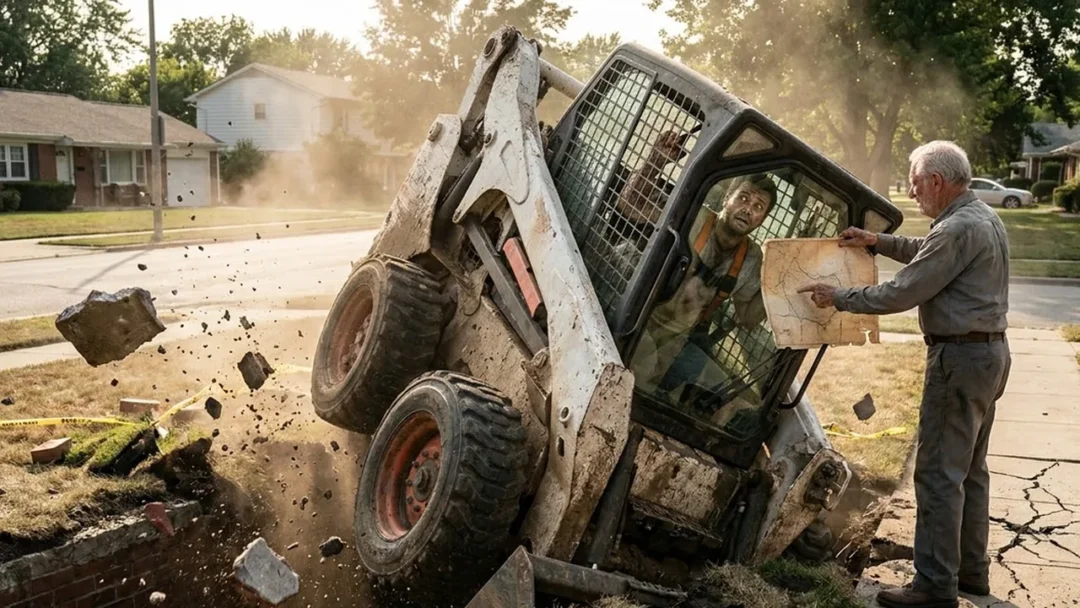
The Abandoned Rainwater Cistern And The Swallowed Skid Steer Loader
CHAPTER 3: THE COLLAPSE OF THE 1890 ARCH
The failure of the subterranean cistern cap did not happen in slow, gradual stages. It occurred with the explosive, instantaneous violence of a mine collapse.
Beneath the eight inches of topsoil, the two-inch unreinforced mortar cap—poured during the Eisenhower administration with lime-rich concrete that had suffered seventy years of moisture erosion and freeze-thaw degradation—reached its ultimate shear limit under the concentrated five-ton surface load of the loader’s heavy tracks.
With a deafening, thunderous CRACK that shook the foundations of the nearby homes and rattled the teacups in Tobias Miller’s kitchen, the entire ten-foot concrete dome gave way.
A ten-foot-wide circular crater opened directly beneath the rear half of the Bobcat T770.
The machine’s heavy diesel engine, cast-iron counterweights, and rear hydraulic pumps—which concentrated sixty-five percent of the loader’s ten-thousand-pound weight over the rear drive sprockets—plunged violently downward into the abyss.
The machine did not drop into dry dirt. It plunged straight into eight feet of stagnant, mineral-rich, black rainwater that had accumulated inside the subterranean brick vault since the late nineteenth century.
A massive geyser of filthy, stagnant water, pulverized lime mortar, and nineteenth-century brick fragments erupted twenty feet into the air. The foul-smelling black plume rained down across the lawn, coating the green turf, the front porch of Tobias’s home, and the glass safety canopy of the loader in a thick, rancid sludge of decayed organic silt.
The forward momentum of the machine was halted with brutal, bone-jarring force.
Because the front rubber tracks were still resting on the intact limestone subgrade at the edge of the hole, the machine did not fall flat. Instead, the rear end plunged six feet deep into the brick-lined chamber, leaving the Bobcat tilted backward at a severe, fifty-degree angle.
The heavy steel eighty-four-inch excavation bucket was thrust violently toward the sky, its hardened teeth pointing straight up at the autumn clouds like the raised claws of a dying beast.
Inside the cab, the violence of the collapse was terrifying.
Brock Kowalski was hurled violently backward and sideways against his five-point safety harness. The brutal deceleration drove the air completely from his lungs, slamming his head against the steel wire protective mesh of the cabin wall. His sunglasses were ripped from his face and lost in the muddy water that surged through the cab floorboards, while his phone flew from the dashboard mount and plunged into the dark water below.
The engine sputtered violently, its exhaust pipe submerged beneath the rising black water, spewing bubbles of blue diesel smoke and hot steam that hissed furiously against the cold subterranean walls.
Then, with a shuddering metallic groan, the diesel engine choked on its own exhaust and died, leaving the cul-de-sac in absolute, ringing silence.
The hydraulic dynamics of an abrupt drop into an enclosed water-filled vault are violent and concussive. The 1890 cistern was essentially a massive inverted masonry kettle, holding twelve thousand gallons of water sealed by impervious lime-mortar brick walls. When the five-ton rear end of the loader breached the ceiling, the massive displacement acted like an industrial piston plunging into a cylinder. The displaced water had nowhere to vent except upward through the annular gap between the machine’s chassis and the collapsed masonry rim. The resulting slurry explosion was a toxic geyser of stagnant groundwater, anaerobic bacterial silt, and fragmented brickbats that coated everything within fifty feet.
Inside the cab, the deceleration forces were brutal. Industrial track loaders are engineered without suspension springs; the steel roller frames are bolted directly to the rigid welded chassis to maximize digging and lifting stability. When the rear tracks dropped six feet into the void, the kinetic impact was transmitted directly to the operator’s seat without mechanical dampening. Brock Kowalski was subjected to an estimated four-G impact that compressed his lumbar spine and whipped his head against the roll-cage before the emergency lock on the safety harness engaged with a sharp mechanical snap.