The Crushed Vintage Show Car And The Ruthless HOA Tow Lift
CHAPTER 3: THE LEATHER DOSSIER AT THE BUMPER
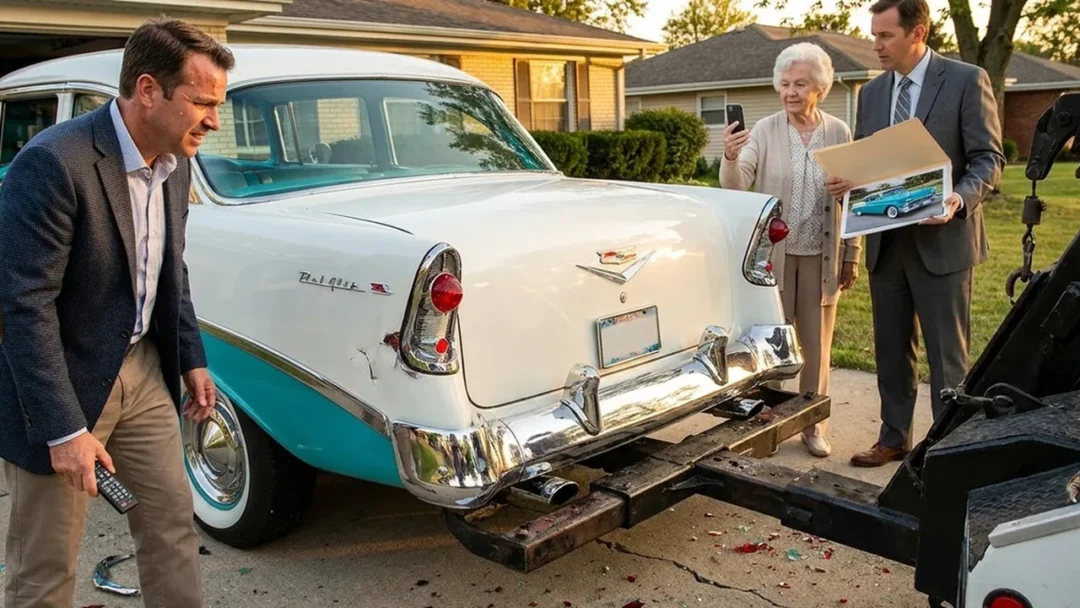
Julian Vance stood frozen, his thumb still pressed against the plastic button of the remote control. The hydraulic pump continued to whine under relief-valve pressure, the heavy steel crossbar firmly wedged beneath the crumpled chrome bumper, pinning the rear end of the classic wagon down against its rear springs. The smell of hot hydraulic fluid, scorched paint, and ozone hung thick in the morning breeze.
The arrogant sneer on Julian’s face was wiped away in an instant, replaced by a look of sheer, uncomprehending shock.
Marcus Sterling sprinted forward, dropping to one knee beside the shattered taillight glass. His face was pale with furious disbelief as he ran his bare, trembling fingers along the mangled chrome.
“Do you have any idea what you just did?” Marcus yelled, his voice shaking with professional outrage as he looked up at Julian. “Do you have the slightest comprehension of what you just destroyed?”
Julian swallowed hard, his voice trembling slightly as he tried to regain his footing. “It… it’s an accident! It was a minor bumper scuff! My towing company has insurance! We’ll take it to a body shop in Bradenton and have them spray some touch-up paint! It’s just an old Chevy!”
“Just an old Chevy?” Marcus stood up, his tall frame looming over the property manager. With a sharp, decisive motion, Marcus unzipped his heavy black leather appraisal portfolio, flipped past the initial inspection sheets, and thrust the certified, gold-embossed valuation certificate directly into Julian’s face.
The document bore the official raised seal of the International Specialty Vehicle Appraisal Guild and the corporate underwriter insignia of Hagerty Classic Insurance.
Centered on the page in bold, black mechanical lettering was the audited valuation:
AGREED VEHICLE VALUE: 40,000.00
CONDITION RATING: CLASS ONE — CONCOURS DELEGANCE WINNER
PROVENANCE AUDIT: 100% FACTORY ORIGINAL NOS COMPONENTS
“Read the ledger, Mr. Vance!” Marcus demanded, his finger tapping the paper with brutal emphasis. “One hundred and forty thousand dollars! That car is an internationally recognized concours winner! That bumper wasn’t a reproduction part ordered from a catalog in Taiwan! That was an original, date-stamped 1955 Detroit experimental California bumper! Only four hundred and fifty of those bumpers were ever forged by General Motors! You cannot buy a replacement at any price on earth!”
Marcus pointed down at the shattered red glass on the coral pavers. “Those taillight lenses were original 1956 Guide glass! They took Arthur seven years to locate at vintage auto auctions in Hershey, Pennsylvania! They cost three thousand dollars for a single pair! You didn’t cause a ‘bumper scuff,’ you ignorant fool! You just destroyed the historical originality of an irreplaceable museum asset!”
Julian’s eyes darted frantically across the numbers on the certificate: 40,000… Concours Winner… NOS Components…
The color drained from Julian’s cheeks until his skin was the color of skim milk. His breath came in shallow, ragged gasps. The corporate bluster that had carried him through hundreds of neighbor intimidation disputes vanished completely, crushed under the absolute, undeniable reality of a six-figure appraisal certificate.
“A… a hundred and forty thousand?” Julian whispered, his hands trembling violently. “That… that can’t be right. It’s a station wagon.”
“It is a hand-restored Bel Air Nomad sport wagon, Mr. Vance,” Arthur Pendelton said calmly, stepping forward with his recording phone. “And your fifteen-dollar towing citation just cost you your career.”
The appraisal methodology utilized by the International Specialty Vehicle Appraisal Guild is recognized by federal courts and major underwriting institutions worldwide. Unlike standard Blue Book dealer guides that calculate simple market depreciation on mass-produced modern sedans, classic vehicle appraisal relies on the rigorous Uniform Standards of Professional Appraisal Practice. Marcus Sterling had spent three days conducting historical title verifications, cross-referencing factory build sheets, and performing non-destructive ultrasound metal thickness testing to confirm that the Nomad’s body panels were one hundred percent original GM sheet metal with zero plastic body filler. The agreed-value policy underwritten by Hagerty was a binding legal covenant; in the event of partial damage, the insurer was obligated to fund specialized hand-restoration by certified historical automotive conservators.
As Julian Vance stared at the gold-embossed seal on the certificate, the legal reality began to penetrate his bureaucratic shield. In tort law, the concept of consequential property damage establishes that an individual who commits an unauthorized physical act against private property is held liable for the full diminished value of the asset. A concours-winning vehicle that suffers structural frame distortion and sheet-metal tearing loses its elite Class One certification instantly; even after flawless metalwork, its provenance is forever branded with an accident record, resulting in an immediate market value drop of thirty to forty percent. That single downward press of the hydraulic remote had generated forty thousand dollars in instant diminished value, alongside fifty thousand dollars in specialized historical restoration costs.
Marcus Sterling’s fingers moved across the crumpled chrome with the practiced diagnostic sensitivity of a surgeon assessing a traumatic fracture. He pointed out the microscopic shear lines where the nickel plating had delaminated from the underlying steel, creating razor-sharp flakes that glittered on the pavement. “Look at this, Arthur,” Marcus said, his voice dropping into quiet, reverent disbelief. “The bumper brackets took the brunt of the kinetic load, but the impact transferred directly into the rear frame horns. This is not something you fix with a hammer and a spray gun. This requires complete dimensional laser re-alignment on a dedicated chassis jig.”
Julian Vance’s corporate arrogance had completely evaporated, replaced by the suffocating weight of personal financial catastrophe. In the property management industry, managers operate under the protective umbrella of corporate errors-and-omissions insurance; but every underwriter explicitly excludes coverage for intentional criminal acts and unlicensed equipment operation. Julian knew with terrifying certainty that his firm would fire him before sunset to protect their corporate bond, leaving him individually exposed to the civil court judgments that would follow. The six-figure appraisal certificate held in Marcus’s hands was an unpayable debt that would haunt his credit for the rest of his life.