The Rose Hedges Over The Boundary Line On Briar Lane
CHAPTER 1: THE STONES ON BRIAR LANE
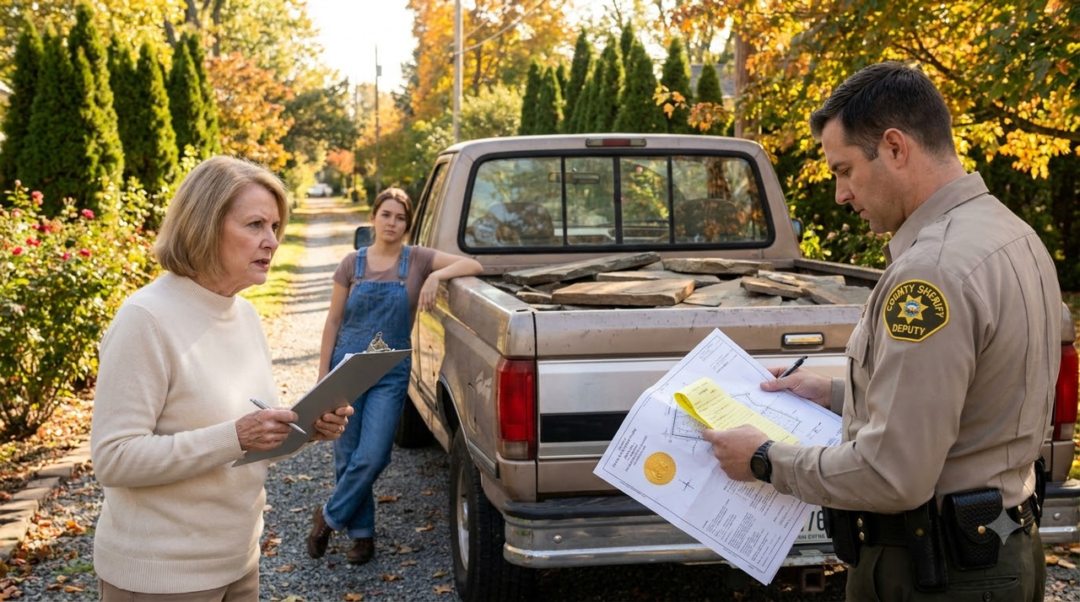
The morning fog hung low over the limestone ridges of Dutchess County, rolling through the sugar maples and clinging to the damp gravel of Briar Lane. Thirty-year-old Clara Mercer pulled the emergency brake on her 1998 Ford F-250, the flatbed creaking under three tons of hand-hewn Pennsylvania bluestone flagstones. She stepped down into the crushed shale driveway, wiping her brow with the back of a suede work glove. Her faded denim Carhartt overalls were spattered with Hudson Valley red clay, a twenty-five-foot steel measuring tape clipped to her leather tool belt.
Before she could unhook the truck’s tailgate chains, the sharp crunch of gravel announced an unwelcome arrival.
“Stop right where you are! Do not drop a single stone onto this pavement!”
Vivian Vanderhoof marched down the private lane with the fury of an empress defending her palace gates. At fifty-two, Vivian treated Briar Lane as her personal fiefdom. As the self-appointed president of the Briar Lane Estates Homeowners Association, she spent her days patrolling the three-mile gravel stretch in a golf cart, hunting for unapproved paint swatches, unpruned hedges, and unauthorized vehicles. She wore an immaculate cream cashmere sweater, a double strand of cultured pearls, and designer reading glasses perched on her sharp nose. Behind her, extending sixty feet along the driveway, stood her pride and joy: a dense wall of thorny English heritage rose bushes backed by a fresh white cedar fence.
Clara kept her hands resting loosely on the tailgate. “Good morning, Mrs. Vanderhoof. I’m resetting the retaining wall along the carriage road so the autumn runoff doesn’t wash out the culvert.”
“This is not a carriage road, young woman! This is Briar Lane Private Right-of-Way!” Vivian snapped, stepping aggressively into Clara’s workspace. Her manicured hand lunged forward and snatched an aluminum clipboard resting on the truck’s fender. “Commercial vehicles over two tons are strictly prohibited under Section Four of the neighborhood bylaws. You have no permit, you have no approval from the architectural review committee, and you are creating an industrial eyesore next to my prize-winning rose garden!”
“I don’t need HOA approval,” Clara replied calmly, her steel-blue eyes steady and unblinking. “The Mercer farmstead is an unencumbered historic parcel. It predates your subdivision by eighty-five years.”
“Your grandfather is dead, Clara! The old farm is defunct!” Vivian’s voice rose to a shrill pitch, echoing through the cedars. “You can’t just roll in here with a load of river rocks and squat on an executive corridor! This entire easement belongs to the association!”
With a vicious flick of her wrist, Vivian tossed the heavy aluminum clipboard into the air.
It tumbled in slow motion, striking the crushed stone driveway with a hollow metallic crash. The spring latch popped open, scattering white survey diagrams, elevation profiles, and county deeds across the gravel in the morning breeze.
Vivian turned toward the road and waved her arms wildly. “Deputy! Over here! I need an officer right now!”
A Dutchess County Sheriff’s patrol cruiser, which had been idling at the crossroads fifty yards down the lane, slowly engaged its low-profile roof strobes and rolled up the driveway. The cruiser stopped, its door swinging open with the heavy thud of official authority.
Deputy Thomas Callahan stepped out into the crisp autumn air. Broad-shouldered, weathered by twenty years of rural patrol, he touched the brim of his campaign hat. His duty belt creaked as he walked up to the two women, his eyes taking in the scattered papers, the loaded pickup, and the trembling rage on Vivian’s face.
“Morning, Mrs. Vanderhoof. Clara,” Callahan said, his voice a calm, low drawl. “What seems to be the dispute out here this morning?”
“Deputy Callahan, thank heaven you’re here!” Vivian cried, pointing an accusatory French-manicured finger directly at Clara’s chest. “I want this squatter arrested for criminal trespassing and illegal dumping! She is unloading industrial building debris directly into my private easement and refusing to vacate. She has destroyed the peaceful enjoyment of my estate!”
Callahan looked at the neat pallets of bluestone in the truck bed, then down at the papers on the gravel. “Clara, you blocking the lane?”
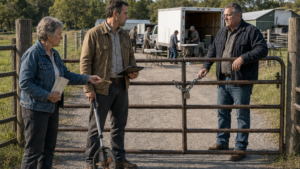
“The truck is parked entirely within the legal bounds of Parcel Four-B, Deputy,” Clara said evenly. She didn’t raise her voice. She didn’t point fingers. Instead, she reached into the deep breast pocket of her canvas overalls and withdrew a crisp, heavyweight vellum document folded into thirds.
She smoothed the paper flat against her forearm. In the morning light, a raised, embossed gold foil seal gleamed brightly at the bottom corner, stamped with the unmistakable signature of the Dutchess County Clerk and the seal of the New York State Department of Transportation.
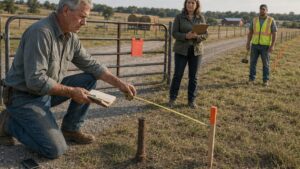
“Take a look at the certified boundary plat, Deputy,” Clara said smoothly, handing the vellum to Callahan. “Surveyed by licensed cadastral engineers on Tuesday, registered at the Poughkeepsie records office yesterday morning. Check the legal frontage on Parcel Four-B.”
Deputy Callahan took the document, adjusting his reading glasses. His eyes traced the bold red boundary line that cut straight through the gravel corridor. He paused, glanced up from the blueprint to Vivian’s pristine white cedar fence, then looked down at the paper again. A long, heavy silence settled over Briar Lane.
“Well, now,” Callahan murmured, his voice dropping into a stern, official register.
“Well what, Deputy?” Vivian demanded impatiently, crossing her cashmere-clad arms. “Are you going to cite her or do I need to call the Sheriff directly?”
Callahan slowly refolded the certified deed. He turned his broad shoulders squarely toward Vivian Vanderhoof, his face hardening like mountain granite.
“Ma’am,” Callahan said, pulling a thick blue citation ledger and a metal ballpoint pen from his duty vest. “According to the state surveyor general’s re-monumentation map, Clara owns the entire gravel corridor. All thirty feet of it. And your white cedar fence and sixty feet of ornamental rose bushes are built ten feet inside her private property line.”
Vivian’s jaw dropped. The color vanished from her face, leaving her chalk-white beneath the Hudson Valley sun. “That… that is an outrage! My garden was designed by an architectural firm in Manhattan! I’ve maintained that hedge for twelve years!”
“Then you’ve been trespassing for twelve years, Mrs. Vanderhoof,” Callahan said coldly, ripping a bright yellow municipal citation from his pad and pressing it firmly into her trembling hand. “You have forty-eight hours to bulldoze this fence and clear your shrubs, or the county will send highway crews with an excavator to do it for you—and bill your personal address for the fuel.”
Vivian stared down at the bright yellow ticket, her fingers shaking violently. But as she looked up, a sharp, sinister smile suddenly cut through her panic.
“You think you’re so clever, Clara,” Vivian whispered, reaching into her cashmere cardigan pocket and pulling out a folded legal envelope stamped in red ink. “You might own the dirt, but you don’t own the road. This is an emergency stop-work injunction signed this morning by the chief municipal zoning inspector. Lay one single stone, and you go to county jail.”