The Rose Hedges Over The Boundary Line On Briar Lane
CHAPTER 7: THE TRUE LINES OF THE VALLEY
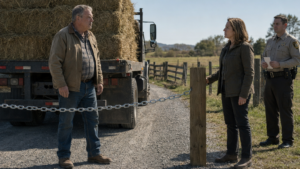
By four o’clock that afternoon, a quiet, golden peace had returned to Briar Lane. The state police cruisers and the highway trucks had departed, leaving the road bathed in the warm, amber light of an Indian summer sunset.
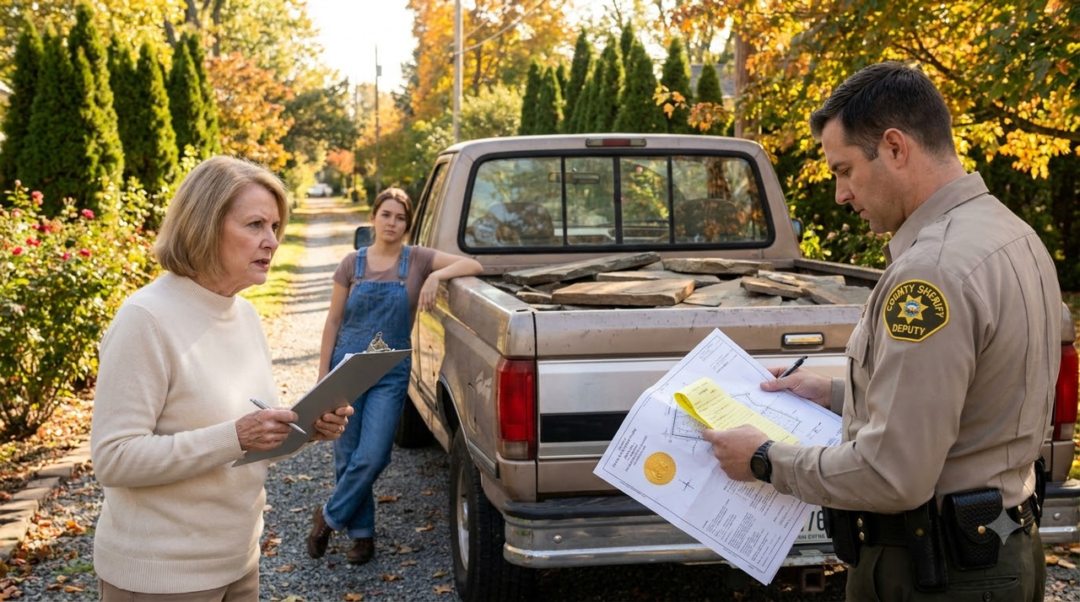
Clara Mercer knelt on the freshly leveled gravel along the true property line. With a heavy rubber mallet, she tapped a massive piece of Pennsylvania bluestone flagstone into place, seating it firmly into a bed of crushed limestone dust. Beside her, Lucas hauled the next stone from the truck bed, his face bright with a smile that hadn’t been seen since before his deployment.
“That’s forty feet of wall reset, Clara,” Lucas said, wiping sweat from his forehead with a cotton rag. “The drainage culvert is clear. Even if we get three inches of rain tomorrow, the road won’t wash.”
Down the lane, the crunch of footsteps signaled an approaching group.
A half-dozen neighbors from the Briar Lane community walked up the road, carrying thermoses of hot apple cider, trays of warm cinnamon donuts, and several garden shovels. Leading them was Arthur Miller, the retired accountant who had resigned from the HOA board the previous evening.
Miller stopped at the edge of the new stone wall, looking at Clara with genuine, humble respect.
“Clara,” Miller said, taking off his work cap. “The remaining homeowners met at noon today. We voted unanimously to dissolve the Briar Lane Homeowners Association permanently.”
Clara looked up from her work, a faint smile touching her lips. “Dissolved?”
“Permanently,” Miller confirmed, nodding toward the open fields. “We don’t need a corporate board telling us what color our shutters can be, and we certainly don’t need walls separating us from our neighbors. We’ve petitioned the town board to take over Briar Lane as an official public road, maintained by the township.”
Miller set a heavy wooden crate down on the tailgate of Clara’s truck. Inside were twelve young saplings, their root balls wrapped in damp burlap.
“We bought these from the county nursery this afternoon,” Miller said, his eyes crinkling. “Heirloom Northern Spy apple trees. The same variety your grandfather Arthur planted in 1950. We were hoping… if you don’t mind the company… we could help you and Lucas plant them along the new boundary line.”
Lucas looked at Clara, his eyes shining with emotion. Clara set her mallet down on the bluestone wall and stood up, looking at the neighbors who had gathered around her truck. For ten years, they had been strangers living behind locked gates and spiteful fences. Now, they stood together in the autumn sun, ready to work with their hands.
“I’d be honored, Mr. Miller,” Clara said, her voice warm and steady. “Let’s get the shovels.”
For the next two hours, the quiet lane echoed with the healthy sounds of honest labor: the crisp ring of steel shovels biting into rich Hudson Valley soil, the laughter of neighbors sharing stories of old Arthur Mercer, and the rustle of dry maple leaves dancing in the evening breeze.
Together, they planted the twelve young apple saplings in a straight, proud row along the northern boundary of Parcel 4B. Each tree stood exactly two feet back from the 1924 surveyor’s pin, its young green branches reaching upward toward the open autumn sky.
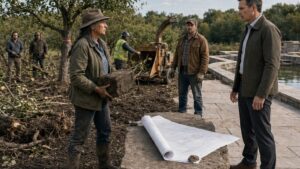
As the sun dipped behind the purple ridges of the Catskills, casting long, golden shadows across the orchard, Clara walked over to the newly uncovered geodetic monument.
The forged iron pin, with its square head and indented cross, sat proud and immovable in the solid limestone shelf. Clara reached down, brushed a speck of dark peat moss from the brass benchmark tag, and placed her hand flat against the cool, ancient stone.
The road was clear. The fences were gone. And across the rolling hills of Briar Lane, the true lines of the valley were restored at last.