The Iron Wings Of Marietta And The Girl With One Shoe
CHAPTER 1: THE IRON WING BAY
The river fog hung heavy and gray over the Muskingum, clinging to the blackened red brick and fluted iron trusses of the old locomotive foundry. Inside Bay Three of Iron Wing Custom Cycles, the damp air smelled of seventy-weight Valvoline motor oil, scorched flux from a Miller TIG welder, and wet river silt drifting up through the cast-iron floor grates. Gabe Mercer stood before his three-inch steel fabrication bench, a sixteen-ounce cross-peen hammer balanced lightly in his calloused right hand. His knuckles were crosshatched with pale silver scar tissue—souvenirs of six years as an Army combat medic in the Korengal Valley and twelve more shaping rigid chopper frames along the industrial margins of southeastern Ohio.
A rhythmic, uneven scuff echoed across the concrete threshold, cutting through the ambient hum of the shop’s transformer.
Gabe lowered the hammer without striking the annealed copper gasket clamped in the Wilton vise. He did not turn abruptly. Survival in violent, unmapped places had taught him long ago that sudden velocity invited panic in those who were already hunted. He set the hammer down onto the cold steel bench with a dull, deliberate clink, letting the resonance announce his stillness, then turned his broad shoulders smoothly toward the open overhead bay door.
Midday autumn sunlight knifed through the sulfur-tinted river mist, framing a child who looked small enough to blow away in an October draft. She was seven, maybe eight years old, with tousled blonde hair that fell in matted, dirt-streaked hanks around her thin collarbones. Her cotton dress, once cornflower blue with tiny white daisy prints, was faded to the color of wet river slate and torn along the jagged hem. But it was her feet that anchored Gabe’s clinical gaze.
On her right foot she wore an adult’s black canvas sneaker—a battered, high-top size eleven laced tightly with rough baling twine around her slender ankle to keep it from slipping off. Her left foot was completely bare, the pale skin scraped and packed with greasy red river clay, leaving damp, smudged prints along the smooth shop concrete as she dragged the oversized shoe forward with an agonizing limp.
In the back of the bay, Bull dropped a thirty-millimeter chrome socket onto a rolling steel cart. The metallic clatter rang out like a gunshot in the cavernous room. Two other veteran mechanics, Dutch and Miller, paused beside the hydraulic bike lift, their burly, leather-vested frames freezing in unison. The heavy iron chain hoists overhead swung gently in the draft, casting oscillating shadows across the rows of vintage Knuckleheads and stripped shovelhead frames lined up against the brickwork.
“Easy, boys,” Gabe murmured, his voice a low, gravelly baritone that barely carried past the workbench. “Back off the tools. Keep your hands down.”
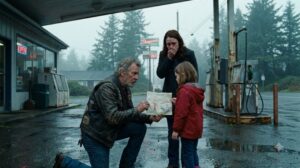
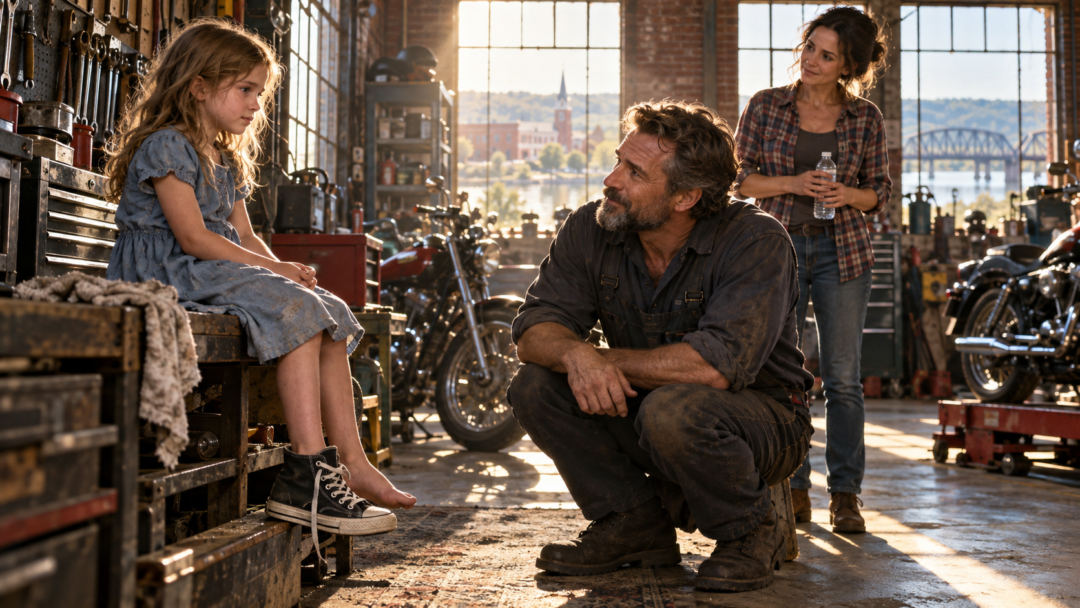
Gabe stepped out from behind the steel table and slowly lowered his six-foot-two frame down onto his haunches, dropping his center of gravity until his gray eyes were level with the girl’s. He spread his thick, scarred palms open at his knees, fingers relaxed, showing empty hands. He knew the posture of a cornered animal; any sudden advance, any towering shadow, would send her bolting back into the maze of overgrown rail spurs and rotting freight docks outside.
“You’re safe in here,” Gabe said, his cadence flat, calm, and steady as an idling Panhead. “Nobody’s going to hurt you. Nobody’s going to shout. What’s your name?”
The little girl stopped three paces away, balancing her weight awkwardly on her shod right foot to keep the lacerated sole of her bare left foot from touching the freezing concrete. Her chest rose and fell in shallow, breathless hitches that rattled with exhaustion. Wide, cornflower-blue eyes darted from Gabe’s graying goatee to the iron skull-and-wings insignia stenciled across the breast of his heavy leather cut, then flicked sideways toward the shadows where thirty motorcycles sat in various states of teardown.
“Avery,” she whispered. The syllable was so faint it was nearly swallowed by the hum of the overhead halogen transformers.
Behind Gabe, rubber-soled work boots clicked softly on the floor. Nora Bell, the garage business manager and a woman who had spent nine years investigating child welfare cases for Washington County before walking away from the department in disgust, stepped quietly into the bay. She carried a clean white cotton shop towel in one hand and an unopened bottle of spring water in the other. Nora did not crowd the child. She knelt four feet to Gabe’s left, her olive utility shirt rustling softly against her knees, her posture open and non-threatening.
“Hi, Avery,” Nora said, her tone gentle, pitched low to match the rhythmic hum of the shop. “That’s a long walk you took on a cold day. Can I give you some clean water?”
Avery’s gaze locked onto the clear plastic bottle. Her small tongue touched her dry, chapped upper lip, but she did not reach out. Her small hands stayed clenched against the dirty folds of her dress, her fingers whitening around whatever hard object she was gripping beneath the cotton fabric.
She looked down at the concrete floor, her chin trembling with an effort to suppress tears that had clearly been flowing for miles. When she lifted her face again, her blue eyes met Gabe’s with an intensity that made the veteran mechanic’s ribs tighten like an iron band.
“They told me no one would believe me,” Avery whispered, her voice cracking on the final word. “They said if I told anyone… Deputy Rusk would put me in the dark cellar at the county home, just like he did to Daddy.”
The warmth drained out of Gabe Mercer’s face. His jaw set into stone, his flared nostrils drawing in the chill autumn air. Behind him, Bull let out a low, guttural curse that died under Nora’s sharp backward glance. Every man in the room knew Deputy Wade Rusk—the senior county officer whose patrol cruisers seemed to hover around every foreclosed property and broken family in the district.
Before Gabe could answer, a dark shadow glided across the open sunlight of the bay.
Out in the gravel alley that separated Iron Wing Custom Cycles from the abandoned B&O freight depot, an unmarked black Ford Explorer cruised silently past. Its tinted windows were rolled completely shut. It had no rooftop light bar, but through the dark windshield, the unmistakable red glow of an active infrared dash-mounted camera was pointed straight into the shop floor, lingering on Avery’s bare foot before the vehicle slowed to an ominous crawl.