The Rose Hedges Over The Boundary Line On Briar Lane
CHAPTER 2: THE IRON PIN BENEATH THE BRIARS
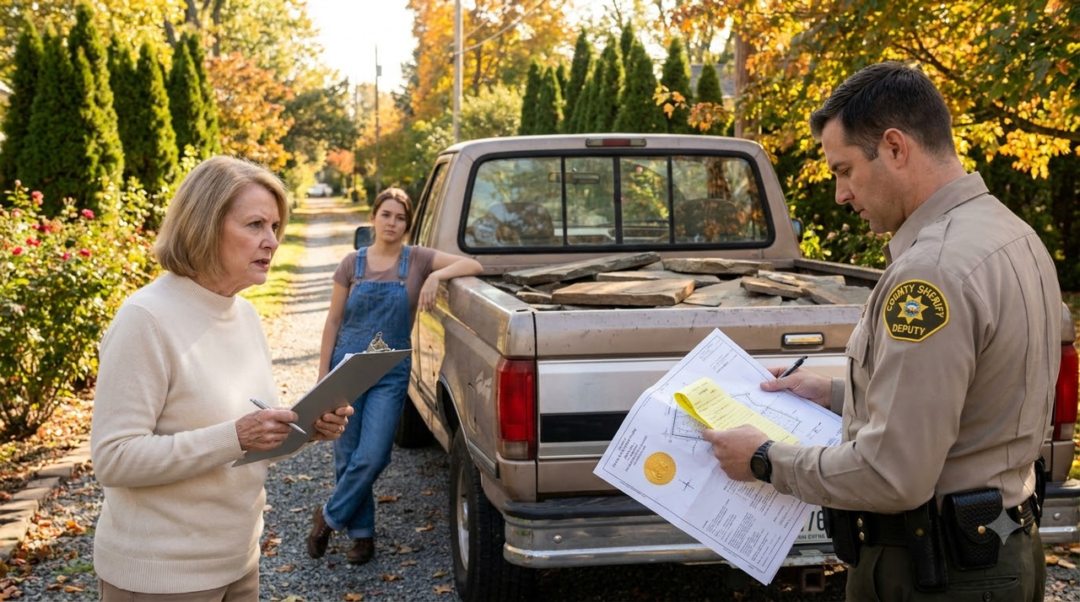
The yellow carbon slip fluttered in the autumn wind between Vivian’s trembling fingers, but the smug malice returning to her eyes was unmistakable. She tapped the red “STOP-WORK ORDER” stamp on the municipal envelope with the edge of her manicured fingernail.
“Harold Finch, Chief of Municipal Zoning and Code Enforcement for the Town of Red Hook,” Vivian announced, her voice regaining its haughty, piercing cadence. “Under Town Ordinance Chapter Forty-Two, any reconstruction of historic stone walls or vehicular retaining structures along designated residential rights-of-way requires an engineered environmental impact assessment and an approved municipal drainage permit. You don’t have either, Clara. If that tailgate opens, Deputy Callahan is legally obligated to take you into custody for violating a summary judicial injunction.”
Deputy Callahan frowned deeply, his eyes narrowing as he took the red-stamped envelope from Vivian’s hand. He examined the signature at the bottom, his jaw tightening until the muscle ticked against his cheek.
“Harold Finch is your brother-in-law, Vivian,” Callahan said, his voice flat with disgust.
“Harold Finch is an officer of the municipal court,” Vivian retorted, chin raised high. “His family connections do not invalidate his administrative authority. The injunction is stamped, sealed, and entered into the town docket as of eight-fifteen this morning. Touch those flagstones, Clara, and let’s see how comfortable a concrete holding cell feels compared to your grandfather’s farmhouse.”
Clara Mercer didn’t flinch. She knelt down on the crushed shale, calmly collecting her scattered survey diagrams and elevation sketches from the gravel. She stacked them neatly, slipped them back under the aluminum clipboard’s spring clip, and stood up to face Vivian.
“I won’t unload the bluestone today, Deputy,” Clara said softly, her voice cool and steady. “I have no desire to force an administrative standoff on the lane.”
“A very wise decision,” Vivian sneered, adjusting her pearls. “I expect that flatbed truck off Briar Lane within the hour. And don’t even think about touching my rose bushes. Adverse possession laws in New York grant equitable easements to established landscaping after ten years of continuous maintenance. My attorneys will file for quiet title by Friday afternoon. You’ll be paying my legal fees before the first snow falls.”
Vivian spun on her designer loafers and marched back up her paved driveway, her cashmere sweater vanishing behind the tall hedges of her two-million-dollar colonial manor.
Deputy Callahan waited until the heavy oak front door of the Vanderhoof estate slammed shut before turning to Clara, his expression weary and troubled. “Clara, I’m sorry. Harold Finch is as crooked as a dog’s hind leg, but that stop-work seal is technically valid until a magistrate vacates it. If you move dirt while that paper is active, Finch will have a warrant issued by the town justice before sundown.”
“Don’t apologize, Thomas,” Clara said, walking over to the tool rack mounted on the side of her truck bed. “Finch only has jurisdiction over new construction and retaining structures. He has zero authority over boundary demarcation and boundary marker recovery under New York State Real Property Law Article Nine.”
She pulled down an electronic surveyor’s total station mounted on a heavy wooden tripod, followed by a magnetic locator wand.
Callahan watched her set the brass leveling screws on the tripod with practiced, effortless precision. “What are you looking for, Clara? The county map already shows her fence is on your parcel.”
“The county map is based on an aerial orthophoto and deed metes-and-bounds,” Clara explained, powering on the magnetic locator. The electronic wand let out a low, rhythmic hum. “To vacate an injunction in Supreme Court, you don’t bring aerial sketches. You bring physical iron monumentation. In 1924, when my great-grandfather Arthur Mercer deeded the right-of-way easement to the town, the county surveyor drove four forged iron benchmark pins into the bedrock along this ridge.”
She swept the magnetic locator wand along the edge of the crushed stone lane, moving steadily toward Vivian’s rose bushes.
“If the 1924 monument is still intact,” Clara continued, “it proves the legal right-of-way boundary was established sixty years before the Briar Lane HOA was ever chartered. And if the HOA charter doesn’t encompass the underlying fee title, Vivian’s bylaws are legally nonexistent.”
The wand’s low hum suddenly jumped an octave, screaming with a sharp, high-pitched electronic whine.
Clara froze. The detector was pointing directly into the thorny, intertwined root base of a massive English heritage rose bush, two feet on Vivian’s side of the white cedar fence.
Clara knelt in the dirt, pulling a steel trowel from her tool belt. She carefully parted the thorny canes, scraping away three inches of dark peat moss and shredded cedar bark.
Beneath the mulch, something metallic caught the morning sun.
It wasn’t a standard iron surveyor pin. It was an industrial-grade copper grounding rod, wrapped tightly in a thick, severed black rubber jacket.
Callahan knelt down beside her, pushing his hat back on his forehead. “What in God’s name is that?”
Clara used the trowel to clear the dirt around the rubber jacket. Stenciled in faded white lettering along the conduit was: DUTCHESS TELECOM & INFRASTRUCTURE – PARCEL 4B SERVICE LATERAL.
The cable had been severed cleanly with hydraulic bolt cutters, the copper ends crushed and corroded with green verdigris. Directly beneath the cut cable lay an antique, square-headed iron bolt stamped with a deeply indented cross: the 1924 Mercer benchmark.
Clara looked up at Callahan, her jaw set like cold iron.
“Two years ago, when my grandfather was in the hospital in Rhinebeck, the farmhouse suddenly lost its landline phone and broadband connection,” Clara said, her voice dropping into a dangerous whisper. “The telecom company told us there was a catastrophic underground fault they couldn’t repair because the Briar Lane HOA refused them right-of-entry to dig. Grandfather couldn’t call for help the night his heart gave out, Thomas. He died waiting for a neighbor to check on him.”
Callahan stared at the severed cable, his weathered face draining of color. “Vivian’s landscapers buried this rose bed the exact same week your grandfather went into the ICU.”
“This wasn’t an accident,” Clara said, touching the cold iron pin beneath the cut wire. “They didn’t just encroach on the land to grow flowers. They cut the line to isolate an old man, force the property into neglect, and pave over the proof.”