They Ordered Him to Remove One Farm Antenna, Then Learned Their Whole Valley Ran Through His Land
Chapter 1: The Orange Flags Appeared Before Breakfast
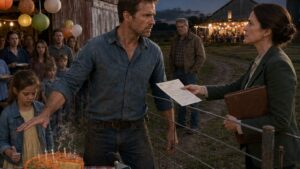
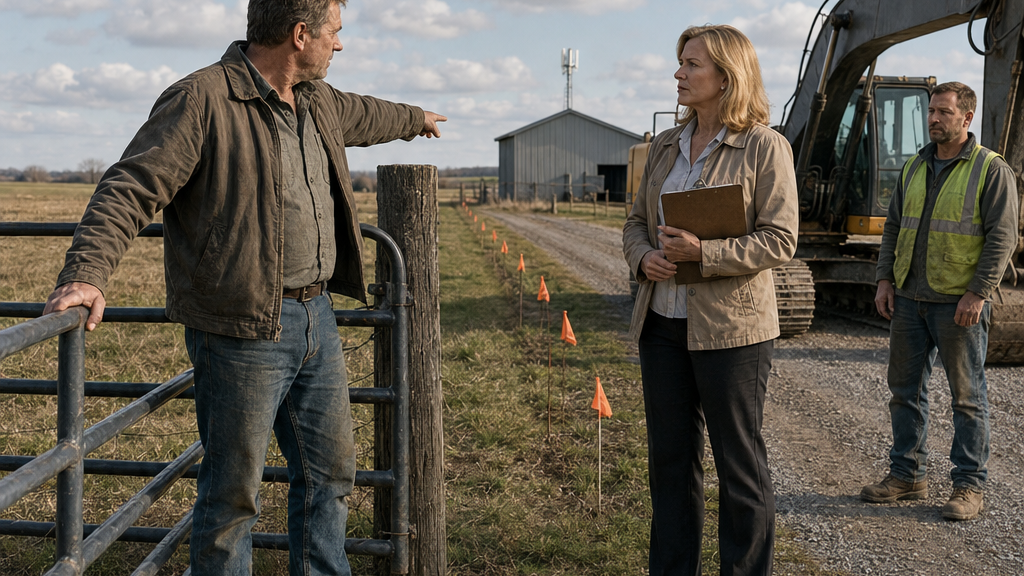
The excavator stopped with its steel tracks less than three feet from George Carter’s cattle gate.
George had been carrying a bucket of mineral supplement toward the lower pasture when he heard the diesel engine climbing the gravel road. By the time he reached the entrance, six bright orange flags had appeared along the shoulder, a fresh line of color cutting across the gray lane toward his equipment shed.
Pamela Green stood beside the machine with a clipboard tucked under one arm.
“Morning, George.”
He set the bucket down.
“Who put those flags there?”
“The association’s contractor.”
“That wasn’t what I asked.”
Pamela glanced at the excavator operator, then back at George. “We’re exercising access under the recorded utility easement. There’s an inspection order related to the unapproved communications equipment.”
George looked past her.
The small white antenna sat high on the south end of the equipment shed, hardly larger than a dinner plate from this distance.
“You brought an excavator to inspect an antenna?”
“The equipment is here for utility access and whatever corrective work is required.”
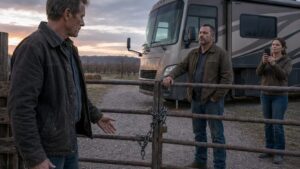
George walked to the gate.
The operator had shut the engine down. The sudden quiet made the ticking of hot metal unusually loud.
George unhooked the gate, stepped through, then pulled it closed behind him.
Pamela’s expression tightened. “You can’t obstruct easement access.”
“I’m not.”
“You just closed the gate.”
“The easement doesn’t go through that gate.”
Pamela gave him a look he recognized from feed-store counters and county meetings, the look reserved for a man presumed to be extending an argument because he had run out of facts.
“George, this isn’t complicated. The association has a recorded utility corridor across your parcel.”
“It does.”
“So move the gate.”
“No.”
The excavator operator shifted his weight but said nothing.
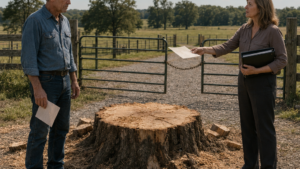
George walked toward the nearest orange flag. It stood in the grassy edge of the lane, perhaps twenty yards beyond the old cedar corner post.
He pulled it from the soil.
Pamela stared at him. “Do not remove survey markers.”
“It’s not a survey monument. It’s a plastic flag.”
“It marks the access route.”
“That’s the problem.”
He carried the flag back toward the cedar post and pressed it into the ground beside the weathered wood.
“The recorded strip ends on this side of the lane.”
Pamela opened the clipboard. “Our map shows otherwise.”
“Then your map is wrong.”
For the first time, the operator spoke.
“You have a survey?”
George looked at him.
“I have a deed.”
“That doesn’t necessarily establish field location.”
“No. But the cedar post does.”
He pointed to a shallow depression disappearing through the grass toward the hayfield. Years ago, before the lane had been widened, the utility trench had followed that line.
“Fiber went in twelve feet east of that post. Narrow corridor. Straight to the relay cabinet.”
Pamela frowned. “You seem awfully certain about an agreement you claim doesn’t give us access.”
“I didn’t say it gives you no access. I said it doesn’t give you this access.”
George pointed to the fresh flags. Two angled toward the equipment shed.
“That route puts a tracked machine across my working lane and outside the utility strip.”
Pamela lowered the clipboard.
“The antenna is in violation. You received notice.”
“I received paper.”
“You received an enforcement notice.”
“Same envelope.”
The operator looked away, suppressing whatever reaction crossed his face.
Pamela did not.
“This attitude is exactly why the board authorized formal action.”
George felt the familiar urge to say more than he should. He swallowed it.
The antenna had been installed only days earlier. He had expected a complaint eventually. He had not expected machinery at his gate before breakfast.
Pamela flipped to another sheet.
“You were notified that exterior communications equipment requires review. The filing fee is outstanding. The late administrative assessment is already accruing.”
“How much now?”
“Six hundred fifty dollars.”
George stared at her.
“For a plate-sized antenna.”
“For failure to submit.”
“And what happens Monday?”
“The board votes on enforcement.”
“Meaning?”
“Additional penalties. Removal authorization if necessary.”
George glanced at the shed.
In the farmhouse behind it, his father would probably be making coffee now, moving slowly between the counter and the kitchen table and pretending he did not need to stop halfway.
George looked back at Pamela.
“You’re not taking that antenna down today.”
“That decision isn’t solely yours.”
“It is if the machine has to leave the easement to reach it.”
Pamela opened her mouth.
The excavator operator raised one hand.
“I’m not crossing a disputed boundary without something clearer than this.”
Pamela turned sharply. “You were retained by the association.”
“I was retained to work where you have authority to put me.”
George said nothing.
That was the first small shift.
Not victory. Not even close.
But the machine stayed still.
Pamela gathered the loose papers against her clipboard.
“Fine. We’ll resolve the boundary issue separately.”
George nodded toward the orange flags.
“Start by putting them where the boundary actually is.”
Her jaw tightened.
“You should understand something before Monday. This is no longer an informal warning. The penalties continue whether you cooperate or not.”
“I understand.”
“And the board is not going to make policy based on who has owned land here the longest.”
George’s eyes settled on hers.
“I didn’t ask it to.”
Pamela held his gaze for a moment, then turned toward her vehicle.
The excavator operator climbed back into the cab but did not start the engine until she had driven away.
George remained at the cedar post.
One by one, the orange flags stirred in the morning breeze, pointing toward a route that looked official simply because someone had marked it.
Above the equipment shed, the white antenna caught a strip of sunlight.
George picked up the bucket he had left by the gate.
The machine eventually backed down the lane.
Before it disappeared, Pamela’s truck stopped at the road. Her window lowered.
“Monday. Seven o’clock. The board will decide the antenna issue then.”
George watched her drive away.
Only after the dust settled did he look again at the white dish above the shed.
Six hundred fifty dollars.
An excavator.
A formal hearing.
All for something small enough to cover with both hands.
Chapter 2: The Antenna Was Never Just for Television
Three days earlier, Frank Carter disappeared in the middle of a sentence.
His face froze on George’s laptop with his mouth half open and one hand raised toward the oxygen tubing under his nose.
The home-health nurse’s voice broke into metallic fragments.
“Mr. Carter, can you—pressure—today?”
Then the screen went black.
Frank looked at George.
“That mean I’m cured?”
George exhaled through his nose.
“It means the connection dropped.”
“Again.”
“Again.”
George moved the laptop toward the kitchen window as if another six inches might persuade the signal to return.
Outside, the equipment shed stood beyond the gravel turnaround. The new white antenna was visible beneath the roofline, angled toward the southern ridge.
A small indicator on the receiver beside the laptop blinked, steadied, then turned solid.
The nurse’s face returned.
“There you are.”
Frank leaned toward the screen.
“Wasn’t hiding.”
The nurse smiled. “How’s the swelling this morning?”
George let them talk.
That was why he had installed the antenna.
Not only because the old cellular hotspot failed whenever clouds settled over the ridge. Not only because winter storms could knock the farm’s ordinary internet connection down for hours.
The antenna gave them a second path out.
Weather alerts.
Clinic calls.
Messages from the pharmacy.
Emergency contact when the main line failed.
And, on Sunday afternoons, football.
George had not put any of that on the association application because there had been no application.
He had mounted the antenna himself on Tuesday morning, four bolts through a reinforced section of the shed roof, cable routed cleanly down the back wall.
On Friday, the notice arrived.
The envelope was waiting in the mailbox with a veterinary invoice and a machinery catalog.
NOTICE OF UNAPPROVED EXTERIOR INSTALLATION.
George read it twice standing at the end of the lane.
Aesthetic review fee: four hundred dollars.
Administrative assessment: two hundred fifty.
Fourteen days to remove or obtain approval.
He folded the page once and carried it inside.
Frank was in his recliner, oxygen concentrator humming beside him.
“That about the antenna?”
George stopped.
“How’d you know?”
“Woman slowed down yesterday and took a picture of the shed.”
“Pamela?”
“Blond hair?”
“Probably.”
Frank returned his attention to the television.
The picture was showing a replay from an old Panthers game.
George put the notice on the kitchen counter.
Frank said, “Take it down if it’s trouble.”
“No.”
“I can watch television without it.”
“That isn’t the point.”
“I lived here forty-nine years before anybody put internet on a fence post.”
“That still isn’t the point.”
Frank glanced over.
George regretted the sharpness immediately.
But his father merely adjusted the oxygen tubing.
“You get mean when you think somebody’s making you ask permission.”
George picked up the notice.
“I’m not asking permission to make sure I can reach a nurse.”
“You could tell them that.”
“I shouldn’t have to give a committee your medical history to bolt six pounds of equipment onto my shed.”
Frank’s gaze stayed on him.
There it was.
The thing George disliked more than the fine itself.
Having to explain.
Having to turn Frank’s failing heart into evidence.
He had spent the last two years rearranging farm work around cardiology appointments, pharmacy pickups, sodium restrictions, bad mornings, better afternoons, and the quiet calculation of whether his father could safely remain in the farmhouse.
George had promised he could.
He intended to keep that promise without advertising the details to a room full of neighbors.
Monday afternoon, another envelope arrived.
The administrative assessment had begun accruing.
A formal hearing had been added to the notice.
George put both pages on the kitchen table.
Frank watched him.
“You going?”
“Yes.”
“You taking the clinic letter?”
George had already printed it.
The nurse had sent a short note confirming Frank’s remote monitoring schedule and the importance of reliable connectivity.
It was folded inside an envelope on George’s desk.
“I might.”
Frank nodded toward the television.
“You know why I care about that thing?”
“The clinic.”
“No.”
George looked at him.
Frank pointed weakly toward the screen.
“Football.”
George almost laughed.
“I put in a satellite connection for medical calls and you’re worried about football.”
“One game a week.”
“You watched football before the antenna.”
“When the signal worked.”
Frank’s expression changed.
The joke left it.
“Sunday used to be your mother making chili, you yelling at officials like they could hear you, me telling you they couldn’t.”
George leaned against the counter.
His mother had been gone six years.
Frank looked back at the screen.
“Most weeks don’t have much shape anymore. Sunday still does.”
George said nothing.
The antenna outside suddenly seemed smaller and more important at the same time.
Not because football was essential.
Because routine was.
Because Frank could still sit in the same chair, argue over a bad call, and feel for three hours that the farm had not narrowed around him.
At six thirty, George changed his shirt and put the violation notice into a manila folder.
The clinic letter remained on the desk.
He stared at it before leaving.
Then he closed the drawer.
Frank noticed.
“You’re stubborn.”
“Learned it here.”
“Don’t blame me for everything.”
George picked up his keys.
At the converted grange hall, pickup trucks already lined the gravel lot.
He parked beside Jack Nelson’s truck and sat for a moment.
The medical letter was twenty minutes away in his desk.
The violation notice was in his hand.
He could still turn around.
Instead, George stepped out, walked to the hall, and opened the door carrying only the paper that said he had done something wrong.
Chapter 3: The Board Mistook Silence for Defiance
The first image on the projector was George’s equipment shed.
The white antenna had been circled in red.
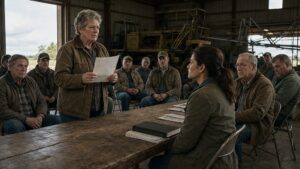
George had barely taken a seat before Pamela Green said, “We’ll begin with unresolved exterior violations.”
He stared at the photograph.
Someone had taken it from the road with enough zoom to make the antenna appear larger than it was.
Pamela sat at the center of the folding tables arranged across the front of the old grange hall. Jack Nelson was two chairs to her left, flipping through the board packet.
About twenty residents occupied the metal chairs behind George.
Pamela clicked to the next slide.
A roadside storage container.
Then an improvised wooden sign.
Then a tall pole beside a driveway.
“This isn’t about one property,” she said. “We’ve had seven unreviewed exterior installations in six months.”
George looked at the screen again.
For the first time, he saw the larger problem she thought she was solving.
Pamela continued.
“The association’s insurer specifically raised concerns about structures near shared roads and utility corridors. We also spent considerably more than projected repairing the north road this year.”
Jack shifted in his chair.
Pamela did not mention the exact deficit, but George understood enough.
Road work had gone badly. Everybody knew it.
Two washouts. Three culvert replacements. Gravel costs higher than expected.
The association wanted tighter control because loose rules had begun costing actual money.
That did not explain six hundred fifty dollars for his antenna.
But it made Pamela’s posture less mysterious.
She called his name.
George carried the violation notice to the front table.
Pamela gestured toward an empty chair.
He remained standing.
“You received the exterior-installation policy?”
“I received this.”
“And you installed without approval.”
“Yes.”
A murmur moved through the room.
Pamela seemed almost disappointed by the easy admission.
“Then we’re not disputing the violation.”
“We’re disputing whether the policy applies the way you’re using it.”
“How would it not?”
“It’s a communications receiver mounted on an existing agricultural building. It doesn’t block a road. It doesn’t interfere with the utility corridor. It doesn’t require association maintenance.”
Pamela folded her hands.
“The rule says exterior communications equipment requires review.”
“The rule also talks about towers, poles and ground structures.”
“It says communications equipment.”
George felt twenty people listening behind him.
He could have ended half the argument then.
My father has congestive heart failure.
His nurse checks him remotely.
Our connection is unreliable.
The antenna helps keep him on the farm.
Instead he said, “It’s on my shed.”
Pamela’s expression hardened.
“That isn’t an exemption.”
“I didn’t ask for one.”
“Then what exactly are you asking for?”
“A reasonable reading.”
Someone behind him coughed.
Pamela leaned back.
“George, this is what has become difficult. We have rules people agreed to follow. Then the moment enforcement reaches their property, suddenly the rules require interpretation.”
He met her eyes.
“I’m asking you to apply them to what actually exists.”
“And I’m telling you the board cannot operate on personal exceptions.”
There it was again.
Exceptions.
Special treatment.
George’s fingers tightened around the notice.
He should have brought the clinic letter.
Knowing it now only made him less willing to admit it.
Pamela turned to Jack. “Anything from finance?”
Jack looked uncomfortable.
“The fees are consistent with the schedule we adopted.”
George glanced at him.
After the discussion paused, Jack followed George toward the water dispenser near the rear wall.
Quietly, Jack said, “Is there something you’re not saying?”
George took a paper cup.
“About what?”
“The antenna.”
“What would I be hiding about an antenna?”
Jack lowered his voice.
“Medical use?”
George looked at him sharply.
Jack lifted both hands slightly.
“I’m asking because if there is, the board needs to know before this goes farther.”
“My father’s health isn’t board business.”
“No. But it might change how this gets handled.”
“That’s exactly why I’m not using it.”
Jack frowned.
“I don’t follow.”
“I shouldn’t need to put him on display to make them read their own policy carefully.”
Jack studied George for a second.
“That may be true. It also may not help you Monday night.”
“We’re already at Monday night.”
“You know what I mean.”
Pamela called the meeting back to order.
George returned to the front.
This time she had the farm photograph printed in front of her.
“Mr. Carter has argued the equipment should be treated differently because it is attached to an agricultural structure.”
“I said the policy distinguishes structures.”
“You have also suggested your property circumstances warrant individualized treatment.”
“No.”
Pamela continued anyway.
“This association cannot create one standard for newer residents and another for families who have owned acreage here for generations.”
The room went very still.
George felt heat rise behind his collar.
“My family history has nothing to do with that antenna.”
“I’m glad we agree.”
“No. We don’t.”
Pamela’s eyes narrowed.
“You brought it into this.”
“Because this board has repeatedly dealt with the idea that long ownership creates informal privileges.”
“I never said that.”
“Not tonight.”
George heard a chair scrape behind him.
For a moment, he wanted to tell the whole room about Frank.
The oxygen concentrator.
The frozen medical call.
Sunday football.
He wanted to put every private detail on Pamela’s table and make her feel the weight of having guessed wrong.
Instead he folded the violation notice.
That silence was no longer restraint.
He knew it.
It was pride.
And now it was costing him.
Pamela moved to the enforcement motion.
The board would authorize a site inspection of the antenna installation and adjacent utility corridor. Contractors could access the recorded easement for that purpose.
Jack hesitated before voting.
But he voted yes.
The motion passed.
George stood.
Pamela looked up.
“You’ll receive the written authorization tomorrow.”
George placed the folded notice into his pocket.
“Make sure the authorization matches the easement.”
“It does.”
“You checked?”
Pamela’s answer came too quickly.
“The association has operated under that easement for years.”
“That wasn’t my question.”
Her face tightened.
“We’re finished for tonight.”
George looked once at Jack.
Jack did not meet his eyes.
Outside, the gravel parking lot was dark except for headlights coming on one after another.
George reached his truck but did not open the door.
The easement.
Pamela kept speaking about it as though it were broad authority.
George remembered something different: a narrow utility strip, limited access, conditions written years ago when the broadband line first came through.
He could picture the old cedar post at his gate.
He could picture exactly where the trench had run.
And suddenly the orange flags from Saturday morning bothered him for a different reason.
They had not merely been aggressive.
They might have been wrong.
George got into the truck.
Before starting the engine, he looked toward the road leading home.
Pamela had just authorized contractors to enter his farm.
Now he needed to find out whether she actually had the right.
Chapter 4: The Old Easement Had One Missing Page
George found the easement at 11:17 that night, folded inside a cracked green file folder marked UTILITIES.
The document should have settled everything.
Instead, it made the problem worse.
He spread the pages across the scarred desk in the farm office, weighting one corner with a socket wrench so the ceiling fan would stop lifting it. The legal description was there. The parcel numbers were there. The grant of access was there.
But the exhibit showing the exact maintenance corridor was missing.
George checked the folder again.
Then the metal filing cabinet.
Then a cardboard box of old closing papers he had not opened in years.
Nothing.
Behind him, through the office window, the small white antenna was visible against the black roof of the equipment shed. Its status light glowed faintly.
George reread the easement.
A narrow corridor for buried communications infrastructure.
Reasonable access for inspection, repair and maintenance.
Restoration of disturbed agricultural ground.
Conditions for heavy equipment.
Except every important reference to the actual route pointed to Exhibit B.
And Exhibit B was gone.
He leaned back.
Pamela had authorized contractors to enter Tuesday morning.
Without the missing page, George knew what he remembered but could not prove what the record showed.
Frank appeared in the doorway in slippers, one hand resting against the frame.
“You planning to plant that paper?”
George looked up.
“What?”
“You’ve been staring at it long enough.”
“You should be asleep.”
“You should too.”
George tapped the easement.
“They’re using this to claim access to the shed.”
Frank came farther into the room.
“They put the cable near the old fence line.”
“I know.”
“Then what’s the problem?”
“I need the recorded map.”
Frank looked at the scattered papers.
“County.”
“I’m going first thing.”
Frank’s eyes moved toward the window.
“Don’t get too pleased if they’re wrong.”
George frowned.
“I’m not pleased.”
Frank gave him a look that said otherwise.
Tuesday morning, George reached the county records office before the clerk had finished unlocking the public terminal room.
He gave her the instrument number.
She typed it in, squinting at the screen.
“Utility easement?”
“Yes.”
“Recorded eight years ago.”
“I know.”
She printed the index page.
George watched the paper emerge.
Four pages listed.
His copy had three.
“There should be an exhibit.”
The clerk clicked deeper into the archived scan.
“There is.”
George leaned forward.
She rotated the screen toward him.
A fourth page appeared.
A narrow rectangular strip crossed his parcel from the county road, followed the eastern edge of the gravel lane, then cut toward the relay cabinet near the hayfield.
It never crossed the cattle gate.
It never reached the equipment shed.
And it certainly did not follow the orange flags Pamela’s contractor had planted Saturday.
George felt something inside him settle.
Not relief.
Something harder.
The clerk printed the page.
He laid it beside the original legal description.
The cedar corner post appeared on the drawing as a reference monument.
George almost smiled.
The same post Pamela’s contractor had passed before setting the first wrong flag.
“You need a certified copy?” the clerk asked.
“Yes.”
“Whole instrument?”
“All of it.”
While she prepared the certification, George read the maintenance notes.
Routine access was permitted within the recorded strip.
Emergency access could expand only as reasonably necessary to protect service or prevent damage.
Non-emergency heavy-equipment access outside the corridor required landowner consent.
George read that sentence twice.
Then a third time.
The excavator had not been there for an emergency.
The antenna was not part of the buried broadband system.
Pamela’s authority ended at the strip.
Saturday replayed in his mind differently now.
The stopped excavator.
The operator asking whether George had a survey.
Pamela saying the association had operated under the easement for years.
She had sounded certain because certainty was useful.
George folded the certified copy carefully.
By noon, he was back at the farm.
The orange flags were still there.
He walked from the road with the recorded exhibit in one hand.
First flag: close.
Second: several feet west.
Third: farther.
By the fourth, the marked route had peeled away from the easement entirely and aimed toward the shed.
George stood beside it.
From there, he could see both the cedar post and the antenna.
He pulled the flag from the ground and held it beside the map.
The error was not subtle.
A truck slowed at the road, and for a moment George thought Pamela had returned.
It was only one of the neighboring farmers.
The driver lifted two fingers from the steering wheel and kept going.
George replaced the flag exactly where he had found it.
He wanted the board to see its own line.
Inside the office, he spread the certified copy beside the violation notice.
That was when he noticed another reference.
Amendment to access terms, recorded the following spring.
George frowned.
He remembered the broadband project.
Everyone did.
Before the fiber line, people along the valley had relied on weak cellular service, old copper lines and whatever satellite provider would install far enough from town.
The original trench had taken months of arguments.
Routes.
Restoration.
Who would grant access.
Who would pay.
George searched the folder again and found the amendment near the back.
Two pages.
The first clarified maintenance procedures.
The second contained signatures.
Pamela’s predecessor as association chair.
A broadband company representative.
And beneath them—
George Carter.
He stared at his own name.
His signature was unmistakable, written with the same compressed G he still used on feed invoices.
For several seconds, he could not remember signing it.
Then pieces returned.
A folding table in this same office.
Frank arguing with somebody on speakerphone.
A map spread between coffee cups.
Neighbors worried about losing fences and pasture.
George insisting that emergency repair access be protected but ordinary work stay inside a defined strip.
He had not merely known where the easement ran.
He had helped decide how it worked.
A vehicle turned onto the lane.
George looked through the window.
A white utility truck.
Not Pamela.
It stopped near the relay cabinet.
A man stepped out, checked something inside the roadside equipment housing, then looked toward the farmhouse.
George folded the amendment slowly.
His anger from Monday night changed shape.
Pamela had assumed he was clinging to old ownership privileges.
The truth was almost the opposite.
Years ago, he had helped give the valley access across his land.
And the board now seemed to believe that cooperation had become permanent permission.
The utility truck left without approaching the house.
George looked down again.
His signature sat below the clause Pamela had apparently never read.
For the first time since the violation notice arrived, George understood that the board might need something from him far more important than an antenna approval.
Chapter 5: The Network Agreement Was His Idea Too
Catherine Roberts slid the amendment across her desk and tapped George’s signature with one finger.
“You didn’t mention this.”
George sat opposite her, arms folded.
“I forgot about it.”
“You forgot helping negotiate the document you’re now relying on?”
“It was eight years ago.”
Catherine gave him a flat look.
“That answer might work on your father.”
“It didn’t.”
She returned to the agreement.
Her office sat above a hardware store in town, close enough to the courthouse that she could walk there. There were no decorative law books behind her, only file boxes, a printer and a mug holding three pens.
George preferred that.
Catherine read silently.
“You’re right about the Saturday access.”
George waited.
“The recorded corridor is narrow. Their marked route crossed outside it. If the purpose was antenna inspection, I don’t see language here authorizing a tracked machine across the rest of your lane.”
“So I stop them.”
“You already stopped them.”
“I mean permanently.”
Catherine looked up.
“Permanently from what?”
“Using my property whenever the board feels like it.”
“That’s different.”
“It shouldn’t be.”
“It is.”
She turned the amendment toward him.
“The easement grants specific rights. You can insist they stay within those rights. You cannot pretend the easement vanished because the board annoyed you.”
“Annoyed me.”
“Fine. Overreached.”
“That’s better.”
“It still doesn’t terminate the broadband easement.”
George looked toward the window.
A grain truck moved through the intersection below.
“What if they need access outside the strip?”
“For routine work?”
“Yes.”
“They ask you.”
“And I say no.”
“You can.”
The answer came too easily.
George turned back.
“That’s it?”
“No. That’s the legal answer to the narrow question. It is not me telling you that every possible refusal is wise.”
George almost smiled.
“You always charge extra for the second answer?”
“No. Unfortunately.”
She opened another page.
“This amendment matters because it confirms the voluntary-access procedure. It also shows you were one of the landowners who negotiated it.”
“I wasn’t representing the association.”
“I didn’t say you were.”
“Then why does that matter?”
“Because you know what the agreement was supposed to accomplish.”
George said nothing.
Catherine studied him.
“Why did you help with it?”
He remembered more now.
The valley before fiber.
Frank driving into town to use Wi-Fi outside the library when paperwork had to be submitted electronically.
A neighbor climbing halfway up a hill just to make a phone call.
Businesses unable to run card readers.
Storm warnings arriving late.
George had owned the cleanest route for the trench.
He had resisted at first.
Then Frank had asked him what good land was if nobody could live on it anymore.
“We needed service,” George said.
Catherine nodded.
“And now?”
“Now the same people benefiting from that access are trying to use it to remove equipment from my shed.”
“Some of the same people. Not all.”
George looked at her.
She had found the weak point.
He disliked her for about two seconds.
His phone rang.
Unknown local number.
He nearly ignored it.
Catherine said, “Take it.”
George answered.
The caller identified himself as the broadband maintenance supervisor.
“We were out near your relay cabinet this morning.”
“I saw the truck.”
“We’re getting intermittent signal loss downstream. Not an outage yet.”
George sat straighter.
“What’s causing it?”
“Could be moisture in the enclosure. Could be a damaged splice. We need testing.”
“You can access the cabinet from the easement.”
“For the first step, yes.”
“For the second?”
A pause.
“We may need to bring a small service rig farther in if the fault traces beyond the cabinet.”
“How far?”
“Don’t know yet.”
“When?”
“Within a couple days, preferably.”
George looked at Catherine.
She could hear enough from his side to understand.
The supervisor continued.
“I also understand there’s a property-access dispute. I’m not calling about that. I’m calling because if this degrades, customers south of your place could lose service.”
“How many?”
“Several dozen.”
George’s eyes went to the amendment.
“I’ll call you back.”
He ended the call.
Catherine leaned back.
“And there it is.”
“There what is?”
“The part where being right becomes inconvenient.”
George stood.
“They can stay inside the easement.”
“If the fault is inside it, yes.”
“If it isn’t, they can ask.”
“And you can say no.”
“Correct.”
Catherine nodded.
“But now you know who pays for that answer.”
George picked up the papers.
“The board had no problem making my father pay for theirs.”
“That is not the same thing.”
“It feels close enough.”
“That’s why you should be careful.”
He left before she could say more.
At the farmhouse that evening, Frank was at the kitchen table cutting an apple into thin slices.
George placed the certified easement on the table.
Frank adjusted his glasses.
“What am I looking at?”
“The reason the excavator stopped.”
Frank read the corridor description.
“You found the old agreement.”
“You remember this?”
“Course I do.”
“I barely did.”
“That’s because you did most of your thinking out loud for six months, then forgot all about it once the trench was covered.”
George pulled out a chair.
“I signed the amendment.”
Frank looked amused.
“You wrote half of it.”
“I did not.”
“You argued half of it until the lawyer wrote words you liked.”
George remembered standing at the cedar post with a tape measure while contractors marked the trench.
Frank had insisted the agreement protect emergency repair access because cutting off the road’s older residents for days would defeat the entire purpose.
George said, “You were the one pushing for broadband.”
“I was pushing you.”
“Same difference.”
Frank took another piece of apple.
“No.”
George told him about the failing relay.
Frank’s hand stopped halfway to his mouth.
“How many people?”
“Several dozen if it goes down.”
“And they need the farm?”
“Maybe.”
Frank watched him.
George knew the question before it came.
“They should have thought about that before authorizing an excavator.”
Frank set the knife down.
“That wasn’t my question.”
“I know.”
“Then answer the one I asked.”
“You didn’t ask one.”
Frank leaned back.
“Are you planning to protect the farm, or punish the board?”
George looked toward the dark kitchen window.
The white antenna was invisible from here, but its receiver light glowed beside the router.
For several days he had wanted Pamela to discover that authority had limits.
Now he had a way to make the lesson impossible to ignore.
What he did not yet know was whether he could use that leverage without becoming the thing he was angry at.
Chapter 6: When the Leverage Became Someone Else’s Problem
The maintenance supervisor called George at 6:42 Wednesday morning.
“We’ve got a window.”
George was already in the barn.
“For what?”
“The relay is degrading faster than we expected. We can stabilize it today if we get access before noon.”
George stopped beside the feed cart.
“Inside the recorded corridor?”
“Initial work, yes. If the test shows damage farther up, I need room to bring the service rig around the cabinet.”
“How far around?”
“Possibly fifteen feet outside the strip.”
George looked through the open barn door toward the lane.
Orange flags still marked Pamela’s route.
“Then you need my permission.”
“Yes.”
The supervisor did not argue.
That helped.
“How long before people lose service?”
“Could be hours. Could be tomorrow. I’m not going to pretend I know.”
George rubbed a hand across his jaw.
“Who’s on that branch?”
“Residential customers. Couple of farms. People working from home.”
“Anybody medical?”
Another pause.
“We don’t normally share customer details. But because you’re asking about the consequence of access, I can tell you we have priority-service notes on more than one account.”
George closed his eyes briefly.
Frank’s frozen video call returned immediately.
“I’ll call you back.”
He drove to the association office instead.
Pamela was already there.
Jack sat at the end of the table with a calculator and three stacks of invoices.
George placed the certified easement on the table.
Pamela looked at it.
“What is this?”
“The complete record.”
“I’m aware an easement exists.”
“No. You’re aware of the part you’ve been using.”
He opened the exhibit.
“The strip ends here. Your contractor marked across my lane and toward the shed.”
Pamela studied the page.
Jack stood and came closer.
George placed Catherine’s highlighted copy beside it.
“Routine maintenance stays in the corridor. Anything outside it needs permission unless there’s an emergency.”
Pamela looked up.
“The relay now requires repair.”
“I know.”
“Then this whole argument is academic.”
“No.”
“If service is at risk, emergency provisions apply.”
“The supervisor said the system is degrading. He did not say he needs emergency access outside the strip yet.”
Pamela’s voice sharpened.
“So you intend to hold broadband service hostage over your antenna fine.”
Jack stopped looking at the map.
George felt the accusation land because part of it was too close to what he had imagined Tuesday night.
“No.”
“Then authorize the repair.”
“Withdraw the antenna penalties.”
Pamela stared at him.
There it was.
The clean trade.
What he had wanted.
Jack looked from one to the other.
Pamela said, “Those matters are separate.”
“You just made them the same sentence.”
“The association cannot erase a violation because you control access to a utility.”
“I don’t control the utility.”
“You control the land.”
“Exactly.”
Jack spoke quietly.
“Pamela.”
She ignored him.
“If thirty or forty homes lose service because you refuse reasonable access, that will be on you.”
George stepped closer to the table.
“And when your contractor crossed outside the recorded easement because you wanted to enforce a cosmetic rule, who was that on?”
Pamela’s face changed.
Not guilt.
Pressure.
George could see it now in a way he had not at the grange hall.
She was tired.
There were road invoices scattered near Jack’s elbow. One had a red past-due stamp.
Pamela said, “We have spent months trying to stop residents from treating every standard as optional. We have an insurance renewal coming. We have road overruns. We have people putting structures beside common access without review.”
“And that makes my father’s antenna what?”
“A rule we either enforce or don’t.”
George almost told her then.
About Frank.
About the nurse.
About Sunday.
Instead he caught himself doing the same thing again—making silence into a test nobody else knew they were taking.
Jack pushed the easement closer to Pamela.
“This doesn’t authorize what we did Saturday.”
Pamela turned to him.
“We acted on the association map.”
“The association map is wrong.”
“We can correct it.”
“We should have checked before sending equipment.”
Her eyes hardened.
“You voted for the inspection.”
“I did.”
Jack did not look away.
“And I was wrong to vote before seeing this.”
The room went quiet.
That mattered more than George expected.
Not because Jack had switched sides.
Because he had admitted error without demanding anything in return.
George looked down at the maps.
The maintenance supervisor called again.
George answered in the room.
“We need an answer.”
George glanced at Pamela.
Then Jack.
Then at the orange route drawn beyond the legal strip.
“You can enter the recorded easement now.”
“And if we need outside it?”
“Call me from the cabinet. I’ll meet you there.”
Pamela said, “George—”
He held up one hand.
“The repair goes forward. My violation dispute does not disappear.”
The supervisor said, “Understood.”
An hour later, the utility truck rolled through the farm entrance.
George stood beside the cedar post.
Pamela and Jack had followed in separate vehicles.
George made them walk the line.
Not because he needed witnesses legally.
Because he needed the board to see the distance between permission and assumption.
The technicians opened the relay cabinet.
Testing took twenty minutes.
Then the supervisor approached.
“The fault is in a splice beyond the cabinet. I need the small rig around this side.”
He pointed outside the easement.
George looked at the ground.
Hay stubble. Firm soil. No livestock in that section.
“How long?”
“Forty-five minutes if it goes clean.”
“Stay between the flags I place. No farther west.”
“Fine.”
George took three unused orange flags from the supervisor’s truck.
He walked the edge himself.
At the cedar post, he stopped.
Pamela watched.
The corrected line ended exactly where George had told her it ended Saturday morning.
The service rig passed through only after George opened a separate farm access and directed it onto the permitted temporary route.
No threats.
No speeches.
No outage.
By early afternoon, the supervisor closed the relay cabinet.
“Signal’s clean.”
George nodded.
Pamela stood near her truck.
“The board will still need to address the antenna.”
“I know.”
“And the outstanding fees remain until then.”
“I know that too.”
Jack looked at her.
“Pamela, we can’t demand immediate cooperation from him while refusing to review whether our own enforcement was proper.”
She folded her arms.
“You want to revisit the vote?”
“I want the complete easement and the antenna issue on the agenda.”
George wiped dirt from his palms.
“Thursday night.”
Pamela looked at him.
“That isn’t the regular meeting schedule.”
“It is now if you want this settled.”
Her mouth tightened.
George pointed toward the repaired relay cabinet.
“I gave access because people needed the service. Not because you were right.”
Pamela glanced at the technicians packing their tools.
For once, she had no immediate answer.
George walked back to the gate.
Above the shed, the small white antenna held steady against the afternoon sky. Below it, the broadband cabinet hummed again for dozens of homes farther down the valley.
Two systems.
Both about connection.
Only one of them had nearly been turned into a weapon.
George rested a hand on the cedar post.
Then he looked back at Pamela.
“Thursday,” he said. “Bring the full board record. I’m bringing the full easement.”
This time, when she nodded, it was not an order.
It was an agreement.
Chapter 7: The Gate Stayed Closed Until the Rules Changed
George placed the complete easement packet on the folding table and set the unpaid antenna notice beside it.
Pamela Green looked at both documents before she looked at him.
The grange hall was fuller than it had been Monday. Word about the broadband repair had traveled quickly, although nobody in the room had actually lost service. That had not stopped people from hearing versions in which George had almost shut down half the valley, or Pamela had tried to seize part of his farm, or a utility company had threatened to dig up the road.
George had heard three versions himself by lunchtime.
None were quite true.
Jack Nelson sat beside Pamela with the association ledger open in front of him. The remaining board members had copies of the certified easement.
George had brought no attorney.
Catherine had offered.
He had declined.
If he could not say what needed saying himself, bringing her would only give him another place to hide.
Pamela called the meeting to order.
“We have two related matters tonight. The Carter exterior-equipment violation and the utility-access dispute.”
George remained seated.
Pamela lifted the antenna notice.
“Before we begin, I want to clarify that the association’s intention was never to interfere with essential utility service.”
George said, “Neither was mine.”
Several people shifted in their chairs.
Pamela glanced at him, perhaps expecting more.
He gave her nothing else.
Jack spoke first.
“The easement exhibit circulated tonight is the certified county record. It differs from the working map the association used Saturday.”
A board member asked, “How?”
Jack projected both onto the wall.
The difference was obvious even at the back of the room.
The association’s version showed a broad path bending across George’s gravel lane.
The recorded exhibit showed a narrow strip stopping east of the cedar gatepost.
Jack pointed to the screen.
“The contractor’s marked route extended outside the recorded corridor.”
Pamela clasped her hands.
“We relied on the map we had in our files.”
George finally spoke.
“That explains the mistake. It doesn’t make the route legal.”
Pamela nodded once.
“No. It doesn’t.”
The admission quieted the room more effectively than an argument would have.
George had prepared himself for resistance.
Instead, Pamela continued.
“The board should have verified the recorded exhibit before authorizing equipment access.”
Jack looked down at the ledger.
George watched Pamela carefully.
She was not apologizing for everything.
But she was correcting something specific, in public.
That mattered.
Pamela moved to the antenna.
“The remaining question is whether the communications installation required prior approval under the exterior-equipment standard.”
George opened his folder.
“This is the current policy.”
He placed a copy in front of the board.
“It identifies freestanding communications towers, poles, roadside structures and equipment affecting common access.”
Pamela said, “It also says communications equipment.”
“It does. It doesn’t say every receiver attached to an existing agricultural building automatically requires the same review.”
“That interpretation wasn’t clear to the board.”
“Then the policy wasn’t clear enough to support six hundred fifty dollars in penalties.”
A board member turned toward Pamela.
Jack said, “I agree with that.”
Pamela’s mouth tightened slightly.
George knew what she was thinking.
One exception became two.
Two became ten.
Soon every roadside structure owner would point at George’s antenna and ask why their project was different.
He understood the fear now.
That did not make the fine reasonable.
Pamela looked toward the residents.
“We have had seven unreviewed installations in six months. We also have an insurance renewal pending and significant road-repair overruns.”
She stopped.
For the first time, her voice lost some of its official flatness.
“The north-road repairs exceeded budget by nearly a third. We have invoices still outstanding. When the complaints started about roadside structures, I believed inconsistency would make the problem worse.”
Nobody interrupted.
Pamela looked directly at George.
“I pushed for enforcement quickly because I did not want the board to appear unable to enforce anything.”
There it was.
Not cruelty.
Not conspiracy.
Fear dressed as certainty.
George could work with fear.
He could not excuse what it had done.
“You wanted the board to look strong.”
“Yes.”
“So you treated questions as defiance.”
Pamela paused.
“Yes.”
George looked at the notice.
Four days earlier, that answer would have satisfied something ugly in him.
Now it simply made the next part easier.
He took another paper from the folder.
“This is the clinic documentation I didn’t bring Monday.”
Frank’s name appeared at the top.
George kept his hand on the page.
“I’m not offering it as a request for special permission.”
Pamela said nothing.
“My father has congestive heart failure. He lives with me on the farm. We use remote appointments. We use weather alerts. We need a reliable second connection because regular service out there isn’t always reliable.”
The room became very still.
George disliked every second of it.
He had spent a week refusing precisely this moment.
But he continued.
“And yes, he watches football through it.”
Someone near the back gave a quiet laugh.
George almost smiled.
“He’d probably tell you that’s the main reason.”
A little of the pressure left the room.
Then George looked back at Pamela.
“I should have told you enough Monday to understand why I cared.”
Pamela appeared surprised.
George was surprised himself.
“But I shouldn’t have needed my father’s diagnosis to get the board to check its own rule.”
“No,” Pamela said. “You shouldn’t have.”
Jack closed the ledger.
“The fees should be withdrawn.”
One board member asked, “All of them?”
“Yes.”
Pamela looked around the table.
Then she said, “I’ll make the motion.”
That surprised George more than anything else that evening.
The motion withdrew the antenna review fee, the administrative assessment and the removal demand.
It passed.
No applause followed.
George was grateful for that.
Paper moved across the table. Someone whispered about revising the exterior-equipment policy.
Pamela leaned toward George.
“We can document the antenna as approved and close the matter.”
“Not privately.”
She frowned.
“I didn’t say privately.”
“You were about to.”
Her expression told him he was right.
George slid the easement packet closer.
“I want the minutes to state three things. The fine was withdrawn. The contractor route exceeded the recorded easement. Future non-emergency access outside that corridor requires landowner permission.”
Pamela sat back.
“That creates a formal finding against the board.”
“It creates an accurate record.”
“We could resolve this without making every internal mistake permanent.”
George thought about Catherine telling him that being right became inconvenient.
Then he thought about his own silence Monday.
Mistakes left unnamed had a way of turning into precedent.
“No.”
Pamela stared at him.
George kept his voice level.
“I’m not asking you to write that anybody acted maliciously. I’m asking you to write what happened.”
Jack said, “He’s right.”
Pamela looked at him.
Jack shrugged once.
“If we correct the map but not the minutes, somebody five years from now finds the same wrong file and does it again.”
That ended the argument.
The wording took another twenty minutes.
It was plain.
The association had relied on an inaccurate working map.
The contractor route had extended outside the recorded corridor.
The antenna penalty had been withdrawn because the existing policy did not clearly classify the installation.
A revised approval process would distinguish small attached communications receivers from towers, major ground installations and structures affecting shared roads or utility access.
When the vote passed, George felt something he had not expected.
Not triumph.
Relief.
Pamela gathered her papers slowly after the meeting.
Most residents had already left when she approached him.
“I still think you made this harder than it needed to be.”
George slipped the clinic letter back into his folder.
“So did you.”
A faint, tired smile crossed her face.
“That may be the first thing we’ve agreed on all week.”
“Second.”
“What was first?”
“The road repairs cost too much.”
Pamela actually laughed.
Once.
Then she looked toward the projected easement map still glowing on the wall.
“I should have checked.”
“Yes.”
“You could have told me about your father.”
“Yes.”
Neither statement canceled the other.
That seemed important.
Saturday morning, association volunteers returned to George’s entrance with a printed copy of the certified exhibit.
No excavator came.
Jack carried a measuring wheel.
George walked the corridor with him while two board members removed the incorrect orange flags.
They replaced only the markers necessary to identify the utility strip.
At the cedar gatepost, Jack stopped.
“That’s it.”
George looked at the final orange flag.
Exactly where he had told Pamela it belonged a week earlier.
“Yep.”
Jack glanced toward the equipment shed.
The white antenna remained fixed near the roofline.
“Funny amount of trouble for that little thing.”
George looked at him.
“It wasn’t really about that.”
“No.”
They both understood that now.
The association took a photograph for its updated property file.
This time, nobody circled the antenna in red.
Sunday afternoon, George carried two bowls of chili into the living room just before kickoff.
Frank sat in his usual chair, oxygen line tucked over his ears.
“You’re late.”
“Game hasn’t started.”
“Pregame started.”
“That isn’t a game.”
“It is when you’re seventy-eight.”
George put a bowl on the side table.
The television picture was clear.
Frank sampled the chili.
“Needs salt.”
“You’re not getting salt.”
“Then why ask me?”
“I didn’t.”
Frank watched him sit down.
“They fix your little war?”
“There wasn’t a war.”
“That why there was construction equipment at my gate?”
George looked toward the window.
Beyond the pasture, the cedar post stood beside the closed gate.
The corrected orange markers stopped before it.
No machine crossed that point now unless the easement allowed it or somebody asked.
Above the equipment shed, the small white antenna faced the ridge.
Farther down the field, hidden beneath the soil, the broadband line carried calls, work, medical information and Sunday games toward dozens of homes.
George had once helped put that connection there because people should not have to leave the valley simply to remain connected to the world.
For a day, anger had almost made him forget that.
Frank pointed at the television.
“You see that?”
George turned.
A player had already been flagged.
“Terrible call.”
Frank smiled.
“You say that every Sunday.”
“So did Mom.”
“That’s why she was usually right.”
George leaned back.
Outside, the gate stayed closed.
The connection stayed open.
For the first time all week, neither felt like surrender.
The story has ended.