He Poured Concrete Across My Farm Lane Without Asking—Then the Survey Changed What Our Handshake Meant
Chapter 1: They Broke Up the Concrete Before Breakfast
The first jackhammer strike came before sunrise.
Daniel Taylor felt it through the soles of his boots before he heard it clearly—a hard mechanical concussion traveling through the gravel at the farm entrance, followed by the brittle crack of concrete that had not been there twenty-four hours earlier.
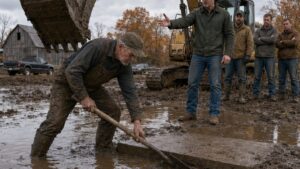
He stood beside the cattle gate with one hand resting on the weathered top rail while a county-authorized crew cut the pale new slab into manageable sections. Dust lifted in short bursts around their boots. Beneath the powder, the concrete still had the clean color of something barely cured.
One of the workers shut off his jackhammer and looked toward Daniel.
“You want the edge kept back from the hinge post?”
Daniel nodded. “Give me six inches if you can.”
The worker marked it with chalk and bent down again.
Across the lane, Anthony Brown’s machinery barn sat behind a line of walnut trees. Its sliding doors were shut. Daniel had not seen Anthony yet.
That was almost worse.
Catherine came down from the house carrying two travel mugs. She handed one to Daniel without speaking and watched another piece of concrete split along a saw cut.
“Never thought I’d see somebody tear out a driveway the morning after it went in,” she said.
“It isn’t a driveway.”
“No.”
Daniel took a drink. The coffee was too hot, but he swallowed anyway.
The slab crossed the lane at a shallow angle, beginning near Anthony’s side and extending past the line where Daniel’s gravel widened toward the cattle gate. From a distance it looked neat. That had been part of what made it so infuriating.
Someone had spent money making the trespass look permanent.
The county inspector had been precise the afternoon before. The section over Daniel’s boundary had to come out. The contractor could recover what remained on Anthony’s side if there was enough to save, but Daniel’s portion was not to stay.
That should have felt like the end of it.
Instead, every hammer strike seemed to expose another question underneath.
Twenty-four hours earlier, Daniel had known none of this was coming.
He had awakened Saturday to the beep of a truck reversing somewhere near the lane.
At first he thought it was one of the feed deliveries. He pulled on jeans, stepped onto the back porch, and saw the concrete truck angled near the cattle gate.
By the time he reached the lane, the forms were already full.
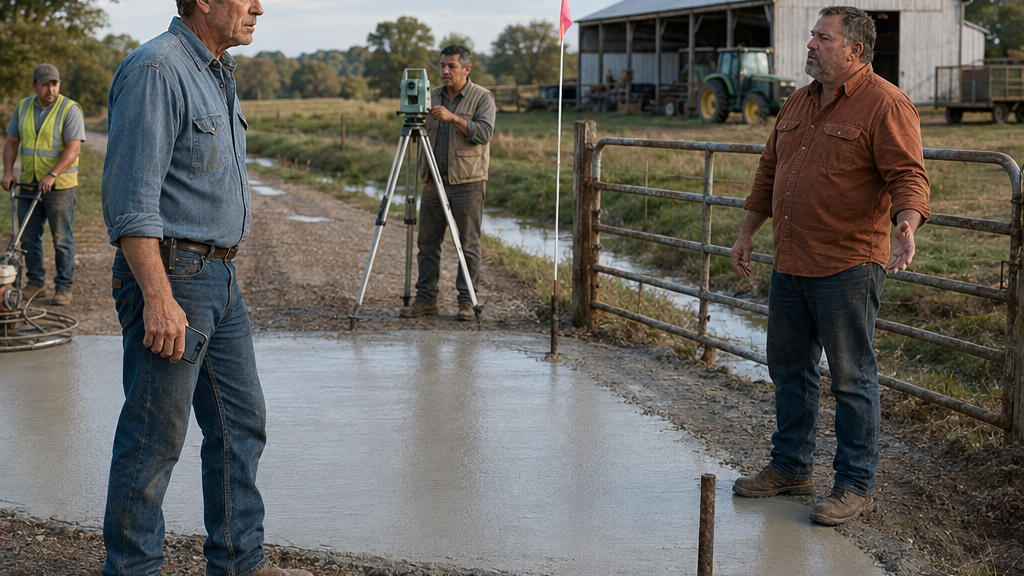
Fresh concrete stretched over the gravel where Anthony had crossed for years to reach his barn. Two men worked the surface with long-handled floats. Another was cleaning tools beside the truck.
Daniel stopped before stepping onto the wet edge.
“What’s this?”
The contractor glanced toward Anthony’s property.
“Access apron.”
“For who?”
The man’s expression changed slightly.
“Brown.”
Daniel looked at the slab again.
The cattle gate stood half open beside it, the bottom corner nearly touching the new concrete. A little farther down, where grass met gravel, Daniel could still see the rust-dark head of an old iron survey pin.
The concrete had passed it.
Not by inches.
By feet.
Daniel took out his phone.
He photographed the slab from the road. Then from the gate. Then the pin. Then the truck. Then the license plate.
The contractor watched him.
“You got a problem with the pour?”
“I’m figuring out what I’ve got.”
He did not raise his voice.
That restraint cost him more than shouting would have.
On the hood of Daniel’s farm pickup, tucked beneath the driver-side wiper, was a folded sheet of yellow legal paper.
He knew Anthony’s handwriting before he opened it.
Daniel—
Had the entrance cleaned up and poured so we quit tearing it up with trailers. Should make things easier for everybody.
Anthony
Daniel read it twice.
Then once more.
Catherine found him standing there with the note in one hand and his phone in the other.
“What did he say?”
Daniel handed it to her.
She read it and looked toward Anthony’s barn.
“Everybody.”
Daniel said nothing.
“He means himself.”
“I know what he means.”
“No, I don’t think you do.”
A worker dragged a finishing tool across the surface, leaving a smooth dark sheen behind it.
Catherine held the paper out.
“He didn’t ask you.”
“No.”
“He knew he should.”
Daniel looked at the old pin.
That was the moment the anger settled into something colder.
Not because concrete had been poured.
Because Anthony had written the note as if permission had already existed.
By midmorning Daniel had found the closing folder from 2019. The certified survey lay behind the deed, creased once down the middle. The line on paper matched what he had understood for years: the lane was his. Anthony’s parcel touched it, but no recorded easement crossed the strip where the slab had been poured.
Daniel had sent photographs to the county office and left a message.
The inspector called back shortly after.
By afternoon the fresh concrete had become an official problem instead of a neighbor argument.
Now, Sunday morning, that problem was being broken into pieces.
A skid-steer lifted a jagged section and dropped it into a dump trailer.
The sound brought Anthony out at last.
He crossed his yard quickly, wearing work boots and an old gray sweatshirt. His face was flushed before he reached the gate.
“What the hell are they doing?”
Daniel set his coffee on the fence post.
“You got the notice.”
“I got a paper shoved in my door.”
“That was the notice.”
Anthony looked at the broken slab.
“You called the county on me?”
Daniel let the question sit.
Anthony stepped closer.
“I paid for that.”
“I know.”
“You could’ve talked to me.”
Daniel looked at him then.
“You poured concrete on my ground before breakfast.”
Anthony opened his mouth, stopped, and looked toward the crew.
“We’ve used this for years.”
“Used it.”
“I improved it.”
“For you.”
“For both of us. That mud hole was a mess every spring.”
Daniel glanced toward the drainage ditch. “You didn’t ask.”
Anthony lowered his voice.
“You never cared before.”
There it was.
Not ownership.
Something more dangerous.
Assumption.
Another section broke free behind them.
Anthony watched the skid-steer lift it.
Then he turned back to Daniel.
“This is costing me twice now.”
Daniel felt Catherine step closer behind him.
Anthony pointed toward the broken concrete.
“I want reimbursed.”
Daniel said nothing.
Anthony’s jaw tightened.
“You heard me. You’re the one who had them tear it out. You can pay me for what I put into it.”
The jackhammer started again.
Daniel looked at the concrete, then at the open gate beside it.
For three years, he had believed leaving that gate open was the easiest way to be a good neighbor.
Now Anthony was standing on the other side of it, asking Daniel to pay for a road he had never agreed to build.
Chapter 2: The Gate We Had Left Open for Years
The first time Anthony asked to use Daniel’s lane, he had stood beside the same gate with a loaded equipment trailer behind his pickup and looked almost embarrassed to ask.
That was three years earlier.
Daniel remembered it because Anthony had come over instead of simply driving through.
“You mind if I cut across here?” Anthony had said. “Just this once. Ground’s too soft on my side.”
Daniel looked past him toward the rear machinery barn Anthony had bought with the adjoining acreage.
The lane gave a straight shot from the county road to the back of Anthony’s place. Without it, Anthony had to make a tight turn around his house and cross a low patch that held water after rain.
Daniel unhooked the chain from the gate.
“Go ahead.”
Anthony smiled.
“Appreciate it.”
That should have been all.
One trailer.
One wet week.
One favor.
Instead, the gate stayed easier to open the second time.
Then the third.
At first Anthony always asked.
Sometimes by phone.
Sometimes from the lane.
Sometimes with a wave from his pickup and a question through the open window.
Daniel rarely said no.
There was usually no reason to.
The two men had known each other long enough to exchange tools, help with broken equipment, and check cattle when one of them was away. Anthony had once spent half an afternoon helping Daniel pull a dead limb off a fence after a storm. Daniel had hauled Anthony’s compact tractor out of mud the following spring.
That was how Daniel understood rural neighborliness.
You remembered who had shown up for you.
You did not count every favor.
The gate gradually stopped being a question.
Daniel left it unlatched during hay season because opening and closing it every time Anthony crossed became pointless. Anthony would slow at the entrance, lift two fingers from the steering wheel, and continue toward his barn.
Then came the first small change.
Catherine noticed it before Daniel did.
She stood at the kitchen window one afternoon looking toward the lane.
“Did you tell Anthony he could spread stone down there?”
Daniel looked up from a parts invoice.
“What?”
She pointed.
A compact tractor moved backward along the entrance, dragging a box blade. Fresh limestone had been spread along the edge where Anthony’s tires usually dropped into soft ground.
Daniel went outside.
Anthony shut off the tractor when he saw him.
“Hope you don’t mind,” he said. “I had some extra stone. Thought I’d fix that rut.”
Daniel looked down.
The rut was gone.
The lane looked better.
“You staying inside the gravel?”
“Far as I know.”
Daniel hesitated.
That was the moment.
Years later, he would remember it more clearly than any argument.
He could have said, Ask me next time.
He could have walked to the barn, pulled out the survey, and pointed to the line.
Instead he kicked at a piece of limestone.
“Looks all right.”
Anthony grinned.
“Figured you wouldn’t complain about free gravel.”
Daniel let that stand.
That evening Catherine asked what he had told him.
“Nothing.”
She stared at him.
“You told him nothing?”
“It fixed the rut.”
“That isn’t what I asked.”
Daniel opened the refrigerator.
“Cat, I’m not starting a property war over half a load of stone.”
She leaned against the counter.
“Nobody said war.”
He shut the refrigerator harder than necessary.
His father had spent nine years fighting with a neighbor over a fence line when Daniel was young. What started with a survey stake became lawyer letters, machinery parked to block access, livestock complaints, and silence between families that had once shared Christmas dinners.
Daniel had promised himself he would never live that way.
So when Catherine raised the issue again, he gave the answer he always gave.
“We know where the line is.”
Catherine folded her arms.
“That’s not the same as him knowing what he can do.”
Daniel changed the subject.
The next year, Anthony’s use increased.
His adult son began working with him, and the machinery barn filled with equipment that had little to do with farming: trenchers, a mini excavator, compact loaders, utility trailers.
Daniel noticed.
He also noticed the trailers became wider.
The crossings became earlier.
And later.
Sometimes two or three in a day.
One afternoon Daniel had to hold cattle back because Anthony’s son came through while the gate was open.
Daniel walked over afterward.
“You boys need to watch when you come through.”
Anthony nodded.
“Sure.”
“I’m moving cattle here. It isn’t just a driveway.”
“Understood.”
For a while, they were more careful.
Then habit returned.
That was the difficulty with habits.
They did not announce when they became expectations.
Catherine began closing the gate more often.
Anthony would open it.
Sometimes he latched it afterward.
Sometimes he did not.
Daniel found himself correcting little things instead of addressing the larger one.
Slow down.
Latch the gate.
Stay off the grass.
Don’t come through when the cattle are moving.
Each instruction dealt with what had happened that day.
None answered the question beneath all of them.
What exactly was Anthony allowed to do there?
By the third year, Daniel was no longer sure Anthony thought of the lane as borrowed access.
One July afternoon, Daniel saw a contractor trailer parked beside Anthony’s barn and heard Anthony say to another man, “Bring it in through our back entrance.”
Our.
Daniel heard it.
He did not correct him.
Later Catherine asked whether he had.
“No.”
She gave him a tired look.
“Why?”
“He knows it’s ours.”
“You keep saying that.”
“Because he does.”
“Then why does he call it his entrance?”
Daniel had no answer that did not sound weak.
He went back outside.
The gate stood open.
By late summer Anthony had begun scraping the approach every few weeks. Daniel did not approve it. He did not stop it.
When a patch of gravel washed out after a storm, Anthony filled it.
When weeds grew near the corner, Anthony cut them.
When a delivery driver asked where Anthony’s machinery barn was, Daniel pointed down the lane.
Every act made sense alone.
Together they formed something neither man had ever discussed.
On Friday evening, Catherine was gathering invoices from Daniel’s pickup when Anthony walked past the open gate speaking into his phone.
She heard only part of the conversation.
“Six-thirty’s fine,” Anthony said. “Truck can back in off the county road. We’ll be ready.”
He listened.
“Yeah. Concrete.”
Catherine stopped with the invoices in her hand.
Anthony saw her and gave a casual wave.
“Evening.”
“Anthony.”
He continued toward his place.
Catherine waited until he was out of earshot, then walked to the barn where Daniel was greasing the haybine.
“He’s got a concrete truck coming tomorrow.”
Daniel kept pumping the grease gun.
“For what?”
“I don’t know.”
“He putting a pad by the barn?”
“Maybe.”
Daniel wiped the fitting with a rag.
Catherine did not move.
“What?”
“You know what.”
He sighed.
“Cat.”
“You ought to ask him.”
“If he’s pouring at his barn, it’s none of my business.”
“And if he isn’t?”
Daniel looked through the barn door toward the lane.
The gate was open.
For three years that had meant trust to him.
Standing there Friday night, he realized he could no longer say with confidence what it meant to Anthony.
Still, Daniel did not walk over.
He told himself he would ask in the morning.
At 6:18 the next day, the warning beeper of a concrete truck woke him from sleep.
Chapter 3: Fresh Concrete Reached Past the Old Survey Pin
Daniel was halfway into his boots when the truck beeped again.
He stepped outside without tying them.
From the porch he could see the drum turning above the hedgerow.
By the time he reached the lane, the first section had already been poured.
Anthony stood near the contractor, pointing toward the gravel as two workers pulled concrete into the forms.
Daniel stopped at the edge.
“Anthony.”
Anthony turned.
For one second, neither man spoke.
Then Anthony said, “Morning.”
“What are you doing?”
Anthony looked toward the slab as if the answer were obvious.
“Fixing the entrance.”
Daniel stared at him.
The forms ran from Anthony’s side across the lane, widening where trailers usually swung toward the machinery barn.
“You ordered this?”
“Yeah.”
“On my lane?”
Anthony’s expression tightened.
“It’s the same access we’ve been using.”
“That wasn’t my question.”
A worker paused with a rake.
Anthony glanced at him, then back at Daniel.
“We’ve talked about the mud out here for years.”
“We talked about mud.”
“Exactly.”
“We didn’t talk about concrete.”
Anthony let out a breath.
“Daniel, come on.”
Daniel looked down.
The concrete had already crossed the gravel crown.
Near the cattle gate, the surface extended into the shallow swale that carried runoff toward the roadside ditch.
Then he saw the old iron pin.
The top of it barely showed beside the form board.
Daniel walked closer.
“Don’t step there,” one of the workers warned.
Daniel stopped.
The pin sat several feet inside the outside edge of the pour.
His anger sharpened.
Not because he needed a surveyor to know the line.
Because Anthony had poured far enough across it that uncertainty no longer explained what he was seeing.
Daniel pulled out his phone.
Anthony frowned.
“What are you doing?”
“Taking pictures.”
“For what?”
Daniel photographed the pin.
Then the gate post.
Then the edge of the slab.
Then a wider shot showing the relationship among all three.
Anthony stepped toward him.
“You seriously going to make something out of this?”
Daniel took another photograph.
“You poured first.”
Anthony lowered his voice.
“I thought you’d be glad somebody finally fixed it.”
“You thought wrong.”
The contractor came over.
“You two need us to stop?”
Daniel looked at Anthony.
Anthony answered first.
“No.”
Daniel looked at the contractor.
“Anything you pour across my property may have to come back out.”
The contractor’s face changed.
“You own this strip?”
“Yes.”
Anthony cut in.
“He lets us use it.”
Daniel turned.
“Use.”
Anthony spread his hands.
“We’ve maintained this for three years.”
“You’ve crossed it for three years.”
“We put stone down.”
“You put stone down without asking.”
“And you said it looked good.”
Daniel felt that land.
Not as law.
As accusation.
The contractor rubbed the back of his neck.
“Do you have an easement?”
Anthony did not answer immediately.
Daniel noticed.
The pause mattered.
Anthony finally said, “We have access.”
“That’s not what he asked,” Daniel said.
Anthony’s face reddened.
“You’re acting like I just took ten acres.”
“No. You took a decision that wasn’t yours.”
The workers had stopped now.
The truck continued turning behind them.
Daniel hated the scene—the crew watching, the unfinished concrete, the fact that a conversation he should have had years earlier was happening in front of strangers.
He stepped back.
“I’m not arguing about this out here.”
Anthony laughed once.
“You already are.”
Daniel walked toward his pickup.
That was when he saw the yellow paper beneath the windshield wiper.
He pulled it free.
Anthony’s handwriting.
Had the entrance cleaned up and poured so we quit tearing it up with trailers. Should make things easier for everybody.
Daniel looked over the page.
Nothing about permission.
Nothing about cost.
Nothing about ownership.
Just the assumption that a permanent improvement had been his to make.
Anthony followed him.
“I left that before you came out.”
Daniel folded the note once.
“You knew I hadn’t agreed.”
“You never objected to the stone.”
“This isn’t stone.”
“It’s better.”
“That doesn’t make it yours to do.”
Anthony’s jaw tightened.
“You’ve let us use it for years.”
Again, there it was.
Not a survey.
Not an agreement.
Years.
Daniel went into the house and pulled the closing file from the cabinet above the desk.
The deed was there.
So was the certified survey from 2019.
Catherine stood beside him while he unfolded it across the kitchen table.
The line ran exactly where Daniel remembered.
He traced it with one finger.
Catherine said, “The pin by the gate.”
“Should be this one.”
“You’re sure?”
“I want somebody else to be sure.”
He called Jonathan Ramirez.
Jonathan had surveyed two neighboring farms for Daniel years earlier and knew the patchwork of older parcels along the county road.
Daniel explained the situation.
Jonathan was silent for a moment.
“Concrete’s already down?”
“Wet.”
“Send me the old survey.”
Daniel did.
Jonathan called back ten minutes later.
“I can come look, but don’t confuse two questions.”
“What questions?”
“Where the boundary is and what access rights may exist. Those are not always the same thing.”
Daniel leaned against the counter.
“There’s no easement on my deed.”
“That helps. It doesn’t answer everything.”
Daniel looked toward the lane.
Anthony had restarted the pour.
“You telling me he can build on it?”
“I’m telling you I survey land. I don’t give legal opinions. I can tell you where the line is. If there’s a fight over years of use, that’s another conversation.”
Daniel hated the uncertainty in that answer.
He wanted the line to settle everything.
A line was clean.
People were not.
By the time Jonathan arrived, the contractor had finished most of the slab.
Jonathan set up his equipment near the road, checked Daniel’s survey, then walked the boundary.
He found the pin near the gate and another reference farther back.
Anthony came over from his property.
“What’s all this?”
“Checking the line,” Jonathan said.
Anthony folded his arms.
“You don’t need to check it.”
Jonathan looked through the instrument again.
“That’s generally why people hire me.”
Anthony glanced at Daniel.
“This is ridiculous.”
Daniel said nothing.
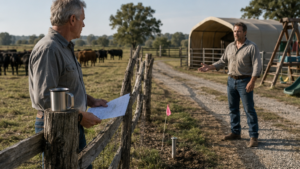
Jonathan marked a point with fluorescent flagging.
Then another.
He stretched a visual line between them and stepped back.
The concrete crossed it clearly.
Anthony saw it.
Daniel watched his face.
For the first time that morning, Anthony did not argue immediately.
Jonathan pointed toward the outer edge.
“Physical encroachment is obvious from these monuments.”
Daniel felt a small release in his chest.
Then Jonathan added, “But I’d still want you to speak to the county and probably counsel before you make assumptions about continued access.”
The release vanished.
Anthony seized on it.
“See?”
Jonathan turned toward him.
“I didn’t say you have rights. I said the history matters.”
Anthony looked at Daniel.
“We’ve been using this openly for three years.”
“Because I let you.”
“You never said temporary.”
Daniel stared at him.
“You asked the first time.”
“And you kept saying yes.”
“I stopped making you ask.”
“Exactly.”
That word hit harder than Daniel expected.
Exactly.
As though Daniel’s silence had been a contract.
As though leaving a gate open had changed ownership.
Jonathan gathered his equipment.
Before leaving, he handed Daniel a preliminary sketch with the measured line marked across it.
“The concrete question looks straightforward,” he said quietly. “The access question may not be.”
Daniel looked from the paper to Anthony.
Anthony stood beside the new slab with his arms folded, angry but no longer certain.
The old survey pin showed dark against the pale concrete.
Daniel had wanted proof that Anthony was wrong.
Now he had it.
What he did not yet know was whether three years of being unwilling to say no had created a problem no survey pin could settle.
Chapter 4: The Survey Settled One Question, Not the Harder One
Jonathan drove another iron stake into the ground and tied a strip of fluorescent flagging around it.
The marker stood less than a foot from the pale edge of Anthony’s new concrete.
Daniel stared at the line Jonathan had established between the old survey monuments. There was no close call, no measurement that required an argument over inches. The slab crossed onto Daniel’s parcel plainly enough that a person could see it without knowing anything about surveys.
“How far?” Daniel asked.
Jonathan checked his notes.
“At the widest point, a little over seven feet onto you.”
Anthony, standing near the concrete with his hands in his pockets, shook his head.
“That can’t be right.”
Jonathan looked up. “I checked twice.”
“The old gravel went through there.”
“Gravel isn’t a property monument.”
Anthony turned toward Daniel. “You knew we were using that whole swing.”
Daniel felt the old impulse rise—to soften the moment before it became a feud.
He resisted it.
“I knew your trailers crossed it. That isn’t the same as giving you seven feet.”
Anthony looked away.
Jonathan packed his equipment carefully.
“I’ll send you the field sketch this afternoon,” he told Daniel. “But like I said earlier, I’m only settling the location. Not the legal history of the access.”
Anthony looked back immediately.
“So there could still be an easement.”
“I said there could be questions. I didn’t say there is one.”
Daniel almost wished Jonathan had been less careful.
A clean answer would have been easier.
At the farmhouse, Daniel spread the deed and survey across the kitchen table while Catherine opened the county parcel map on her laptop.
“No recorded easement,” she said.
“I know.”
“You’ve checked three times.”
“I’m making sure.”
Catherine leaned back.
“Or hoping something on that paper tells you what to do.”
Daniel gave her a look.
She did not take it back.
The county zoning inspector arrived shortly after one.
He was an older man in work boots who spent more time looking at the ground than talking. Daniel showed him the survey, Jonathan’s flags, photographs from that morning, and the concrete edge.
Anthony came over before the inspection was finished.
“Can somebody tell me why zoning is involved in a private driveway?”
The inspector pointed with the end of his clipboard.
“First, that isn’t all your private driveway. Second, you altered drainage along an agricultural entrance.”
Anthony frowned. “Drainage?”
The inspector walked toward the cattle gate.
Before the pour, runoff from the lane had crossed a shallow depression and moved toward the roadside ditch. The new concrete sat several inches higher than the gravel and formed a low barrier along part of the swale.
“Water’s going to hit this edge,” the inspector said. “Then it’ll follow the slab.”
Daniel looked along the line.
Toward his gate.
The inspector nodded.
“You could end up holding water here.”
Anthony stared at the concrete.
“That can be fixed.”
“Maybe.”
“I’ll cut a channel.”
The inspector shook his head.
“Not today.”
Anthony’s voice sharpened. “Why not?”
“Because you don’t own the ground you’d be cutting.”
Silence settled between them.
The inspector walked back to his truck and made a phone call. When he returned, he carried a printed form.
“The portion beyond the surveyed boundary needs removed. You can coordinate with the contractor, but no more alterations until that’s done.”
Anthony took the paper.
“You’re ordering removal based on one guy’s survey?”
“Based on visible encroachment supported by recorded parcel information and field monuments.”
Anthony looked at Daniel.
Daniel expected anger.
Instead he saw something closer to calculation.
“When?”
“The contractor can start tomorrow morning if they’re available.”
Anthony gave a humorless laugh.
“So I get to pay them to pour it and pay them to tear it out.”
The inspector did not answer.
Daniel felt the satisfaction come—brief, sharp, undeniable.
The concrete was coming out.
Anthony had crossed the line, and there was now an official piece of paper saying so.
For several minutes, Daniel let himself believe that was enough.
Then Anthony said, “You realize what happens if you close that lane.”
Daniel turned.
“What?”
“My son and I have three trailers back there. The excavator. Trencher. Loader. We can’t make the turn by the house with the bigger ones.”
“That doesn’t change whose land this is.”
“I didn’t say it did.”
It was the first thing Anthony had said all day that sounded less like defiance.
He folded the removal order.
“We started taking more contracting jobs because we could get equipment in and out through here.”
Daniel looked toward the machinery barn.
He knew the equipment had increased.
He had never asked why.
Anthony continued, quieter now.
“My son left his warehouse job last winter. He’s working with me full-time.”
Catherine had come down from the house and was standing by the gate.
Anthony glanced at her, then back at Daniel.
“We’re not fooling around back there. That’s income.”
Daniel said, “You should’ve thought about that before you poured on my property.”
Anthony’s expression hardened again.
“I thought I had dependable access.”
“You had permission.”
“For three years.”
“Permission isn’t ownership.”
“I know that.”
Daniel stopped.
Anthony had said it too quickly.
Not argued.
Not misunderstood.
Known.
The inspector closed his truck door.
“I’d recommend both of you talk to counsel about future access instead of having this conversation beside wet concrete.”
Then he left.
Anthony walked back toward his place without another word.
Daniel watched him go.
The fluorescent flag beside the gate snapped lightly in the breeze, bright against the gray concrete.
The boundary was no longer uncertain.
That part had been settled.
Inside the kitchen, Catherine poured two glasses of water and set one in front of Daniel.
“You feel better?”
“The slab’s coming out.”
“That wasn’t what I asked.”
Daniel rubbed his thumb along the rim of the glass.
“He knew it was ours.”
“Yes.”
“That matters.”
“It does.”
“He poured anyway.”
“Yes.”
Daniel looked at her.
Catherine held his gaze.
“And you let him believe for three years that crossing whenever he wanted was normal.”
Daniel pushed the chair back slightly.
“I never told him he could build.”
“No.”
“Then what exactly are you saying?”
“I’m saying Anthony is wrong.”
She paused.
“But he didn’t invent all of this by himself.”
Daniel’s jaw tightened.
Catherine pointed toward the lane.
“You let him spread gravel.”
“It fixed a rut.”
“You let him grade it.”
“I didn’t authorize that.”
“You watched him do it.”
Daniel said nothing.
“You heard him call it his back entrance.”
Daniel looked down.
Catherine’s voice softened, which made it harder to dismiss.
“You kept telling me you didn’t want a fight.”
“I didn’t.”
“So every time there was a small thing you should’ve corrected, you decided keeping peace mattered more.”
“My father spent half his life fighting over a fence.”
“I know.”
“I wasn’t doing that.”
“No. You were doing the opposite.”
Daniel looked up.
“And look where it got you.”
Outside, the new survey flag stood beside the gate like a warning Daniel should have planted years earlier.
The county had told Anthony where the concrete could not stay.
Jonathan had told them where the land changed ownership.
But neither one could tell Daniel how much of the mess had begun with Anthony’s entitlement—and how much had grown inside the silence Daniel had mistaken for peace.
Chapter 5: Anthony Had Built More Than a Shortcut on Trust
The trailer stopped six feet from the locked gate.
Daniel heard the pickup idle before he saw it.
It was still early Sunday, not long after the concrete crew had finished loading the broken sections, and the lane was scarred where the slab had been removed. The gate, which Daniel had chained shut after the workers left, stood squarely across Anthony’s usual route.
Anthony’s pickup was on the other side.
Behind it sat a flatbed trailer carrying a compact excavator.
Anthony got out and walked to the chain.
He looked at the padlock.
Then toward Daniel, who was standing near the barn.
“You serious?”
Daniel walked over.
“For now.”
“I need to put this away.”
“You’ve got your own entrance.”
Anthony stared at him.
“You know that trailer won’t make the turn.”
Daniel knew.
That was precisely why the lane had become useful in the first place.
Anthony rattled the chain once.
“So what am I supposed to do?”
“Park it on your side until we figure this out.”
Anthony laughed without humor.
“Figure out what? The concrete’s gone. You won.”
Daniel disliked the word immediately.
“Wasn’t a contest.”
“Sure feels like one.”
Anthony walked back toward the truck, then stopped.
“If you leave this closed, I can’t get half my equipment to the barn.”
Daniel said, “Then maybe it shouldn’t have been stored somewhere that depends on somebody else’s property.”
Anthony turned.
For a moment Daniel thought he would shout.
Instead Anthony leaned one forearm on the trailer fender and looked down.
“That barn was here when I bought the place.”
“I know.”
“The old owner used this lane.”
“With permission.”
“So did I.”
“Yes.”
Anthony looked up.
“That’s what I keep saying.”
“No. You keep saying it like permission and entitlement are the same thing.”
Anthony’s face tightened.
Daniel stepped closer to the gate.
“You knew the property line wasn’t yours.”
Anthony did not answer.
“Didn’t you?”
A long pause.
Finally Anthony said, “I knew the deed was yours.”
The admission changed the air between them.
Daniel had expected another argument about maps, gravel, old tracks, or what previous owners had done.
Not that.
“You knew.”
“I knew the strip was technically yours.”
“Technically?”
“You know what I mean.”
“No. I don’t.”
Anthony rubbed both hands across his face.
“I thought the access was settled.”
“By who?”
“By three years of using it.”
“That’s not an answer.”
Anthony snapped, “By you, Daniel.”
The words hung there.
“You never once told me I might lose it. You let us fix the ruts. You let us grade it. You watched trailers go through every week. When my son started working with me, you knew we were keeping equipment back there.”
Daniel said, “And that gave you the right to pour concrete?”
“No.”
The answer came so quickly Daniel almost missed it.
Anthony looked toward the damaged entrance.
“No. I should’ve asked about the concrete.”
It was the closest he had come to admitting fault.
Then he added, “But I thought you’d say yes.”
Daniel’s anger did not lessen.
It clarified.
Anthony had not mistaken the land for his.
He had assumed Daniel’s answer.
That was different.
And worse.
Daniel unlocked the gate just long enough for Anthony to pull the excavator trailer through and park it by the machinery barn.
When Anthony returned on foot, Daniel had left the gate open.
“Thank you,” Anthony said.
Daniel relocked it once Anthony crossed back.
Anthony watched the chain settle.
“That how it’s going to be now?”
“Until we decide what it’s going to be.”
That afternoon Daniel walked the boundary on his own.
From the far side he could see why Anthony had become dependent on the lane.
The machinery barn stood behind his house, where the land narrowed between an old drainage dip and a stand of walnut trees. A pickup could reach it from Anthony’s front drive. A small utility trailer probably could too.
The longer equipment could not turn cleanly without backing twice across soft ground.
Anthony’s son was near the barn, repositioning the excavator Daniel had let through.
Three other trailers sat nearby.
Daniel counted them.
One trenching machine.
A skid steer.
Stacks of pipe.
Buckets and attachments.
This was not occasional side work anymore.
Daniel had watched the change happen without understanding what it meant.
Catherine came up behind him.
“He built a business around your gate.”
Daniel nodded.
“Looks that way.”
“That isn’t your responsibility.”
“No.”
She looked at him.
“You said that awfully fast.”
Daniel shoved his hands into his coat pockets.
“He shouldn’t have assumed.”
“I agree.”
“But I saw all this coming through.”
“You saw equipment.”
“I saw more than that.”
Catherine waited.
Daniel looked toward Anthony’s barn.
His father’s old feud came back to him in fragments: chains across lanes, survey stakes pulled in the night, two families making daily life harder just because they could.
Daniel had spent years believing the opposite of that behavior had to be virtue.
Keep the gate open.
Ignore the small things.
Don’t write letters.
Don’t make rules.
But there was a difference between refusing to weaponize a boundary and pretending no boundary needed defending.
That evening Anthony came to the farmhouse.
Daniel met him on the porch.
“I’ve got a proposal,” Daniel said before Anthony could begin.
Anthony folded his arms.
“What kind?”
“Temporary access. Written. Until we settle something longer term.”
Anthony’s expression closed.
“Written.”
“Yes.”
“What, I sign in every time I drive through?”
“No.”
“Then what?”
“Hours. Vehicle size. You keep it latched. No alterations. No grading, no gravel, nothing unless we both agree.”
Anthony shook his head.
“So now I need a rulebook to drive where I’ve driven for three years.”
“You need permission written down.”
“I already had permission.”
“And we both learned what happens when we mean different things by it.”
Anthony looked past Daniel toward the kitchen window.
Catherine was inside, deliberately not joining them.
“What’s this cost?” Anthony asked.
“We haven’t gotten there.”
“Of course.”
Daniel’s patience thinned.
“You poured concrete without asking me.”
“And I’m paying to remove it.”
“That doesn’t reset everything.”
Anthony stepped back from the porch.
“You know what this sounds like?”
Daniel waited.
“Renting permission to get to my own barn.”
“You’d be crossing my ground.”
Anthony nodded slowly.
“There it is.”
“What?”
“That’s what this is now. Not neighbor helping neighbor. Your ground, my ground, permission, conditions.”
“You made it that way.”
Anthony stared at him.
Daniel heard his own father in the sharpness of the sentence and hated it.
But he did not take it back.
Anthony looked toward the lane.
“Fine.”
Daniel thought for a moment he meant the proposal.
Then Anthony said, “I’ll build my own entrance.”
Daniel frowned.
“You’ve looked at that?”
“I will.”
“You know what the drainage is like.”
“I’ll deal with it.”
“That could cost you.”
“So will whatever you’re planning.”
Daniel started to speak.
Anthony cut him off.
“I’d rather spend money on my own driveway than pay somebody every month for the privilege of being reminded it isn’t mine.”
He walked off the porch.
At the gate, he stopped and looked back.
“You want it clear, Daniel? I’ll make it clear.”
Then he headed across his property toward the front road, leaving Daniel with a possibility neither of them had seriously considered before.
Anthony might decide the open gate was no longer worth asking for at all.
Chapter 6: The Other Route Cost More Than Either Man Expected
By Tuesday morning, orange stakes ran across Anthony’s front field in a crooked line toward the county road.
Daniel saw them from his tractor and knew exactly what they meant.
Anthony was serious.
A county road technician stood beside a pickup near the ditch, pointing toward the frontage while Anthony and his son followed him through the grass.
Daniel kept working for another twenty minutes before curiosity won.
When he reached the fence, Anthony noticed him but did not wave.
The technician was explaining the proposed entrance.
“You can put an access here,” he said, “but you’ll need a culvert sized for this drainage. Then you’ve got grade to deal with.”
Anthony looked toward the machinery barn.
“Can I run straight back?”
“Not unless you want to move a lot of dirt.”
The technician pointed toward the low ground.
“You’ve got fall through there, then it rises again. For loaded trailers, you’ll probably want to bring the lane around that shoulder.”
Anthony’s son asked, “How much length?”
The technician paced part of it visually.
“More than you’re thinking.”
Daniel could see Anthony doing numbers in his head.
Stone.
Culvert.
Excavation.
Compaction.
A wider road entrance.
Possibly tree work.
Nothing impossible.
Nothing cheap.
The important fact was that Anthony did have another option.
Daniel felt relieved by that.
Then, unexpectedly, disappointed.
If Anthony built his own access, the argument would end cleanly.
Maybe that should have been ideal.
But clean endings were not always repaired endings.
Anthony walked over after the technician left.
“Satisfied?”
Daniel shook his head.
“I didn’t call him.”
“No. Just closed the gate so I had to.”
“You said you wanted your own entrance.”
“I do.”
Daniel looked toward the stakes.
“Looks expensive.”
Anthony gave him a dry smile.
“Thanks for the concern.”
“I mean it.”
“That somehow makes it worse.”
He turned away.
Daniel said, “Anthony.”
Anthony stopped.
“You still have the temporary access offer.”
Anthony faced him again.
“On paper.”
“Yes.”
“You really can’t let go of that part, can you?”
“No.”
Anthony studied him for a moment.
“Neither can I.”
By Wednesday afternoon a band of heavy rain was moving toward the county.
Daniel was checking a hay wagon tire when he heard Anthony’s pickup at the gate.
This time Anthony did not rattle the chain.
He called.
Daniel looked at the screen for several seconds before answering.
“What do you need?”
“The trencher’s still back there.”
“So?”
“I’ve got a job tomorrow if the rain doesn’t wash us out. Trailer’s already hooked up.”
Daniel looked west.
The clouds had gone nearly black beyond the soybean fields.
Anthony continued, “If that low spot by my house gets soaked, I won’t pull it through there until Friday.”
Daniel could have said no.
The gate was locked.
The boundary was surveyed.
Anthony was building his own solution.
No one could reasonably accuse Daniel of doing anything wrong if he left the chain where it was.
That was exactly why the choice bothered him.
“I’ll meet you at the gate,” Daniel said.
Anthony was already there when Daniel arrived.
Daniel unlocked the chain.
Anthony glanced at him.
“You want me to sign something first?”
The sarcasm was mild, but present.
Daniel held the gate open.
“No.”
Anthony said nothing.
The pickup came through slowly with the trencher behind it. Anthony’s son drove, watching the mirrors carefully so the trailer stayed off the grass.
Daniel noticed that.
They had not always been that careful.
When the trailer cleared, Anthony stepped through.
Daniel expected him to keep walking.
Instead he stopped.
“You didn’t have to do that.”
“No.”
“Then why did you?”
Daniel looked at the first drops darkening the gravel.
“Because keeping you from getting equipment out before a storm doesn’t fix what happened.”
Anthony’s expression shifted.
Daniel continued, “And letting you through today doesn’t erase it either.”
Anthony nodded once.
For the first time since the pour, neither man seemed to need the last word.
Daniel closed the gate after him.
But he did not lock it immediately.
That evening Catherine found the chain hanging loose around the post.
“You let them through.”
“Trencher needed out.”
“I saw.”
Daniel waited for criticism.
Instead Catherine said, “Good.”
He looked at her.
“You wanted the gate closed.”
“I wanted the assumption closed.”
She touched the chain.
“Those aren’t the same thing.”
Daniel leaned against the post.
“They’re pricing another driveway.”
“I know.”
“He can build one.”
“I know that too.”
“It’s going to cost him.”
Catherine looked toward Anthony’s frontage where the orange stakes were still visible.
“That doesn’t mean you owe him your lane forever.”
“I didn’t say it did.”
“No. But now you’re trying so hard not to enjoy being right that I’m worried you’ll swing back the other way.”
Daniel almost laughed.
“Hard man to please.”
“I’ve had practice.”
The humor faded.
Catherine looked at the gate.
“If you let him keep using it, Daniel, it has to be different.”
“It will be.”
“No handshake.”
He was quiet.
“No ‘we both know what we mean.’”
“I know.”
“No pretending you don’t notice when the rules drift because you don’t want an argument.”
Daniel looked at her.
That one landed where she intended.
His father had treated property lines like battle lines.
Daniel had reacted by treating them as though naming them was itself hostile.
Both approaches let a boundary control more of a relationship than it should.
The next morning Daniel called an agricultural attorney.
He explained the lane, the three years of informal use, the unauthorized concrete, the survey, the county removal order, and Anthony’s alternate access.
The attorney listened.
“What outcome do you want?”
Daniel looked out the window at the gate.
“I don’t want to give him ownership.”
“That’s clear.”
“I don’t want an unrestricted easement.”
“Also clear.”
“And I don’t want to close him out just because I can.”
There was a short pause.
“Then you want a license or carefully limited access agreement, depending on how you structure it.”
“I want something nobody has to guess about.”
“That I can draft.”
Daniel gave him the conditions.
Defined route.
Defined vehicle limits.
Maintenance responsibility.
No physical alterations without written consent.
Termination provisions.
No language that could reasonably be mistaken for ownership of the lane.
When the attorney asked whether there would be a fee, Daniel hesitated.
Then he said yes.
Not because he wanted rent from Anthony.
Because free access had become invisible to both of them.
Something formal needed consideration attached to it—not enough to punish Anthony, but enough that neither man could later pretend the arrangement had simply happened by habit.
After the call, Daniel walked down to the gate.
He fastened the chain but left the padlock open in his hand.
Across the field, Anthony stood near one of the orange stakes for his proposed driveway.
For the first time, Daniel understood that the next move was no longer about proving whose land lay beneath the gravel.
That had already been answered.
The real decision was what kind of neighbor Daniel intended to be now that saying nothing was no longer an option.
He closed the padlock, put the key in his pocket, and waited for the attorney’s draft.
Chapter 7: This Time the Open Gate Had Rules Behind It
Anthony arrived Thursday afternoon carrying no folder, no tools, and no argument prepared loudly enough for Daniel to hear from the yard.
That alone made Daniel uneasy.
He watched from the kitchen window as Anthony crossed from his property and stopped outside the farmhouse. For the first time since the concrete had been poured, he did not come through the farm gate. He walked around by the road instead.
Catherine noticed too.
“He thinks you’re closing it for good.”
Daniel looked at the envelope on the table.
The agricultural attorney had sent the final draft that morning. Daniel had already read it three times. Catherine had read it twice and circled one paragraph before deciding the wording was clear enough.
The terms were not complicated.
Anthony could use a defined strip of the farm lane to reach his machinery barn. The permission applied to specified vehicles and trailers. He would contribute toward gravel and ordinary maintenance. He could not grade, widen, pave, trench, install drainage, move a post, cut a tree, or otherwise alter the route without Daniel’s written approval.
The agreement did not transfer ownership.
It did not create unrestricted access.
And it could be terminated under defined conditions.
Beside the papers lay a new brass key.
Daniel opened the door.
Anthony looked at the envelope in his hand.
“So this is it?”
“Come inside.”
Anthony hesitated, then followed him to the kitchen.
Catherine was already seated at the far end of the table. She gave Anthony a brief nod.
He returned it.
Daniel placed the agreement between them.
Anthony did not touch it immediately.
“You had a lawyer write this.”
“Yes.”
“What happened to temporary?”
“This is what comes after temporary.”
Anthony pulled out a chair.
For several minutes there was only the sound of paper turning.
Daniel resisted the urge to explain every paragraph. That was another version of the same habit he was trying to break—softening a clear thing until nobody could tell where it ended.
Anthony stopped at the section defining the route.
“This says twenty feet.”
“That’s the usable width through the narrow part.”
“My equipment trailer is wider with the mirrors.”
“The trailer isn’t.”
Anthony looked at him.
Daniel held his gaze.
“You can fold the truck mirrors where the lane pinches. You’ve done it before.”
Anthony returned to the page.
“And no alterations of any kind.”
“Without written agreement.”
“So if a rut opens, I call you?”
“Yes.”
“That’s ridiculous.”
“Then use the other entrance.”
Anthony sat back.
Catherine said nothing.
Daniel could see the answer forming in Anthony’s face. Two weeks earlier, he would have delivered it with anger.
This time he looked down at the agreement again.
“What about snow?”
“Routine clearing is allowed.”
“Stone?”
“We agree first.”
Anthony tapped the paper.
“And this maintenance contribution.”
Daniel nodded.
The number was modest. Enough to make the arrangement formal, not enough to turn the lane into a source of income.
Anthony gave a short laugh.
“So I am paying rent.”
“No.”
“Looks like money changing hands.”
“You’re helping maintain a route your business uses.”
“I maintained it before.”
“You changed it before.”
Anthony’s expression tightened.
Daniel let the silence stand.
That was different too.
In years past he would have stepped in, softened the wording, found a way to rescue both men from discomfort.
Anthony finally said, “I paid for the concrete twice.”
“You paid to put it in and to take it out.”
“Same result.”
“Not the same reason.”
Anthony’s eyes lifted.
Daniel continued, quietly.
“You knew the ground was mine.”
Anthony’s jaw moved once.
“I already admitted that.”
“And you poured anyway.”
“I thought you’d agree.”
“You didn’t ask.”
Anthony looked toward the window.
From the kitchen table they could see the top of the farm gate beyond the yard.
“I was wrong about that.”
It was not an apology exactly.
Daniel had stopped expecting one shaped the way he wanted.
He nodded once.
Anthony turned another page.
The removal costs were listed separately. Anthony was responsible for them, as the contractor had already invoiced him.
Then came the termination section.
“You can shut this down if I miss the maintenance payment?”
“After notice.”
“Or if I violate the conditions.”
“Yes.”
“And if I pave it again?”
Despite himself, Daniel almost smiled.
“That would qualify.”
Anthony did not smile back.
But some of the stiffness left his shoulders.
He read the final page.
Then he placed both palms on the table.
“I could pay several years up front.”
Daniel frowned.
“For what?”
“In exchange for making the access permanent.”
“No.”
Anthony studied him.
“Not even if the number makes sense?”
“No.”
“You didn’t ask the number.”
“I don’t need to.”
Catherine glanced at Daniel but remained quiet.
Anthony leaned back.
“Why?”
Daniel looked toward the brass key.
“Because that puts us right back where we started.”
“No, it doesn’t. It gives you money.”
“That isn’t what I mean.”
Anthony waited.
Daniel chose his words carefully.
“For years I acted like spelling out the limits would make us bad neighbors. Then you started acting like the lack of limits meant there weren’t any.”
Anthony’s eyes dropped toward the agreement.
Daniel went on.
“I’m not selling the decision about this lane. If someday you build your own entrance and don’t need mine, fine. If someday this arrangement stops working, then we deal with that. But I’m not taking a lump sum today so we can argue ten years from now about what you bought.”
Anthony rubbed his thumb across the edge of the paper.
“That lawyer tell you to say all that?”
“No.”
Catherine said, “He’s been practicing.”
Daniel gave her a look.
Anthony actually laughed.
It was small and tired, but it was the first genuine laugh Daniel had heard from him since before the pour.
Then it disappeared.
Anthony picked up the pen.
Before signing, he said, “My son thinks I should build the other driveway anyway.”
“Maybe you should.”
“That surprise you?”
“No.”
Anthony looked at him.
“I thought this was supposed to keep me from doing that.”
“It’s supposed to give you an option.”
Anthony considered that.
Then he signed.
The scratch of the pen across the paper was quieter than the jackhammer had been.
It still felt more final.
Daniel signed beneath him.
Catherine witnessed both signatures.
When it was finished, Daniel took the brass key from beside the envelope and slid it across the table.
Anthony looked at it.
“What’s this?”
“New lock for the gate.”
“You’re giving me a key?”
“Under the agreement.”
Anthony picked it up.
For a second Daniel saw the old relationship trying to reappear—the easy assumption, the open gate, the belief that a key meant freedom to do as one pleased.
Then Anthony closed his fingers around it.
“I’ll keep it on the truck ring.”
“That’s fine.”
“And if I need something outside the agreement?”
“You ask.”
Anthony nodded slowly.
“Right.”
They walked outside together.
Daniel had replaced the old chain and padlock that morning with a heavier latch designed to be opened from either side with the same key. The gate itself was still the old galvanized steel one, scratched by years of use and slightly bent along the lower rail.
Anthony inserted his key.
The latch opened.
He swung the gate wide enough to walk through, then stopped.
“You ever think we’d get here?”
Daniel looked at the concrete scars still visible in the gravel.
“No.”
“I still think you made too much of that pour.”
Daniel turned toward him.
Anthony raised one hand.
“And I know I should’ve asked.”
That was as far as he could go.
Daniel found that it was enough.
“Then we know two things.”
Anthony looked at him.
“Your lane,” he said.
“And your access,” Daniel answered.
“For now.”
“Under the terms.”
Anthony shook his head, but there was no anger in it.
“You really like that phrase.”
“I’m learning.”
The gate closed between them with a clean metallic click.
Over the next several weeks, the orange stakes along Anthony’s proposed driveway remained in the field. He did not remove them, but he did not begin construction either.
The lane settled back into use.
Not the old use.
Anthony’s trucks slowed before entering.
His son latched the gate behind every trailer.
When a rut developed after three days of rain, Anthony sent Daniel a photograph instead of arriving with a load of gravel.
Daniel replied that they would repair it Saturday.
They did.
Together.
Neither man mentioned how strange that felt.
Late one afternoon in early fall, Daniel was repairing fence near the pasture when he saw Anthony’s pickup stop at the gate.
A wide equipment trailer waited behind it.
Anthony got out.
He did not unlock the gate.
Instead he walked along the fence until Daniel could hear him.
“This one’s a few inches wider than what we wrote down.”
Daniel wiped his hands on his jeans.
Anthony pointed toward the trailer.
“I can make the other turn if you’d rather.”
For a moment Daniel simply looked at him.
Three months earlier, the gate would already have been open.
Three years earlier, Daniel would have waved him through without considering what the answer meant.
Now Anthony was standing beside the fence waiting for one.
Daniel walked toward the lane.
“Stay tight to the north edge coming through.”
Anthony nodded.
“I will.”
“And have your son watch the gatepost.”
“Okay.”
Daniel took out his key.
Anthony said, “You want me to use mine?”
Daniel looked at him.
Then he handed Anthony the latch.
“Go ahead.”
Anthony unlocked it himself.
He opened the gate, waited for Daniel to move clear, and waved the trailer forward.
Nothing about the moment looked important.
No inspector stood there.
No surveyor.
No attorney.
No broken concrete.
Just two neighboring men beside an old farm gate, one asking before crossing and the other answering without fear that saying yes would somehow prevent him from saying no later.
When the trailer cleared, Anthony shut the gate behind it.
This time he checked the latch twice.
The story has ended.