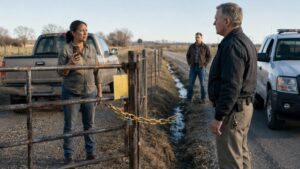
They Mocked the Old Farmhand at the Drainage Meeting—Then He Opened the Survey Folder Nobody Had Checked
Chapter 1: The Chair They Said Frank Did Not Need
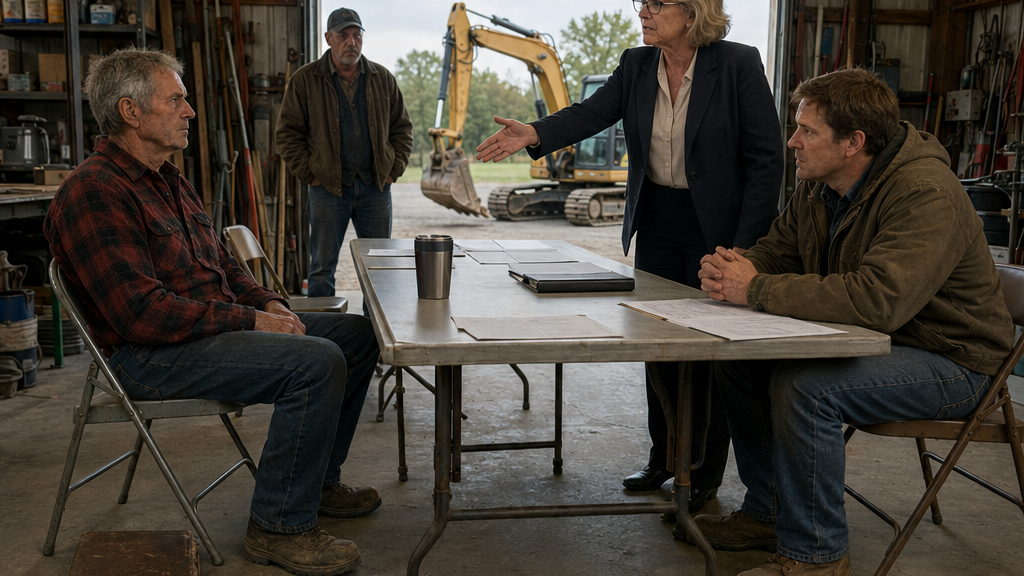
“Why is the hired hand sitting at the owners’ table?”
Margaret Nelson did not lower her voice when she asked it.
The metal equipment shop carried sound farther than people expected. Her words traveled past the folding tables, past the coffee urn and box of store-bought doughnuts, and out through the raised overhead door toward the excavator waiting on the gravel.
Frank Walker looked down at his boots.
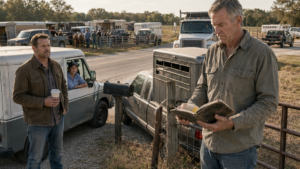
Mud had dried gray around the seams. One lace had been replaced with baling twine three months ago and never properly fixed. His red flannel shirt was faded at the elbows. On the concrete beside his right boot rested a stained brown field folder with its corners softened from years of use.
Margaret pointed toward his chair.
“We’re short a seat. This meeting is for property owners.”
One of the two landowners near the end of the table looked away. The other gave a small embarrassed laugh.
Frank felt the old irritation rise fast and familiar.
He had spent too many years walking into county offices with clay on his boots and being directed toward maintenance entrances. Too many meetings where engineers half his age explained drainage to him before realizing whose inspection initials were on their plans.
He could have answered Margaret immediately.
Instead, he bent, lifted the folding chair by its steel frame, moved it six inches closer to the table, and sat again.
Then he placed the folder in front of him.
“I’ll stay until we get through the drainage item.”
Margaret stared at him.
Joshua Davis, sitting two places down, cleared his throat.
“Frank owns the north forty and the pasture behind it.”
Margaret’s expression changed, but only slightly.
“I thought you worked that place for the Walkers.”
“I am a Walker.”
A silence moved around the table.
Frank did not enjoy it as much as he thought he would.
Margaret gathered the pages in front of her. “Fine. Then you have a vote like everybody else.”
Outside, the excavator’s boom stood above the open doorway like a bent arm. A contractor leaned against his pickup, waiting.
Margaret began.
The shared gravel road had washed twice in three years. The culvert near Joshua’s lower field had backed up during spring storms. Emergency grading, stone and ditch clearing had cost the association more each season. The proposal before them would deepen the roadside ditch, replace the undersized culvert and cut a new outlet toward the lower ground.
The association treasurer passed around the projected assessment.
Frank heard somebody whistle softly.
The number was high enough to hurt.
Margaret kept going.
“The contractor has an opening now. If we miss it, we may wait six weeks. That puts us into planting and probably into the heavy storms.”
Joshua rubbed his jaw. “My feed truck barely got through last time.”
“That’s why we’re doing it now,” Margaret said.
Frank kept his hands away from the folder.
The contractor came inside when Margaret reached the drawing. He spread a clean site plan across the table and held the corners flat with two coffee mugs.
A heavy black line marked the proposed new ditch.
Frank studied it.
He looked once toward the open door, where orange survey stakes could be seen down the road.
Then he asked, “What elevation are you using at the new outlet?”
The contractor tapped the drawing.
“Here.”
“That’s the location. What elevation?”
The man paused.
Margaret answered for him. “The engineer reviewed the grade.”
Frank looked at the contractor.
“What benchmark did he shoot from?”
The contractor shifted his weight.
“We worked off the road profile.”
“Which point?”
Another pause.
Joshua stopped studying the cost sheet.
The contractor bent over the plan. “There’s a benchmark at the culvert.”
“The old culvert invert?”
“That’s what I was given.”
Frank nodded once.
“And the outlet?”
“Calculated from there.”
“Calculated or measured?”
Margaret’s mouth tightened.
“Frank, we’re not turning this into an engineering seminar.”
“No.”
He looked again at the line.
“We probably shouldn’t.”
For the first time that morning, the contractor seemed less interested in finishing the meeting quickly.
He traced the proposed outlet with his finger. “You know something about that grade?”
Frank could feel every face at the table turn toward him.
There it was—the invitation he had been waiting for.
He almost opened the folder.
Almost.
Instead he said, “I know water doesn’t care what the line looks like on paper.”
Margaret exhaled through her nose.
“We have a contractor, a plan and a flooding problem. Unless someone has an actual reason to stop this, I’d like to vote.”
Frank’s jaw tightened.
An actual reason.
He had several.
But proving that Margaret had underestimated him was beginning to compete with the reason he had come.
That bothered him.
The vote passed, though not unanimously. Frank voted no. One other owner abstained. Joshua voted yes after staring for a long time at the figure on the assessment sheet.
Margaret stacked the ballots.
“Work starts Monday.”
Frank looked toward the excavator.
“I thought you said the contractor had an opening.”
“He does.”
“You already unloaded the machine.”
Margaret met his eyes.
“We intended to be ready.”
That told Frank more than the vote had.
The decision had been moving before anybody entered the shop.
People began folding chairs and carrying coffee cups toward the trash. Joshua approached Frank while Margaret spoke with the contractor.
“What was that elevation business?”
Frank picked up his folder.
“Just a question.”
“You don’t ask questions like that for no reason.”
Frank stepped outside.
The bright morning made him squint. Beyond the contractor’s pickup, orange stakes ran beside the shallow grassed ditch that had carried stormwater as long as Frank could remember.
He followed them slowly.
One stood beside the road.
Another near the culvert.
A third marked the bend toward the lower field.
Then Frank saw the fourth.
He stopped.
The stake was thirty yards beyond the old drainage line, driven into ground that rolled gently toward Deborah Hall’s pasture.
A stripe of fluorescent paint continued downhill from it.
Frank looked back toward the shop.
Margaret was shaking the contractor’s hand.
He looked again at the painted line.
They were not cleaning the ditch.
They were moving the water.
Chapter 2: The Water Always Finds the Lowest Ground
The orange stake stood where no drainage outlet had ever belonged.
Frank pushed it lightly with two fingers.
The ground beneath it was soft from an old seep, though the surface looked dry.
Joshua came down the slope behind him.
“You planning to pull that?”
“No.”
“You’re looking at it like you want to.”
Frank crouched and opened his folder for the first time that morning.
Joshua leaned closer.
Inside were no polished reports. Frank kept field paper, folded plats, graph sheets, notes written in pencil and copies of older county maps that had been handled enough to turn soft at the creases.
He took out a small level, a measuring tape and a pencil.
Joshua frowned. “You carry that stuff around?”
“Some of it.”
“Why?”
Frank gave him a look.
Joshua raised both hands. “All right.”
They walked the proposed route.
The existing drainage ditch followed the road before bending gradually toward a grassed swale. During ordinary rain it hardly looked like anything—a shallow green depression across the land.
During a hard storm, Frank knew, it carried thousands of gallons.
The new orange stakes did something different.
They cut straighter.
Straighter meant cheaper.
It also meant downhill.
Margaret’s pickup rolled to a stop beside them.
She stepped out holding the contractor’s plan.
“Are we surveying now?”
“Checking.”
“We already paid for engineering.”
Frank stretched the tape between two points.
“You paid for a drawing.”
Her eyes narrowed.
“That’s exactly the kind of comment that makes these meetings impossible.”
Joshua looked between them. “Margaret, let him finish.”
She seemed more surprised by Joshua than by Frank.
Frank wrote down another measurement.
Margaret folded her arms.
“Every week we delay this costs somebody. You remember Joshua pulling a grain truck out last April?”
“I remember.”
“And the road shoulder washing out?”
“Yes.”
“Then what are we doing?”
Frank straightened.
“Making sure we don’t solve his water problem by giving it to somebody else.”
Margaret glanced downhill.
The pasture beyond the fence belonged to Deborah Hall. An older barn sat on a slightly raised pad near its northern edge. Cattle grazed farther back.
“The outlet doesn’t go to her barn.”
“I didn’t say it did.”
“Then what are you suggesting?”
Frank walked another twenty yards.
At the fence, he stopped and pointed toward a low spot in Deborah’s pasture.
“Your cut enters here.”
Margaret checked the plan. “It disperses.”
“Eventually.”
“What does that mean?”
“It means water keeps going downhill.”
Joshua had been studying the land rather than the paper now.
His face changed.
The realization came slowly enough that Frank saw it happen.
“The old swale turns east,” Joshua said.
“Yes.”
“This one doesn’t.”
“No.”
Joshua looked back toward his own lane.
The proposed line would pull water away from the culvert that repeatedly flooded his access.
Then he looked toward Deborah’s pasture.
“It fixes mine.”
Frank tucked the pencil behind his ear.
“And moves the peak flow downhill.”
Joshua went quiet.
Margaret shook her head.
“That is not what the engineer said.”
“What did he say?”
“That the new route improves drainage.”
“For whom?”
She stared at Frank.
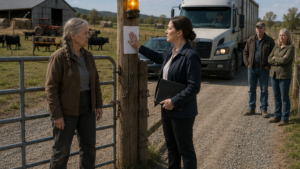
Before she could answer, a side-by-side vehicle rattled down the pasture lane. Deborah stopped at the fence and climbed out.
She was still wearing work gloves.
“What are all of you doing along my fence?”
Margaret lifted the drawing.
“Checking the association drainage route.”
Deborah looked at the orange paint.
“That’s the route?”
“Yes.”
Deborah climbed through the gate and came closer.
“I thought you were cleaning the ditch by the road.”
Frank watched Margaret.
There was a small pause.
“We are improving the whole drainage system.”
“That line comes onto my place.”
“The water already crosses your lower ground.”
“Not there.”
Margaret tapped the plan. “The engineer accounted for it.”
Deborah took the sheet from her.
She turned it once, then again, trying to orient herself.
“Nobody showed me this.”
Joshua looked at Margaret.
Frank said nothing.
Margaret’s voice became more careful.
“The board approved the project at the previous meeting.”
“I wasn’t at the previous meeting.”
“You received notice.”
“I received a notice saying ditch maintenance.”
The word hung there.
Maintenance.
Frank looked toward the old swale.
There were legal meanings to that word and ordinary meanings, and people got in trouble when they pretended they were the same.
Deborah handed the plan back.
“Does this increase water on my pasture?”
Margaret looked toward Frank as if resenting the fact that he had made the question unavoidable.
“The engineer’s design distributes flow safely.”
“That wasn’t what I asked.”
Joshua answered before Margaret could.
“It looks like it could.”
Margaret turned on him. “You voted for it.”
“I voted for what I thought we were doing.”
The temperature of the conversation changed.
Frank did not feel satisfaction.
He felt the heaviness that came when a disagreement stopped being theoretical.
Deborah’s pasture had flooded before. He remembered standing near that barn twenty years earlier while county crews checked an old tile outlet after a summer storm.
He pulled another sheet from the folder and made three measurements along the fence.
Margaret watched.
“How do you know where to measure?”
Frank wrote the numbers down.
“I used to do this.”
“For who?”
“The county.”
Margaret’s expression shifted.
Joshua gave a short laugh, but there was no humor in it.
“You might want to be more specific than that, Frank.”
Frank closed the folder.
“Drainage. Culverts. Erosion work.”
Margaret studied him.
“How long?”
“A while.”
He turned away before she could ask more.
By late afternoon, Frank had enough field measurements to know his memory had not betrayed him. The proposed line sat below the old controlled route and would send concentrated storm flow toward Deborah’s lowest ground before spreading.
Not every storm would cause trouble.
The right storm would.
At home, he added the measurements to the folder.
Just before supper, his phone rang.
The number belonged to the excavation contractor.
Frank answered.
“Walker.”
The man did not bother with small talk.
“I thought you ought to know they told us to start at daylight Monday.”
Frank looked through the kitchen window toward the distant road.
“You still don’t have a field shot on the outlet?”
“No.”
“Then why are you digging?”
A pause.
“Because that’s the job I was hired to do.”
Frank pressed his thumb against the edge of the folder.
Monday was less than two days away.
And the first cut would be made before anybody had answered the question Deborah should have been asked weeks ago.
Chapter 3: Thirty Years Beneath Other People’s Roads
Joshua found Frank’s initials before Frank had decided whether to show them to him.
Sunday morning, the two men stood at Frank’s kitchen table with old county sheets spread between coffee cups.
Joshua lifted one yellowed page.
“F.W.”
Frank kept sorting.
Joshua pointed to the bottom corner.
“Field review. F.W. That’s you.”
“Yes.”
“1998.”
“Yes.”
Joshua lowered the sheet.
“You reviewed this whole drainage corridor?”
Frank pulled another folded map from the cabinet.
“Part of it.”
“Yesterday you said you ‘used to do drainage.’”
“I did.”
“For thirty years?”
“Thirty-one.”
Joshua stared at him.
Frank disliked the look immediately.
It was the same look people gave when they discovered a fact they believed should have been offered sooner.
He had seen it countless times.
Usually he blamed them for not asking.
Joshua sat down.
“What exactly did you do?”
“County drainage and soil work. Culvert inspections. Erosion complaints. Permit field checks. Whatever landed on the desk.”
“You signed off on this road?”
“I inspected portions of it when they widened the crossing.”
“And Deborah’s outlet?”
Frank stopped moving papers.
“That area too.”
Joshua leaned back.
“So yesterday, when Margaret was telling you the engineer had handled everything—”
“I knew what the ground used to do.”
“And you said almost nothing.”
Frank looked at him.
“I asked the question that mattered.”
“No. You asked a question nobody else understood.”
Frank closed the cabinet harder than necessary.
“Same thing if somebody answers it.”
Joshua’s face tightened.
“That’s exactly why people think you’re difficult.”
The words hit with more accuracy than Frank wanted to admit.
He walked to the sink.
Outside the window, a pair of cattle stood at the fence waiting for feed.
Joshua stayed at the table.
After a while he said, “Call Margaret.”
“No.”
“Frank.”
“She has the same phone I do.”
“She doesn’t know what you know.”
“She could’ve asked.”
Joshua let out a breath.
“You wanted her to ask.”
Frank turned.
“What’s that supposed to mean?”
“It means you sat there yesterday waiting for her to realize she’d made a mistake about you.”
Frank’s expression went still.
Joshua pushed the old county sheet across the table.
“And maybe she deserved to feel stupid. But Monday morning there’s going to be a trackhoe in that ditch.”
Frank looked down at the paper.
His initials seemed smaller than he remembered.
For years his name had rarely appeared prominently on anything. Engineers stamped plans. Supervisors signed approvals. Elected officials stood in photographs.
Frank walked the ground.
He checked slopes, found failing culverts, argued with contractors about compacted fill and watched water after storms.
When everything worked, nobody knew his name.
When something failed, everyone wanted it.
He had told himself that not needing recognition was a virtue.
Somewhere along the way, that had become a convenient way to punish people who failed to recognize him.
“Help me find the old corridor file,” he said.
Joshua said nothing about winning the argument.
They worked.
Frank brought out a gray metal field-storage box from a closet off the mudroom. Inside were notebooks, duplicate plats and records he had been allowed to retain after retirement because they contained his own field notes rather than official originals.
They found a 1996 culvert sketch.
Then a 1998 erosion review.
Then a later sheet showing the roadside swale after reconstruction.
Frank traced the contour with one finger.
“There.”
Joshua bent closer.
A pencil note followed the lower pasture boundary.
“Existing agricultural drainage easement,” Joshua read.
Frank nodded.
“Where’s the easement?”
“Not here.”
“County?”
“Should be.”
Joshua reached for his phone.
Frank stopped him.
“Records office is closed.”
“Margaret still needs to know this.”
“We don’t know what it says.”
“We know it exists.”
Frank folded the sheet along its old crease.
“An easement can allow more than people remember. It can allow less. I’m not calling her with half an answer.”
Joshua stood.
“You had half an answer yesterday.”
Frank’s eyes hardened.
“And you voted yes with less than that.”
Joshua looked away.
That landed.
His own financial pressure had been sitting at the table too. Planting had been delayed twice the previous spring because trucks could not reach his lower field. He had wanted the road fixed. Wanted it badly enough to assume somebody else had checked the details.
After a moment, Joshua said, “Fair.”
He reached for his cap.
Then he stopped at the door.
“But if they dig tomorrow and you find out Tuesday you could’ve stopped it today, that’s yours too.”
The door shut behind him.
Frank remained in the kitchen.
The folder lay open on the table.
For the first time, it did not feel like proof.
It felt like a clock.
He spent the afternoon comparing field notes with the contractor drawing Deborah had photographed and sent to Joshua. The more Frank looked, the less the word maintenance fit.
The old ditch had followed a broad drainage corridor.
The new design cut across it.
Near dusk, Frank found a second reference in a handwritten inspection note.
“Outlet modification subject to existing shared drainage easement.”
He read it twice.
Then a third time.
There should have been an exhibit attached to the original parcel record describing what modifications required consent.
Margaret’s meeting packet had contained nothing like it.
Frank slid the note into the folder and picked up his phone.
He found the county records office number and left a message for first thing Monday.
When he finished, he nearly called Margaret.
Her name sat on the screen.
He could tell her there was an easement.
He could tell her the proposed route might cross its restrictions.
He could tell her not to let the excavator touch the ground until they knew.
His thumb hovered over the call button.
Then he remembered her voice in the shop.
Why is the hired hand sitting at the owners’ table?
Frank locked the phone.
The small act gave him an immediate, ugly satisfaction.
It lasted less than a second.
On the table beside him, the old field note waited beneath the contractor’s clean new plan.
At the bottom of the page was a reference number for an easement nobody at Saturday’s meeting had mentioned.
Monday morning, Frank intended to find out exactly what it said.
The excavator was scheduled to start at daylight.
Chapter 4: Maintenance Became Something Else on Paper
The excavator bucket was already in the ground when Frank reached the road Monday morning.
He parked crooked on the shoulder, left the truck door open, and walked toward the machine as another scoop of dark soil rolled onto the grass.
The cut was outside the old ditch line.
Not by much.
Enough.
Frank raised one hand.
The equipment operator saw him but looked toward the excavation contractor first.
The contractor stepped away from his pickup.
“Morning.”
“You started.”
“That was the agreement.”
Frank looked at the trench.
“You told me you didn’t have a field shot on the outlet.”
“I also told you I was hired to dig.”
Behind them, the excavator idled.
Margaret’s pickup approached from the opposite direction.
Frank could see the folder on the passenger seat of his truck through the open door. He had brought everything he found Sunday, including the old note referencing the drainage easement.
But not the easement itself.
Not yet.
Margaret got out.
“What’s the problem?”
Frank pointed at the trench.
“That’s not the existing ditch.”
“It’s the approved improvement.”
“Approved as what?”
Her expression hardened.
“Drainage maintenance.”
Frank looked at the contractor.
“Show me the work sheet.”
Margaret stepped between them slightly.
“You don’t supervise him.”
“No.”
Frank kept his voice level.
“I want to see what he was hired to build.”
The contractor hesitated, then walked to his pickup and retrieved a rolled plan.
Margaret said, “You saw the drawing Saturday.”
“I saw the presentation sheet.”
The contractor unrolled the construction set across the hood of the truck.
Frank leaned over it.
The difference was immediate.
Saturday’s sheet had shown the new ditch as a heavy line with few dimensions. This drawing showed stations, slopes and outlet coordinates.
Frank put his finger on the original roadside ditch.
Then he moved it to the new outlet.
“That’s a relocation.”
Margaret shook her head.
“It improves the existing system.”
“It leaves the existing corridor.”
“Because the existing corridor is part of the problem.”
“That doesn’t make it maintenance.”
Joshua’s truck came down the gravel road and slowed beside them.
He climbed out without shutting off the engine.
“You started already?”
Margaret answered, “As scheduled.”
Joshua joined Frank at the truck hood.
Frank showed him the two lines.
Joshua frowned.
“The board packet didn’t show this much change.”
Margaret folded her arms.
“The contractor refined the route after approval. That’s normal.”
Frank looked up.
“Not if the approval was for maintenance.”
For a second nobody spoke.
Then Margaret said, “We’ve had two road failures. We have another storm cycle coming. I’m not going to let an argument over terminology strand equipment again.”
There was strain in her voice now, not just irritation.
Frank heard it.
That made the situation less comfortable, not more.
She believed she was fixing something real.
And she was.
Just not safely enough.
Frank turned to the contractor.
“Hold the cut until noon.”
Margaret said, “No.”
The contractor looked between them.
Frank added, “I’m going to county records.”
Margaret gave a short, disbelieving laugh.
“And if you don’t find what you’re looking for?”
“Then you’ll have lost four hours.”
“And if it rains Thursday?”
Frank looked toward Joshua’s road.
“That’s why I’m going now.”
Margaret’s jaw tightened.
But the contractor raised both hands.
“I can work the culvert end until lunch without extending this cut.”
She stared at him.
“You’re willing to delay for this?”
“I’m willing not to be caught in the middle of an easement fight.”
The word changed the air.
Margaret looked at Frank.
“What easement?”
“I don’t know yet.”
“That’s convenient.”
“No. It’s incomplete.”
He walked back to his truck.
The county records office smelled like paper, dust and floor cleaner.
The clerk listened while Frank gave the parcel numbers and the old reference.
She searched the electronic index first.
Nothing.
Then an older scanned ledger.
There it was.
An easement recorded decades earlier across several adjoining farm parcels.
“Can I see the exhibit?”
The clerk clicked.
A blank screen opened.
“No scan.”
“Original?”
“Possibly archived.”
“How long?”
She glanced toward the clock.
“If it’s in the annex, maybe today.”
Frank set his palms on the counter.
“I need to know what that agreement allows.”
“I can print the recorded text.”
She did.
Frank read it standing up.
The easement granted shared rights for drainage maintenance, access and repair.
That much favored Margaret.
He read the paragraph again.
No prohibition on maintenance.
No immediate language stopping the work.
His certainty weakened.
The clerk watched him.
“Not what you expected?”
“Not enough.”
He found the exhibit reference at the bottom.
Parcel descriptions.
Conditions.
Attached map.
Missing.
Frank called Joshua from the hallway.
“The easement exists.”
“And?”
“It allows maintenance.”
Joshua was silent.
“So Margaret’s right?”
“About that part.”
“What about moving it?”
“That’s what the missing exhibit may answer.”
Joshua sighed.
“They’re digging again.”
Frank looked through the records-office window at the parking lot.
“What?”
“Contractor says Margaret told him the written easement confirms maintenance rights.”
Frank felt something cold settle behind his ribs.
Technically, she had a basis for saying it.
Technically, he had handed it to her by calling with half an answer.
He returned to the counter.
“Find the exhibit.”
The clerk nodded.
“I already sent the request.”
Back at the road, another thirty feet of soil had been opened.
Margaret stood beside the trench.
Frank approached carrying the printed easement.
“You were right,” she said.
He stopped.
“About what?”
“There is an easement.”
“That doesn’t mean this route is permitted.”
“It means the association has drainage rights.”
“For maintenance.”
“Which is what we are doing.”
Frank looked at the trench.
The new cut angled visibly away from the old channel.
He took the contractor’s drawing from the truck hood and laid the association meeting packet beside it.
Two papers.
Two different projects.
Frank tapped the first.
“This is what you voted on.”
Then the second.
“This is what you hired.”
Margaret looked at them.
Joshua came closer.
The contractor stopped pretending not to listen.
The meeting packet called for cleaning, deepening and culvert replacement along the existing drainage system.
The construction drawing showed a new outlet crossing ground outside that line.
Joshua said quietly, “That wasn’t on Saturday’s vote.”
Margaret’s eyes remained on the papers.
“The engineer changed the alignment because the existing route doesn’t give enough fall.”
“Then the project changed,” Frank said.
“It improved.”
“It changed.”
Her face tightened.
“We needed a workable design.”
Frank heard the fatigue beneath the defensiveness now.
He remembered the washed gravel, the stranded trucks, the calls after storms.
Margaret was not inventing the problem.
But urgency had made every adjustment feel justified to her because the goal stayed the same.
Frank knew that temptation.
He had seen county crews make the same mistake.
Sometimes he had made it himself.
His phone rang.
The county clerk.
Frank answered.
“We found the exhibit,” she said. “It was filed under a different parcel reference.”
“Which one?”
She read the number.
Frank looked across the fence toward the low pasture.
Deborah Hall’s tract.
“Can you hold it?”
“Yes.”
“I’m coming back.”
He ended the call.
Margaret watched him.
“What?”
Frank folded the contractor’s drawing and slid it into his worn field folder.
“The missing easement exhibit was found.”
“Where?”
“Under Deborah’s parcel.”
For the first time all morning, Margaret had nothing ready to say.
Chapter 5: The Easement Nobody Thought to Read Twice
Deborah Hall’s parcel number appeared twice on the faded exhibit.
Frank saw it before the clerk finished placing the archival copy beneath the protective sheet.
The first reference marked the drainage corridor.
The second marked a condition.
He bent closer.
The clerk pointed toward the margin.
“That section is easier to read on the original.”
Frank followed the typed language line by line.
Routine cleaning.
Vegetation removal.
Culvert repair.
Restoration of existing drainage.
All permitted.
Then came the sentence that changed the argument.
Any relocation or substantial alteration of the shared drainage course required written consent from the owners of every parcel carrying the modified flow.
Frank read it again.
The clause was plain enough that he almost felt disappointed.
He had expected something obscure.
Instead, the problem had been sitting in ordinary language for decades.
He asked for certified copies.
While the clerk prepared them, Frank stared at the map.
The original route curved with the land.
The proposed route cut away from it and pointed directly toward Deborah’s lower acreage.
His first impulse was sharp and familiar.
Margaret had been wrong.
He had proof.
Then Joshua’s words from Sunday returned.
If they dig tomorrow and you find out Tuesday you could’ve stopped it today, that’s yours too.
Frank looked at the wall clock.
He had known enough Saturday to raise a serious objection.
He had known enough Sunday to call.
He had waited.
The certified copies came out warm from the machine.
He placed them in the folder.
By the time he returned to the farm road, the excavator was silent.
The contractor had stopped the new cut voluntarily after Frank left. Margaret stood near the equipment shop with Joshua and Deborah.
Deborah had her arms folded.
She was angry in a different way than Margaret.
Less loud.
More settled.
Frank approached.
“I found it.”
Margaret’s eyes dropped to the folder.
“Of course you did.”
Frank ignored the tone.
He laid the certified copy on the hood of Joshua’s truck and pointed to the clause.
Deborah read it first.
Then Joshua.
Margaret waited until last.
Her mouth tightened as she reached the final sentence.
“This says relocation.”
“Yes.”
“We are improving drainage.”
Frank said nothing.
Joshua pointed toward the construction drawing.
“That line is in a different place.”
Margaret looked at the contractor.
He rubbed a hand across the back of his neck.
“It’s not the same alignment.”
“How different?”
“Enough that I wouldn’t call it cleaning the existing ditch.”
Margaret looked at Frank.
“So what happens?”
“We stop that portion until the county looks at it and affected owners consent.”
Deborah gave a small incredulous laugh.
“Affected owners.”
Margaret turned toward her.
“You were notified.”
“I was notified about ditch maintenance.”
“You received the meeting notice.”
“I did.”
“Then you had an opportunity to participate.”
Deborah’s face hardened.
“You want to know why I didn’t?”
Margaret did not answer.
“Because your letter said you were cleaning the ditch and replacing a culvert. I didn’t think I needed to drive twenty minutes to a Saturday meeting to approve where you were sending water across my pasture.”
Margaret looked down.
That landed harder than Frank’s legal language.
Deborah continued.
“Did anybody send me this map?”
“No.”
“Did anybody ask me to sign anything?”
Margaret hesitated.
“No.”
The wind moved one corner of the certified copy.
Frank held it down with two fingers.
Joshua said, “Then we’re done, right?”
Frank looked at him.
“For now.”
Margaret’s head came up.
“For now?”
“The work can’t continue as designed. That doesn’t solve the road.”
“No,” she said. “It doesn’t.”
There was no triumph in her expression.
Only exhaustion.
Frank felt the satisfaction he had imagined on Sunday slipping away before he could enjoy it.
The county drainage inspector arrived less than an hour later.
He walked the cut, reviewed the association packet, the contractor drawings and the old easement.
He did not threaten anyone.
He did not raise his voice.
He simply told the contractor that no work outside the existing drainage footprint should continue until the altered route had been reviewed.
The contractor nodded.
Margaret asked, “Can we finish the culvert?”
“Possibly, if it stays within the approved maintenance work. I’ll confirm.”
It was practical, limited and frustrating.
Exactly how most real authority worked.
After the inspector left, Joshua stayed beside Frank’s truck.
Deborah had gone home. Margaret was inside the equipment shop calling someone.
Joshua tapped the folder.
“You had enough to raise this Saturday.”
Frank did not answer.
Joshua waited.
“You knew the route looked wrong.”
“Yes.”
“You knew there was an easement Sunday.”
“Yes.”
“And you didn’t call her.”
Frank looked across the field.
Joshua’s voice stayed calm.
“Why?”
Frank wanted to say because he did not have the full language.
That was true.
He wanted to say because Margaret had already decided what she wanted.
Also true.
He wanted to say because people had ignored him before.
True again.
None of those answers reached the center of it.
Margaret came out of the shop before Frank responded.
“The contractor wants payment for mobilization whether we finish or not.”
Joshua looked toward her.
“How much?”
She told him.
He winced.
Margaret looked at Frank.
“And if we redesign, the engineer bills again.”
Frank felt every argument he could make lining up neatly.
You should have waited.
You changed the route.
You did not get consent.
All true.
But Joshua was still waiting for the answer to a different question.
Frank rested both hands on the truck hood.
“I wanted her to ask me what I knew.”
Margaret went still.
Joshua did not move.
Frank continued before pride could close his mouth again.
“When you called me a hired hand, I decided I wasn’t going to make it easy for you.”
Margaret’s expression hardened.
“So you let us dig?”
“I told myself you were responsible for checking.”
“You knew.”
“I knew enough to object harder than I did.”
The silence afterward was worse than the laughter in the equipment shop.
Because this time Frank had earned part of it.
Margaret looked at him for several seconds.
“That doesn’t make what I did right.”
“No.”
“And it doesn’t make what you did right either.”
“No.”
Joshua looked from one to the other.
Nobody had won anything.
The excavator stood useless beside an open trench. The association owed money. The road still flooded. Deborah no longer trusted the process. Margaret’s authority had been damaged.
And Frank had finally proved he knew more than anyone in the room.
It felt remarkably small.
He closed the folder.
Margaret walked back toward the shop.
Joshua stayed behind.
“You think they’ll listen to you now?”
Frank watched the orange stakes running toward Deborah’s pasture.
“I’m not sure they should.”
Chapter 6: Stopping the Excavator Did Not Stop the Water
Rain began falling into the unfinished trench Wednesday afternoon.
At first it only darkened the soil.
Then the roadside ditch started carrying water.
Frank stood under the brim of his cap and watched the narrow flow become a brown ribbon along the gravel road.
The excavator had not moved since Monday.
Yellow county tape marked the section where the new cut stopped.
The machine that had looked threatening two days earlier now looked useless.
Joshua’s pickup came down the road too fast.
He braked near Frank.
“The culvert’s backing up.”
Frank looked upstream.
Water was already spreading toward the shoulder.
“How high?”
“Six inches below the top when I left.”
Frank climbed into the truck.
They drove together to the crossing.
The old culvert could not move the storm fast enough.
That had always been the real problem.
Water collected on the upstream side, swirling with corn stalks, leaves and bits of gravel. The road shoulder had begun to soften.
Joshua stood with his hands on his hips.
“So we stopped the bad plan.”
Frank nodded.
“And the good part stopped with it.”
Frank looked at the culvert.
“Yes.”
There was no argument to make.
Margaret arrived carrying a plastic document envelope under her jacket.
Her hair was wet and flattened at one side.
She walked directly to Frank.
“You wanted records.”
She pulled several invoices from the envelope and held them out.
Frank took them.
Emergency grading.
Stone delivery.
Culvert clearing.
Shoulder repair.
Temporary access.
The amounts climbed from one page to the next.
“These are the last two washouts,” Margaret said.
Frank read the totals.
Joshua looked over his shoulder.
Margaret pointed toward the water.
“Last spring, a milk truck had to back half a mile because it couldn’t cross. The year before that, a loaded grain truck dropped a wheel off the shoulder.”
Frank remembered both incidents.
He had not known the costs.
Margaret continued.
“The contractor told us in January that his price would go up if we waited until summer. The engineer said the old route did not have enough fall. I had six owners calling me every time it rained.”
Joshua said, “That doesn’t mean you could move water onto Deborah.”
“I know that now.”
Her reply came fast.
No defense.
That surprised Frank more than anger would have.
Margaret looked at him.
“But you keep acting like the choice was between my plan and doing nothing.”
Frank folded the invoices.
“I never said that.”
“You didn’t have to.”
Rain struck the paper hard enough that he put it under his jacket.
Margaret pointed toward the stalled excavator.
“You stopped the route. Fine. It needed stopping. What replaces it?”
Frank looked away toward the shallow grassed swale.
Water shimmered through it in a broad sheet.
Not deep.
Moving.
He had walked that swale hundreds of times without thinking of it as infrastructure.
That was often the trouble with old rural systems. If they worked quietly, people stopped seeing them.
Joshua followed his gaze.
“What?”
Frank did not answer.
He stepped across the ditch and walked toward the grass depression.
Rain soaked his shoulders.
The swale curved east, away from Deborah’s lower pasture, exactly as it had on the old county sheets.
But years of sediment had flattened part of it.
Brush narrowed another section.
At the road, the culvert was plainly too small.
Frank crouched.
Water spread around his boots.
Margaret approached behind him.
“This was the old route?”
“Part of it.”
“Engineer said it was inefficient.”
“It is now.”
Joshua frowned.
“What does that mean?”
Frank pointed.
“Twenty years of sediment. That bank’s built up. That section has narrowed. And the culvert can’t carry peak flow.”
Margaret crossed her arms against the rain.
“So clean it.”
Frank shook his head.
“Not that simple.”
Her expression sharpened.
“Of course not.”
He ignored that.
“The culvert probably needs to be bigger. The swale needs its grade restored, not deepened into a ditch. You’d have to check the downstream capacity.”
Joshua looked toward Deborah’s property.
“But it keeps the water on the old corridor?”
“Mostly.”
Margaret stared at him.
“Mostly is doing a lot of work there.”
“Yes.”
The admission seemed to disarm her.
Frank stood.
This was the part he had avoided.
Stopping something required certainty about one flaw.
Building something better required responsibility for all the others.
The rain increased.
Water reached the gravel edge of Joshua’s access lane.
Joshua looked at it.
“If this keeps up another hour, I’m going to lose the shoulder.”
Frank walked back toward the culvert.
They cleared loose debris by hand while the contractor, called back only for emergency protection work approved by the county, brought stone to reinforce the softest section.
Nobody spoke about winning.
By dusk the water had stopped rising.
The road held.
Barely.
Inside the equipment shop afterward, Margaret spread the repair invoices on the same table where she had mistaken Frank for a hired hand.
Frank’s folder sat beside them.
He opened it.
Every page inside did one thing.
Objected.
Old easement.
Wrong alignment.
Field measurements.
Historic drainage note.
Evidence of what should not be built.
Nothing showed what should.
Margaret stood across from him.
“If we wait six weeks for a complete redesign, we may do this again twice.”
Frank knew she might be right.
Joshua leaned against the table.
“Can the old route be made to work?”
Frank looked at the county sketch.
Then at the contractor plan.
Then at the blank back of a field sheet.
For years he had been very good at seeing where water would go.
Lately he had become equally good at seeing where blame belonged.
Only one of those skills could help them now.
He pulled the blank sheet free.
Margaret watched as he turned it sideways.
“You got an idea?”
Frank took a pencil from his shirt pocket.
“Maybe.”
He drew the road first.
Then the existing culvert.
Then the shallow swale.
He did not wait for Margaret to ask what he knew.
Chapter 7: Frank Finally Put a Better Line on the Map
By seven the next morning, Frank had already driven six stakes into wet ground.
They did not follow the contractor’s straight line.
They curved.
The first stood near the existing culvert. The next three traced the shallow grassed swale eastward. The fifth marked a narrowed section where sediment had raised the bed. The sixth stood where the land widened enough to slow water before it reached Deborah Hall’s lower pasture.
Joshua came through the gate carrying two coffees.
“You been out here since dark?”
“Close.”
Joshua handed him one.
Frank took it without looking away from the swale.
The rain had stopped overnight, but the ground still showed everything. Brown water stains marked the grass. Small strands of crop residue clung to fence wire. The route Frank had sketched in the shop was visible now, not as a line on paper, but as the path the storm had tried to take on its own.
Joshua followed the stakes with his eyes.
“So this is your answer?”
“Maybe.”
“You said that yesterday.”
“It was true yesterday too.”
Frank walked toward the culvert.
The opening was too small. That much was obvious. During the storm, water had stacked against it and spilled sideways toward Joshua’s lane. Replacing it with a larger pipe would solve part of the pressure.
The rest depended on the swale.
Frank crouched and scraped away a layer of silt with his boot.
“Here.”
Joshua looked down.
“What?”
“The old bottom.”
There was a difference of several inches between the original channel and what decades of sediment had built above it.
Joshua shook his head.
“That little bit matters?”
“Over several hundred feet?”
Frank stood.
“It matters.”
A pickup approached.
Margaret.
She stopped beside the road and got out carrying the same plastic envelope from the day before.
Frank expected an argument.
Instead she looked at the stakes.
“You moved them.”
“I set new ones.”
“I can see that.”
She walked the first fifty yards without speaking.
At the fifth stake she stopped.
“This keeps the water off Deborah’s lower field?”
“It keeps the concentrated flow on the old corridor.”
“And when the corridor fills?”
“It spreads here before it reaches her.”
Margaret looked toward the pasture.
“You sure?”
“No.”
She turned.
Frank continued.
“I’m sure enough to have it checked. That’s different.”
Margaret studied him for a moment.
The answer seemed to matter.
A contractor pickup arrived half an hour later.
The excavation contractor stepped out with a measuring rod and one of the plan sets rolled beneath his arm.
Frank handed him the field sheet he had drawn the night before.
The contractor looked at it.
“This yours?”
“Yes.”
“No engineer stamp.”
“No.”
Margaret said, “We know.”
The contractor glanced at her, then back at Frank.
“So what are you asking?”
“Whether it’s buildable.”
The man walked the route with them.
He checked the existing culvert. Shot several elevations. Measured the narrow section of swale. Stood for a long time at the low spreading area before Deborah’s fence.
When he finally returned to the road, he unrolled the original plan over the hood of his truck.
Frank laid his hand-drawn sheet beside it.
The difference between the two lines was almost embarrassing in its simplicity.
One cut directly downhill.
The other bent with the land.
The contractor tapped Frank’s route.
“This could work.”
Joshua’s shoulders loosened.
Margaret did not react yet.
“What changes?”
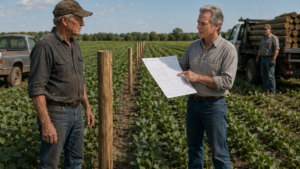
“Bigger culvert. Restore the swale grade instead of cutting a new outlet. We’d need erosion protection here and here.”
He pointed.
“And I’d want the downstream capacity checked before we touch anything.”
Margaret asked, “Price?”
The contractor gave a number.
Joshua’s expression fell.
“That’s more.”
“About twelve percent.”
Margaret looked at Frank.
“Your cheaper solution is more expensive.”
“I never said cheaper.”
Joshua rubbed the back of his neck.
The contractor continued.
“You save some excavation. Lose it on the larger culvert and stabilization.”
“And schedule?”
“Longer.”
Margaret laughed once without humor.
“Of course.”
Frank looked at her.
“This is the part you were right about.”
She stopped.
“We do have a time problem.”
The contractor rolled the plans loosely.
“If the county turns the review fast and everybody signs, I can keep the machine here through the end of the week. After that, it goes to another job.”
There it was again.
Pressure.
Not corruption.
Not stupidity.
Time, money and water.
The things that made people cut corners even when they knew better.
Deborah arrived before the county drainage inspector.
She followed the new stakes carefully.
At the spreading area she stood with Frank.
“You’re telling me this won’t flood my pasture?”
“No.”
Her face tightened.
Frank pointed toward the grass.
“I’m telling you it won’t deliberately concentrate the flow onto it. Big storms can still put water down here. They always have.”
Deborah looked at him.
“That’s less comforting.”
“It’s more accurate.”
After a second, she nodded.
“That I’ll take.”
The county drainage inspector arrived near noon.
He reviewed Frank’s field sheet, then walked the corridor independently.
Frank stayed back.
For once, he did not follow the man explaining every detail before he had been asked.
When the inspector returned, he pointed toward the culvert.
“Upsize that, restore this swale, and keep the outlet inside the easement corridor, and you’ve got something I can review.”
Margaret asked, “Can we submit it today?”
“If your engineer signs off on final grades.”
Joshua exhaled.
The problem had moved.
It was no longer whether they had a solution.
It was whether they were willing to pay for the right one.
That afternoon they reconvened in the equipment shop.
The folding tables were in the same places as Saturday.
So was the chair where Frank had sat.
This time nobody asked why he was there.
Margaret stood at the front, but she did not begin with a recommendation.
She put both plans on the table.
“The first proposal is no longer under consideration.”
One of the landowners asked why.
“Because it changed the drainage route without the consent the easement requires.”
She said it plainly.
No excuses.
Then she pointed to Frank’s plan.
“This alternative follows the existing drainage corridor, restores the swale and uses a larger culvert. It costs more.”
The treasurer gave the revised assessment.
Nobody liked it.
That helped.
Frank had learned to distrust plans everyone liked immediately.
A landowner at the end of the table said, “Why should I pay extra because the first design was wrong?”
Margaret answered, “Because the road still belongs to all of us.”
Another asked, “And who guarantees this one works?”
Frank spoke before Margaret could turn toward him.
“Nobody guarantees what water does in every storm.”
The room went quiet.
He continued.
“We can design for the grades we have, restore the route that was intended to carry it, increase capacity at the crossing and stop sending concentrated flow somewhere it wasn’t meant to go.”
No one applauded.
Good.
They asked questions instead.
What happened if the culvert clogged?
Who maintained the swale?
Would Deborah allow access?
Could costs be staged?
Would future changes require another vote?
For nearly an hour, the meeting became what Saturday’s should have been.
Messy.
Slow.
Useful.
When the last question had been answered as well as anyone could answer it, Margaret gathered the papers.
“There’s one more thing.”
She looked toward Deborah.
“The previous vote excluded an affected owner from the actual decision.”
Deborah met her eyes.
Margaret continued.
“We’re not doing that again.”
She placed a fresh ballot sheet on the table.
“This vote includes every parcel carrying the drainage corridor.”
Then she looked at Frank.
Not for permission.
Not for rescue.
Simply because he was there.
“We vote on the revised plan tonight.”
Chapter 8: The Folder Stayed Closed at the Second Meeting
Margaret had left an empty chair beside her.
Frank noticed it as soon as he entered the shop.
For a second he considered sitting somewhere else.
Then Joshua caught his eye from across the table and tilted his head toward the chair.
Frank walked over and sat.
His worn field folder went on the table beside him.
Closed.
Margaret did not comment on it.
She opened the meeting.
The revised plan had come back from the engineer that afternoon. The county drainage inspector had approved the grades for construction subject to the landowners’ consent. The contractor could begin the next morning if the association accepted the higher cost.
The treasurer read the assessment again.
Nobody liked it any more than they had the previous day.
One owner asked whether the association could simply patch the road and wait another year.
Joshua answered before Frank did.
“We’ve done that twice.”
Another asked if they could negotiate the contractor lower.
Margaret said she had tried.
A third wanted to know why everyone should pay when the worst flooding affected only part of the road.
That question sat badly in the room.
Frank watched Joshua’s expression harden.
Deborah looked down at her hands.
Margaret said, “Because shared access only works while everybody can use it.”
It was the kind of sentence Frank might have dismissed a week earlier if she had said it at the wrong moment.
Now it sounded earned.
The discussion moved to the easement.
Margaret handed copies around.
“This is the consent language we missed.”
Missed.
Not misunderstood.
Not overlooked by somebody else.
Missed.
Frank glanced at her.
She kept going.
“From now on, any change outside ordinary maintenance gets circulated with the actual drawing before a vote.”
The treasurer asked, “Every time?”
“Yes.”
“That’ll slow things down.”
“Yes.”
Margaret did not defend the answer.
She simply let it stand.
Deborah picked up the revised plan.
Frank watched her trace the new route with one finger.
It remained inside the old corridor.
At the lower end, erosion stone and a broad spreading area had been added before the water reached her boundary.
“What about access onto my pasture?” she asked.
The contractor answered from the back of the room.
“Only if maintenance requires it. We can reach most of the swale from the association side.”
“And if you need to cross?”
“We ask.”
Deborah looked at Margaret.
“In writing.”
Margaret nodded.
“In writing.”
Deborah sat back.
“That’s what I wanted in the first place.”
Frank knew that was not entirely true.
At first Deborah had wanted to avoid the whole thing.
She had ignored the meeting because the notice sounded routine.
But nobody benefited from saying that aloud.
People were allowed to become more careful without being punished for how careless they had been.
The vote began.
The first two owners voted yes.
The third hesitated over the assessment, then voted yes.
Joshua voted yes.
Frank did too.
Margaret’s ballot came next.
Yes.
Then Deborah.
She held the pen for several seconds.
The room stayed quiet.
She looked at the plan one more time.
“The downstream protection stays exactly as shown?”
Margaret answered, “Any change comes back to all of us.”
Deborah signed.
“Yes.”
The tension in the room did not break into celebration.
Someone immediately asked when the first payment was due.
Another complained about contractor rates.
Joshua laughed under his breath.
“That’s more like us.”
Even Frank smiled.
Construction started the next morning.
This time, Frank arrived before the excavator but did not stand in front of it.
The contractor had the approved drawing clipped to the hood of his pickup.
Frank’s hand-drawn sheet was underneath it.
The old culvert came out first.
It was smaller than anyone remembered once it lay on the grass.
The replacement looked almost excessive by comparison.
Then the crew worked along the swale.
They scraped sediment rather than carving a deep trench. Brush came out. Low sections were restored. Stone was placed where fast water could otherwise cut soil.
At the lower end, they built the wide spreading section before Deborah’s pasture.
Nothing about it looked dramatic.
That pleased Frank.
Good drainage rarely did.
Margaret visited the work twice a day.
She asked questions.
Sometimes too many.
Frank answered most of them.
When he did not know, he said so.
That took more effort than he expected.
By Friday afternoon the excavator was loaded again.
The association still owed more than anyone wanted.
The contractor still charged for the wasted mobilization from the first attempt.
The engineer billed for revised work.
The county review added delay.
Nobody escaped the cost of getting it wrong.
Frank thought that was fair in a way punishment rarely was.
Two weeks later, another hard rain came through.
Not a catastrophic storm.
A good test.
Frank drove to the road while it was still falling.
Joshua was already there.
They stood near the larger culvert as water passed cleanly through it.
No backing.
No spill toward the access lane.
They followed the swale east.
Water moved through the grass in a broad shallow sheet.
At the restored section, it accelerated slightly.
At the spreading area, it slowed.
Deborah stood behind her fence wearing a raincoat.
She raised one hand.
“Barn’s dry.”
Joshua called back, “So’s my road.”
Frank looked toward the pasture.
Water reached the low ground, as it always had.
But it arrived spread out instead of driven through a new cut.
That distinction was not impressive enough for a photograph.
It mattered anyway.
Margaret’s pickup stopped at the roadside.
She came down carrying an umbrella that the wind kept trying to turn inside out.
Joshua grinned.
“You look pleased.”
“I look wet.”
She checked the culvert.
Then the swale.
At the lower end, she stood beside Frank.
For a while neither of them spoke.
Finally Margaret said, “I owe you an apology.”
Frank looked at the water.
“You already fixed the process.”
“That isn’t the same thing.”
“No.”
She waited.
Frank could have made her say it all.
Could have let her explain the chair, the hired-hand remark, the meeting notice, the route change.
A week earlier, he might have.
Instead he said, “I shouldn’t have waited either.”
Margaret looked at him.
“You were right about the route.”
“And wrong about what to do with being right.”
The corner of her mouth moved.
“That sounds unpleasantly reasonable.”
“I’ve been told worse.”
She laughed once.
It was the first time he had heard her laugh without somebody being the target of it.
At the next association meeting, Frank arrived five minutes late because a heifer had slipped through a gate.
His chair was still empty beside Margaret.
Nobody had taken it.
He sat down, set his folder on the table and reached for the agenda.
The folder stayed closed.
When the discussion reached seasonal ditch maintenance, Margaret asked the room, “Anything we’re missing before we vote?”
Frank looked around the table.
Not at her.
Around it.
Deborah raised a question about access.
Joshua asked about debris checks at the culvert.
The contractor had left maintenance notes.
People answered one another.
Frank listened.
By the time he spoke, there was very little left to add.
Months later, after another heavy rain, he walked the drainage corridor alone.
The pasture smelled of wet grass and cattle.
Water slipped beneath the road through the larger culvert, entered the restored swale and followed the shallow curve east.
At the spreading ground, it thinned.
No orange stakes marked a shortcut downhill anymore.
Frank stopped where the wrong route had once pointed toward Deborah’s pasture.
He could still picture the fluorescent line.
He remembered how good it had felt, for less than a second, to know Margaret was about to discover he had been right.
The feeling seemed childish now.
He tucked his hands into his jacket pockets and continued walking.
Back at the road, the water stayed inside the old green channel.
It did not know who had won the argument.
It only knew where it had been given room to go.
The story has ended.