The Shattered Beehives On The Farm Lane And The Engulfed SUV
CHAPTER 4: THE TRAPPED KEY AND THE GOLDEN PUDDLE
Thirty minutes passed under the warm Virginia sun.
Trent Sterling sat on a limestone boulder at the edge of the state highway easement, his expensive suit stained with dirt and sweat, his face and neck swelling with painful, throbbing red welts. Every muscle in his body ached from his desperate sprint through the briars. He pulled his pockets inside out, searching in vain for his phone.
Then, with a sickening jolt of realization, he remembered where it was.
His iPhone 15 Pro, containing his private digital keys, his firm’s banking applications, his closing contracts, and the phone numbers of his investment partners, was resting in the wireless charging tray on the center console of the Escalade. And the proximity key fob to the eighty-five-thousand-dollar truck was still sitting in the cup holder beside it.
Trent rose to his feet, grimacing in pain, and crept cautiously back down the gravel lane toward the locked farm gate. He stopped twenty feet away, his eyes widening in disbelief at the spectacle before him.
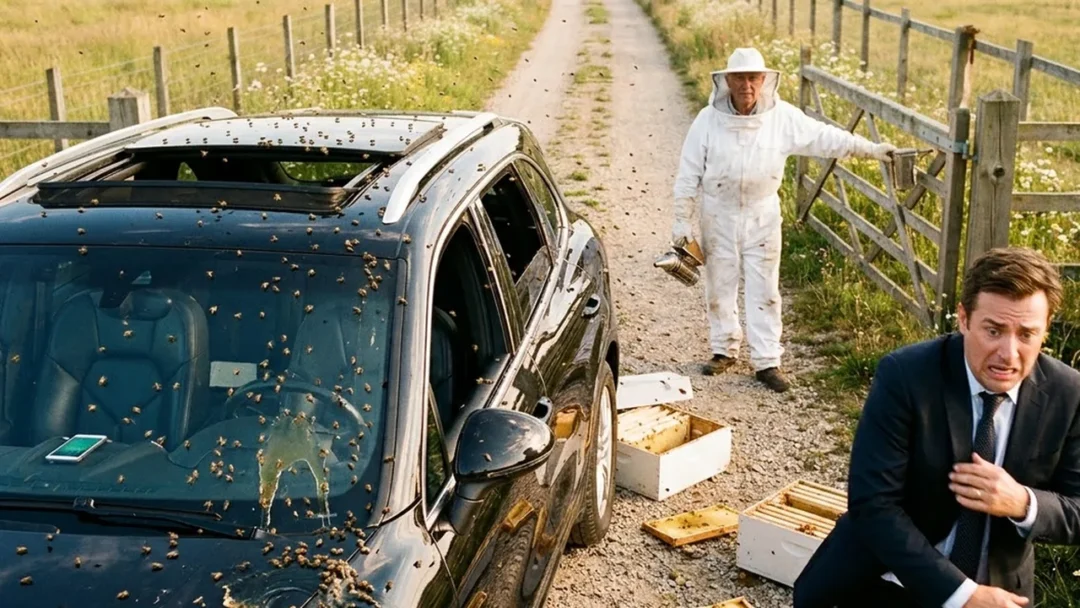
The black Cadillac Escalade was virtually unrecognizable.
The hood was covered in a thick, sticky puddle of golden wildflower honey, studded with hundreds of broken wax cells and crawling with tens of thousands of busy bees. Honey was slowly dripping off the leading edge of the hood, forming a glistening puddle on the gravel roadbed. The front windshield was completely obscured by bees licking the sweet syrup.
Inside the vehicle, the scene was even more terrifying. The open sunroof had acted as a natural funnel. The entire roof headliner was draped in dense clusters of bees forming comb chains. The leather steering wheel had vanished beneath a writhing, pulsing mass of black and amber bodies. Through the driver’s side window, Trent could see the screen of his phone glowing brightly with incoming calls from his lead investor in Richmond.
The screen lit up: INCOMING CALL: MARCUS VANCE – TITLE CLOSING.
Trent took two hesitant steps forward, reaching out a trembling hand toward the door handle.
Instantly, three guard bees detached from the window frame, hovering in front of his face with high-pitched, aggressive buzzes. Trent gasped, stumbled backward, and threw himself behind a cedar fence post, his heart hammering against his ribs. He couldn’t get within ten feet of the truck, let alone reach inside to grab his keys.
A cloud of white dust rose from the state highway as an Augusta County Sheriff’s patrol cruiser turned onto the gravel farm lane, followed closely by a green state fleet pickup truck bearing the seal: VIRGINIA DEPARTMENT OF AGRICULTURE AND CONSUMER SERVICES.
The cruiser pulled to a stop behind Trent’s boulder. The driver’s door opened, and Deputy Luke Harrison stepped out. At thirty-six, Deputy Harrison was an experienced rural law enforcement officer who had grown up on a family dairy farm three miles down the river. He knew the Yoder family, he knew the Century Farm boundaries, and he understood livestock law.
Stepping from the state agricultural pickup was Dr. Evelyn Ross, the Senior State Apiary Inspector for the Commonwealth of Virginia. Dr. Ross wore a khaki field vest and carried a digital inspection tablet and an evidence camera.
Trent rushed toward the deputy like a drowning man grasping a life preserver.
“Deputy! Thank God you’re here!” Trent cried, pointing a trembling finger at the locked gate. “That crazy farmer locked me out! He set his bees on me! Look at my neck! I’ve been assaulted! My eighty-five-thousand-dollar truck is being destroyed! Shoot the gate lock off and get my car out of there!”
Deputy Harrison looked at Trent’s swollen neck, then at his muddy clothes, and finally at the locked cedar gate and the bee-covered Escalade. His expression remained entirely deadpan.
“Mr. Sterling, settle down,” Deputy Harrison said calmly. “Nobody is shooting any locks today. You called dispatch screaming about a riot. What I see is an active agricultural quarantine zone on private property.”
The legal status of private agricultural easements in Virginia is rooted in common law principles of necessity and historic grant. Under the Code of Virginia, a private farm easement granted for agricultural husbandry grants the underlying fee owner the absolute right to regulate, restrict, or close access during active agricultural maneuvers. Delivery trucks, postal carriers, and emergency services are granted conditional access, but third-party commercial travelers possess zero statutory right to treat agricultural lanes as high-speed bypass routes. When a driver ignores a closed farm barrier, they cross the legal threshold from a civil dispute into active statutory trespass.
From his vantage point on the highway boulder, Trent’s physical agony was rapidly compounded by financial panic. The closing in Staunton was not an ordinary transaction; it was a high-risk commercial syndication structured with a hard three-o’clock financing contingency. His firm had deposited two hundred and fifty thousand dollars in non-refundable escrow earnest money, contingent upon delivering certified signatures by the close of the banking day. With his encrypted corporate smartphone trapped inside the bee-swarmed Escalade, Trent was utterly powerless to notify his escrow officers, verify the wire transfers, or request an emergency extension. His arrogance had not merely cost him his vehicle; it was actively destroying his firm’s commercial liquidity.
Deputy Luke Harrison stepped down into the gravel swale, examining the deep tire ruts left by Trent’s aggressive braking maneuver. His trained eye followed the skid marks from the gravel crest down to the splintered remains of the cedar sawhorse. As a rural law enforcement officer, Harrison had investigated dozens of boundary disputes, livestock escapes, and hunting trespasses, but the physical evidence in front of him was extraordinary in its one-sided arrogance.
“Mr. Sterling,” Deputy Harrison said, his voice dropping into the cool, measured cadence of a formal interrogation, “your vehicle left forty-two feet of locked-wheel deceleration marks across a deeded agricultural easement posted with reflective warning signage. You breached an active farm barrier, struck an agricultural transport vehicle, and destroyed registered state livestock. Under Virginia law, operating a motor vehicle in willful disregard of farm safety signage constitutes reckless driving as a Class One misdemeanor.”