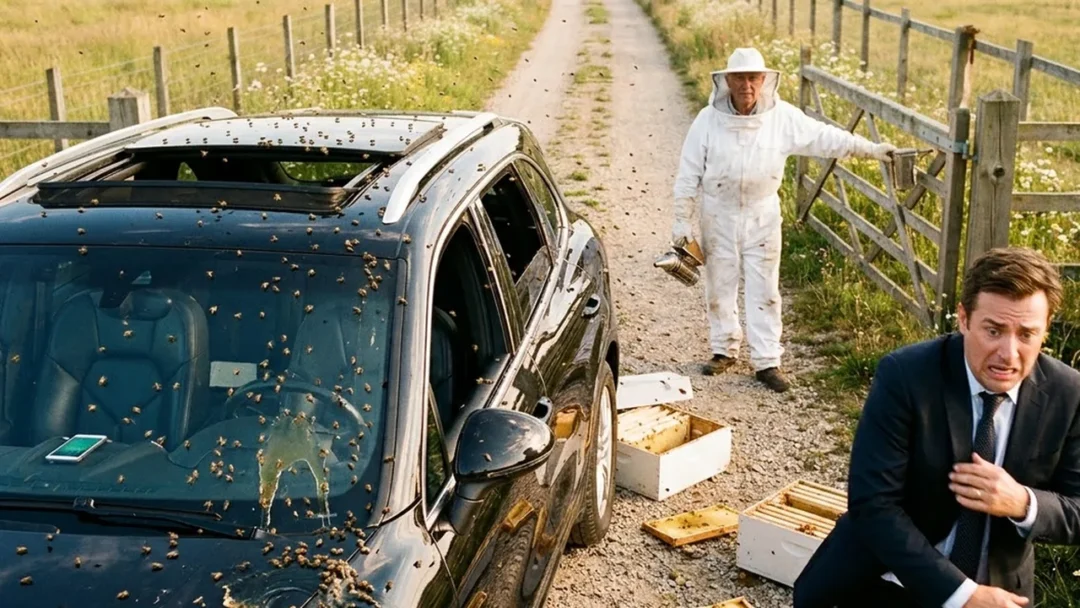
The Shattered Beehives On The Farm Lane And The Engulfed SUV
CHAPTER 5: THE LEDGER OF THE STATE APIARIST
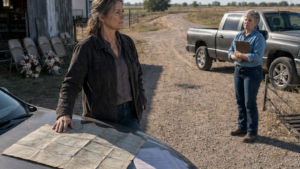
Dr. Evelyn Ross walked up to the locked cedar gate, pulling a lightweight mesh veil over her sun hat. She unlatched her inspection kit, looking through the wire mesh at the shattered white boxes resting on the Escalade’s hood.
“Deputy Harrison,” Dr. Ross said, her voice filled with deep professional indignation. “Look at those boxes. Those aren’t standard production supers. Those are certified ten-frame breeder colonies from Clover Hill’s closed-line hygienic Italian queen breeding program.”
Dr. Ross turned to Trent Sterling, her eyes blazing with cold scientific fury. “Did you touch those boxes, Mr. Sterling?”
“I pushed them off a handcart!” Trent yelled, pacing back and forth on the gravel. “They were blocking the road! I had every legal right to clear a public obstruction!”
“This is not a public road, Mr. Sterling,” Deputy Harrison stated, pulling an official county GIS deed plat from his patrol clipboard. “This lane is a deeded private agricultural easement owned exclusively by Clover Hill Farm under the Virginia Century Farm Act of 1969. You had zero legal right to be on this gravel, zero right to touch that sawhorse, and zero right to interfere with registered livestock.”
Dr. Ross tapped her digital tablet, pulling up the state apiary registry. “Amos Yoder’s breeding stock is registered with the Department of Agriculture under Virginia Code Title 3.2, Chapter 44. Those two colonies contained verified hygienic queen mothers imported under federal research permits. By shoving those supers off that cart and crushing the comb against your vehicle, you destroyed seventy-two hours of controlled larval grafting and killed two registered breeding queens.”
Dr. Ross pointed her digital camera through the gate rails, taking twelve rapid high-resolution photographs of the shattered dovetailed boxes, the dented hood, and the golden honey pooling across the chrome grille.
“Under Virginia Code section 3.2-4408, the intentional, malicious destruction of a registered quarantine apiary is a Class One misdemeanor carrying mandatory statutory restitution for genetic loss,” Dr. Ross explained with surgical precision. “The replacement and genetic reconstruction value of those two certified queen colonies is eight thousand five hundred dollars. The loss of thirty frames of drawn comb and sixty pounds of organic wildflower honey adds another twelve hundred dollars. And the emergency hazardous containment mobilization adds four thousand dollars.”
Trent stared at the state inspector, his mouth falling open. “You’re charging me fourteen thousand dollars for some bugs?”
“They aren’t bugs, Mr. Sterling. They are state-certified agricultural livestock,” Deputy Harrison interjected, unhooking his citation book from his utility belt. “And that’s just the agricultural department’s invoice. From the Augusta County Sheriff’s Office, you are being issued an immediate criminal summons for Trespass by Motor Vehicle under Virginia Code eighteen-point-two-one-nineteen, and Criminal Property Damage under eighteen-point-two-one-thirty-seven.”
Deputy Harrison tore off the yellow carbon citations and handed them to Trent.
Trent looked down at the court summons, then back at his bee-engulfed luxury SUV. “What about my truck? I have to get my truck out of there! Call a tow truck!”
Deputy Harrison shook his head slowly. “No standard commercial wrecker in Augusta County will touch that vehicle while it’s covered in sixty thousand defensive honeybees, Mr. Sterling. It’s an active biological hazard. You’re going to have to wait until Mr. Yoder finishes his work.”
Dr. Evelyn Ross’s role as State Apiary Inspector carried the statutory authority of a sworn agricultural magistrate under Virginia law. Trained at Virginia Tech in apiculture entomology and veterinary parasitology, Dr. Ross had spent twenty years cataloging and protecting the state’s agricultural pollinators from parasitic mites, viral pathogens, and illegal pesticide applications. The Virginia queen breeding program was one of only five state-certified genetic sanctuaries in the United States, producing hygienic Italian honeybee queens bred specifically for natural resistance to Varroa destructor mites without requiring synthetic chemical acaricides.
Dr. Ross methodically documented the destruction on her digital terminal, entering forensic measurements of the damaged supers, the broken comb area, and the estimated mortality of the brood chambers. Under agricultural restitution guidelines, the destruction of certified breeding stock is calculated not by the market value of raw honey, but by the generational reproductive value of the queen line. A certified, artificially inseminated breeder queen represents hundreds of hours of genealogical selection, morphological verification, and laboratory testing. By crushing two active breeder queens under the wheels of an industrial sawhorse and a vehicle hood, Trent had inflicted an irreparable genetic loss on the regional agricultural economy.
Dr. Evelyn Ross adjusted her wire-mesh veil, stepping within six feet of the Escalade’s hood to photograph the damaged brood frames with a macro-lens camera. On the screen of her field tablet, she brought up the official genetic registry of Clover Hill Farm. For three decades, the Yoder family had cooperated with researchers at the United States Department of Agriculture’s Honey Bee Breeding, Genetics, and Physiology Research Laboratory in Baton Rouge, breeding colonies that exhibited ninety-eight percent hygienic uncapping behavior against parasitic brood pests.
“These colonies were scheduled for formal genetic transfer to the Shenandoah Valley Pollinator Reserve tomorrow morning, Deputy,” Dr. Ross said, her tone severe and uncompromising. “The loss of these two matriarch lines sets the regional research program back two full breeding cycles. In addition to the statutory livestock replacement fines, the Department of Agriculture will be seeking full administrative recovery for all veterinary forensic hours, emergency quarantine transport, and lab verification diagnostics.”