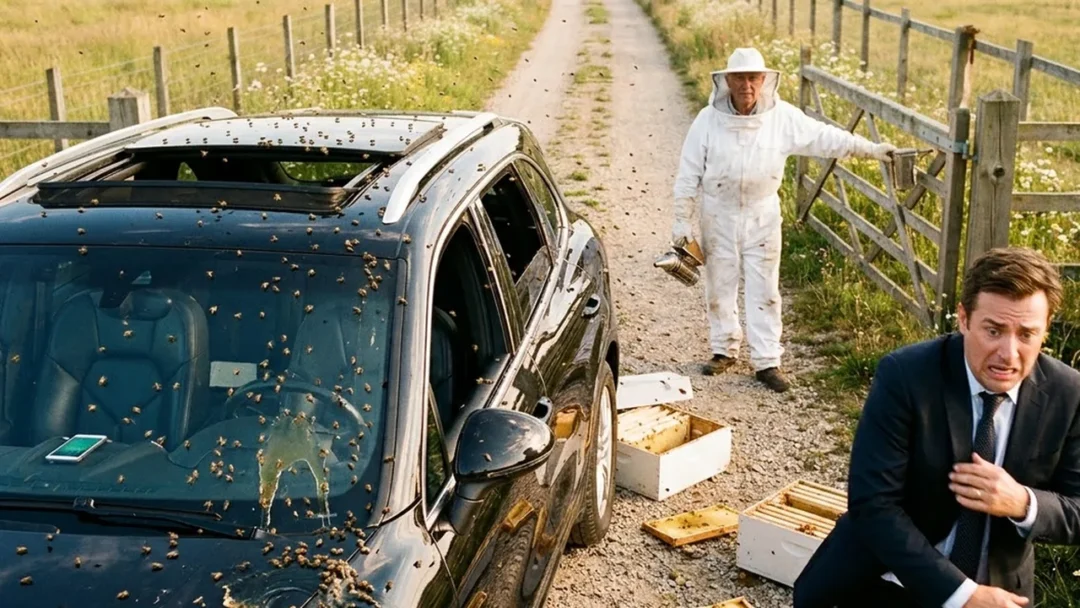
The Shattered Beehives On The Farm Lane And The Engulfed SUV
CHAPTER 3: THE PHEROMONE CLOUD AND THE FLIGHT
The defensive swarm did not search blindly for their target.
The alarm pheromone had tagged Trent Sterling’s clothes, his hands, and the shattered frames resting on his luxury vehicle. The hot engine block of the idling Escalade, the vibrating serpentine belt, and the sweet scent of six gallons of warm honey created an irresistible beacon for the enraged colony.
A dozen guard bees struck Trent’s linen shirt, burying their barbed stingers through the thin fabric into his shoulders. Two more struck his neck below his left ear, delivering sharp, white-hot pulses of apitoxin that made him shriek in agony.
“Get them off me!” Trent screamed, his voice cracking into a high-pitched, hysterical wail. He began flailing his arms frantically, swatting at his hair and face, which only provoked dozens more bees to zero in on his rapid, thrashing movements.
He spun on his heel and attempted to dive back into the open driver’s seat of his Escalade.
He was too late.
The cloud of bees was already pouring through the wide-open panoramic sunroof and all four rolled-down windows like smoke drawn into a vacuum chimney. Thousands of insects swarmed into the climate-controlled cabin, drawn by the shattered honeycombs that lay oozing on the armrest and center cup holders. The leather steering wheel was black with crawling bees; the digital dashboard display was covered in a vibrating layer of wings; and the perforated cooled leather seats were buried under a carpet of defensive workers.
Trent took one look inside his car and let out a strangled gasp. To climb into that cab was suicide.
Clutching his stinging neck with both hands, Trent turned and sprinted down the gravel farm lane on foot, running faster than he had ever run in his life. His designer blazer flapped in the wind, his leather loafers slipped on the loose stones, and his terrified screams echoed across the quiet pastures as he fled toward the distant state highway.
Amos Yoder did not run. He moved with slow, deliberate discipline.
He walked past the idling Escalade, keeping his smoker puffing gently, and made his way to the lane entrance. The cedar farm gate, built from solid Virginia locust posts and white oak rails, stood intact where Trent had left it.
Amos reached out with his heavy goatskin glove, grasped the iron latch, and smoothly swung the heavy farm gate shut.
He looped a heavy galvanized steel chain around the gate post, took a brass master padlock from his pocket, and snapped the shackle securely in place with a crisp metallic click. The private agricultural barrier was once again completely closed, locked, and legally secured.
Through the cedar rails, Amos watched Trent Sterling collapse in the grass two hundred yards down the lane, gasping for air and swatting at his ankles, completely stranded in the middle of nowhere without a phone, without transport, and without a closing contract.
Amos looked back at the Escalade. The idling V8 engine rumbled smoothly, but the black vehicle was no longer a symbol of corporate luxury. It was an active, humming, sixty-thousand-bee hive on wheels.
Amos walked back to his handcart, his expression peaceful and unhurried.
“Now you can wait,” Amos murmured to the quiet valley breeze.
The stinging apparatus of a female worker honeybee is a marvel of evolutionary lethality against mammalian predators. The stinger consists of two barbed lancets that alternate in rapid, motorized thrusts, driving the shaft deeper into the epidermal layer of the skin while pumping apitoxin from the venom sac. Unlike wasps or hornets, whose smooth stingers allow multiple attacks, a honeybee’s barbed lancet anchors itself permanently in the elastic dermis of human skin. When the bee pulls away, the stinger, venom gland, and associated nerve ganglion tear away from the abdomen, continuing to pump venom autonomously for up to sixty seconds while releasing fresh bursts of alarm pheromone directly into the wound site.
As Trent Sterling sprinted down the gravel lane, swatting in blind panic, his flailing movements generated intense air turbulence that further provoked the airborne swarm. Honeybees are visually tuned to track high-speed movement and dark, contrasting silhouettes; Trent’s dark Italian navy blazer against the light limestone gravel made him an irresistible visual beacon. With every step, the sharp, white-hot venom pulses injected melittin and apamin directly into his subcutaneous capillaries, triggering violent localized histamine releases that swelled his skin into throbbing, crimson welts. His screams of agony were drowned out by the thunderous, low-frequency roar of twenty thousand bees circling his abandoned truck.
Trent Sterling stumbled through the dense briars lining the drainage ditch, his designer loafers stripped of their shine, the fine Italian leather gouged by sharp limestone rocks. His vision was beginning to blur as his body struggled to process the concentrated dose of apitoxin coursing through his bloodstream. Honeybee venom is a complex polypeptide soup containing histamines, dopamine, and phospholipase A2, which actively breaks down cell membranes and causes localized capillary necrosis. Each sting burned like a miniature match head pressed into his flesh.
Behind him, the roar of the swarm reached a steady, hypnotic crescendo. The black Escalade was now completely hidden beneath a shimmering, undulating veil of golden wings and black abdomens. In the still autumn heat, the scent of warm wildflower honey was overwhelming, attracting feral bees and yellowjackets from adjacent tree hollows to join the feast. The vehicle’s expensive sound system, still connected to Trent’s phone via Bluetooth, began playing the theme music of an incoming investor call through the exterior mirror speakers, its cheerful digital melody absurdly counterpointing the primitive biological siege.