They Fined His Farm for Blocking a Shared Gravel Lane—Then He Compared Eighteen Months of Records
Chapter 1: The Orange Tag on His Own Farm Truck
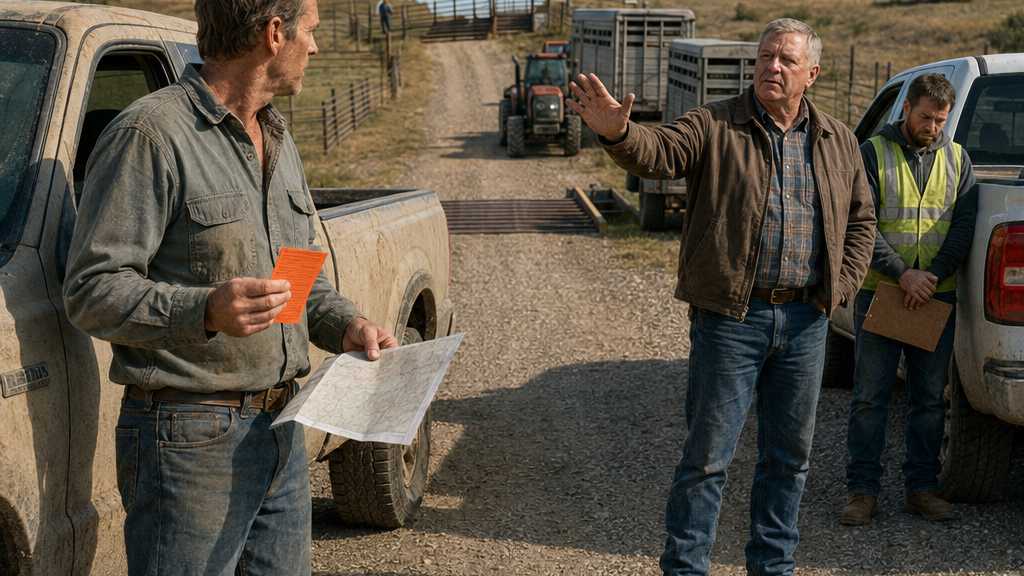
The orange tag was clipped beneath Stephen Walker’s windshield wiper while three unticketed trailers sat farther up the same gravel lane.
He stopped beside his truck with one hand still wrapped around the handle of a five-gallon water jug.
For a moment, he thought the bright square of paper was an auction notice. Edward Campbell had been hosting an equipment sale on the adjoining farm since eight that morning, and handwritten directions, bidder numbers, and temporary signs had appeared everywhere along the shared lane.
Then Stephen saw the words at the top.
LANE OBSTRUCTION.
Below that was his parcel number.
He set the jug down.
His old farm truck stood with its passenger-side tires just beyond the grass edge, leaving enough room for a loaded hay wagon to pass. Stephen knew because one had passed twenty minutes earlier.
Forty yards uphill, Edward’s pickup was parked half on the gravel.
Beyond it sat two livestock trailers nose to tail. A compact tractor with a loader attachment had been left near the bend where the lane narrowed.
None carried orange tags.
A young farmhand in a reflective vest walked toward Stephen with a clipboard.
“You put this on here?”
The young man slowed. “I was told to mark anything obstructing traffic.”
Stephen looked past him.
“At this end?”
The farmhand glanced toward the auction crowd.
“Mr. Campbell gave me the list.”
That was answer enough.
Stephen pulled the tag free and read it twice. Ninety dollars, payable to the private agricultural road association. An additional administrative fee would apply after ten days.
He felt the first hot rise of anger in his chest.
His father had taught him that anger on a shared road was expensive. You still had to see the same people tomorrow. You still needed them to move a tractor when the ditch washed out. You still waved from the cab even after an argument.
Stephen folded the tag once instead of crushing it.
Edward stood near the gate to his equipment yard, talking with two neighboring landowners. He was broad through the shoulders despite being past sixty, his boots planted as if the gravel beneath them belonged more firmly to him than to anyone else.
Stephen walked over.
Edward saw the orange paper before Stephen spoke.
“You need something?”
“I need to know why my truck got this.”
Edward barely looked at it. “Because we’re trying to keep the lane clear.”
Stephen turned and pointed downhill.
“You mean clear like your truck?”
One of the neighboring men looked away.
Edward’s jaw shifted.
“My truck’s part of the event.”
“And the trailers?”
“Temporary.”
“So is mine.”
Edward gave a short breath through his nose. “You were told we’d have traffic today.”
Stephen had been told. Everyone on the lane had received the same association notice three weeks earlier. It warned that the upper turnaround near Edward’s equipment yard would be restricted during the auction so buyers with trailers could enter and exit without backing into pasture fencing.
Stephen had read it because he had a feed delivery scheduled that afternoon.
He went back to his truck, opened the glove compartment, and pulled out the folded association map he kept with road notices and gate codes.
When he returned, Edward was still standing in the same place.
Stephen opened the map over the hood of a nearby utility trailer.
“Show me.”
Edward frowned. “Show you what?”
“Where my truck is inside the restricted area.”
The two neighboring men were looking now.
Stephen placed one finger on the printed turnaround circle. Then he traced the lane downhill to his own farm entrance.
“The restricted zone starts past the cattle guard.”
Edward looked at the map without leaning closer.
“We have discretion during heavy-traffic events.”
“Where does it say that?”
“You want to argue definitions while people are trying to move equipment?”
“No. I want to know what rule I broke.”
For the first time, Edward’s voice sharpened.
“You’re blocking association access.”
Stephen looked down the lane again.
A pickup towing a flatbed came around the bend. It passed Stephen’s truck with several feet to spare, then slowed behind Edward’s two parked trailers.
Nobody said anything until it edged around them onto the grass.
Stephen tapped the map.
“My truck is outside the marked turnaround. Traffic can pass it. If there’s another rule, show it to me.”
Edward folded his arms.
“The chairman can make temporary decisions when conditions require it.”
Stephen had served on enough county advisory committees to recognize that sentence. It sounded official because no one had yet asked where it was written.
He looked at the farmhand.
“Were you told to tag every vehicle below the cattle guard?”
The young man hesitated.
Edward answered for him.
“He was given instructions.”
“That wasn’t what I asked.”
The farmhand glanced at Edward, then down at his clipboard.
“I was told to start at Walker’s entrance and work uphill if it got crowded.”
Stephen went still.
His irritation changed shape.
Until then, he had believed Edward was being inconsistent. Rural associations were full of inconsistency. Somebody’s nephew parked too long. A board member forgot a rule. A chairman made a bad call during a busy Saturday.
But “start at Walker’s entrance” was not the same thing.
Stephen refolded the map carefully.
“I’ll appeal it.”
“You’re welcome to.”
Edward’s tone had gone calm again.
Stephen picked up the water jug and walked back toward his truck.
Behind him, the auctioneer’s amplified voice rolled across the farmyard. A diesel engine started. Someone laughed near the bidder table.
The ordinary sound of the morning bothered him more than shouting would have.
He placed the orange tag on the passenger seat instead of throwing it away.
At home that afternoon, he photographed the truck exactly where it had been parked. He photographed the width of the open lane. He photographed the association’s painted cattle-guard marker and the map showing the official turnaround.
Then he wrote a short appeal.
No accusations.
No mention of favoritism.
He attached four photographs and quoted the restriction notice word for word.
At 4:12 p.m., he sent it to Sharon White, the association secretary.
Stephen expected an answer sometime the following week.
At 9:47 that night, his phone buzzed on the kitchen counter.
He opened Sharon’s email.
The appeal had already been denied.
The ninety-dollar assessment remained.
An additional fifteen-dollar administrative review fee had been added.
Stephen read the message once, then looked at the folded map lying beside the orange tag.
Less than six hours had passed since he filed the appeal.
He had not even known the board was meeting.
Chapter 2: The Map Said Something Different
“Can you send me the vote that authorized the temporary restriction?”
Stephen asked the question before Sharon White had finished unlocking the association shed.
She stopped with the key halfway out of the padlock.
“What vote?”
“The one that moved the restricted area downhill to my farm entrance.”
Sharon looked at him over her shoulder.
“It wasn’t moved.”
“Then what was I fined under?”
She opened the door.
The shed was barely more than a converted utility building beside the shared gravel lane. A metal desk sat against one wall. Filing cabinets occupied another. Road invoices, culvert receipts, insurance papers, and meeting binders had accumulated there for years.
Sharon switched on the fluorescent light.
“Edward said Saturday required temporary traffic control.”
“I know what Edward said.”
Stephen placed a copy of the auction notice on the desk.
“I’m asking what the association approved.”
Sharon took off her glasses and cleaned them with the edge of her shirt.
“There was discussion.”
“At a meeting?”
“I’d have to look.”
Stephen waited.
He had taken an early lunch from his county job to come here. He had promised himself he would not turn it into a confrontation.
That promise was beginning to irritate him.
Sharon opened the latest minute book.
She worked backward through several pages.
“July meeting was drainage.”
Another page.
“June was the gravel contract.”
Another.
“Here’s the auction discussion.”
Stephen stepped closer.
Sharon read silently.
“What does it say?”
“That members were notified of increased traffic.”
“And restrictions?”
She kept reading.
“It says the upper turnaround should remain open.”
Stephen pointed to the map he had brought.
“The upper turnaround.”
“Yes.”
“My truck was below it.”
“Yes.”
He let the word settle.
“Does it authorize the chairman to expand the restricted area?”
Sharon searched the next page, then the previous one.
“No.”
“Any standing rule?”
She moved to another binder.
Ten minutes later, there was still no rule.
Sharon finally sat down.
“Edward’s always handled temporary access problems.”
“That’s not the same as having authority to fine people wherever he decides.”
“I didn’t say it was.”
“You denied my appeal.”
Her expression tightened.
“I processed the decision.”
“Whose decision?”
She did not answer immediately.
Stephen noticed a paper tray beside the desk. His appeal was on top, printed in black and white. The photographs were stapled behind it.
There were no handwritten board notes.
No initials.
No vote tally.
Nothing showing anyone besides Sharon had reviewed it.
“Did the board see this?”
“Edward did.”
“That wasn’t my question.”
Sharon’s mouth pressed into a line.
“No. Not the full board.”
Stephen looked at the orange tag he had brought in his shirt pocket.
The answer should have felt like vindication.
Instead, he felt something closer to embarrassment.
The process had been thinner than he expected, and he had still spent four days quietly assuming the institution behind it must be more formal than it appeared.
Sharon turned the appeal over.
“I can put it on next month’s agenda.”
“That’s three weeks away.”
“Yes.”
“And the fee?”
“Technically it’s due before then.”
Stephen almost laughed.
“So I pay the penalty first and discuss whether it was valid later.”
“You can leave it unpaid.”
“And trigger another fee.”
Sharon looked genuinely uncomfortable now.
“I didn’t write the schedule.”
Stephen knew that. He also knew Sharon had kept the association books for nearly a decade and had never seemed interested in power. Her problem was different.
She treated procedure as something that existed because Edward said it did.
Stephen recognized an uncomfortable resemblance to himself.
He treated fairness the same way.
He gathered his papers.
“I’m not trying to make your job harder.”
“I know.”
“I just want the same rule applied to everybody.”
Sharon nodded, but the nod was tired rather than reassuring.
Outside, Stephen stood beside his truck and looked uphill.
Edward’s farm sat beyond the bend. The auction signs had been removed, but tire tracks remained pressed into the grass where buyers had driven around parked vehicles.
Stephen could have called Edward.
He could have demanded a special meeting.
He could have refused payment and forced the issue.
Instead, that evening, he opened the association payment portal and paid the fifteen-dollar review fee along with the original assessment.
He told himself it was practical.
Ninety-five minutes of arguing could cost more than a hundred and five dollars in lost work. Hay did not care about principles. Neither did payroll. His feed supplier had already moved one delivery because of the auction.
His father would have said not every wrong turn needed a fence built across it.
Stephen entered the payment.
For several seconds, the confirmation page stayed on his screen.
Then he printed it.
He placed the receipt in a manila folder with the orange tag and the association map.
The folder went into the bottom drawer of his farmhouse desk.
He closed it harder than necessary.
Two days later, Stephen was greasing the bearings on his hay trailer when something bright moved in the breeze near the tongue.
He wiped his hands on a rag and walked around.
A second orange tag had been wired to the trailer jack.
LANE OBSTRUCTION.
Stephen stared at it.
The trailer was inside his own gate.
Its rear wheels were three feet off the gravel.
He looked up the lane.
No one was there.
Chapter 3: Three Notices Became a Pattern
The date on the third notice was wrong.
Stephen knew it before he finished reading the first line.
He stood in the farmyard with the orange tag in one hand and the morning mail tucked beneath his arm.
The violation listed the previous Saturday at 10:35 a.m.
Obstruction of shared agricultural access.
Vehicle description: white farm pickup with livestock trailer.
Stephen read the time again.
At 10:35 the previous Saturday, that truck had been sitting outside a livestock auction nearly one hundred eighty miles away.
So had Stephen.
He carried the notice into the farmhouse and cleared a space on the kitchen table.
From the bottom drawer of his desk he retrieved the first orange tag, the second, the association map, and his payment receipt.
Three tags now lay in a row.
The first had been attached to his truck during Edward’s equipment auction.
The second had been wired to his hay trailer inside Stephen’s gate.
The third described a truck that had not been in the county.
He no longer felt angry in the clean way he had that first Saturday.
Anger had been simple.
This was something else.
He pulled up his bank account and found the fuel purchase from the auction trip. Then he opened his email and located the livestock-auction receipt with the timestamp.
9:58 a.m.
He had bought replacement heifers just before ten.
At 11:16, he had paid for lunch at a diner across from the sale barn.
At 12:03, his fuel card had been used fifteen miles farther west.
There was no possible route that put his truck back on the shared lane at 10:35.
Stephen printed everything.
By noon, four pages of receipts sat beside the third orange tag.
He called Sharon.
“I need to know who issued notice number thirty-one.”
There was keyboard noise on the other end.
“Give me a second.”
Stephen waited beside the kitchen window.
A loaded feed truck came slowly along the gravel lane, its tires rolling close to the ditch edge before turning into his farm.
“Edward entered it.”
“Did he see my truck?”
“I don’t know.”
“The notice says observed obstruction.”
“That’s the standard wording.”
“Sharon, my truck was in another county.”
Silence.
“How far?”
“About a hundred eighty miles.”
Another silence.
“I have receipts.”
“I believe you.”
Stephen looked at the three tags.
“Then how did it get entered?”
“I’ll have to ask him.”
“No.”
The word came out sharper than he intended.
Sharon went quiet.
Stephen rubbed his forehead.
“Sorry. I mean don’t ask him yet. Send me whatever documentation supports the notice.”
“There may just be the entry.”
“Then send me the entry.”
He hung up and walked outside.
The feed-truck driver was lowering a hose toward the storage bin.
“Lane tight today?” Stephen asked.
The driver glanced back toward the entrance.
“Not bad.”
“Been bad other times?”
The driver shrugged.
“Sometimes I have to wait on trailers. That bend’s narrow.”
“Mine?”
“Everybody’s.”
That answer followed Stephen for the rest of the afternoon.
He had spent three weeks thinking about Edward’s unfairness. He had not spent much time thinking about why the lane had become such a sensitive subject in the first place.
Five years earlier, Stephen had run a smaller operation. Fewer cattle. Less purchased feed. Most hay moved from fields connected directly to the farm.
Now he had more animals, two seasonal hands, regular feed deliveries, livestock pickups, fertilizer trucks, and equipment moving between leased parcels.
The road had not widened because Stephen’s farm had.
Near four, Maria Rodriguez pulled her utility vehicle beside the fence and shut off the engine.
“You get another one?”
Stephen looked at her.
“How’d you know?”
“Edward was complaining about traffic at the co-op.”
Stephen held up the tag.
“This one says my truck was here Saturday morning.”
Maria waited.
“It wasn’t.”
“Where were you?”
“Livestock sale. Almost three hours away.”
Her eyebrows rose.
“That’s different.”
“Different from what?”
Maria rested both arms on the steering wheel.
“Different from the other complaints.”
Stephen felt himself stiffen.
“What other complaints?”
She hesitated long enough to make the answer clear before she gave it.
“Your delivery traffic.”
“You think I’m blocking the road?”
“I think last fall there were mornings I couldn’t get my trailer out because a feed truck was backing into your place.”
“That’s not the same as issuing fake notices.”
“I didn’t say it was.”
Stephen looked toward the lane.
Maria continued carefully.
“You expanded fast. You know that.”
“I’m allowed to run my farm.”
“Of course you are.”
“Then what are we talking about?”
“We’re talking about you thinking Edward invented every complaint because he’s handling them badly.”
Stephen said nothing.
Maria looked down at the orange notice.
“He is handling them badly.”
“That sounds like a polite way to describe this.”
“It probably is.”
She started the utility vehicle, then paused.
“But if you’re going to make this about fairness, don’t pretend nobody had a problem before the tags started.”
She drove away.
Stephen stood beside the fence after the sound of her engine disappeared.
He disliked what she had said because some of it was true.
There had been a feed delivery in October that blocked the bend for nearly twenty minutes. A fertilizer truck had once arrived before dawn and waited partly in the lane because Stephen had forgotten to unlock the south gate.
Edward had complained then.
Stephen remembered the conversation now.
Too many trucks, Edward had said.
Stephen had answered that the lane existed for farm access.
Both statements could be true.
Neither explained a citation issued against a truck one hundred eighty miles away.
That evening, Sharon emailed the requested record.
There was no photograph.
No witness name.
No timestamp beyond the typed entry.
The notes field contained six words:
Observed per chairman. Walker parcel access.
Stephen read the line several times.
Then he opened the drawer containing the other documents.
He arranged all three orange tags by date.
The first had a map contradiction.
The second described a trailer sitting inside his gate.
The third described a truck that was not there.
For years, Stephen’s county job had involved reviewing agricultural-access requests, permit records, traffic counts, and property-linked complaints. Most of the work was dull. Sometimes that was exactly why it mattered.
A single complaint meant almost nothing.
A pattern could mean something.
He had taught newer analysts the same rule: never start by trying to prove what you already believe. Start by asking whether the data behaves normally.
Stephen carried his laptop to the kitchen table.
He hesitated before logging into the county access-record system.
The database included records shared by local road associations when they filed maintenance assessments, access disputes, or insurance documentation. He had never searched his own parcel before. Doing so felt uncomfortably close to turning a personal fight into professional work.
He almost closed the computer.
Then he looked at the third orange tag.
Observed per chairman.
Stephen logged in.
He selected the road-association dataset.
Under parcel search, he typed his own number.
For a second, nothing happened.
Then the screen populated.
One entry appeared.
Then another.
And another.
Stephen stopped counting after the sixth line.
The list continued below the bottom of the screen.
Chapter 4: Eighteen Months Hidden in Plain Sight
Stephen stared at the list until the parcel numbers began to blur together.
His property had not been flagged three times.
It had been flagged nine.
Some entries were only maintenance notes. Others were formal lane-obstruction complaints. Several predated the orange tags now lying on his kitchen table by more than a year.
He scrolled back to the top.
The first entry had been filed eighteen months earlier.
Walker parcel access—commercial vehicle delay.
The next came six weeks later.
Walker parcel access—turnaround interference.
Then another.
And another.
Stephen pulled a legal pad toward him and started writing dates.
He forced himself to slow down.
At work, this was the point where inexperienced analysts made mistakes. They saw a pattern they expected to find and stopped looking for reasons it might be legitimate.
So Stephen widened the search.
He entered Maria Rodriguez’s parcel.
Two entries.
One was a drainage question. One was a trailer complaint that had been resolved without a fee.
He searched another neighboring parcel.
One entry.
Then Edward Campbell’s.
Stephen sat straighter.
There were road-maintenance records attached to Edward’s land. Culvert work. Gravel assessments. Insurance correspondence.
But no obstruction citations.
He tried the parcel associated with another board member.
Nothing.
Then a third.
Nothing again.
Stephen checked the event dates.
On the Saturday of Edward’s auction, the county-linked association records showed Stephen’s citation.
No comparable entries appeared for Edward’s pickup or the trailers that had sat farther into the lane.
He opened another archived event record.
Same pattern.
Stephen began building a spreadsheet.
Date.
Parcel.
Complaint type.
Vehicle description.
Outcome.
By midnight, his kitchen table had disappeared beneath paper.
The orange tags sat in the upper-left corner, weighted beneath a coffee mug.
At 12:23 a.m., Stephen leaned back and looked at the columns.
Nine flags associated with his parcel.
Zero obstruction penalties associated with three board-linked parcels across comparable high-traffic days.
He did not feel victorious.
The numbers were too uneven for that.
They made him uneasy.
He printed the first summary page and laid it beside the orange tags.
Then he opened the underlying traffic records.
That was where the story changed again.
Stephen’s feed deliveries had increased sharply the previous year.
Not a little.
Nearly forty percent.
His livestock-hauling permits had risen too. So had fertilizer deliveries and equipment transfers.
The shared lane had absorbed more commercial traffic because Stephen’s operation had grown.
He traced one monthly series with his finger.
Edward had been right about that.
Not about the citations.
Not about the impossible date.
But about the road carrying more weight than it used to.
Stephen thought of Maria standing by the fence.
Don’t pretend nobody had a problem before the tags started.
He closed his eyes.
Years earlier, after his father died, Stephen had promised himself he would keep the farm viable without turning every disagreement with a neighbor into a feud.
At the time, the promise had felt like maturity.
Now he wondered how often he had used it to avoid saying something difficult while there was still time to say it plainly.
The next morning, he took the spreadsheet to the county office.
He arrived before most of the staff and used the quiet hour to check his work against original records.
No assumptions.
No shortcuts.
He removed two entries that were not actually enforcement-related.
He added one complaint that had been coded under maintenance instead of access.
The pattern remained.
A county road clerk passing his desk slowed.
“You doing an audit?”
“Something like that.”
The clerk glanced at the columns.
“Private association?”
“Yeah.”
“Those get messy.”
Stephen gave a humorless smile. “I’m noticing.”
By nine-thirty, he had reduced eighteen months of material to two pages.
The first showed the dates and treatment of Stephen’s parcel.
The second listed comparable event dates involving board-linked parcels.
He did not include Edward’s name in the heading.
He did not write selective enforcement.
He wrote only what the records showed.
When he returned home that evening, an email from Sharon was waiting.
Subject: Special Meeting Notice.
Stephen opened it.
Edward had called a special association meeting for Thursday night at the volunteer fire hall.
The stated purpose was to consider revised penalties for lane obstruction, commercial delivery interference, and repeat violations.
Stephen read the proposed fee schedule twice.
Second offense: doubled assessment.
Third offense: suspension of discretionary access privileges during association events.
He looked at the dates on his orange tags.
Under the proposed rules, he would already qualify as a repeat offender.
His phone rang.
Sharon.
“Did you see it?”
“I did.”
“I told Edward next month’s regular meeting would be cleaner.”
“What did he say?”
“That this needs fixing before harvest traffic gets heavier.”
Stephen walked to the kitchen table and placed the phone on speaker.
“Did he know I requested the old records?”
A pause.
“Yes.”
“When?”
“Yesterday.”
Stephen looked at the two-page summary.
“And today he called a special meeting.”
“I’m not saying those things are connected.”
“You don’t have to.”
Sharon exhaled.
“Stephen, if you’re bringing this up Thursday, bring documents. Not accusations.”
“That was already the plan.”
After the call, Stephen slid the orange tags into the manila folder.
For the first time, they did not feel like fines.
They felt like entries in a sequence.
He left only the two-page comparison on the table.
At the bottom of the special-meeting notice, one line had been underlined:
PROPOSED RULES EFFECTIVE IMMEDIATELY UPON APPROVAL.
Edward was not waiting for Stephen’s appeal anymore.
He was trying to change the rules first.
Chapter 5: The Reason Edward Would Not Let Go
Edward arrived at Stephen’s fence line two evenings before the special meeting without a binder, a clipboard, or even his usual association cap.
That alone made Stephen suspicious.
Edward stopped beside a weathered post while Stephen finished checking the latch on a pasture gate.
“We need to talk.”
Stephen closed the latch.
“About Thursday?”
“About you turning this into something it doesn’t need to be.”
Stephen looked at him.
“What do you think I’m turning it into?”
Edward’s eyes moved toward the farmhouse.
“I heard you pulled eighteen months of association records.”
“I reviewed records I’m allowed to review.”
“I’m not arguing that.”
“That’s new.”
Edward ignored it.
“I’m asking you not to walk into that room and make this personal.”
Stephen almost laughed.
Instead, he leaned against the gate.
“You fined a truck that wasn’t here.”
Edward’s face hardened.
“That entry may have been wrong.”
“May have?”
“I’m saying I’ll review it.”
“You already denied two appeals.”
“I wasn’t talking about those.”
“No. You weren’t.”
Edward looked past Stephen toward the cattle.
For several seconds, the only sound was the slow scrape of an animal rubbing against a fence brace.
Then Edward said, “Do you remember the washout by the bend two winters ago?”
Stephen did.
They had lost half the lane edge after three days of rain.
“Yes.”
“Do you remember what it cost?”
“Not exactly.”
“I do.”
Edward reached into his jacket and pulled out a folded stack of photocopies.
Repair invoices.
Gravel.
Grading.
Drainage work.
Culvert stone.
The total was higher than Stephen expected.
Edward tapped one page.
“Then last spring we had to do it again.”
Stephen looked through the copies.
“You think my trucks caused all of this?”
“I think the road was built for six farms that used to move cattle and hay. Not feed semis twice a week.”
“They’re not semis.”
“You know what I mean.”
Stephen did.
Edward continued.
“You expanded. That’s your right. But every time anybody brought up limiting delivery hours, you treated it like we were trying to tell you how to farm.”
Stephen remembered the conversation.
Edward had caught him outside the machinery shed almost a year earlier.
Keep the big deliveries after nine, Edward had said. Give Maria time to move her trailer. Give school traffic time to clear.
Stephen had answered too quickly.
The association doesn’t schedule my business.
He had considered that the end of the matter.
“You never brought a formal proposal,” Stephen said.
“I tried to solve it without one.”
“You tried to tell me what to do.”
Edward’s mouth tightened.
“And you made it clear you wouldn’t hear it.”
There it was.
Not innocence.
Not justification.
But something Stephen had not wanted to admit.
Edward’s resentment had not started with the orange tags.
It had started when Stephen refused to acknowledge that his expanding farm changed the lane for everyone else.
Stephen handed the invoices back.
“That still doesn’t explain nine flags against my parcel.”
Edward’s expression changed slightly.
“You counted nine?”
“After removing unrelated entries.”
“And you checked everybody else?”
“Yes.”
Edward looked toward the lane.
Stephen watched him closely.
For the first time since the auction, Edward did not seem angry.
He seemed cornered.
“I told people to watch the problem area,” Edward said.
“My farm.”
“The place the complaints were coming from.”
“And when your auction trailers blocked the lane?”
“That was controlled traffic.”
“By you.”
“Yes.”
“Which is the point.”
Edward folded the repair invoices.
“No, Stephen. The point is I’m trying to keep a road usable when half the people on it want somebody else to pay for it.”
“And you decided I was the easiest person to discipline.”
“I decided your traffic was the biggest change.”
“That’s not the same thing.”
“No.”
The admission came quietly.
Stephen studied him.
“Did you tell Sharon to deny my first appeal?”
Edward did not answer immediately.
“Yes.”
“Before the board saw it?”
“Yes.”
“Why?”
“Because if every temporary decision turns into a full board dispute, nothing gets done.”
Stephen felt the old anger return, but it no longer fit as neatly as before.
Edward had abused discretion.
He had also been staring at genuine repair bills Stephen had not bothered to examine.
Both facts occupied the fence line between them.
Edward put the invoices back into his jacket.
“Withdraw the records issue. We’ll void the Saturday citation. Then Thursday can be about the road instead of accusations.”
“What about the other tags?”
“We’ll review them.”
“By the same process?”
Edward’s eyes narrowed.
Stephen shook his head.
“That’s why I’m not withdrawing anything.”
Edward nodded once.
Not agreement.
Recognition.
“Then don’t act surprised when I show those repair bills.”
“I won’t.”
Edward turned toward his truck.
Before he reached it, another engine approached.
Maria Rodriguez slowed beside the fence.
She saw Edward, then Stephen.
“Bad time?”
Edward opened his truck door.
“You two can finish it.”
He drove away.
Maria watched the taillights disappear.
“What was that?”
“He wants me to drop the records.”
“And?”
“I said no.”
Maria shut off her utility vehicle.
Stephen held up one of the copied invoices Edward had accidentally left beneath the fence brace.
“He had a reason to be angry about the road.”
Maria was quiet.
Then she said, “So did I.”
Stephen looked at her.
She gripped the steering wheel.
“Last fall, I told Edward he needed to do something about your deliveries.”
The words landed harder than Stephen expected.
“You told him to fine me?”
“No.”
“What did you tell him?”
“That talking to you wasn’t working.”
Stephen stepped closer to the fence.
“You never talked to me.”
“I mentioned the feed truck twice.”
“You joked about it.”
“I was trying not to make it a fight.”
Stephen almost answered.
Then he stopped.
The sentence sounded too familiar.
Maria looked embarrassed.
“I thought stricter enforcement meant everybody would get the same rule. I didn’t ask what Edward was actually doing.”
Stephen looked down at the faded orange tag caught beneath the edge of his clipboard.
For weeks, he had imagined the story ending with Edward exposed and everyone else finally seeing what Stephen had seen.
But Maria had just made that version impossible.
There had been a real problem.
Edward had turned it into selective enforcement.
Maria had encouraged action without checking the method.
And Stephen had dismissed complaints because acknowledging them felt too much like surrendering control over his own farm.
That night, Stephen sat at his kitchen table with the speech he had written for Thursday.
It ran four pages.
He read the first paragraph.
Then he tore it in half.
He tore the second page too.
By the time he finished, the wastebasket contained every sentence accusing Edward of targeting him personally.
Stephen kept only two pages.
Nine flags.
Three board-linked parcels.
Comparable event dates.
Outcomes.
Nothing else.
He placed Edward’s repair invoice beside them.
For the first time, Stephen knew what he did not want Thursday’s meeting to become.
He still had to decide what he wanted instead.
Chapter 6: Nine Flags Against One Parcel
Edward called for a vote before Stephen’s name appeared on the agenda.
The volunteer fire hall was nearly full.
Folding chairs faced three plastic tables pushed together beneath fluorescent lights. Muddy boots lined the aisle. Two neighboring landowners stood along the back wall because every chair had been taken.
Stephen sat three rows from the front with two sheets of paper on his lap.
Not the orange tags.
Not the photographs.
Not even the impossible-date receipt.
Just two pages.
Edward read the proposed rule in a flat, businesslike voice.
“Repeat obstruction assessments will increase after a second documented violation. The chairman or designated officer may impose temporary restrictions during high-traffic agricultural events.”
Stephen looked toward Sharon.
She was seated beside Edward with the minute book open.
Her expression gave nothing away.
Edward continued.
“If there’s no further discussion, I’ll entertain a motion.”
Stephen raised his hand.
“My records request is on the agenda.”
Edward glanced down.
“Under new business.”
“The rule changes whether those records matter.”
“The rule is prospective.”
“Then there’s no reason to vote before discussing the existing enforcement.”
A murmur moved through the room.
Edward set down his paper.
“You’ll have your turn.”
Stephen stayed seated.
“I’m asking for it before the vote.”
One of the board members shifted.
Sharon looked at the printed agenda.
“He’s right that the records item was submitted before the special notice.”
Edward’s jaw tightened.
“Fine.”
He leaned back.
“Five minutes.”
Stephen stood.
He walked to the front without the folder of orange tags.
That seemed to surprise Edward.
Stephen placed the first sheet on the table.
“I reviewed eighteen months of association-linked access records.”
Edward said nothing.
Stephen looked toward the room.
“My parcel was flagged nine times.”
Someone in the back whispered, “Nine?”
Stephen continued.
“I compared those dates with three parcels connected to current board members.”
He placed the second sheet beside the first.
“On comparable event and high-traffic dates, those three parcels received zero obstruction penalties.”
The room became still.
Stephen did not look at Edward.
“Nine against one parcel. Zero against three board-linked parcels.”
Edward leaned forward.
“That’s cherry-picking.”
Stephen nodded.
“It would be if I hid the criteria.”
He slid the pages toward Sharon.
“Dates, event type, complaint category, and outcomes are listed.”
Edward’s voice rose slightly.
“You’re comparing commercial traffic with private vehicles.”
“Some are commercial. Some aren’t.”
“Your operation generates more traffic.”
“Yes.”
That answer changed the room.
Edward seemed to lose the next sentence he had prepared.
Stephen continued.
“My farm creates more heavy traffic than it did five years ago. That affects road wear. It affects delivery congestion. I should have taken those complaints more seriously.”
Maria was sitting near the aisle.
She lowered her eyes.
Stephen touched the first page.
“But increased traffic does not explain a citation against a truck that was one hundred eighty miles away.”
Now people looked at Edward.
Stephen did not.
“It does not explain an obstruction tag on a trailer parked inside my gate. And it does not explain why the written restricted zone at the auction ended uphill from where my truck was parked.”
Edward pushed his chair back.
“The chairman has always had emergency discretion.”
Sharon spoke before Stephen could.
“I checked.”
Everyone turned toward her.
She had opened an older binder.
“There’s language allowing temporary traffic direction.”
Edward pointed toward her.
“Exactly.”
Sharon kept reading.
“Direction. Not monetary penalties.”
Edward’s hand lowered.
She turned several pages.
“And I could not find a board authorization expanding the auction restriction below the cattle guard.”
No one applauded.
No one needed to.
The silence had changed.
Edward looked at Stephen.
“You went through a year and a half of records to embarrass me over a hundred dollars?”
Stephen shook his head.
“I paid the hundred dollars.”
That produced another murmur.
“I’m here because paying it didn’t stop anything.”
Edward opened the folder in front of him.
“Then let’s talk about what did happen.”
He pulled out the road invoices Stephen had seen at the fence.
Grading.
Stone.
Culvert repair.
He passed copies down the table.
“Traffic on that road has changed. Walker’s deliveries increased. Heavy trucks are using a lane designed decades ago for smaller equipment. Somebody has to pay for that.”
Stephen looked at the invoices.
“I agree.”
Edward stared at him.
“You agree.”
“Yes.”
Several people shifted again.
Stephen could feel the shape of the argument changing under them.
He had spent weeks preparing to prove the enforcement was unequal.
Edward had spent months believing that if Stephen admitted the road problem, the rest of the conflict would disappear.
Neither was enough.
A neighboring landowner raised a hand.
“So what are we deciding? Whether Stephen got bad tickets or whether his trucks cost us money?”
“Both,” Stephen said.
Edward answered at the same time.
“The road.”
Stephen turned toward him.
“That’s the problem.”
Edward’s face reddened.
“What is?”
“You keep treating those as the same question.”
Stephen pointed to the repair invoices.
“If my traffic causes more wear, assess my share under a written maintenance formula.”
Then he touched the two-page comparison.
“If someone blocks the lane, enforce one obstruction rule against whoever does it.”
Edward opened his mouth.
Stephen continued before he could redirect the room.
“Those are separate responsibilities.”
Maria raised her hand from the third row.
“I complained about Stephen’s trucks last fall.”
Several heads turned.
Stephen looked at her.
Maria swallowed.
“I thought the road was getting harder to use. I still think that. But I assumed enforcement meant the same standard for everybody.”
Edward stared at her.
Maria continued.
“I didn’t know Stephen was being flagged when other vehicles weren’t.”
A board member at the table looked toward Sharon.
“How many of these notices actually have photos?”
Sharon flipped through a small stack.
“Not all of them.”
“Witness names?”
“Not consistently.”
Edward put both hands flat on the table.
“We have never required photographs.”
“Then maybe we should,” Stephen said.
Edward looked directly at him.
“You want to turn a farm lane into county bureaucracy.”
“No.”
Stephen picked up the proposed rule.
“I want fewer judgment calls.”
He let the paper fall back onto the table.
“If the restricted turnaround starts at the cattle guard, mark it there. If a vehicle blocks the traveled lane, document it. If heavy traffic causes more road wear, calculate that separately.”
A landowner along the back wall spoke.
“And the old fines?”
Stephen looked at his own two pages.
That was the moment he had not completely decided before entering the room.
He could ask for his money back.
He could demand every one of Edward’s decisions be overturned.
He could make the meeting about correction aimed backward.
Instead, he thought of his father’s promise.
Keep the farm viable without feuding with neighboring families.
For years Stephen had treated that as an instruction to stay quiet.
Maybe it had meant something harder.
Say what must be said while leaving everyone a road home.
Stephen faced the board.
“Withdraw every discretionary obstruction citation that can’t be supported under a documented standard.”
Edward’s expression hardened.
“Including yours.”
“Including mine.”
“And then what?”
Stephen slid the proposed penalty schedule toward the center of the table.
“Then we replace this with one written access rule.”
Edward stared at him.
“Same marked boundaries. Same documentation. Same appeal process. Every parcel.”
Stephen glanced at the repair invoices.
“And we create a separate maintenance formula for heavy commercial traffic. If my farm owes more because I use more of the road, put the numbers on paper and I’ll pay my share.”
The room stayed quiet.
Edward looked from Stephen’s comparison to his own invoices.
For the first time all evening, neither document canceled the other.
They simply sat beside each other.
One showed unequal enforcement.
The other showed unequal impact.
Stephen folded his hands behind his back.
“I’m not asking you to pretend my traffic hasn’t changed.”
He looked at Edward.
“I’m asking you to stop pretending discretion is a rule.”
Edward did not answer.
A board member finally broke the silence.
“We should postpone the penalty vote.”
Another nodded.
“Until we have language that separates obstruction from maintenance.”
Sharon wrote something in the minute book.
Edward watched her.
Then he looked at Stephen again.
The anger in his face had not disappeared.
But something else had entered it.
Calculation.
Loss.
Maybe relief.
Stephen could not tell.
Edward picked up the proposed rule and held it for several seconds.
Then he set it back down without calling the vote.
The meeting moved toward a motion to suspend unsupported citations and draft a uniform access standard.
Nothing was settled yet.
Not the maintenance shares.
Not the old records.
Not Edward’s authority.
But the original rule package was no longer moving forward.
As the room began arguing over who should draft the replacement, Stephen returned to his chair.
The two pages remained on the table beside Edward’s repair invoices.
For the first time since the first orange tag appeared, Stephen was no longer asking the association to make an exception for him.
He had asked Edward to give up the power to make exceptions for anyone.
Chapter 7: The Rule That Applied to Everyone
Sharon White carried the cardboard box into the association meeting with both arms and set it on the table hard enough to make everyone look up.
“Before we approve anything,” she said, “we need to see this.”
Stephen recognized the box from the road-association shed. One corner had softened from years of damp air. A faded marker line ran across the lid.
Edward Campbell was already seated at the far end of the table.
“What is it?”
“Old enforcement records.”
Sharon pulled off the lid.
Inside were orange tags.
Dozens of them.
Some were bright enough to look recent. Others had faded toward yellow. Several were clipped to handwritten notes or folded copies of old meeting minutes.
Stephen had brought his own three tags in a manila folder, but he did not take them out.
The room was smaller than the volunteer fire hall they had used for the special meeting. Only the association board and several affected landowners had come. The purpose was supposed to be simple: finalize the access rule they had spent nearly a month drafting.
The box made it less simple.
Sharon removed the first stack.
“I started checking older notices because of the documentation problem.”
Edward leaned back.
“How far?”
“Six years.”
Stephen looked at her.
“That many?”
“Not all of them are penalties. Some are warnings.”
She separated several sheets.
“But the standards change depending on who issued them.”
One notice included a photograph.
Another had only a vehicle description.
A third said blocked access without explaining what portion of the lane had been blocked.
One old citation had been withdrawn after the owner complained verbally. Another nearly identical notice had remained unpaid long enough to collect two late fees.
Stephen felt the shape of the problem widen.
This had not started with him.
His parcel had received the most concentrated attention recently, but the association had been relying on informal judgment for years.
Edward picked up one of the old notices.
“We handled things as they came.”
“That’s exactly what these show,” Sharon said.
Her voice was not accusing.
That made it harder to dismiss.
“We handled each one as it came. We just didn’t always handle them the same way.”
Edward looked at the paper in his hand.
Stephen watched him, expecting resistance.
Instead, Edward placed it back on the table.
“All right.”
The word was quiet.
Sharon opened the draft rule.
They had spent three weeks reducing the old system to a single page.
The traveled portion of the lane was marked on an attached map.
The upper turnaround boundary was fixed at the cattle guard.
An obstruction had to prevent or materially delay normal passage, not merely place a vehicle near the road.
Any monetary citation required a photograph or two-person verification, date, time, location, and vehicle description.
Appeals would go to three board members rather than the person who issued the notice.
Temporary event restrictions had to be marked before the event and applied to every parcel equally.
Stephen read the language again even though he already knew it.
The rule seemed almost disappointingly ordinary.
That was its strength.
No chairman’s discretion buried between vague phrases.
No special understanding that longtime members were expected to know.
No unwritten exception based on whose trailer was in the way.
Edward tapped the second document.
“And maintenance?”
That question remained harder.
Stephen had known it would.
Equal enforcement did not make his feed trucks lighter.
The association had reviewed gravel invoices, grading hours, drainage repairs, delivery counts, and the number of heavy commercial movements tied to each farm.
Stephen’s operation accounted for more of them than anyone else’s.
Not all road wear could be assigned precisely. Rain mattered. Poor drainage mattered. Age mattered.
But his farm mattered too.
One neighboring landowner spoke first.
“I don’t think Stephen should pay for every pothole just because he runs the biggest place.”
“I don’t either,” Stephen said.
Edward looked at him.
Stephen slid the proposed maintenance formula toward the center.
“But I should pay more than Maria if I’m putting more loaded trucks over it.”
Maria Rodriguez sat across from him.
“You’re sure?”
“No.”
That earned a few surprised looks.
Stephen almost smiled.
“I’m sure pretending all parcels use the road equally is just another version of pretending all violations were enforced equally.”
He pointed to the calculation.
“Base share for every property. Then an additional heavy-use share based on documented commercial traffic.”
Edward studied the figures.
“That puts you at almost thirty percent of the variable portion.”
“I know.”
“That’s substantially more than you pay now.”
“I know that too.”
Maria leaned back.
A month earlier, Stephen would have heard the number as an accusation. He would have started with everything the road association had done wrong before acknowledging anything his farm contributed.
Now the two questions no longer felt connected.
He could refuse unfair punishment and still accept a fair cost.
Edward turned another page.
“And if your traffic drops?”
“We recalculate annually.”
“And if somebody else expands?”
“Same formula.”
Edward looked up.
“Same rule.”
Stephen met his eyes.
“That’s the idea.”
For several seconds neither man moved.
Stephen remembered the first Saturday—the bright tag beneath his windshield, Edward’s trailers sitting untouched uphill, the young farmhand saying he had been instructed to start at Walker’s entrance.
That moment no longer needed an argument attached to it.
They all knew what had happened.
Sharon moved to the outstanding citations.
“There are fourteen old discretionary notices without enough documentation to survive the proposed standard.”
Stephen’s three were among them.
“So we void them?” a board member asked.
Sharon nodded.
“And refund any assessments paid on those notices.”
Stephen looked at his hands.
The hundred and five dollars would come back.
A month earlier, that would have felt like the victory.
Now it seemed almost administrative.
Edward did not object.
Sharon continued.
“I also recommend removing the chairman’s independent citation authority.”
The room went quiet again.
This was the part Edward had resisted longest.
Not because he had defended every citation. He no longer did.
But the road association had operated for years through habit and personality. Edward had been the person people called when a culvert clogged, when a truck got stuck, when somebody left equipment in the turnaround.
Giving up unilateral authority meant giving up the fastest way to solve problems.
It also meant giving up the easiest way to turn irritation into policy.
Edward looked at the draft.
“You understand this makes everything slower.”
“Some things,” Sharon said.
“If somebody blocks the road during harvest, nobody wants three board members debating it while a truck sits there.”
Stephen answered.
“Traffic direction can stay immediate. Monetary punishment doesn’t have to be.”
Edward rubbed his thumb along the edge of the paper.
Stephen did not press him.
That was another habit he was trying to change: not silence this time, but the belief that every important pause had to be filled.
Edward had spent years thinking of himself as the man who kept the road usable.
Some of that was earned.
Stephen could acknowledge it without returning the authority that had been misused.
Finally Edward said, “Put it to a vote.”
Sharon read the motion.
Uniform obstruction standard.
Documented appeal process.
Separate heavy-use maintenance formula.
No unilateral monetary citations.
Cancellation and reimbursement of unsupported historical assessments.
When Sharon called Edward’s name, everyone looked at him.
He stared at the table for a moment.
Then he said, “Yes.”
There was no apology.
Stephen had stopped expecting one.
Edward did not say he had singled Stephen out.
He did not admit pride had turned a legitimate concern into selective enforcement.
He simply voted away the power that had allowed him to do it.
For Stephen, that was enough to matter.
Not enough to erase anything.
Enough to change what happened next.
The following Monday, Sharon posted the new access standard at the association shed and emailed a copy to every parcel owner.
There were no orange warning signs.
No threatening language.
Just a map, measurable boundaries, delivery procedures, and the same requirements for everyone.
Stephen adjusted his major feed deliveries to begin after nine whenever possible.
He gave Maria advance notice when oversized equipment was coming through.
Twice that month, she did the same for him.
Edward arranged for fresh gravel at the bend before autumn rains.
Under the new formula, Stephen paid the largest variable share.
He wrote the check without argument.
A week later, he found Edward beside the freshly graded section measuring the ditch fall with a level.
Stephen stopped his truck.
“Looks better.”
Edward nodded.
“Should hold longer.”
Stephen waited.
Edward looked at the road, not at him.
“Your feed truck’s coming tomorrow?”
“Ten-thirty.”
“I’ve got a hay wagon moving out around nine.”
“I’ll tell the driver.”
Edward nodded again.
That was all.
No handshake.
No apology.
No declaration that they understood each other now.
Stephen drove on.
At the workshop, he opened the cabinet where he kept receipts and road records.
The three orange tags were still clipped together.
The first was creased from the day he folded it instead of crushing it.
The second had two small holes where wire had held it to the hay trailer.
The third carried the impossible date.
For weeks, Stephen had kept them close because he did not want to forget what had happened.
Now he understood that remembering and carrying were not the same thing.
He filed all three in the association-record folder.
Then he noticed one older orange tag still pinned above his workbench—the first one he had copied before filing the original.
He pulled the tack free.
Outside, diesel noise rolled up the lane.
The feed truck.
Stephen stepped through the workshop door.
The driver slowed before the bend, exactly as arranged.
Farther uphill, Edward’s hay wagon had already cleared the shared section.
Maria’s gate stood open, but nothing blocked the road.
Stephen raised one hand to guide the truck into his farm entrance.
The driver turned cleanly off the gravel without stopping traffic.
No one had been given special permission.
No one needed it.
Stephen folded the faded orange copy once, carried it back inside, and placed it in the file with the others.
Then he returned to the lane before the feed truck finished backing into place.
The road still belonged to all of them.
For the first time in a long while, so did the rule.
The story has ended.