The Wall Behind The Grate: The Hidden Twin Unmasking Portland’s Darkest House
CHAPTER 1: THE WHISPERS IN THE GRATE
The grandfather clock in the downstairs gallery of the West Hills Craftsman struck two in the morning. Outside the leaded-glass bay windows, the dark firs of the Portland ridge were weeping cold autumn rain, their heavy branches scraping against the cedar shingles like fingernails. The air inside the hundred-year-old house smelled of damp plaster, beeswax floor polish, and the faint, sweet chemical scent of Evelyn’s lavender room spray.
Brian Callahan woke to the creak of floorboards in the upstairs corridor.
At forty-two, the red-haired architect and timber contractor was a light sleeper, his nervous system permanently attuned to the phantom sounds of a house that had lost half its soul three years ago. He threw back the wool duvet, stepping barefoot onto the cold fir flooring, his dark flannel work trousers pulled on in the dark.
He moved silently down the hallway toward the master staircase.
At the end of the long gallery, beneath the framed architectural sketches of historic Oregon covered bridges, a faint amber glow was shining.
Six-year-old Clara was kneeling on the dark wood floor in her pink flannel pajamas. In her small hands, she held a peanut butter sandwich wrapped in a paper napkin. She had used a butter knife from the pantry to pry open the heavy, cast-iron scrollwork grate of the central heating ventilation duct.
With quiet, practiced care, Clara pushed the sandwich down between the iron slats into the dark galvanized tin shaft.
“Clara?” Brian whispered, stepping forward.
The little girl didn’t flinch. She looked up with her wide hazel eyes, her blonde hair messy from sleep, and placed a tiny finger to her lips.
“Shh, Daddy,” Clara whispered back, her voice completely earnest. “She gets hungry at night. The cold air makes her stomach hurt.”
Brian knelt beside his daughter, his brow furrowing in deep, protective worry. Ever since his first wife Sarah had died of sudden heart failure four years ago, and their other twin daughter Maya had supposedly succumbed to acute infant leukemia in a Seattle clinic ten months later, Clara had spoken to walls, floorboards, and heating registers. Evelyn, Sarah’s younger sister whom Brian had married eighteen months later out of grief and domestic necessity, had insisted it was childhood dissociative fantasy—a lingering trauma response that required psychiatric sedatives.
“Clara, sweetie,” Brian said gently, stroking her hair. “We talked about this with Dr. Vance. There’s nobody down in the furnace ducts. It’s just the wind blowing off the river.”
“She isn’t the wind, Daddy,” Clara said, her voice dropping into a solemn hush. “She sings the boat song you taught us. And she showed me Barnaby.”
Brian froze. His heart slammed against his ribs like a dropped timber.
Barnaby was the hand-stitched, honey-brown Steiff teddy bear that had been buried with Maya in the private cemetery columbarium in Lake Oswego three years ago.
Before Brian could speak, heavy footsteps clicked on the hardwood behind them.
Evelyn stood at the top of the landing. At thirty-nine, she looked effortlessly poised even at two in the morning, wrapped in a shimmering champagne-gold satin blouse and silk trousers, her diamond stud earrings catching the dim hall lamp. But her face was drained of color, her dark eyes glittering with sharp, feral alarm.
“Brian!” Evelyn’s voice was too loud, a nervous, shrill edge cutting through the quiet house. She rushed forward, her bare feet practically sprinting across the runner, and grabbed Brian’s arm with manicured fingers that dug painfully into his bicep. “Brian, don’t look in there! You’re indulging her delusions! Clara, go back to bed this instant!”
“Wait a second, Evelyn,” Brian said, pulling his arm free.
He unclipped the heavy, aircraft-grade aluminum tactical flashlight from his duty belt. He clicked the tail-switch, throwing a thousand lumens of blinding white LED light straight down through the iron vent grate.
The light illuminated galvanized metal, dust bunnies, and the crushed crust of the sandwich Clara had pushed through. But ten feet down, where the horizontal duct joined the central chimney chase, something moved.
A small, dirty hand—bare, pale, and covered in yellowed bruises—reached out into the light beam, snatching the sandwich into the dark cavity.
Brian’s breath hitched in his throat as if an ax had struck him in the chest.
“Brian, stop it!” Evelyn screamed, throwing her entire weight against his back, clawing at his shoulders, her gold blouse tearing at the collar. “It’s a raccoon! It’s a feral stray from the ridge! Call pest control in the morning!”
Brian didn’t answer.
A red fog of raw, primal instinct exploded in his mind. He spun around, shoving Evelyn backward onto the hallway carpet with one sweeping arm, and reversed the heavy tactical flashlight in his grip, using the hardened tungsten glass-breaker bezel as a sledgehammer.
Wham! Wham! CRACK!
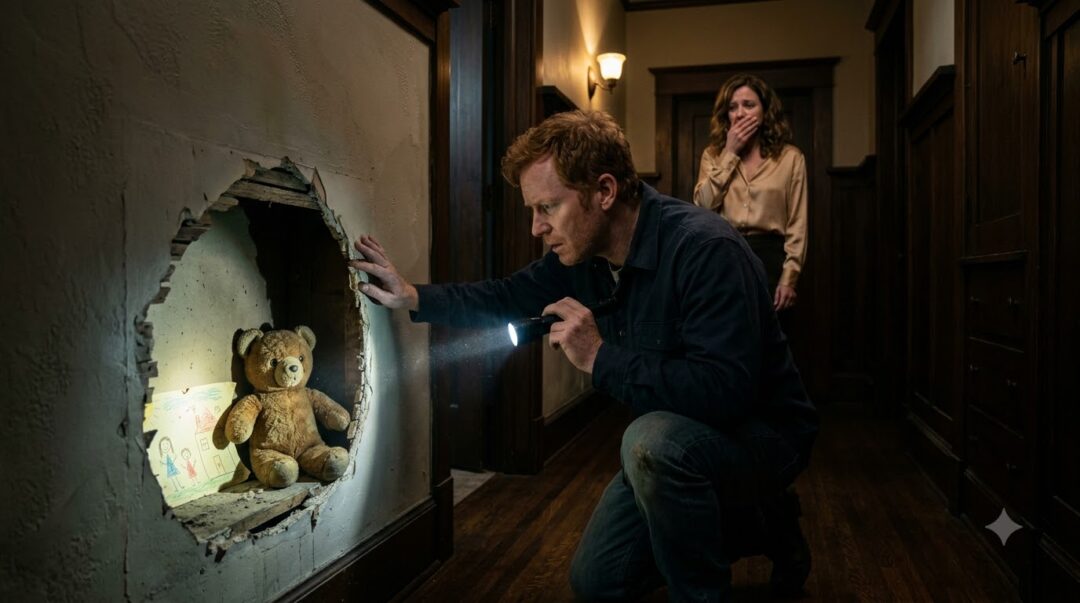
Brian punched the steel bezel into the lath and plaster of the wall directly above the baseboard heating grate. The hundred-year-old plaster shattered in white clouds of pulverized lime and splintered fir lath. He shoved his fingers into the jagged hole, tearing off an entire four-foot section of wallboard with a savage roar of muscle.
Plaster dust swirled in the blinding white cone of his flashlight.
Inside the three-foot-deep architectural wall cavity—in a forgotten void between the brick chimney and the sealed dumbwaiter shaft—sat a human child.
She was curled on a dirty mattress of packing foam, wearing a filthy, tattered white nightgown four sizes too small. Her thin arms and bare legs were covered in purple bruises and yellow antiseptic ointment, her matted blonde hair tangled with cobwebs. In her lap, she clutched a battered, honey-brown Steiff teddy bear missing one button eye.
The little girl lifted her bruised, tear-streaked face into the blinding light. She squinted, her cracked lips parting in a trembling, hoarse sob:
“Dad!”
Brian dropped the flashlight. It clattered against the floorboards, its beam illuminating an old, faded silver-framed photograph lying on the dusty mattress beside the child.
Brian’s shaking hand reached into the hole, his fingers picking up the picture.
It was a photograph taken six years ago on the back porch of this very house: Brian sitting in a cedar rocker, holding two identical infant girls with matching blonde curls, both clutching identical honey-brown teddy bears.
Brian stared at the photograph, then stared at the crying child inside the wall, his soul shattering into a million pieces.
“Why does she call me that?!” Brian whispered, his voice choking on a wave of suffocating nausea.
He turned toward Evelyn.
Evelyn was backed against the opposite wall, her gold blouse smeared with white plaster dust, her trembling hands pressed against her mouth, tears of naked guilt streaming down her cheeks.
Brian’s face contorted into an expression of unholy, demonic fury. Neck veins bulged against his collar, his fists shaking with enough violence to crack bone.
He lunged across the narrow hallway, backing Evelyn against the grandfather clock with a roar that shook the rafters of the house:
“You hid my daughter right here in this very house!”
CHAPTER 2: THE COLD COLUMBARIUM
The grandfather clock shuddered as Evelyn’s back slammed against its carved mahogany housing, the pendulum inside swinging with a discordant, violent clatter.
“Brian, please! Listen to me!” Evelyn wept, her voice trembling in raw, panicked terror as she shrank beneath the towering fury of her husband. “It was for the family! You were going bankrupt on the timber contracts! The medical bills for Sarah’s hospice were bleeding us dry! If Maya had lived, the insurance settlement was void!”
Brian didn’t hear her.
He turned away from her with a sound of pure disgust, stepping back to the jagged hole in the wall.
He reached both arms into the dusty cavity, his large hands slipping under the little girl’s trembling shoulders. Maya cried out—a soft, bird-like whimper of terror that made Brian’s heart tear in two—before her thin arms suddenly wrapped around his neck with desperate, iron strength, burying her face into the crook of his throat.
“I’ve got you, Maya,” Brian wept, hot tears cutting clean tracks through the plaster dust on his red beard. “Daddy’s got you. You’re never going back in the dark. Never.”
Clara stood beside the hole, her small hands holding the dusty Steiff bear, her hazel eyes bright with triumphant tears. “I told you, Daddy. She was waiting for you.”
Evelyn slowly pushed herself up from the floor, her eyes darting toward the open master bedroom at the end of the hall where her leather handbag sat on the vanity.
“Brian,” Evelyn whispered, her voice attempting to regain a sliver of that smooth, soothing cadence she had used to drug him for two years. “We can fix this. We can take her to a private clinic in Switzerland. Nobody has to know—”
“Get out,” Brian said.
His voice was dead. Flat as a gravestone.
“Brian, you don’t understand the legal exposure—”
“If you are in this house when the sheriff arrives,” Brian whispered, his gray eyes fixing upon her with a murderous coldness that made the breath die in her throat, “I will not wait for a judge.”
Evelyn backed away down the hall, turned on her heels, and sprinted down the front staircase. Moments later, the heavy front door slammed shut, followed by the screech of tires as her Mercedes SUV tore out of the gravel driveway into the foggy Portland night.
Brian carried Maya downstairs, wrapped both girls in thick fleece blankets, and carried them out to his heavy-duty Ford F-350 crew-cab pickup.
He drove with one hand on the wheel and his other arm stretched across the bench seat, where both girls sat pressed against his side, Maya holding Clara’s hand so tightly her small knuckles were white.
Thirty minutes later, the truck pulled into the rear ambulance bay of the Lake Oswego Pediatric Emergency Center.
Dr. Ronald Vance—Sarah’s childhood family physician and a lifelong friend of Brian’s late father—met them at the secure triage doors. At sixty-eight, Dr. Vance had delivered both girls in this very hospital.
When the elderly physician saw the bruised, emaciated child in Brian’s arms clutching the tattered teddy bear, his coffee cup slipped from his fingers, shattering across the linoleum tile.
“Dear God in heaven…” Dr. Vance breathed, his face turning gray. “Brian… is that…?”
“Run the dental records, Ron,” Brian said, his voice shaking with restrained agony. “Run the blood panels. Check her DNA against Clara’s.”
Two hours later, Brian sat in the quiet conference room of the pediatric wing.
Clara and Maya were asleep in twin hospital beds in the adjoining room, clean, fed, their wounds treated, guarded by two armed Lake Oswego police officers.
Dr. Vance walked into the room, holding a plastic manila folder and a series of digital radiographic scans. He set the folder on the table, his hands trembling as he removed his reading glasses.
“It’s her, Brian,” Dr. Vance said, his voice thick with tears. “The dental radiographs match Maya’s infant records perfectly. The scar on her left clavicle from her four-month immunization is identical. The child in that room is Maya Callahan.”
Brian buried his face in his calloused hands, his shoulders heaving with silent, racking sobs. Three years of mourning, three years of visiting a marble niche in the Riverview Columbarium, three years of drowning his grief in twelve-hour shifts at timber mills—all of it had been an orchestrated, predatory lie.
“Ron,” Brian said, wiping his face and looking up. “What did we bury in Lake Oswego?”
“I signed that death certificate, Brian,” Dr. Vance whispered, his face haunted by profound guilt. “Evelyn brought me the medical records from the Rainier Specialized Pediatric Hospice in Beaverton. The attending physician, Dr. Harold Finch, certified that Maya had passed away from acute lymphoblastic leukemia. Finch supplied the sealed urn containing the ashes. I trusted Evelyn because she was Sarah’s sister.”
Dr. Vance opened his laptop, typing rapidly into the state medical board database.
His hands froze.
“Brian…” Dr. Vance murmured, turning the screen. “Look at this alert.”
On the screen was an automated fraud notification generated by the Oregon Department of Justice twenty minutes ago:
ALERT: EMERGENCY LIQUIDATION OF THE CALLAHAN FAMILY BENEFICIARY TRUST.
AMOUNT: $1,840,000 USD.
DESTINATION: CAYMAN ISLANDS COMMERCE BANK.
IP ORIGIN: PRIVATE CHARTER TERMINAL, HILLSBORO REGIONAL AIRPORT.
Attached to the electronic transaction was Evelyn’s digital signature, executed at 3:15 AM—forty-five minutes after she had fled the West Hills house.
Brian stood up, his jaw set in iron, his hands closing into fists.
“Call Sheriff Hayes, Ron,” Brian said, pulling his truck keys from his pocket. “Tell him to meet me at the old lumber kiln on the river. Evelyn isn’t boarding that plane alone.”
CHAPTER 3: THE HOUSE OF HOLLOW BEAMS
The rain had paused, leaving Portland shrouded in an eerie, suffocating sea fog that drifted up from the Willamette River, blanketing the West Hills in white, soundless damp.
Brian pulled his heavy truck back into the gravel driveway of the Craftsman estate. The massive house stood dark and brooding against the mist, its towering gables and overhanging eaves looking less like a family sanctuary and more like a fortress built to conceal an unspeakable crime.
Beside him in the passenger seat sat Deputy Thomas Hayes of the Multnomah County Sheriff’s Office. At fifty-two, Hayes was a weathered, six-foot-two veteran of rural law enforcement who had gone to high school with Brian. He wore a dark tactical vest over his tan uniform, a twelve-gauge Remington shotgun resting across his knees, his leathery face set in deep, troubled lines as he studied the darkened structure.
“You’re sure you want to go back inside, Brian?” Hayes asked, his sharp eyes scanning the quiet windows of the second floor. “The crime scene unit and the state forensic investigators are on their way from downtown Portland. Protocol says we hold the perimeter.”
“I need to know how she did it, Tom,” Brian answered, cutting the truck’s diesel engine. “I built the structural renovations on this house five years ago with my own hands. I framed every header, every joist, every wall stud. I know every square inch of this lumber. A child doesn’t survive in a wall cavity for three years without an external infrastructure. Somebody had to feed the air, somebody had to run the power, and somebody had to supply the drugs.”
They stepped onto the wide cedar porch, their heavy work boots quiet on the damp, moss-streaked timber.
Brian pushed the front door open. The house was freezing now, the central furnace having automatically shut down after the ductwork was torn apart in the hallway. The sharp, chalky smell of pulverized plaster dust and damp century-old fir still hung heavy in the foyer air, mingling with the sickening sweet perfume Evelyn had sprayed to mask the scent of human confinement.
Brian led Hayes up the wide craftsman staircase to the second-floor gallery.
With his heavy contractor’s crowbar, Brian began systematically tearing away the remaining wallboard along the corridor, exposing the structural skeleton of the 1912 mansion.
Behind the lath and plaster lay a hidden, meticulously engineered world that Brian had never designed.
The old dumbwaiter shaft—sealed during the 1970s electrical upgrades—had been converted into a vertical utility tunnel. Welded steel ladder rungs snaked down into the floor cavity between the primary load-bearing timbers. Running alongside the bricks of the central chimney was a flexible two-inch ventilation pipe connected to a silent, inline HEPA filtration fan wired into the attic circuits, circulating warm air directly into the space while muffling any cries from within.
“Jesus, Brian…” Hayes breathed, shining his tactical light down into the opening. “Look at the floor of the shaft. Look at what they were doing to her.”
On the floor of the cavity lay a small wooden crate containing plastic bottles of children’s liquid melatonin, empty pediatric electrolyte pouches, and half-eaten protein biscuits. Beside the bedding were a series of primary-school picture books with the family photographs torn out, and a small ceramic bowl filled with cold water.
Mounted to the central timber stud was a tiny, wide-angle pinhole surveillance camera—its infrared lens pointed directly at the foam mattress where Maya had slept in darkness.
A bundle of thin black coaxial cables snaked from the camera, running through the ceiling joists toward the rear of the second floor.
Brian followed the cables down the hall into Evelyn’s private sewing room at the back of the wing.
The room was furnished with antique walnut dressers, a vintage Singer sewing machine, and bolts of imported silk. But beneath the false bottom of the antique linen armoire, Brian found the terminus of the wires.
Mounted inside the cabinet was an enterprise-grade digital video recording unit and a flat-screen security monitor.
The monitor was still glowing with ambient green power.
It displayed four split screens: the vent shaft in the hallway, Maya’s mattress inside the wall, the master bedroom, and the private office of Callahan Timber Restoration in downtown Portland.
Brian tapped the keyboard, bypassing the simple password with Sarah’s birthday.
The system was logged into an active encrypted file-sharing portal titled PROJECT OSPREY.
Brian clicked open the primary folder, his hands trembling with mounting dread.
Inside were hundreds of scanned financial documents, bank routing numbers, and certified corporate resolutions for Callahan Timber Restoration.
Brian’s eyes locked onto a document stamped with a red corporate seal:
AGREEMENT FOR PURCHASE AND ASSIGNMENT OF TIMBER HARVESTING RIGHTS.
SELLER: CALLAHAN TIMBER TRUST.
BUYER: VANCE MARITIME LOGISTICS (SEATTLE, WA).
CONSIDERATION: $4,500,000 USD.
AUTHORIZED SIGNATORY: EVELYN CALLAHAN (SOLE TRUSTEE).
Attached to the contract was an email exchange between Evelyn and Donald Vance—the corporate attorney for the Seattle shipping cartel:
“Evelyn, the Lloyd’s of London life insurance payout on Maya Callahan ($5,000,000) has cleared probate. Once Brian Callahan is declared deceased due to carbon monoxide asphyxiation via the modified heating system, the timber rights transfer automatically to our offshore account in Grand Cayman. Ensure Dr. Finch has the death certificate ready.”
Brian felt the blood drain from his face, replaced by a cold, murderous clarity.
Evelyn hadn’t just faked Maya’s death for the trust fund.
The ventilation pipe running to Maya’s wall cavity was rigged to the central gas line through a modified solenoid valve in the basement. Evelyn had planned to flood the master bedroom with carbon monoxide while Brian slept, staging his death as a tragic heating failure, leaving her as the sole surviving owner of both the multi-million-dollar timber reserves and the insurance millions.
Suddenly, the security console beeped with an urgent, piercing alarm.
A red alert flashed on the screen:
INTRUSION DETECTED: BEAVERTON HOSPICE ARCHIVES.
REMOTE ACCESS TERMINATED BY USER: DR. HAROLD FINCH.
Hayes leaned over Brian’s shoulder, his jaw tightening until the muscle bulged beneath the skin. “Finch is cleaning out his clinic in Beaverton right now, Brian. He knows Evelyn fled the house. If we don’t move right this second, he’ll burn the medical records and destroy the paper trail before we can prove the forgery.”
CHAPTER 4: THE BEAVERTON PAPER TRAIL
The rain began again in earnest as Brian’s heavy truck tore down Highway 217 toward Beaverton, the wipers slapping against the windshield in a frantic, metronomic cadence.
The Rainier Specialized Pediatric Hospice sat at the end of a deserted commercial cul-de-sac, surrounded by overgrown arborvitae hedges and rusted chain-link fencing. The three-story brick building had been officially shuttered fourteen months ago following a state Medicaid audit, but through the rain-streaked darkness, amber lights were glowing behind the frosted windows of the basement pharmacy.
Brian killed the truck’s headlights fifty yards from the entrance, rolling silently onto the weed-choked gravel lot.
Hayes drew his Glock from his duty holster, racking the slide with a clean, practiced click. “Standard protocol, Brian. We establish perimeter, call Beaverton PD for backup, and wait for a warrant.”
“There’s no time for Beaverton PD,” Brian interrupted, his voice like gravel grinding between heavy gears. “Finch has an industrial medical incinerator in the basement. If he burns Sarah’s files, we lose the paper trail. We lose the only proof that Maya was declared dead while she was still breathing.”
Brian grabbed a thirty-inch iron wrecking bar from the bed of his truck, vaulted the side gate, and sprinted toward the rear delivery entrance through the driving downpour.
The reinforced steel fire door was locked with a heavy deadbolt.
Brian jammed the chisel tip of the wrecking bar into the frame beside the bolt, threw his two-hundred-pound frame into the lever, and heaved with all his strength. The steel frame groaned, sheared, and gave way with an explosive crack that echoed through the empty commercial alleyway.
They stepped into the damp, chemical-smelling darkness of the basement corridor.
The air was thick with the stench of rubbing alcohol, moldering cardboard, and the acrid, oily smoke of burning paper. At the far end of the hall, through an open fireproof door, the heavy cast-iron door of the medical waste incinerator was wide open, glowing bright orange as hungry flames roared inside the brick chamber.
A man in a stained white lab coat was frantically feeding cardboard banker’s boxes into the roaring fire.
At sixty-four, Dr. Harold Finch was thin, stooped, with thinning gray hair and thick bifocal spectacles sliding down his sweating nose.
“Step away from the furnace, Finch!” Hayes shouted, raising his weapon with both hands. “Multnomah County Sheriff! Put your hands where I can see them right now!”
Finch shrieked in terror, dropping a box of medical charts onto the wet concrete floor, scrambling backward against an industrial stainless-steel embalming sink.
“Don’t shoot! Please, don’t shoot!” Finch stammered, his trembling hands held high above his head, his chest heaving in hysterical panic. “She told me you were dead! Evelyn told me she took care of Brian two hours ago! She swore the gas would do the job!”
Brian crossed the room in two lunging strides, grabbing Finch by the lapels of his white coat and slamming him violently back against the steel sink.
The doctor gasped, his spectacles falling and shattering on the concrete.
“Whose ashes did you put in that urn, Finch?” Brian growled, his face inches from the trembling doctor’s, his knuckles whitening against the man’s throat until Finch began to gag. “Whose body did you cremate and tell me was my daughter?!”
“It was an unclaimed neonatal specimen!” Finch sobbed, tears cutting through the soot on his cheeks. “From the state morgue in Salem! Evelyn paid me three hundred thousand dollars to sign the pediatric leukemia death certificate! She had the Lloyd’s of London policy pre-approved! I didn’t want to do it, Brian! She had photos of my offshore accounts in Panama… she threatened to send them to the attorney general if I refused!”
“Where is she, Finch?” Brian demanded, tightening his grip until the doctor’s eyes bulged in terror. “Where did she go?!”
“Hillsboro Airport!” Finch wheezed, his fingers clawing weakly at Brian’s wrists. “Hangar Seven! A private Gulfstream chartered by Vance Maritime! The flight clears for Belize at four in the morning! She has the cash bearer bonds in her luggage! She’s taking everything!”
Hayes knelt by the overturned banker’s box on the floor, quickly pulling a thick, water-damaged manila folder from the papers before they could catch fire.
He flipped through the documents under his tactical light, his eyes widening in mounting, sickened horror.
“Brian…” Hayes murmured, his voice dropping into stunned disbelief. “Look at this. This goes back way before Maya.”
Brian looked down, his heart tightening into an icy fist.
The folder was labeled: CALLAHAN, SARAH — POST-MORTEM TOXICOLOGY & METABOLIC PANEL.
Brian let Finch drop to the floor, grabbing the folder with shaking hands.
Sarah’s death four years ago had been officially ruled a fatal cardiac arrest caused by postpartum cardiomyopathy. But attached to the coroner’s appendix was an internal laboratory memo stamped CONFIDENTIAL — DO NOT RELEASE TO HUSBAND:
AUTOPSY FINDINGS: SARAH CALLAHAN.
CHRONIC DIGOXIN TOXICITY DETECTED.
CAUSE: SYSTEMIC ADMINISTRATION OF CARDIAC GLYCOSIDES VIA PRENATAL VITAMIN SUPPLEMENTS OVER NINE MONTHS.
PRESCRIBING APPLICANT: EVELYN REED (SISTER).
Brian’s knees nearly buckled against the concrete floor.
Sarah hadn’t died of natural causes.
Evelyn had systematically poisoned her own older sister over nine agonizing months, engineering Sarah’s heart failure so she could step into the home, marry Brian, and claim the multi-million-dollar timber inheritance for herself.
From the floor beside the sink, Finch reached into his lab coat pocket and pulled out a small black remote transponder.
With a desperate, manic grin, Finch slapped the red emergency button on the device.
The heavy steel fire-doors of the basement slammed shut with a deafening hydraulic bang, the ventilation shafts instantly reversing with a terrifying roar, pumping thick, suffocating smoke from the incinerator straight into the sealed corridor.
CHAPTER 5: THE HANGAR ON RUNWAY 3
The basement corridor filled with blinding gray smoke in less than fifteen seconds.
The air was toxic with burning plastic and formaldehyde, tearing at Brian’s throat and burning his eyes. Finch scrambled through a narrow service hatch behind the furnace, but Brian didn’t pursue him.
“Hayes! The air intake!” Brian shouted, coughing violently as he grabbed the thirty-inch iron wrecking bar.
He sprinted through the blinding haze toward the exterior ventilation grille high on the concrete foundation wall. With three savage, bone-jarring swings of the iron bar, Brian tore the steel security mesh from the wall, kicking out the brickwork until a three-foot gap opened into the rain-soaked grass outside.
Brian shoved Hayes through the opening into the fresh night air, then pulled himself through, tumbling onto the wet lawn, coughing up soot and ash.
Behind them, sirens were already wailing in the distance as Beaverton fire units converged on the burning clinic.
Brian didn’t wait.
He jumped into the driver’s seat of his F-350, fired the diesel engine, and roared across the lawn onto the pavement, heading west on Highway 26 toward the Hillsboro Regional Airport.
It was 3:38 AM.
The airfield at Hillsboro was a vast expanse of wet asphalt runways and towering corrugated metal hangars, illuminated by yellow sodium lamps that cast long, eerie reflections across the puddles.
At the far western perimeter, beside Runway 3, Hangar Seven stood with its colossal bi-fold doors open.
Inside the brightly lit hangar sat a sleek, white Gulfstream IV executive jet, its twin Rolls-Royce turbofans whining in a high-pitched idling pitch that rattled the hangar’s metal siding. A fuel truck was disconnecting its grounding cables, and a black luggage van sat idling near the boarding stairs.
Standing at the bottom of the airstairs was Evelyn.
She had changed into a dark cashmere travel coat and leather gloves, holding a small leather briefcase containing the family bearer bonds. Standing beside her were two armed private security guards in charcoal suits and tactical headsets, carrying short-barreled submachine guns.
Brian didn’t tap his brakes.
He aimed the four-ton Ford truck straight at the hangar’s perimeter chain-link gate, smashing through the steel posts in an explosive shower of sparks, roaring across the tarmac at sixty miles an hour.
The security guards spun around, raising their weapons.
Brian cut the wheel hard to the left, throwing the heavy truck into a sideways drift that slammed the reinforced steel utility bumper directly into the luggage van, crushing the side doors and pinning the first guard against the fuselage of the fuel truck.
The second guard opened fire, nine-millimeter rounds starring the bullet-resistant windshield of the Ford.
Hayes kicked his passenger door open, returning fire with his twelve-gauge Remington. The heavy blast of double-ought buckshot tore through the guard’s tactical vest, lifting him off his feet and throwing him onto the wet tarmac.
Evelyn screamed, dropping her leather briefcase, scrambling up the aluminum boarding stairs of the Gulfstream.
Brian vaulted out of the truck cab.
He cleared the twelve steps of the airstair in three lunging strides, catching Evelyn by the collar of her cashmere coat just as she reached the pressurized cabin door.
He yanked her backward with savage force, throwing her onto the wet aluminum landing.
Evelyn rolled onto her back, her blonde hair plastered to her face with rain and sweat, her manicured hand pulling a small, nickel-plated .25 automatic pistol from her coat pocket.
She raised the barrel, aiming directly between Brian’s eyes, her face contorted with hysterical, venomous malice.
“Don’t you dare touch me, Brian!” Evelyn shrieked over the deafening whine of the jet engines. “You were always a pathetic, sentimental fool! Sarah was weak, and you were an idiot! Everything in that house belonged to me! I built that fortune with Donald Vance!”
Brian looked down at the pistol barrel. His gray eyes were as cold and dead as a frozen mountain lake.
“You poisoned my wife, Evelyn,” Brian said, his voice cutting cleanly through the engine roar. “You locked my six-year-old child in a three-foot wall for three years.”
Evelyn laughed—a shrill, manic sound that made the hair on Brian’s neck stand up.
“Sarah took everything from me since we were girls!” she snarled, her finger tightening on the trigger. “And Maya was the spitting image of her! Every time I looked at that brat’s face, I wanted to strangle her! I should have turned the gas valve three years ago!”
Brian didn’t wait for her to pull the trigger.
His right hand shot forward like a steel trap, clamping around the slide of the pistol, twisting the weapon with brutal torque that snapped Evelyn’s wrist with a sickening crack.
Evelyn shrieked in agony as the pistol clattered down the aluminum stairs.
Brian hauled her to her feet by her lapels, dragging her down the stairs onto the tarmac where Hayes was waiting with steel handcuffs.
Hayes slammed her against the hood of the crushed luggage van, clicking the cuffs around her wrists with unyielding finality.
As Evelyn was forced into the back of Hayes’s cruiser, she glared at Brian through the rain, her lips parting in a cold, triumphant sneer.
“You think you saved them, Brian?” Evelyn whispered, blood trickling from her split lip. “Look at your watch. It’s four o’clock. Donald Vance’s men aren’t in Seattle. They went to the pediatric wing in Lake Oswego fifteen minutes ago. Your precious twins are already gone.”
CHAPTER 6: THE ST. JOHNS LUMBER FIRE
Brian’s heart plummeted into a freezing, bottomless abyss.
He didn’t speak. He vaulted back into the cab of his Ford F-350, slammed the shifter into drive, and launched the four-ton truck across the wet Hillsboro runway, tearing onto Highway 26 with all four heavy tires smoking against the wet asphalt.
He dialed Dr. Vance on his hands-free console, his hand gripping the steering wheel so tightly the leather wrap groaned.
The phone rang four times, each ring feeling like an eternity. Then Dr. Vance’s voice answered, breathless, panicked, accompanied by the piercing wail of hospital emergency alarms:
“Brian! Thank God! Two men in tactical vests breached the third-floor pediatric wing! They overpowered the lake Oswego patrol officers with stun weapons! They took Clara and Maya through the rear service stairwell!”
“Where are they taking them, Ron?!” Brian roared, weaving through midnight freight traffic at ninety-five miles an hour, his truck engine screaming.
“I heard them on their tactical radio!” Dr. Vance shouted over the alarms. “They’re heading to the old Callahan Timber Mill at the foot of the St. Johns Bridge! They have a river barge waiting on the Willamette to transport them into international waters! Brian, hurry!”
Brian killed the call, threw the wheel hard right, and cut across the grassy median onto Interstate 405, barreling north toward the towering gothic green spires of the St. Johns Bridge.
Fifteen minutes later, the colossal steel suspension towers of the bridge rose into the mist above the dark waters of the Willamette River.
Below the bridge, on the industrial waterfront of St. Johns, sat the Callahan Timber Restoration Mill—a sprawling complex of corrugated iron warehouses, towering sawdust silos, and outdoor lumber drying kilns that Brian’s family had operated for three generations.
The heavy steel security gate was smashed wide open, chains hanging broken in the rain.
Parked beside the primary drying kiln was a black Ford Expedition with its engine running and parking lights dimmed.
Brian killed his truck lights fifty yards away, rolling silently into the deep shadows between two twenty-foot stacks of kiln-dried Douglas fir timbers. He unholstered his Glock, slipped his heavy carpenter’s framing ax from the bed of his truck, and moved on silent boots toward the entrance of Kiln Number 4.
The drying kiln was a massive, reinforced concrete structure eighty feet long, used to cure industrial structural timbers using superheated forced-air fans powered by twin industrial natural gas burners.
Through the narrow wire-reinforced glass inspection port in the heavy steel door, Brian saw them.
Clara and Maya were tied together against a heavy steel timber cart in the center of the concrete floor, their small mouths gagged with duct tape, their eyes wide with absolute, helpless terror.
Standing beside the kiln’s automated control panel was Donald Vance—the ruthless corporate attorney from the Seattle shipping cartel.
Donald was wearing a wet cashmere trench coat, holding an industrial radio transmitter, talking frantically into a satellite phone:
“Yes, Eleanor! I have both children secured in the kiln! If Brian doesn’t sign the unconditional transfer of the timber trust within ten minutes, I’ll ignite the industrial gas burners! The heat will reach four hundred degrees in three minutes—there won’t be enough DNA left for a coroner to identify, and the fire will look like an industrial accident!”
Brian didn’t wait another second.
He stepped up to the door, raised the heavy carpenter’s ax with both hands, and drove the steel head with terrifying, berserker force directly into the kiln door’s emergency manual latch.
CRACK!
The heavy steel latch sheared clean through. Brian kicked the heavy blast door open, stepping into the cavernous concrete chamber like an avenging demon emerging from the night.
Donald spun around, his eyes bulging in sheer horror, fumbling frantically inside his coat for a pistol.
Brian closed the thirty feet between them in four lunging strides.
He didn’t use the ax blade. He swung the flat of the heavy steel poll like a sledgehammer, striking Donald square in the ribs.
The sound of shattering bone was sickeningly loud in the concrete vault. Donald was lifted clean off his feet, crashing violently into the steel control console, his pistol skidding across the wet floor into the central drainage ditch.
Donald lay on the concrete, clutching his crushed ribs, wheezing and coughing up dark blood. “Brian… wait… Eleanor promised me… twenty million… we can split it…”
Brian didn’t even look at him.
He dropped to his knees beside the timber cart, slicing the ropes and duct tape from his daughters with his pocketknife, his hands moving with gentle, lightning speed.
Clara and Maya threw their small arms around his neck simultaneously, burying their faces in his broad chest, weeping in frantic, overwhelming relief.
“I’ve got you,” Brian breathed, holding both girls tight against his heart, his large hands shielding their heads. “Daddy’s here. It’s over. You’re safe now.”
Suddenly, from the floor behind them, Donald’s bleeding hand reached up to the control console.
With a dying, venomous sneer, Donald slapped the manual emergency override switch.
A loud, mechanical klaxon began to wail with deafening intensity:
WARNING: KILN IGNITION SEQUENCE INITIATED. CHAMBER SEALING IN 30 SECONDS.
The colossal steel blast doors at the kiln entrance began to slide shut on heavy hydraulic rails, and high above them, the massive natural gas burners hissed to life, ready to ignite into an inescapable inferno.
CHAPTER 7: THE LIGHT IN THE WEST HILLS
The hiss of expanding natural gas was deafening inside the concrete chamber, filling the air with the sharp, sickening stench of mercaptan.
Above them, the electric spark igniters began to snap with rhythmic, clicking violence:
Snap… snap… snap…
The heavy steel blast door was sliding across the eight-foot entrance opening on its pneumatic tracks, leaving only a thirty-inch gap between the hardened steel edge and the concrete frame.
“Hold onto me!” Brian roared.
He scooped both girls into his arms—Clara clutching his left shoulder, Maya clutching his right, their small arms locked around his neck like iron bands.
Brian didn’t look at the igniters. He didn’t look at Donald Vance groaning on the floor.
He lowered his shoulder and launched his two-hundred-pound frame through the closing gap.
His shoulder slammed against the steel edge of the moving door with bone-bruising force, but his momentum carried them through. He hit the wet gravel outside in a sliding dive, rolling across the muddy yard, shielding both girls beneath his broad chest as the kiln blast doors slammed shut with a thunderous hydraulic seal.
One second later, an explosive WHUMP shook the concrete building.
Bright orange flames flared behind the reinforced glass inspection ports of the kiln, roaring through the sealed chamber, consuming the industrial timbers and the controls in an inescapable sea of fire.
Brian lay in the cold rain on the gravel, gasping for air, feeling the steady, frantic heartbeats of his two daughters pressed against his ribs.
Clara lifted her head, her face wet with rain and tears, looking at Maya.
Maya was looking back at her, her small hand reaching out to touch Clara’s cheek, a soft, radiant smile breaking through her bruised, dirty face.
“We made it, Clara,” Maya whispered.
“Daddy saved us,” Clara answered, pressing her forehead against her twin’s.
Around the perimeter of the timber yard, dozens of flashing red and blue emergency lights sliced through the morning mist.
Sheriff Thomas Hayes led six Multnomah County cruisers and two Portland fire engines through the gates, their sirens winding down into silence as deputies rushed forward with blankets and first-aid kits.
Donald Vance survived the fire by sheltering in the sub-floor ventilation trench, only to be dragged out in steel chains to face federal charges of attempted murder, kidnapping, and arson alongside Eleanor Vance in Seattle.
Four weeks later, the persistent autumn rain gave way to a crisp, golden December morning across the West Hills of Portland.
The historic Craftsman mansion was filled with the warm, vibrant aroma of fresh blueberry pancakes, brewed dark-roast coffee, and clean pine shavings.
All the heavy velvet curtains had been torn down, replaced by sheer white linen that let the winter sunlight flood every corner of the gallery. The air vents in the floorboards had been completely removed, replaced by handcrafted fir registers with wide, open scrollwork that allowed the heat to rise freely into the house.
Brian stood in the kitchen, wearing a clean wool sweater and denim work pants, smiling as he flipped golden pancakes on the cast-iron griddle.
Sitting at the sunny breakfast nook by the bay window were Clara and Maya.
Both girls were dressed in matching dark green corduroy overalls and white flannel shirts, their blonde hair brushed and shining in the morning light. On the bench between them sat Barnaby—the honey-brown Steiff teddy bear, his torn seams neatly repaired by Dr. Vance’s wife with bright golden thread, a brand-new brass button sewn into his missing eye socket.
The girls were giggling, passing a jar of Oregon marionberry jam back and forth, their laughter ringing light and innocent through the high-ceilinged rooms.
A knock sounded at the front door.
Brian walked to the foyer, opening the heavy oak door to find Sheriff Hayes standing on the porch, holding a large manila envelope bearing the golden seal of the Oregon State Probate Court.
“Morning, Brian,” Hayes said with a warm grin, stepping inside and shaking the morning frost from his Stetson hat.
“Morning, Tom. Come in for some coffee.”
“Can’t stay long, but I wanted to deliver these in person,” Hayes said, handing the envelope to Brian. “Judge Miller signed the final decrees yesterday afternoon. Evelyn entered a formal guilty plea to first-degree murder for Sarah’s death and two counts of aggravated kidnapping. She’s looking at life without parole at Coffee Creek Correctional.”
Hayes touched Brian’s shoulder with a heavy, supportive hand. “The Lloyd’s of London trust, the timber rights, and Sarah’s estate have been completely restored in the girls’ names, with you as permanent, unassailable sole trustee. The house is yours, Brian. Clear and free.”
Brian looked down at the official documents, feeling a profound, peaceful stillness settle into his chest for the first time in four years.
“Thank you, Tom,” Brian said softly. “For everything.”
Hayes nodded, smiled at the girls sitting at the table, and walked back down the porch steps into the crisp morning air.
Brian walked into the sunlit dining room.
He pulled out a chair between Clara and Maya, sitting down and wrapping an arm around each of his daughters.
Maya leaned her head against his chest, her small fingers tracing the callouses on his hand. “Daddy?”
“Yes, Maya?”
“Are we ever going to close the windows?”
Brian looked around the bright, open kitchen, looking through the glass toward the majestic green firs standing tall beneath an endless blue Oregon sky.
He smiled, kissing the top of Maya’s head, then kissing Clara’s forehead.
“No, sweetheart,” Brian whispered, his voice rich and full of warmth. “From now on, the windows stay wide open. And the light is never going out again.”