They Fined Every Farm Sign on the Road—Then Jack Found the Strip They Never Controlled
Chapter 1: The Sign Karen Pulled Down Before Noon
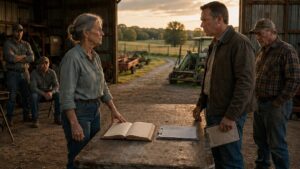
Karen Davis had Sarah Green’s sign halfway out of the ground when Jack Mitchell’s hay truck came around the bend.
Jack saw the white board first, rocking between Karen’s hands as she worked the wooden stake loose from the shoulder. Then he saw Sarah standing beside the mailbox in house shoes and a blue cardigan, one hand pressed against her opposite wrist.
Two children waited farther up her driveway with their backpacks on.
Jack eased off the accelerator.
The truck’s load shifted behind him with a dry rustle.
The sign had been hand-painted in red letters large enough to read from the road.
SLOW DOWN — CHILDREN CROSSING.
Karen pulled once more. The stake came free.
She carried the sign toward her pickup.
Jack stopped.
He told himself he had stopped because Karen’s truck partly blocked the road.
That was almost true.
Sarah looked toward him.
Karen did too.
Jack lowered his window.
“Morning.”
Karen tucked the sign into her truck bed as if it were scrap lumber. “Morning, Jack.”
Sarah said nothing.
Jack glanced toward the bend behind him. From Sarah’s driveway, visibility in that direction was poor. A cedar hedge on one side and the rise of the road on the other gave a driver only a few seconds to see anyone stepping across.
He had known that for years.
Karen held a laminated sheet in one hand.
“Association rule,” she said before Jack asked. “No unauthorized roadside signage within the maintained corridor.”
Sarah finally spoke. “It was there three days.”
“That doesn’t make it authorized.”
“My grandkids get off the bus here.”
“I know what it says.”
Karen’s voice was not cruel. That almost made it worse. She sounded like someone correcting a measurement.
Sarah looked at Jack again.
He felt the request in it.
Not rescue. Not even agreement.
Just somebody else saying that the thing in front of them was as unreasonable as it looked.
Jack rested his forearm on the open window. “How far does the maintained corridor go?”
Karen’s eyes shifted to him.
“The association has always treated both shoulders as part of the road.”
“That wasn’t exactly what I asked.”
A small tightness appeared around her mouth.
“We adopted the updated roadside standards in July.”
Jack remembered the envelope. He had skimmed it at the kitchen table, seen references to sightlines, obstructions, seasonal displays and trailers, then dropped it in a drawer with the rest of the association paperwork.
He had farms to run.
“Then Sarah can raise it at the next meeting,” he said.
The disappointment on Sarah’s face was slight, but he saw it.
Karen nodded once, as if Jack had confirmed the proper procedure.
“I already told her that.”
Jack put the truck back in gear.
He drove on.
For the next quarter mile, he could see Sarah’s white sign in his side mirror, sticking crookedly above the bed of Karen’s pickup.
By the time he reached his own gate, he was irritated mostly with himself.
He spent the morning unloading hay into the equipment barn and replacing a cracked hydraulic hose on the loader. Work usually settled him. That day it did not.
At eleven-thirty, Sarah’s car rolled into his drive.
She stayed in it until Jack walked over.
“I’m not asking you to get involved,” she said when he opened the passenger-side conversation through her window.
“That usually means somebody’s about to ask me to get involved.”
She almost smiled.
Then she handed him a yellow sheet.
Three hundred dollars.
Jack read the violation twice.
“Three hundred?”
“She says roadside safety violations are higher because of liability.”
“For a safety sign.”
“She says the sign itself is the hazard.”
Jack looked toward the county road beyond his pasture.
“You contesting it?”
Sarah rubbed her thumb over the steering wheel. “I paid the last one.”
Jack looked up.
“What last one?”
“A hundred and fifty. In May.”
“For what?”
“My mailbox flower box was six inches into whatever they call the maintained corridor now.”
“You never said anything.”
“What was there to say? I moved it.”
Jack folded the notice once, then opened it again.
Sarah’s voice softened.
“I thought if I paid it, that would be the end of it.”
Jack knew the logic. He had used a version of it himself for years.
Don’t feed a dispute.
Don’t turn neighbors into enemies over little things.
Get through planting. Get through hay season. Get through winter.
There was always a practical reason to remain quiet.
Sarah looked toward the road.
“The children really do cross there.”
“I know.”
“They’ve had three gravel trucks come through this week like they’re running a highway.”
“I know.”
She took the notice back from him.
Jack wanted to tell her he would look into it.
Instead he said, “You should put the sightline issue in writing before the meeting.”
Sarah nodded.
It was sound advice.
It also cost him nothing.
After she left, Jack drove his pickup to the bend and parked on the shoulder.
He stood where the grandchildren would stand.
A cattle trailer came from the north.
Jack heard it before he saw it.
By the time its grille appeared over the rise, it was close enough that he instinctively stepped backward.
The driver slowed and lifted two fingers from the steering wheel.
Jack watched the trailer disappear.
He measured nothing.
He did not need to.
The sign had not created the hazard.
It had described one.
At dusk he drove to check the lower pasture.
Karen’s place stood near the road entrance, larger than most houses along the lane, with a low stone arch spanning the mouth of her driveway. Recessed lights were built into both columns. A small decorative plaque hung from one side.
Jack had passed it a thousand times.
For the first time, he wondered exactly where the association thought its roadside authority began and ended.
The thought irritated him enough that he tried to dismiss it.
He checked the cattle, repaired a loose strand of fence, and returned home after dark.
The next morning, a folded paper was clipped beneath the latch of his front gate.
Jack almost missed it.
The association logo sat at the top.
NOTICE OF NONCOMPLIANCE.
His seasonal HAY FOR SALE board, which had stood beside that gate every September for eleven years, was listed as an unauthorized roadside commercial sign.
He read to the bottom.
Removal deadline: ten days.
Jack looked across the road toward the empty shoulder where Sarah’s safety sign had been.
Then he looked back at his own notice.
Karen had not merely removed one handmade warning.
She had begun redrawing the road.
Chapter 2: The Rules Did Not Reach Every Gate
Eric Allen arrived at Jack’s kitchen door the next morning carrying a violation notice in one hand and his coffee in the other.
“Two hundred fifty dollars,” he said before Jack had fully opened the door.
Jack stepped aside.
Eric slapped the paper onto the table.
“For a sign I use six weeks a year.”
Jack picked it up.
Eric’s HAY — ROUND BALES board had stood at his driveway entrance for as long as Jack could remember. It was painted on an old sheet of plywood and leaned against two steel posts during cutting season.
The notice called it an “unapproved commercial display within association-controlled frontage.”
Jack read the phrase twice.
“Did you move it?”
“No.”
“You planning to?”
“No.”
“You planning to pay this?”
“Also no.”
Jack pushed the notice back.
Eric lowered himself into a chair.
“I heard she got you too.”
“Who told you?”
“Sarah.”
Jack gave him a look.
Eric shrugged. “This is a road with nine houses and four working farms, Jack. Information travels.”
“Usually wrong.”
“This part isn’t.”
Jack poured coffee.
Eric watched him over the rim of his cup.
“You used to get paid to deal with this kind of thing.”
“I used to get paid to advise commercial landowners. I didn’t get paid to referee neighbors.”
“Same paper.”
“Not the same problem.”
Eric leaned back. “Looks like the same problem from where I’m sitting.”
Jack said nothing.
That encouraged him.
“You know what Karen thinks? She thinks nobody will challenge her because nobody wants the headache. And so far she’s right.”
Jack set his mug down harder than he intended.
“You want a fight, go start one.”
“I want the rule to mean what it says.”
“That makes two of us.”
“Then do something useful with that.”
Eric left his violation notice on the table when he went.
Jack found that deliberate.
He also found it effective.
For most of the morning, he resisted opening the association binder.
At noon, he opened it.
The roadside standards adopted in July were six pages long. Most of them dealt with legitimate problems: vehicles parked too close to the travel lane, brush blocking sightlines, culvert access, oversized delivery boxes and trailers left where road graders could not pass.
Jack agreed with more of it than he expected.
Then he reached the sign section.
“No private sign, decorative structure, temporary advertisement, fixture, display or landscape installation shall be placed within Association-controlled frontage without approval.”
Association-controlled frontage.
Not right-of-way.
Not easement.
Not maintained surface.
Jack underlined the phrase.
A paragraph near the end stated that controlled frontage was “as depicted on the Road Association Easement Map attached hereto.”
He turned to the exhibit.
The map was a clean modern drawing with the road shown in gray and broad shaded bands along both sides.
There were no survey bearings.
No deed-book reference.
No recording number.
No preparer’s stamp.
Jack sat back.
It looked official.
That was not the same thing as being authoritative.
He drove the road that afternoon with the July standards on the passenger seat.
At Eric’s gate, the plywood hay sign stood four feet beyond the gravel shoulder.
At Sarah’s, the flower box was gone.
Two houses farther down, another resident had moved a small produce stand behind a fence.
Then Jack reached Karen’s place.
He slowed.
The stone entrance arch stood close to the edge of the maintained shoulder. Two masonry columns rose from landscaped beds. Low-voltage wiring ran through protective conduit at their bases. Each column held a built-in light. A permanent decorative name plaque hung between them.
Jack pulled onto the far shoulder.
He opened the standards.
Decorative structure.
Fixture.
Lighting installation.
Private display.
At least three provisions could apply depending on where the supposed controlled frontage line sat.
Yet the arch had been there for years.
Jack remembered when it was built. Four summers ago, maybe five.
No hearing.
No dispute.
No laminated notices taped to Karen’s gate.
He took no pictures.
Not yet.
When he got home, Eric’s notice was still on the kitchen table.
Jack laid his own beside it.
Then Sarah’s fine amount, copied on a scrap of paper.
The amounts varied.
The wording did not.
Association-controlled frontage.
He called Karen.
She answered on the fourth ring.
“Jack.”
“I’m looking at the July standards.”
A pause.
“All right.”
“What exactly is the source for the frontage shown on the attached map?”
“The association easement.”
“Which one?”
“The road easement.”
“That’s not a recording reference.”
Her tone changed slightly.
“It’s the map the board approved.”
“I can see that.”
“Then I’m not sure what you’re asking.”
“I’m asking who prepared it.”
Another pause.
“I’d have to check.”
“Surveyor?”
“I said I’d have to check.”
“Was it based on the recorded easement?”
“Yes.”
Too quick.
Jack leaned against the counter.
“Which recorded easement?”
Karen exhaled.
“If you’re disputing your violation, put it on the agenda.”
“I’m not disputing anything yet.”
“That sounds like what you’re doing.”
“I’m trying to understand the boundary.”
“The board has administered the road this way for years.”
“Administration isn’t a legal description.”
Silence settled between them.
Jack regretted the sharpness immediately. Not because the statement was wrong, but because he knew what happened when technical language became a weapon. He had watched clients do it to one another for years.
Karen spoke more quietly.
“We’ve had three near misses with equipment this summer, Jack. We had a delivery truck clip a marker post. We have people putting things wherever they want. Somebody has to keep the corridor clear.”
“That’s a different question from whether you control it.”
“It isn’t different when you’re the one responsible if somebody gets hurt.”
There it was.
Not only control.
Fear.
Jack understood the argument even as he disliked the way she used it.
“I’ll look at the recorded documents,” he said.
“You do that.”
The call ended.
That evening Jack spread the association documents across the kitchen table.
He compared the modern map with an old farm deed he kept in a fireproof box. His deed described his parcel to a point “along the easterly margin of the private access easement,” but it did not state the easement width on that page.
He found a reference to an earlier instrument.
Book number.
Page number.
Recorded decades before the association existed.
Jack looked again at the July exhibit.
No book number.
No page number.
He turned it over as if something might be printed on the back.
Nothing.
The map Karen was enforcing against every gate on the road was not the original recorded plat.
It was somebody’s interpretation of one.
And Jack had spent enough years in land work to know that an interpretation could move several feet without anybody noticing—until those feet mattered.
Chapter 3: The Old Survey Pin Beside the Gravel
The easement line on the county plat stopped nearly six feet short of where Karen’s map said it did.
Jack stood at the recorder’s counter with one finger on the old image and thought he had misread the scale.
He checked again.
The county recorder waited without comment.
The document was from 1987, created when the larger tract had been divided into rural parcels. The access easement ran along the existing gravel lane, with a specified width centered on a described line.
Jack traced it toward his frontage.
Thirty feet total.
Fifteen feet from centerline.
The modern association map shaded nearly twenty-one feet on his side in places.
“Can I get a certified copy of this?”
The recorder nodded. “Plat and referenced easement?”
“Yes.”
She wrote down the instrument numbers.
Jack spent another forty minutes following cross-references.
The original road easement granted ingress and egress, road maintenance, drainage work reasonably necessary to preserve the road, and access for utilities serving the parcels.
It did not say aesthetic control.
It did not say signs.
It did not say decorative frontage.
That did not make the association powerless.
A sign inside a drainage area could still interfere with maintenance. A structure could still create a sightline problem. The agreement gave broad practical rights where road safety was concerned.
But broad practical rights were not the same as ownership of every strip beside the gravel.
Jack knew better than to confuse the two.
By lunchtime he had certified copies rolled inside a cardboard tube on the seat beside him.
He should have felt vindicated.
Instead he felt cautious.
One line on a forty-year-old plat did not resolve how a road had actually been used, maintained or amended since then.
He spent the afternoon reading.
Later amendments addressed assessment formulas and grading schedules. One added authority to remove physical obstructions from the travel corridor. Another allowed the board to maintain drainage ditches where runoff threatened the road.
Nothing Jack found extended the easement width.
Nothing adopted the shaded boundary shown on Karen’s July map.
The following morning he went looking for the survey monument.
His frontage grass was knee-high beyond the mowed shoulder. He carried a tape, the plat copy and a narrow probing rod.
The road centerline was easy enough to estimate from the gravel crown, but Jack did not trust an estimate.
He found an older fence corner shown on the plat and worked from there.
Twenty minutes passed.
Then the probing rod struck metal.
Jack stopped.
He scraped away packed soil with his boot.
A rust-dark iron pin emerged beneath the grass.
He crouched beside it.
The top sat several inches below grade, old enough that nobody driving past would ever notice it.
He laid the tape toward the road.
The measurement was not perfect without a survey, but it aligned closely with the recorded dimensions.
More importantly, it placed Jack’s HAY FOR SALE sign outside the recorded easement.
Not by inches.
By several feet.
He remained crouched longer than necessary.
For weeks, Karen’s notices had made the association’s authority feel like a physical thing extending from the gravel to every mailbox, gatepost and piece of plywood along the lane.
The pin reduced that certainty to a line in the dirt.
Jack took photographs.
Then he stopped himself.
This was the moment his old professional habits wanted to take over: document everything, build the file, corner the opposing interpretation before anyone could adjust.
He knew how satisfying that could feel.
He also knew how quickly it could turn a solvable disagreement into a permanent war.
Sarah drove past while he was still beside the road.
She braked and rolled down her window.
“Lose something?”
“Found something.”
She looked at the iron pin.
“That little thing?”
“Apparently.”
“What is it?”
“Old survey monument.”
Sarah glanced toward Karen’s end of the road.
“Good for us or bad for us?”
Jack brushed dirt from his hands.
“Depends what somebody tries to make it mean.”
Sarah studied him.
“That sounds like consultant talk.”
“It is.”
“I liked farmer Jack better.”
“So did I.”
She smiled, but her expression faded.
“Karen sent me another letter.”
Jack straightened.
“For what?”
“Nothing new. It says if I put the safety sign back, they can assess additional penalties.”
“You going to?”
“No.”
Her answer was immediate.
Jack looked down at the pin again.
His own silence had been immediate too, that first morning.
He had told himself Sarah could handle her own dispute. He had told himself a road association was not worth damaging neighbor relationships over.
But the relationship was already being damaged.
He had simply chosen not to stand where it happened.
“I’m going to the county planning office,” he said.
Sarah raised an eyebrow.
“About my sign?”
“About mine.”
That afternoon a county planning clerk reviewed Jack’s parcel map, zoning designation and photographs.
She did not give him the easy answer he expected.
“You may be outside the private easement,” she said, “but anything near the road entrance still has setback and sight-distance requirements.”
“I assumed that.”
“And agricultural signs have size limits unless you use the freestanding information-sign category.”
Jack looked at the application sheet she slid across the counter.
“How big?”
She pointed.
He read the dimensions.
Larger than his seasonal hay board.
Much larger.
He almost laughed.
The clerk mistook his expression.
“Does that not work?”
“It might.”
She continued. “You’d need a site sketch. Foundation detail if it’s permanent. No illumination toward traffic. And we’d review placement for visibility.”
Jack ran a finger down the fee schedule.
“What about the private association?”
“That’s between you and them. County approval doesn’t override private covenants.”
“I understand.”
That distinction mattered.
A county permit would not magically erase the association’s actual rights.
But if the board’s rights ended at the recorded easement, the county could approve something the association had no aesthetic authority to prohibit.
Jack folded the application.
For the first time since Karen had pulled Sarah’s sign from the ground, he saw a path that did not require shouting at a meeting.
It required precision.
At home, he laid the certified plat beside the July association map.
The difference looked almost absurd once the pages were aligned.
Karen’s shaded corridor swallowed the old survey pin.
The recorded easement did not.
Jack marked the pin with a small pencil circle.
Then he opened the county application again.
A permitted freestanding agricultural information sign could stand on his parcel if he kept it outside the easement and satisfied the county sightline review.
He sat there until the kitchen grew dark around the papers.
There was one obvious thing he could put on such a sign.
HAY FOR SALE.
There were several less obvious things.
Jack reached for the association’s last four annual financial statements, which he had never read closely before.
If he was going to make Karen look at a boundary she had ignored, he decided, he ought to be certain he had not ignored any himself.
Chapter 4: The Morning the Posts Went Up
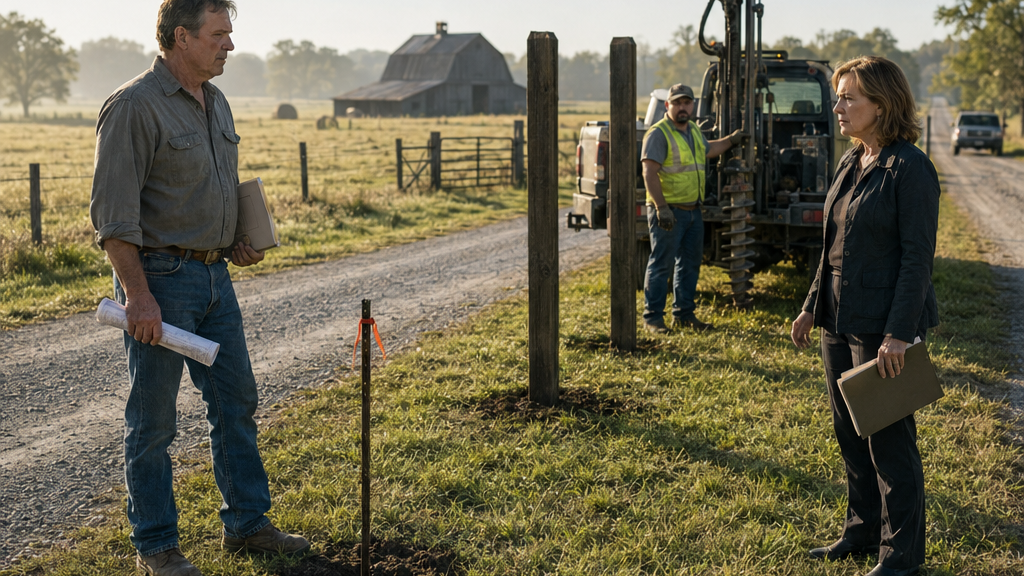
The post-setting truck turned into the gravel entrance just after seven, before Karen Davis knew Jack’s permit had been approved.
Jack was already waiting beside the frontage strip with the certified plat folded under one arm.
The contractor climbed down, looked at the two white stakes Jack had placed the evening before, and glanced toward the road.
“You’re sure about this line?”
“I’m sure enough to tell you not to move past it.”
“That’s not exactly confidence.”
“It’s enough for today.”
The contractor smiled faintly and unloaded the auger.
Jack had spent three weeks doing everything he could to make the installation boring.
The county had required a sight-distance sketch, post dimensions, setback measurements and confirmation that the sign would not interfere with traffic visibility. Jack had revised the placement twice. He had paid the fee. He had answered questions about agricultural use, road access and the sign face.
Most important, he had kept the posts beyond the recorded easement.
Nothing about it was accidental.
The auger bit into the soil.
By the time the first hole was three feet deep, a pickup came fast down the lane.
Karen stopped partly on the gravel shoulder.
She got out carrying a bright folder.
“Stop.”
The auger stopped.
The sudden silence seemed louder than the machine.
Karen walked toward the contractor first.
“You cannot install that here.”
The contractor looked at Jack.
Jack said, “Morning, Karen.”
She ignored the greeting.
“This frontage falls under association control.”
Jack looked at the folder in her hand.
“Which frontage?”
“You know exactly what I mean.”
“I do. I’m asking which boundary you’re using.”
She opened the folder and handed him a notice.
EMERGENCY WORK-STOP DEMAND was printed across the top.
Jack read it.
The association cited obstruction rules, sign restrictions, roadside maintenance rights and the July frontage standards.
“You prepared this before the posts went in?”
“I prepared it when I learned what you intended to do.”
“How did you learn that?”
“That doesn’t matter.”
“It might.”
“Jack.”
Her voice dropped.
“Don’t turn this into something it isn’t.”
He looked at her.
“That’s what I’ve been trying not to do.”
She pointed toward the open hole.
“This sign creates a roadside hazard. It violates the standards. The contractor needs to stop.”
The contractor shifted his weight.
Jack handed the notice back.
“Can you show him the easement line?”
Karen stared at him.
“Excuse me?”
“The recorded line. Show him where it is.”
“I don’t need to stand in the ditch with a tape measure to know what the association controls.”
“You’re asking him to remove work from private property. I think he deserves a line.”
The contractor gave a small nod.
Karen opened her folder again and pulled out the same shaded map Jack had studied at his kitchen table.
“This is the board-approved corridor.”
Jack unfolded his certified plat.
He placed both documents on the hood of his pickup.
The modern map looked clean beside the old county copy.
Jack pointed to the road.
“Here’s your exhibit.”
Then to the plat.
“Here’s the recorded easement.”
Karen’s jaw tightened.
“The association has maintained beyond that line for years.”
“In spots, yes.”
“That establishes our maintenance interest.”
“Maybe for drainage or necessary access. It doesn’t establish ownership.”
“I didn’t say ownership.”
“Then what gives you aesthetic control outside the easement?”
Karen said nothing.
A second vehicle slowed at the entrance.
Eric.
Of course.
He pulled onto the shoulder and stayed in his truck.
Jack wished he had kept driving.
Karen saw him too.
“This is exactly what I was worried about.”
“What is?”
“Turning road administration into a spectacle.”
Jack looked toward Eric’s pickup.
“One farmer sitting in a truck isn’t a spectacle.”
“Not yet.”
The contractor tapped the edge of the plat.
“Where’s the monument?”
Jack led him through the grass.
He had left the rust-dark survey pin exposed, with a short orange flag several inches away so nobody would accidentally disturb it.
The contractor measured from the road centerline, then from the pin.
He checked Jack’s proposed post location.
Karen followed.
The contractor straightened.
“I’m not a surveyor,” he said, “but I’m not pulling these posts based on that association map.”
Karen’s face changed.
Not much.
A slight loss of certainty around the eyes.
“You’re under contract to him.”
“And I’m insured. If there’s a property dispute, I don’t touch anything unless I know where I’m authorized to work.”
Karen looked at Jack.
“So that’s it?”
“No.”
Jack reached into his truck and took out the county permit.
“That’s it.”
She read the first page.
Then the second.
Her eyes stopped at the approval stamp.
The county had approved the sign two days earlier.
Karen looked up.
“You applied for this before we even discussed the easement at a board meeting.”
“I asked you what your boundary was.”
“You asked me on the phone.”
“And you gave me an answer that wasn’t supported by the recorded map.”
“That is your interpretation.”
“It is.”
Jack took the permit back.
“And this is the county’s approval of the placement.”
She gave a tight laugh.
“County approval doesn’t cancel private restrictions.”
“I know.”
For the first time, Karen seemed unsure what to do with his answer.
He could have enjoyed that moment.
A younger version of him probably would have.
Instead he felt the same unease he had felt when Sarah looked at him from beside her mailbox.
Knowing where the line was did not automatically tell him what he ought to do with it.
The contractor restarted the auger.
Karen remained beside the road while the second hole was drilled.
By nine-thirty, two heavy posts stood vertical in fresh concrete.
The sign face arrived on another truck shortly before noon.
Eric was no longer alone.
Two neighbors had stopped.
Sarah stood near her driveway farther up the bend, not close enough to be part of the confrontation but close enough to see.
Karen had gone home.
Jack had almost convinced himself she would stay there.
Then her pickup returned as the contractor raised the sign face.
The panel was large enough to command the entrance without blocking the road.
Jack watched it rise.
For three weeks he had imagined this as the clean moment.
The answer.
A large lawful sign in the exact place Karen’s rule could not automatically reach.
But as the panel turned toward the road, his stomach tightened.
The message became visible.
ROAD ASSOCIATION MEMBERS:
REVIEW $31,000 IN MAINTENANCE CHARGES.
REQUEST THE RECORDS.
The contractor secured the bolts.
No insult.
No accusation of theft.
No name.
Jack had rewritten the wording three times to keep it factual.
Still, the effect was unmistakable.
Every vehicle entering the lane would see it.
Karen got out of her pickup and read the sign.
Her face lost color.
“What is that supposed to mean?”
Jack heard Eric shift behind him.
He did not look around.
“It means members should review the maintenance accounts.”
“You’re implying money is missing.”
“I’m saying the figures deserve review.”
“Thirty-one thousand dollars?”
“That’s the total I couldn’t reconcile from the disclosures against the invoices I could access.”
Karen stared at him.
“You put that on a roadside sign before you brought it to the board?”
There it was.
The question Jack had been avoiding.
He had told himself the board would bury it.
He had told himself public pressure was the only language Karen respected.
Both might be true.
Neither made his choice automatically right.
“I asked for records twice,” he said.
“You asked for supporting invoices. Nicole was gathering them.”
“And I received part of them.”
“So you decided the rest must be wrongdoing?”
“I didn’t write that.”
“You didn’t have to.”
Karen looked toward the neighbors.
Then back at him.
“This isn’t about Sarah’s sign anymore.”
“No.”
She folded the work-stop notice.
“For once, we agree.”
Her truck left hard enough to throw gravel.
The contractor finished shortly after noon.
By three, photographs of the sign were already moving between neighbors.
Jack did not know who had taken the first one.
At five-thirty, Nicole Torres drove into his yard.
She did not get out immediately.
When she finally did, she carried a thick accordion folder.
Jack met her beside the barn.
She looked toward the road, though the sign was hidden from there.
“You made a very specific number public.”
“I did.”
“Then you’d better have a very specific explanation.”
“I can show you how I got it.”
Nicole held up the folder.
“No. You’re going to show me every line.”
She walked past him toward the farm office.
“And then I’m going to show you which ones you got wrong.”
Chapter 5: The Money Was Not Missing in One Place
Nicole dropped four years of invoices onto Jack’s farm-office table and said, “Your thirty-one thousand dollars does not mean what your sign makes people think it means.”
The stack landed hard enough to slide one of Jack’s notebooks toward the edge.
He caught it.
Nicole remained standing.
She wore no association badge, carried no polished board folder and made no effort to soften her expression.
Jack pulled out a chair.
“Sit down.”
“I’d rather stand.”
“That seems uncomfortable for both of us.”
After a moment, she sat.
Jack opened the spreadsheet he had built from the annual disclosures.
“These are the totals reported under road maintenance, drainage and common improvements.”
“I know what they are.”
“And these are the invoices I received.”
“You received incomplete files.”
“I know that now.”
Nicole looked at him sharply.
“You knew it before you put up the sign.”
Jack did not answer immediately.
That was answer enough.
She leaned back.
“Good. At least we’re starting in the right place.”
Jack turned the laptop toward her.
“I didn’t accuse anyone of stealing.”
“No. You used a number large enough that everybody else would do the accusing for you.”
The words landed because they were accurate.
Jack had spent his professional years warning clients against exactly that kind of implication.
State what you can prove.
Separate irregularity from wrongdoing.
Do not let an incomplete record become a conclusion.
He had followed those rules when other people’s reputations were involved.
He had been less careful when anger was involved.
“Show me,” he said.
Nicole opened the accordion folder.
The first discrepancy was simple.
A gravel delivery Jack had treated as unsupported had been split across two invoices, one filed under maintenance and another under emergency repairs.
“Legitimate?” he asked.
“Yes. Spring washout.”
She produced photographs and a delivery ticket.
Jack crossed out the line.
The next was a culvert replacement.
He had counted it twice because the annual disclosure summarized the deposit in one quarter and the final payment in another.
He crossed that one out too.
Nicole said nothing.
The room grew quieter with every correction.
By the time they reached the second year, nearly nine thousand dollars of Jack’s apparent discrepancy had explanations.
He stood and walked to the small refrigerator.
“Water?”
Nicole nodded.
He gave her a bottle.
“I should revise the sign.”
“Yes.”
He sat again.
“I’m not taking it down yet.”
“I didn’t expect you to.”
That surprised him.
Nicole opened another folder.
“I think the accounts need review too.”
Jack stopped.
“But?”
“But messy accounting isn’t theft. And Karen isn’t sitting on thirty-one thousand dollars in a coffee can.”
“I never said she was.”
Nicole gave him a tired look.
“You know how signs work.”
Jack looked down.
Outside, a tractor started somewhere near the equipment shed.
The vibration traveled faintly through the office floor.
“What do you think is wrong?” he asked.
Nicole took a breath.
“Classification. Documentation. Board approvals. Sometimes all three.”
She pulled out a drainage invoice.
The description read ROAD EDGE STABILIZATION AND RUNOFF CONTROL.
The amount was substantial.
Jack compared the location notation to the road map.
“This is near Karen’s place.”
“Yes.”
“Shared ditch?”
“Partly.”
“Partly?”
Nicole folded her arms.
“The road used to sheet water toward her lower field entrance. The contractor rebuilt the ditch and installed stone.”
“That sounds like road maintenance.”
“Keep reading.”
A second page listed trenching, pipe, grading and landscape restoration.
Jack looked at the sketch.
The pipe extended beyond the roadside ditch toward Karen’s private driveway.
“Who paid this?”
“The association.”
“All of it?”
“Yes.”
“Why?”
Nicole’s mouth tightened.
“Because it was presented as one drainage project.”
“Was it?”
“The first half was.”
Jack set the invoice aside.
They continued.
Entrance lighting repairs coded under road safety.
Stonework repairs listed as common entrance stabilization.
Brush clearing that included private fence lines.
None of it looked like a secret theft scheme.
That made it harder, not easier.
The money had not vanished in one dramatic transfer.
It had blurred.
A little private benefit folded into a legitimate job here. A loosely described invoice there. A board vote recorded without enough detail. Expenses approved because the same contractor was already on site.
The deeper they went, the less Jack liked the story he had placed on the sign.
And the less he liked the records.
By late afternoon, Eric called.
Jack ignored it.
Then Sarah.
He answered.
“People are saying Karen took thirty-one thousand dollars.”
Jack closed his eyes.
“Who’s saying that?”
“Everybody has a different version.”
“That isn’t what the sign says.”
“I know.”
A pause.
“But you knew what they’d think.”
Nicole looked at him from across the table.
Jack turned toward the window.
“Yes.”
Sarah was quiet for a moment.
“I’m glad somebody finally stood up to her.”
Jack waited.
“That doesn’t mean I want her accused of something she didn’t do.”
“I know.”
“You going to fix it?”
“I’m working on what fixing it means.”
He hung up.
Nicole slid the drainage file toward him again.
“This is the one that bothers me.”
“Why more than the rest?”
“Because I asked about it at the time.”
Jack looked up.
“You did?”
“I asked whether the private-driveway portion should be billed separately.”
“And?”
“I was told the drainage system had to function as a whole.”
“Karen told you that?”
Nicole did not answer immediately.
“Yes.”
“Was there a board vote?”
“There was a vote on the project.”
“That specific allocation?”
“No.”
Jack leaned back.
For the first time that day, the number on the sign stopped feeling merely reckless.
Not correct.
But not invented either.
“What else?”
Nicole pulled another document from the folder.
A lighting invoice.
Karen’s stone entrance feature.
Jack recognized the address before he finished reading.
“This is her arch.”
“Replacement fixtures and wiring after a storm.”
“Charged to road safety.”
“Yes.”
Jack stared at her.
“Why?”
“The board argued the lights marked the entrance.”
“Her private driveway entrance.”
“It also sits near the road entrance.”
“That’s convenient.”
Nicole’s face hardened.
“Don’t do that.”
“Do what?”
“Turn every judgment call you dislike into corruption.”
Jack let the invoice drop.
She was right again.
That was becoming irritating.
Nicole gathered several folders and aligned their edges.
“I defended these expenses because the road really did need work. Still does. The reserve account is thin. Gravel is up. Drainage is getting worse at the north bend. If people stop paying because they think the whole system is crooked, we have a different problem.”
“So keep quiet?”
“No.”
“Then what?”
“Get the facts right.”
The meeting that evening was fuller than usual.
Nobody applauded Jack when he entered.
He was grateful for that.
Karen sat at the front table with two board members. Nicole took her usual place with the financial binder.
Jack sat in the second row.
Eric leaned toward him.
“You should make them answer the number.”
Jack said quietly, “The number needs work.”
Eric stared at him.
“What?”
“Some of it reconciles.”
“You’re kidding.”
“No.”
“So the sign is wrong?”
“Not exactly.”
Eric gave a humorless laugh.
“That sounds like consultant talk again.”
The meeting began badly.
Three residents asked about missing money before the minutes were approved.
Karen answered each one the same way.
“No funds have been demonstrated missing.”
Technically precise.
Emotionally useless.
Then Nicole spoke.
“There are accounting issues that need clarification.”
Karen turned toward her.
Nicole did not look away.
Jack watched the room change.
Not dramatically.
No gasps.
Just people sitting straighter.
Nicole walked through several classifications. Legitimate road expenses. Poorly labeled invoices. Costs that should have been better separated.
Then she reached the drainage project.
Karen interrupted.
“That project protected the road.”
“Part of it did,” Nicole said.
“The whole system had to drain.”
“That is not the question.”
Karen’s mouth tightened.
Jack recognized the expression from the roadside.
Nicole placed the invoice on the table.
“The question is whether the association should have paid one hundred percent of work extending beyond the shared drainage function.”
One board member shifted.
Karen looked at Jack.
“You’ve already made up your mind.”
He shook his head.
“I had. That was part of the problem.”
The room went quiet.
Jack stood.
“My sign implies that thirty-one thousand dollars in charges cannot be accounted for. That is too broad. Some of it can.”
Eric looked away.
Jack continued.
“That doesn’t resolve the private-benefit expenses or the authority used to approve them.”
Karen’s fingers rested on the drainage invoice.
“You think I benefited personally.”
“I think your property did.”
“That drainage kept water off the road.”
“Some of it.”
“You weren’t here the morning that ditch failed.”
“I’m not arguing that.”
Her voice sharpened.
“You’re arguing from four years of paper like paper tells you what the road looked like.”
Jack stopped.
The sentence was defensive.
It also sounded true.
Nicole spoke before he could.
“Karen, why wasn’t the private portion separated?”
Karen looked at her.
Something in her posture gave way.
Not surrender.
Fatigue.
“Because I approved it as one project.”
Nobody spoke.
Nicole’s voice became quieter.
“You approved the coding?”
“Yes.”
Karen pushed the invoice across the table.
“I approved it.”
Jack looked at the document, then at her face.
The question had changed.
It was no longer whether the records were messy.
Karen had just admitted she knew at least one shared-road charge included work beyond the clearly shared portion.
Now Jack needed to know why.
Chapter 6: What Karen Thought Would Happen Without Control
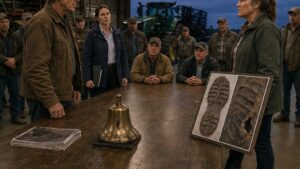
Karen put six photographs on the table in front of Jack.
In the first, the gravel road was gone.
Not damaged.
Gone.
Brown water had cut through the center of it, carrying stone into the lower field and leaving a channel deep enough to expose the culvert.
“When?” Jack asked.
“Seven years ago.”
They were alone except for Nicole and the association attorney at the far end of the meeting room.
Karen pushed another photograph toward him.
A pickup sat stranded on one side of the washout.
The road surface on the other side had collapsed into a ditch.
“We had two days when a fire truck could not have reached four properties without coming across pasture.”
Jack studied the photograph.
“I remember the storm.”
“You didn’t live on this section then.”
“I owned the farm.”
“You leased it out and came down twice a month.”
The correction was accurate.
Jack said nothing.
Karen moved to the next photograph.
A temporary gravel crossing.
Then an excavator.
Then stacks of crushed stone.
“The emergency assessment was eighteen hundred dollars per parcel.”
“I saw it in the records.”
“You saw the number.”
Her finger tapped the photograph.
“You didn’t see the meeting.”
Jack looked up.
“People refused?”
“Three did outright. Two paid half. One threatened to sue because he said the washout was caused by somebody else’s runoff.”
Nicole said, “The reserve was almost empty afterward.”
Karen nodded.
“We barely paid the contractor.”
Jack leaned back.
“So that’s when you decided the board needed stronger control.”
“That’s when I learned what happens when every person on a private road treats shared responsibility as optional.”
The statement had an edge.
But beneath it Jack heard something he had missed before.
Fear.
Not fear of losing status.
Fear of the road failing while everyone argued over whose responsibility it was.
Karen continued.
“After that, every obstruction mattered. Every ditch mattered. Every trailer parked where the grader needed to swing mattered.”
“And every sign?”
Her expression tightened.
“No.”
Jack waited.
Karen looked toward the photographs.
“The signs became part of the same policy because people kept pushing things closer to the road. Produce stands. Mail shelters. Advertising boards. Landscaping stones. Once we drew a controlled corridor, enforcement became simpler.”
“Your corridor.”
“The board approved it.”
“Based on what survey?”
She did not answer.
“Karen.”
“Based on maintenance practice.”
“That’s not the same thing.”
“I know that now.”
Jack looked at her.
The admission was so plain that it took a moment to register.
“You knew before I found the plat.”
Karen’s silence answered.
Nicole shifted in her chair.
The attorney watched without expression.
Jack felt anger rise slowly.
Not the sharp satisfaction he had expected from catching her in something.
Something heavier.
“You knew the boundary was uncertain.”
“I knew the documentation was old.”
“That isn’t what I asked.”
Karen met his eyes.
“I knew the map gave us more room than the recorded easement appeared to.”
Nicole closed her binder.
“Karen.”
“We needed room to manage the road.”
“You needed authority,” Jack said.
“Yes.”
The answer came without apology.
Jack stared at her.
Karen folded her hands.
“You know what happens when you tell nine property owners that half the rules depend on interpretation? Every culvert becomes a lawsuit. Every mower pass becomes trespass. Every assessment becomes optional in somebody’s mind.”
“So you made uncertainty disappear on paper.”
“I made a system people could follow.”
“You fined Sarah three hundred dollars for a safety sign.”
“That sign was inside the corridor we were enforcing.”
“A corridor you knew was questionable.”
Karen’s face changed.
“That was wrong.”
The words were quiet.
Jack had imagined hearing them.
They gave him less satisfaction than he expected.
Karen continued.
“But the blind bend is also a safety issue. A handmade sign five feet from the shoulder was not the only way to solve it.”
“No. It was just the way Sarah could solve it herself.”
Karen looked away.
The attorney finally spoke.
“We need to separate the moral argument from the operational problem.”
Eric would have hated that sentence.
Jack almost smiled.
The attorney continued.
“The association has legitimate maintenance obligations under the easement. There are also legitimate questions about the scope of adopted frontage rules and certain expenditures.”
“Certain expenditures,” Jack repeated.
“That is intentionally careful language.”
“I noticed.”
“If this becomes a contest of public allegations, every member may begin taking independent positions on the easement. That can trigger competing claims. It could also delay contracts already scheduled for fall drainage work.”
Jack looked at Nicole.
“North bend?”
She nodded.
“The ditch is already sloughing in.”
Karen pushed another photograph across the table.
It was recent.
The road shoulder had collapsed around an outlet pipe.
“If that fails during a hard rain,” she said, “we lose part of the lane.”
Jack studied the image.
There it was again.
The part he had not wanted to see.
Karen had stretched authority.
She had enforced selectively.
She had approved charges that should have been separated.
And the road still needed somebody to pay for gravel, ditch work and culverts.
If Jack destroyed confidence in the association without replacing the system, he would not be protecting Sarah or Eric.
He would be helping wash out the road.
The meeting adjourned without agreement.
Jack drove home alone.
At the barn, he found Sarah’s old safety sign leaning behind a stack of fence posts.
He had picked it up from her place after Karen returned it weeks earlier, meaning to repair the split stake.
He had forgotten about it.
SLOW DOWN — CHILDREN CROSSING.
The red paint was rough.
One corner was muddy.
Jack carried it into the light.
The sign had begun the whole fight because it asked for something simple and specific.
Slow down here.
Children cross here.
Karen had responded with a rule bigger than the problem.
Jack had responded with a sign bigger than hers.
Now everybody was arguing over thirty-one thousand dollars while the actual road threatened to fail at the north bend.
He rested Sarah’s sign against the workbench.
The next afternoon, the board met again in closed session.
Jack attended at Nicole’s request.
Karen looked exhausted.
There were no photographs this time.
Only documents.
Jack placed a single sheet in front of him.
“I’ll change the sign.”
Karen looked up.
“Take it down?”
“I said change it.”
“What do you want?”
“Independent accounting review.”
Karen’s expression closed.
“Paid for by whom?”
“The association.”
“We’re already short.”
“Then credit my share of the review against whatever private-benefit amount the audit determines was improperly allocated.”
Nicole looked at him.
Karen said, “That could be nothing.”
“It could.”
“Or it could be more than your share.”
“I know.”
The attorney leaned forward.
“What else?”
“Rewrite the roadside standards around the recorded easement. Safety and maintenance rights stay where the documents support them. Aesthetic control outside that line goes.”
Karen shook her head immediately.
“No.”
Jack had expected that.
“Then the sign stays.”
“That sounds like coercion.”
“It’s leverage.”
“Same thing when you’re on the receiving end.”
Jack absorbed that.
“You’re right.”
Karen blinked.
“So let’s make it less personal.”
He slid the page toward her.
“Independent review. Clear boundaries. Specific safety exceptions. Seasonal farm signs with setback standards. No blank authority called ‘controlled frontage.’”
Nicole read the proposal.
“What about the drainage work?”
“Keep funding necessary road drainage.”
“And past charges?”
“Reclassify them where the audit supports it. Credit back private-benefit portions instead of pretending every dollar was either stolen or perfect.”
Karen looked at him for a long time.
“You think one audit fixes trust?”
“No.”
“Then why do this?”
“Because the alternative is everybody hiring their own lawyer to prove where six feet of grass belongs.”
The attorney gave a small nod despite himself.
Karen looked down at the proposal.
“What happens to your sign during the review?”
Jack thought of Sarah’s handmade board in his barn.
“I’ll replace the thirty-one-thousand-dollar message with a notice telling members the records are under independent review.”
“And after?”
“That depends on what we learn.”
Karen’s eyes narrowed.
“You want the sign structure to stay.”
“Yes.”
“Why?”
Jack looked toward the window, where the gravel lane disappeared beyond the meeting-room lights.
“Because I think we’re going to need a sign.”
Karen almost smiled.
Almost.
Then she returned to the proposal.
For the first time since the dispute began, she did not reach for a rule to end the conversation.
She reached for a pen.
Chapter 7: The Sign That Stayed After the Fight Ended
The independent review came back six weeks later and disappointed nearly everyone.
Jack knew that before he reached the second page.
No thirty-one thousand dollars had vanished.
No single explanation cleared the board either.
The accountant had divided four years of disputed charges into three categories: properly documented shared-road expenses, inadequately documented but defensible maintenance costs, and expenses that had provided enough private benefit that they should not have been charged entirely to the association.
Jack sat at his kitchen table with the report open beside the certified plat.
The number that mattered now was smaller than the one he had put on the sign.
It also carried more weight.
The review recommended credits to association members for the private-benefit portions of several drainage, lighting and entrance-work invoices. It recommended new approval procedures, clearer invoice descriptions and separate billing whenever shared work extended onto an individual parcel.
Jack read the conclusion twice.
Then he called Nicole.
“You’ve seen it?”
“Yes.”
“What’s Karen saying?”
“She wants the board to vote tonight.”
“On all of it?”
“The audit recommendations and the new road standards.”
Jack looked toward the window.
The large sign at the entrance had changed three weeks earlier. The thirty-one-thousand-dollar message was gone.
In its place:
INDEPENDENT FINANCIAL REVIEW IN PROGRESS.
RESULTS AVAILABLE TO MEMBERS.
The sign had become less interesting almost immediately.
Jack considered that a good sign.
At the evening meeting, every chair was occupied.
Eric stood along the wall.
Sarah sat near the back with the folded remains of her old handmade safety sign resting across her knees.
Karen sat at the board table with Nicole and the other board members.
She looked smaller somehow.
Not physically.
Just less surrounded by certainty.
Nicole summarized the review without drama.
Most road expenditures, she explained, had gone where they were supposed to go.
Some accounting had been careless.
Several projects had mixed public and private benefit without properly allocating the cost.
The association would apply credits against future assessments rather than attempt to collect reimbursements immediately from individual property owners.
A neighbor raised a hand.
“So nobody stole anything?”
Nicole answered carefully.
“The review found no evidence supporting that conclusion.”
Several people looked toward Jack.
He stood before anyone asked him to.
“My first sign was too broad.”
Eric shifted against the wall.
Jack continued.
“I had records I couldn’t reconcile. I also had incomplete records. I knew the difference, and I still chose a number that invited people to assume the worst.”
Nobody rescued him from the silence.
Jack did not expect them to.
“The records needed review,” he said. “The sign helped force that review. Both things can be true.”
Sarah gave the smallest nod.
Karen looked down at the papers in front of her.
The audit vote passed without argument.
The harder vote came next.
Nicole distributed the revised roadside standards.
The phrase Association-controlled frontage was gone.
In its place were specific categories tied to recorded rights: travel surface, recorded easement, necessary drainage access and temporary maintenance areas.
Outside those areas, the association would no longer claim general aesthetic control.
Seasonal agricultural signs were permitted with setback and sight-distance requirements.
Mail shelters and roadside fixtures outside the easement required no association approval unless they created a documented safety or maintenance obstruction.
Jack read the language even though he already knew it.
Then he reached the new section titled Safety Notices.
Temporary child-crossing, livestock-crossing and emergency-warning signs could be approved under a simplified standard.
Sarah touched the old sign on her lap.
Karen noticed.
“The wording can be cleaner,” Karen said.
Sarah looked up.
“The wording on mine?”
“The rule.”
A few people smiled, but nobody laughed.
Karen went on.
“The county inspector recommended reflective material if the sign is near the bend.”
Sarah said, “That seems reasonable.”
Jack watched Karen’s expression.
There was no apology.
Not the kind Sarah might have deserved.
But there was something that would have been impossible two months earlier: Karen discussing how the sign could stay rather than explaining why it had to disappear.
The revised standards passed by one vote.
Eric leaned toward Jack afterward.
“Closer than I expected.”
“That’s usually what happens when a rule means something.”
Eric frowned. “You could enjoy this a little.”
“I am.”
“You don’t look like it.”
Jack folded his copy of the standards.
“That’s because you enjoy things louder than I do.”
At the end of the meeting, Karen remained standing behind the board table while people filed out.
Jack was nearly at the door when she called his name.
He turned.
She held a single sheet.
“I’m not running again.”
Jack walked back.
“For chair?”
“For the board.”
He had expected anger, maybe a final attempt to defend herself.
Instead she placed the sheet with the meeting materials.
“You think I should?”
“That’s not my decision.”
“That has never stopped people from having opinions.”
Jack considered her.
“I think the road needed somebody willing to do the work.”
Karen waited.
“I think you started believing that meant nobody else was allowed to question how you did it.”
Her face tightened, but she did not look away.
“That sounds about right.”
It was not an apology.
Jack realized he did not need to force it into one.
She glanced toward Sarah, who was speaking with Nicole near the door.
“The bend still needs the warning.”
“Yes.”
“I know.”
That was all.
Three days later, Jack met the sign contractor at the road entrance.
They removed the large accusation panel but left the posts.
The replacement was smaller.
Plain.
At the top it identified the road association.
Below it was space for meeting notices, temporary safety warnings and seasonal information approved under the new standards.
The structure still stood entirely on Jack’s property, beyond the old easement line.
The rust-dark survey pin remained visible in the grass several feet away.
Jack had considered covering it again.
He decided not to.
Sarah arrived carrying a new sign.
The board had paid for reflective material, but she had insisted on keeping the words simple.
SLOW DOWN — CHILDREN CROSSING.
Jack held the bottom edge while she fastened it to the notice board.
“You’ve got it crooked,” he said.
Sarah stepped back.
“It looks straight to me.”
“It’s off about half an inch.”
She gave him a look.
“Careful.”
Jack laughed.
He loosened the corner and let her adjust it herself.
A truck came around the bend.
The driver saw the reflective sign and slowed before reaching Sarah’s driveway.
Neither of them said anything until it passed.
Sarah tightened the final screw.
“You think Karen will complain about the size?”
“No.”
“You sure?”
Jack looked toward the survey pin.
Then toward the gravel road, the ditch beyond it, and the sign that no longer belonged to one person’s argument.
“No,” he said. “But if she does, we know where the line is.”
Sarah smiled.
Jack gathered the tools.
For years he had believed staying out of conflict kept peace.
Now he understood that sometimes peace depended on somebody being willing to mark a boundary clearly enough that everyone could live beside it.
He left the sign standing at the entrance.
Not as a threat.
As something useful.
The story has ended.