The Approved Cedar Fence Stain And The Rotting Property Boundary
CHAPTER 1: THE SWATCH AGAINST THE CEDAR
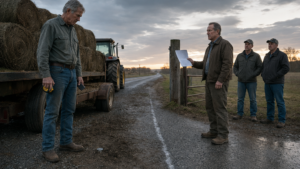
The warm late-afternoon sun poured over the rolling bluegrass pastures of Franklin, Tennessee, casting long, amber shadows across the white board fences and stone walls of Whispering Hills. In this affluent corner of Williamson County, where multi-million-dollar equestrian estates bordered historic Civil War battlegrounds, property boundaries and architectural decorum were maintained with religious, litigious fervor. Hannah Vance stood on the lush clover along her eastern side yard, holding a high-density stain pad attached to an aluminum extension pole. Resting before her was sixty linear feet of brand-new, six-foot-tall western red cedar privacy fence. The cedar boards were exquisite—clear-grade lumber with straight, tight grain, precision-beveled at the tops and fastened to horizontal runners with marine-grade stainless steel trim-head screws. The stain she was applying was a rich, warm honey-amber oil that brought out the natural iridescence of the wood, protecting the timber against southern summer humidity and fungal decay. Beside her, her twelve-year-old son, Caleb, was using a horsehair brush to seal the lower end-grain where the pickets met the gravel drip trench. Hannah was a master carpenter who built bespoke dining tables and custom architectural cabinetry for Nashville recording executives, a woman whose entire life was built on millimeter precision and deep respect for wood.
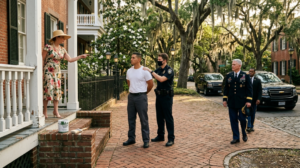
The peaceful rhythmic brushing was shattered by the sharp crunch of Italian leather driving shoes on gravel. Patricia Sterling-Giles marched across the lawn like a storm front, her pastel silk equestrian scarf fluttering over her cream cashmere cardigan, her oversized tortoiseshell sunglasses catching the golden sun. Patricia was the senior trustee of the Whispering Hills Architectural Review Tribunal, an heiress to a regional commercial real estate empire who believed that her family name gave her personal sovereignty over every square foot of the subdivision. Walking beside her was Inspector Diane Caldwell of the Williamson County Building and Covenants Compliance Department. Inspector Caldwell was a tall, athletic woman in her mid-forties, wearing a crisp khaki county tactical uniform, heavy composite-toe work boots, and carrying an aluminum field clipboard equipped with a laser distance finder, digital moisture meters, and a laminated architectural standards ring binder.
“Look at this garish, unauthorized monstrosity, Inspector Caldwell!” Patricia declared, thrusting an index finger tipped with French manicure acrylic toward Hannah’s fence. Her voice was shrill, sharp, and laden with the theatrical indignation of a feudal landlord witnessing an insurrection. “Look at that offensive orange stain! It screams across the meadow like a highway construction barrier! Section Twelve of the Whispering Hills Master Covenants explicitly mandates that all perimeter wooden barriers must use approved muted earth-tone pigments approved in advance by the architectural tribunal! It degrades the pastoral heritage of this valley, diminishes our property equity, and creates an unbearable aesthetic nuisance! I demand you issue an immediate citation, order this fence sanded down to bare raw wood within forty-eight hours, and levy a daily hundred-dollar non-compliance penalty!”
Hannah paused, dipped her pad into the steel tray, and set the extension pole against the fence. She pulled off her cowhide work gloves, her calm, composed gaze meeting Patricia’s furious glare through her dark lenses. “Good afternoon, Inspector Caldwell. Hello, Patricia. The stain is semi-transparent oil, applied according to manufacturer specifications.”
Inspector Caldwell stepped past Patricia onto the grass, her heavy boots making soft thuds on the sod. She pulled a heavy, fan-folded booklet of color swatches from her clipboard—the official Williamson County Master Architectural Color Palette—and flipped directly to Palette Four: Exterior Timber Stains. She selected a laminated cedar chip labeled Natural Cedar Semi-Transparent #402, holding it flush against the middle picket of Hannah’s freshly stained fence.
Inspector Caldwell tilted the swatch in the direct sunlight, examined the pigment absorption, checked the sheen with a surface gloss gauge, and turned toward Patricia with an expression of flat, procedural finality.
“The stain is an exact optical match for ‘Natural Cedar Four-Oh-Two,’ Mrs. Giles,” Caldwell said, her voice calm, professional, and completely unimpressed by Patricia’s dramatic gasps. “Section 12.3 of the Whispering Hills Covenants explicitly designates ‘Natural Cedar Four-Oh-Two’ as a pre-approved master color for all western red cedar privacy installations. When a homeowner uses a pre-approved standard color, no prior committee review or variance filing is required. Mrs. Vance’s fence is built from clear vertical-grain timber, fastened with non-corrosive stainless screws, and the stain has been applied with uniform mill thickness. The installation is fully compliant, legally permitted, and lawful in every respect.”
Patricia’s painted lips tightened into a white, furious line, her diamond rings clicking against her clipboard as her hands shook. “Pre-approved? Under what technicality? In this afternoon light, it looks orange! It clashes with the pastoral mood of my formal garden! I sit on the architectural executive tribunal, and I know what maintains our property values!”
Hannah wiped a trace of sawdust from her forearm, her voice dropping into a quiet, razor-sharp whisper. She pointed her wooden ruler along the shared boundary line, past the clean new cedar, toward the rear half of the property boundary where Patricia’s section began. “If we’re discussing property values, architectural decorum, and structural maintenance, Patricia, let’s talk about your fence.”
Inspector Caldwell turned to look. Continuing along the exact same boundary line, extending seventy feet toward the tree line, was Patricia’s adjoining perimeter fence. It was a disaster of pure neglect. The pickets were unpainted, unsealed, and weathered to a sickly, rotting gray-green hue, encrusted with thick patches of spongy green moss and black lichen. Half a dozen pickets were missing entirely, leaving open gaps choked with wild blackberry brambles. The horizontal structural rails were bowed under their own weight, sagging six inches in the center, and held together by rusted baling wire and loose, corroded nails that poked through the splintered wood.
Inspector Caldwell walked down the property line, her boots crunching through the tall weeds on Patricia’s side. “How long has this fence stood in this condition, Mrs. Giles?”
“Hers hasn’t seen a drop of sealant in ten years,” Hannah said, walking beside the inspector. “The base rails are resting directly in wet topsoil, completely rotted through. When the wind blew out of the south last month, two sections nearly collapsed into my pasture.”
Patricia hurried after them, her cashmere cardigan catching on the briars. “That is completely different! That is not rot! That is authentic, distressed rustic farmhouse patina! It is historic architectural character! High-end designers spend tens of thousands of dollars to achieve that aged, weathered look! It blends into the natural southern landscape!”
Inspector Caldwell stopped beside a massive 4×4 structural corner post. The base of the post was buried in decaying leaves and black mulch. Caldwell knelt down, removed her glove, and reached out with her right index finger.
She did not kick the post. She did not strike it with a hammer. She simply pressed her bare index finger firmly against the center of the wooden post.
With a soft, wet, sickening crunch of collapsing cellulose fibers, the entire post gave way. Caldwell’s finger sank four inches deep into the wood as the timber pulverized into dark brown, spongy dry-rot mulch and sawdust. The structural core had been hollowed out by subterranean termites and white-rot fungi. With a loud groan of straining timber, the entire eight-foot section of fence wobbled violently and sagged toward the ground at a thirty-degree angle.
Patricia gasped, lunging forward with both hands to prop up the leaning fence, her designer sunglasses slipping down her nose as she strained against the rotting wood.
Inspector Caldwell stood up, pulling a bright pink municipal citation pad from her clipboard with cold, deliberate authority. “Fence maintenance code Section 12, Mrs. Giles. Failure to maintain structural perimeter barriers. This structure has completely failed. You are officially cited for an active structural hazard.”
Patricia shoved the fence upright, her face crimson with humiliation. “It’s standing! Look at it, it’s still standing on its own!”
“It’s standing because you’re holding it up with your cashmere sweater,” Caldwell said, writing out the ticket.
As Caldwell handed the pink carbon slip to Patricia, Hannah knelt beside the pulverized wood at the base of the collapsed post. Beneath the crumbling brown mulch, exposed to the daylight for the first time in a decade, sat a heavy cylindrical iron boundary monument driven into the bedrock. But as Hannah brushed away the rotted wood, she froze. The top of the official iron surveyor’s pin had been freshly sheared off by an angle grinder, its jagged steel surface shiny and unoxidized beneath the dirt.
Hannah had spent two decades studying the structural cellular biology of American timber, from slow-growth white oak harvested in the Appalachians to vertical-grain red cedar from the Pacific Northwest. She knew that western red cedar possessed natural organic thujaplicins—antifungal phenolic compounds that resisted wet rot, carpenter ants, and southern humidity for fifty years if properly sealed with non-film-forming penetrating oils. She had built this fence not merely as a boundary marker, but as an architectural frame for her property, ensuring that water drained freely away from the end-grain pickets into a six-inch trench of crushed river pea gravel. But to Patricia Sterling-Giles, a fence was never about craftsmanship or structural protection; it was an instrument of territorial aggression, an arbitrary line in the dirt to be weaponized against anyone who did not bow to her dynastic pretense. Standing in the warm clover, Hannah watched Inspector Caldwell examine the wood, confident that true craftsmanship spoke a language of durability that no amount of social bluster could contradict.
Whispering Hills had originally been partitioned from the historic Carter farm in the early 1990s, an expansive development designed to combine upscale executive living with traditional southern equestrian pursuits. The covenants governing the development had been drafted by a respected local judge to ensure that horse trails remained accessible, pasture buffers were maintained, and timber boundaries respected the natural contours of the Harpeth River basin. But over the last decade, as land values in Williamson County skyrocketed to unprecedented heights, the architectural tribunal under Patricia Sterling-Giles had transformed from a protective oversight board into a predatory land-grabbing syndicate. Patricia had used her wealth and family connections to force out smaller landowners, using architectural non-compliance lawsuits to exhaust their legal funds and buy up adjoining parcels at distressed prices. But Hannah Vance had built her life on hard-won independence, running her custom woodworking guild with pride, and she had no intention of surrendering her ancestral soil to a suburban tyrant.