The Approved Cedar Fence Stain And The Rotting Property Boundary
CHAPTER 2:THE SEVERED BOUNDARY MONUMENT
The cool Tennessee dusk settled over the rolling pastures of Franklin, bringing a crisp, clean scent of curing hay and woodsmoke that drifted off the limestone ridges. Inside Hannah Vance’s spacious timber-frame woodworking shop, the wide concrete floor was dusted with fragrant cedar and black walnut shavings. Suspended from the high oak rafters, industrial LED shop lights cast a clean, white illumination across Hannah’s ten-foot cast-iron workbench.
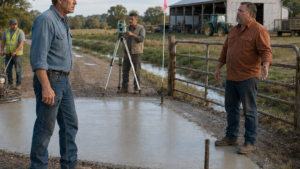
Resting on a clean piece of drafting paper on the workbench was the heavy iron survey monument Hannah had carefully recovered from beneath Patricia’s collapsed fence post. Standing beside the bench was Inspector Diane Caldwell, who had returned with an electronic digital metal detector, a high-precision laser rangefinder, and a copy of the original 1994 Williamson County master plat map for the Whispering Hills subdivision.
“Look at this cut, Diane,” Hannah said, holding an optical magnifying loupe over the severed iron pin. “This isn’t an accidental strike from a lawnmower or an old tractor plow. This is a cold, calculated mechanical cut made with an industrial cutoff wheel. Someone deliberately ground the brass identification cap off this boundary monument, drove the iron rod twelve inches deeper into the subsoil, and covered it with rotten wood mulch to hide it from sight.”
Inspector Caldwell leaned over the magnifier, her jaw tightening as she examined the telltale circular grinding grooves on the hardened steel. “Every iron monument driven by a licensed surveyor in this county carries an embossed brass cap stamped with the surveyor’s license number and the legal lot corner. If you grind the cap off and bury the pin, you erase the physical proof of the property boundary on the ground.”
“Why would someone destroy an official county survey monument?” Hannah asked.
Caldwell unrolled the 1994 master plat map across the drafting table, weighting the corners with brass plane irons. “Because forty-eight hours ago, Patricia Sterling-Giles filed a formal boundary dispute and adverse possession petition with the Williamson County Chancery Court. She claims that the fence line separating your parcel from hers has stood in its current position for over twenty years without objection, and that under Tennessee adverse possession doctrine, the eight-foot strip of land between the fence and your driveway now belongs to her as legal titled property.”
Hannah felt a cold shock of indignation ripple through her chest. “Eight feet? An eight-foot strip running the entire four-hundred-foot depth of my lot? That encompasses my drainage swale, my gravel access lane, and half my mature pecan grove!”
“It encompasses exactly zero-point-seven-four acres of prime Franklin pastureland,” Caldwell confirmed, tapping the plat map with her pencil. “At current Williamson County commercial and residential valuations, that eight-foot strip is worth nearly two hundred thousand dollars. Patricia’s husband, Harold Giles, is the senior partner at Giles Land Holdings. They’ve been trying to assemble a thirty-acre commercial equestrian easement along this corridor for two years. If she can steal that eight-foot strip from you by claiming adverse possession through a neglected, rotting fence, she gains direct legal access to the county arterial road without having to pay you a dime.”
Caldwell stood up, switching on her handheld metal detector. The device let out a crisp, rhythmic electronic chirp. “Let’s walk the boundary line, Hannah. If they cut one monument, they had to deal with the others.”
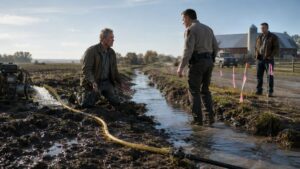
Under the pale silver light of a rising October moon, Hannah and Inspector Caldwell walked the length of the property line, following the sagging, rotten fence into the dark cedar grove. Caldwell swept the search coil slowly across the weeds, two inches above the wet sod.
Twenty yards past the collapsed post, the detector let out a sharp, continuous high-pitched shriek.
Hannah knelt with an entrenching shovel, carefully slicing through the dense sod. Six inches beneath the surface, buried beneath a fresh layer of river stones and pine needles, Caldwell’s trowel struck solid metal.
Brushing away the dirt, they uncovered a second iron survey pin. Unlike the first monument, this pin was intact. Stamped into the circular brass cap was the official seal: WILLIAMSON COUNTY SURVEY – LOT 14/15 BOUNDARY MONUMENT – 1994.
Inspector Caldwell unrolled her heavy fiberglass tape measure, hooking the brass end onto the uncovered survey pin and extending the tape directly to the center of Patricia’s rotting fence.
The black numbers on the yellow tape were unmistakable. The rotting fence was not sitting on the property line. It was sitting eight feet four inches inside Hannah’s legal boundary.
“She didn’t just let the fence rot, Hannah,” Caldwell whispered, her voice dark with fury. “Ten years ago, Patricia had her contractors secretly move the fence eight feet onto your property under the guise of an emergency repair, and then intentionally let it decay into ruins so no one would ever question the boundary. It’s land theft disguised as agricultural neglect.”
Inspector Caldwell pulled a pair of digital vernier calipers and a portable hardness tester from her tactical vest, testing the wood density of the broken post fragments. ‘This wood has suffered advanced brown-rot decay,’ Caldwell noted, pointing to the cubical cracking pattern across the splintered core. ‘The moisture content in this post is over thirty-eight percent, creating an ideal incubation vector for subterranean termites. Under Williamson County building codes, structural wooden fence posts must maintain a minimum density of thirty pounds per cubic foot and be pressure-treated with copper azole for direct ground contact. This post was untreated scrap pine, buried directly in topsoil without concrete footings, and left to rot for a decade. It was an intentional structural failure.’ Hannah listened carefully, realizing that the decay was not an accident of nature, but a calculated, deliberate strategy of neglect designed to blur the boundary line.
Hannah picked up a piece of the crumbling wood post, rubbing the dry fibers between her thumb and forefinger. In her woodworking studio, she kept reference samples of wood species from all over North America, studying how moisture, fungal decay, and insect damage affected mechanical load capacities. ‘A structural four-by-four post made from pressure-treated southern yellow pine should have a bending strength of at least one thousand pounds per square inch,’ Hannah explained to Inspector Caldwell. ‘This post has an effective strength of zero. It is essentially compressed dirt held together by dried moss. If a grazing horse or a child had leaned against this fence, the entire panel would have collapsed, exposing them to jagged rusty nails and splintered wood. Neglecting a perimeter barrier to this degree in an equestrian community is an act of gross negligence.’ Caldwell nodded in total agreement, carefully documenting the safety assessment in her permanent municipal compliance log.