They Fined Him for One Farm Camera Until He Asked What Their Nine Cameras Were Recording
Chapter 1: The Orange Tag on Daniel’s Cattle Gate
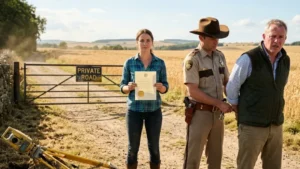
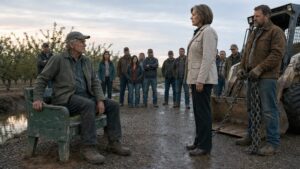
Daniel saw the orange tag before he saw Sharon Walker.
It snapped in the morning breeze beneath the small black camera mounted to his cedar gatepost, bright enough to look unnatural against gray gravel, green pasture, and weathered wire.
Sharon was standing beside the post with a plastic tie still in one hand.
“Don’t cut that down,” she said.
Daniel stopped halfway out of his pickup.
Thirty yards behind him, cattle pressed along the feed bunk. A delivery truck was due before nine, and he still had a hydraulic line to replace on the loader. Sharon had chosen a Monday morning because she knew he would be busy.
He shut the truck door.
“What is it?”
“You know what it is.”
The paper was inside a clear sleeve. Across the top, in letters large enough to read from several feet away, was the farm-road association’s name. Daniel ignored the rest and looked above it at the camera.
The lens faced down the gravel approach to his own gate.
Sharon folded her arms. She was in her early sixties, white hair cut close around her ears, boots clean enough to show she had not walked through anyone’s barnyard that morning.
“You were notified last week,” she said.
“You sent an email.”
“That was notification.”
“It asked me to remove it. It didn’t tell me what rule I broke.”
“It records association traffic.”
“It records my entrance.”
“The road is shared.”
Daniel glanced toward the shallow ditch. Beyond it, the gravel lane curved behind a line of maples before dividing toward three other farms and Kathleen Torres’s orchard. Anyone entering his property had already traveled several hundred yards on association-maintained ground.
That distinction mattered to Sharon.
It mattered less to the person who had opened Daniel’s cattle gate twice the previous fall.
The first time, nothing happened. Daniel had found the chain hanging loose before sunrise and assumed he had failed to latch it properly.
The second time, seven heifers reached the gravel lane.
One had made it almost to the county road before Daniel and a feed-truck driver turned her back.
After that he stopped assuming.
He installed the camera himself.
“No audio,” Daniel said. “Motion zone ends at the gate. Image masks cover the road past the drainage post.”
Sharon gave him a thin smile.
“That means something to you.”
“It should mean something to whoever wrote the complaint.”
“The complaint is about the camera being there.”
“So you don’t care what it records.”
“I care that one member decided, by himself, to mount surveillance equipment on a shared-road entrance.”
“My gatepost.”
“Beside our road.”
Daniel looked again at the orange tag.
“How much?”
“First day is fifty.”
He reached for the sleeve.
Sharon put a hand against it. “It stays.”
Daniel looked at her hand until she removed it.
“Then what?”
“One hundred tomorrow. After that, the board can assess a daily compliance penalty.”
“How high?”
“Up to two hundred.”
Daniel let out a short breath through his nose.
“That seems reasonable to you?”
“What seems reasonable is following the same process everyone else follows.”
She had used that sentence before. For drainage culverts. For gravel assessments. For where trailers could be parked during auction week.
The association had begun decades earlier because six farms needed one road and no township wanted responsibility for maintaining it. Over time, the road acquired rules, dues, meetings, committees and a small equipment shed beside the livestock-loading yard.
The system worked because no one could afford for it not to.
That was why Sharon’s next sentence landed harder.
“If you remain out of compliance,” she said, “the board can review your shared-access privileges.”
Daniel stared at her.
“You’re threatening access to my farm.”
“I’m telling you what the bylaws allow.”
“My feed trucks use this lane.”
“And so do everybody else’s.”
“You know there’s no other practical entrance.”
“That is why people should think before deciding rules don’t apply to them.”
The irritation Daniel had been holding flattened into something colder.
Sharon saw the change.
“You always do this,” she said. “You decide you understand the technical side, so the rest of us are supposed to accept whatever you’ve decided.”
Daniel said nothing.
That was another habit of his Sharon disliked.
People often mistook Daniel’s silence for uncertainty. Sharon never did. She understood that when he stopped talking, he had usually decided the conversation was no longer worth having.
It was not his most useful quality.
She pointed at the camera.
“Take it down today, Daniel.”
“No.”
The answer came so plainly that Sharon blinked.
“No?”
“No.”
A truck rattled around the bend. Daniel stepped aside as a plain farm pickup passed them. The driver lifted two fingers from the steering wheel, then looked longer than usual at Sharon and the orange paper.
Daniel waited until the truck disappeared.
“Come here.”
Sharon frowned.
He walked to the post.
His phone was already in his hand. He opened the camera application and held the screen toward her.
The live image showed the inside edge of the gate, a strip of gravel and part of Daniel’s battered pickup. Beyond the drainage post, the image turned into a gray privacy block.
He tapped another control.
“No microphone channel. Never enabled.”
Sharon leaned closer despite herself.
He pointed at the detection outline.
“Anything going east on the shared lane isn’t tracked. Anyone entering my driveway is.”
She straightened.
“That doesn’t change the installation.”
“It changes the claim that I’m surveilling everyone.”
“The rule isn’t dependent on whether you think your settings are responsible.”
Daniel locked his phone.
There it was.
The part that had been bothering him since her email.
Not what the camera did.
That it was his.
He looked past Sharon toward the bend in the road. One hundred yards away, mounted beneath the eave of the association equipment shed, was a white camera housing.
From where he stood, only the bottom half was visible.
He knew that shape.
He had known it for years.
“Thursday,” Sharon said.
Daniel looked back.
“Seven o’clock. Emergency compliance hearing during the regular board meeting.”
“For a camera.”
“For refusing a board directive.”
“That’s different.”
“Yes,” Sharon said. “It is.”
She started toward her SUV, then stopped.
“I’m giving you until Wednesday evening. If it’s down, I’ll recommend the board close the matter.”
Daniel looked up at the camera above his gate.
For a moment he remembered the sound of hooves on gravel in darkness, the terrible empty space where cattle should have been, and his own certainty afterward that nobody would open that gate again without leaving a record.
“I’ll be there Thursday,” he said.
Sharon’s expression hardened.
“So will the entire board.”
She drove away, leaving the orange tag snapping beneath the lens.
Daniel waited until the dust settled.
Then he looked again toward the distant equipment shed and the white camera mounted beneath its roof.
He knew exactly what his own camera could see.
What he did not yet know was how much Sharon understood about hers.
Chapter 2: Nine Cameras Above the Loading Yard
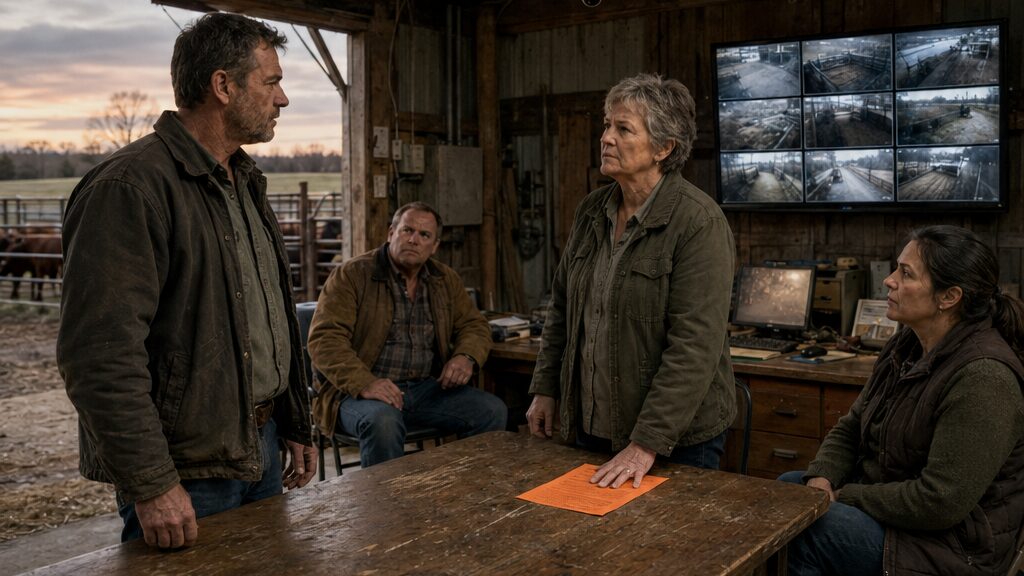
The orange violation notice was lying in the center of the meeting table when Daniel walked into the equipment shed Thursday night.
Sharon had put it there before his chair was even pulled out.
Around it sat a coffee thermos, the association ledger, two stacks of maintenance invoices and a yellow legal pad in front of Richard Smith. Eight landowners filled the folding chairs behind Daniel.
Nobody talked when he came in.
Daniel took the empty chair nearest the side wall.
Richard looked at the notice, then at Daniel.
“You could have taken the thing down for a week,” he said quietly.
“And then?”
“Then you and Sharon could’ve worked it out without this.”
Daniel glanced toward Sharon.
She was standing beside the office desk speaking with the association secretary.
“Does that look worked out?”
Richard sighed.
He had known Daniel for fifteen years and disliked arguing with him for the same reason most people did: Daniel answered exactly what was asked and nothing more.
“You make everything harder than it needs to be,” Richard said.
“That doesn’t make her right.”
“No. But it doesn’t automatically make you right either.”
Daniel let that sit.
Above Richard’s shoulder, a flat monitor hung on the wall.
Nine boxes filled the screen.
Gate entrance.
Mailbox turnout.
Fuel tank.
Loading chute.
Equipment yard.
North bend.
Storage shed.
Road junction.
Meeting-room entrance.
Daniel counted them twice.
He had seen individual association cameras before. He had never seen all the feeds displayed together.
Sharon called the meeting to order.
Road grading came first. Then drainage along Kathleen’s orchard. Then a repair estimate for the loading-yard lights.
Daniel understood the strategy.
Make him wait.
By the time Sharon lifted the orange notice, everyone was tired and aware that he was the only unfinished business between them and home.
“This should be straightforward,” she said.
She placed the notice upright against the ledger.
“Mr. Wright installed an unapproved surveillance device at his cattle entrance. The device faces a road owned and maintained collectively by association members. He was asked to remove it. He refused.”
Daniel watched the people behind her more than he watched Sharon.
Kathleen Torres sat two rows back with her arms folded.
She did not look sympathetic.
Sharon continued.
“The original compliance period expired Wednesday evening. The first assessment has been posted. A second assessment will be added tomorrow if the device remains.”
Richard cleared his throat.
“For the minutes, we’re at fifty now?”
“One hundred fifty as of tomorrow morning.”
A murmur came from the folding chairs.
Daniel said, “And after that?”
Sharon looked at him.
“As I explained Monday, the board may impose a daily penalty until compliance.”
“How much?”
“Up to two hundred dollars per day.”
The room changed slightly.
Not outrage. Not yet.
But people shifted.
Farmers understood daily costs.
Two hundred dollars was seed. Diesel. Veterinary medicine. Repair parts.
Sharon noticed the reaction.
“The purpose isn’t to collect money,” she said. “The purpose is compliance.”
Daniel almost smiled.
Kathleen caught it.
“Don’t,” she said from the second row.
Daniel looked at her.
“If you have something useful,” she continued, “say it. Otherwise you’re making this look exactly like Sharon says.”
The words bothered him because they were fair.
Sharon gestured toward him.
“You have the floor.”
Daniel remained seated.
“My camera covers my gate.”
“It covers part of the approach.”
“My approach.”
“A shared lane.”
“It masks the lane past my property.”
“You have said that.”
“I showed you.”
“And you still did not request approval.”
Daniel looked toward the monitor again.
Nine views.
The loading yard camera showed the rear of a livestock trailer. Another displayed the mailbox turnout. The meeting-room entrance camera showed the same people sitting inside, seen from above.
“Approval for what?” he asked.
“Exterior surveillance equipment.”
“Where is that rule?”
The secretary opened a binder.
Sharon answered before she could.
“Section twelve permits the board to regulate equipment affecting shared access.”
“Does it say cameras?”
“It does not have to name every device.”
“Does it say recording?”
A pause.
“Daniel,” Richard said, “this is the part where you’re going to lose people.”
Daniel looked at him.
Richard lowered his voice.
“You know what she means.”
Yes, Daniel thought.
He did.
That was part of the problem.
Sharon stepped around the table.
“This isn’t complicated. We’ve spent years improving security along this road because people complained about theft, dumping and strangers cutting through after dark. We did it collectively. You chose to build your own system outside that process.”
Her hand lifted toward the wall monitor.
There it was.
Not merely enforcement.
Pride.
“We have cameras at every vulnerable common point,” she said. “Nine of them. Everyone here has benefited.”
Daniel looked at the screen.
The camera over the fuel area was a newer model.
So was the one above the loading chute.
The meeting entrance unit had the same rounded lower housing.
He knew the product family.
Not the exact configuration.
But enough.
Sharon mistook his attention for concession.
“When equipment belongs to the association,” she said, “there are procedures. Records. Access controls. When one person installs a camera on his own, we have no idea what he’s collecting or why.”
Daniel turned to her.
“You asked me that Monday.”
“I asked you to remove it.”
“No. You said it recorded association traffic.”
“It does.”
“I showed you the privacy mask.”
“I saw a phone screen.”
“And no audio channel.”
Sharon’s jaw tightened.
“You keep hiding behind technical details.”
A few people nodded.
That hurt more than Daniel expected.
Kathleen was one of them.
He realized then how the situation looked from anywhere except inside his own head.
He had installed the camera without speaking to anyone.
He had refused Sharon without explaining the nights the gate had been opened.
He had given her settings and specifications when what people wanted was a reason to trust him.
Daniel could have fixed part of that.
Instead, he said, “My technical details are the reason you’re wrong.”
Kathleen looked down.
Richard rubbed his forehead.
Sharon almost seemed relieved.
“Thank you,” she said. “That is exactly the attitude we are dealing with.”
She turned toward the room.
“If every member decides his own judgment overrides the association’s, there is no association. Daniel thinks because he installs security equipment, normal rules somehow become optional.”
Daniel felt the old instinct return.
Let her finish.
Let her commit to what she was saying.
He looked again at the monitor.
Nine feeds.
The fuel camera.
The loading yard.
The mail turnout.
The room entrance.
He noticed tiny speaker icons at the bottom edges of several windows.
His shoulders went still.
The interface had been updated since the system he remembered.
Sharon was still speaking.
“These cameras have prevented vandalism. They have documented trespassing. They have given us records when insurance companies asked what steps we were taking. They are operated for the benefit of everyone here.”
Daniel leaned forward.
Richard noticed.
“What?” Richard whispered.
Daniel did not answer.
Sharon returned to the table.
“The board’s recommendation is simple. Remove your camera by eight tomorrow morning. The current fine remains. If you refuse, additional assessments begin and the access committee reviews your standing.”
The room waited.
Daniel looked at the orange paper.
Then at Sharon.
“I’m not taking it down.”
Richard closed his eyes.
Sharon’s voice sharpened.
“Then you will be fined.”
“All right.”
“And if you continue to refuse?”
“We’ll deal with that.”
“You seem awfully confident for somebody asking everyone else to make an exception.”
Daniel looked past her at the nine glowing rectangles.
“I’m not asking for an exception.”
“Then what are you asking for?”
Daniel pointed toward the monitor.
“For you to answer one question.”
Sharon turned halfway.
“What question?”
Daniel’s eyes settled on the camera feed showing the very room they were sitting in.
“Do all nine record sound?”
Chapter 3: The Question Sharon Should Have Checked First
“Yes,” Sharon said.
She answered too quickly.
For half a second, nobody moved.
Then Sharon glanced at the monitor as if the proof were right there.
“They have audio capability,” she continued. “Good audio. That was part of the upgrade.”
Daniel felt Richard turn toward him.
“How good?” Daniel asked.
Sharon gave him an impatient look.
“Clear enough to be useful.”
“Useful for what?”
“If someone damages equipment, threatens somebody, disputes what happened—Daniel, we are not putting our entire security program on trial because you don’t want to remove one camera.”
Daniel looked at the ceiling.
Directly above the meeting table, inside a white housing no larger than his fist, sat another camera.
He had not noticed it when he entered.
Now everyone else was looking too.
“Is that one recording us?” Kathleen asked.
Sharon followed her gaze.
“It monitors the room entrance and interior.”
“That wasn’t my question.”
The association secretary stopped writing.
Daniel heard the low electrical hum of the heater along the wall.
Sharon’s expression changed—not to fear, exactly, but annoyance at a meeting slipping away from the agenda she had built.
“The system records when activated,” she said.
Richard pushed back his chair.
“You mean it’s recording right now?”
“I don’t know whether this particular session is being stored.”
“But it could be?”
“It’s security equipment, Richard.”
He stared at her.
For the first time all evening, Daniel said nothing.
He knew better than to claim a crime or quote a law he had not verified. Rules governing audio recording depended on circumstances, expectations, purpose and consent. The technical fact was simpler.
People had not known.
Kathleen looked at Daniel.
“Your camera doesn’t do this?”
“No.”
“You can prove that?”
“Yes.”
“You could turn audio on later.”
“Not on the unit I installed.”
Sharon seized on it.
“There. That is exactly why the board regulates installations. We shouldn’t have to take your word for what a private device can do.”
Daniel nodded.
“I agree.”
That stopped her.
Richard looked between them.
“You agree?”
“On that part.”
Daniel stood and walked toward the monitor.
He kept several feet away from the desk.
“These newer association units have microphones built into the housing. Whether audio is enabled depends on configuration.”
Sharon crossed her arms.
“I already told you it is enabled.”
“And everyone here knew that?”
No one answered.
Daniel looked at Richard.
“Did you?”
Richard shook his head.
Kathleen said, “No.”
One of the farmers behind her muttered, “First I’ve heard of it.”
Sharon’s cheeks reddened.
“We discussed the security upgrades.”
“We discussed cameras,” Richard said. “I approved the invoice for cameras.”
“Audio is part of the equipment.”
“That isn’t the same thing.”
Sharon pointed toward the loading-yard feed.
“Last winter somebody cut the lock off the diesel cage. Before that we had illegal dumping at the north bend. Everybody wanted better security when it was costing us money.”
“We wanted better security,” Kathleen said. “Did we agree to microphones?”
Sharon looked at the secretary.
“Pull the minutes.”
The secretary opened the binder, flipped backward, then stopped.
“I can find approval for the upgrade package.”
“Read it.”
“It says expanded camera coverage, nighttime image quality, remote access and storage.”
“Keep going.”
The secretary turned a page.
“That’s the motion.”
Richard stared at Sharon.
“No audio?”
“It may be in the contractor specifications.”
Daniel looked at the monitor again.
The mailbox turnout appeared in the upper-right corner.
A pickup rolled into view, stopped beside the row of metal boxes, and a man stepped out.
Richard followed Daniel’s gaze.
His face changed.
“That camera,” he said.
Nobody answered.
“The mailbox one.”
Sharon looked at him.
“What about it?”
Richard pointed.
“That thing has a microphone too?”
“If it’s one of the upgraded units.”
Richard stood fully now.
“I talk to people there.”
“Everybody talks to people there,” Kathleen said.
Richard barely heard her.
“My brother meets me there sometimes before milking. Feed salesman catches me there. I’ve talked to the bank from that turnout.”
Sharon said, “No one is sitting around listening to your conversations.”
Daniel turned.
“That isn’t the question.”
“It matters.”
“It matters later. First question is whether the system captures them.”
Sharon’s voice tightened.
“You’re making this sound sinister.”
“I haven’t called it anything.”
“You know exactly what you’re doing.”
Daniel did.
That was the part beginning to bother him.
He had spent years learning to control a difficult room by asking questions in the right order. Let somebody else establish the fact. Avoid claims you could not support. Separate what a device could do from what anyone intended to do with it.
Professionally, it was sound.
Personally, it was beginning to feel like a trap he had allowed Sharon to walk into.
Kathleen looked up at the camera over the meeting table.
“How long?”
Sharon frowned.
“How long what?”
“How long has audio been on?”
“I’d have to check.”
“Months?”
“I said I’d have to check.”
“Years?”
The question hung in the room.
Daniel finally stepped back from the monitor.
“Don’t guess,” he said.
Sharon laughed once without humor.
“Now you’re protecting me?”
“I’m protecting the facts.”
She stared at him.
Richard pointed toward Daniel’s orange notice.
“Fine is suspended.”
Sharon turned.
“You can’t do that yourself.”
“I’m treasurer. I can refuse to post another assessment until the board understands what we’re enforcing.”
“That is not procedure.”
“Then call a vote.”
For several minutes the meeting became something Daniel had not expected.
Not a victory.
A fracture.
One farmer wanted every camera shut off immediately. Another said that was foolish with fuel and machinery sitting along an isolated road. Kathleen wanted the recordings preserved until they knew what existed. Sharon warned that tampering with the security system could create insurance problems.
Daniel remained near the wall.
No one was talking about his gate camera anymore.
He should have felt satisfied.
Instead, he kept looking at the equipment.
The housing above the table had a shallow curved seam along the lower edge.
Familiar.
Too familiar.
At last the board agreed on three temporary steps: Daniel’s fine would be paused; no camera would be removed that night; and the association would request the installer’s configuration records before an emergency meeting.
People left in small groups.
Richard passed Daniel without speaking.
Kathleen stopped at the doorway.
“You knew,” she said.
“I suspected.”
“That’s not what I asked.”
Daniel looked at her.
“I recognized the interface tonight.”
She studied him for a moment, then walked out.
By Friday morning, the orange tag was still hanging at Daniel’s gate, but the road felt different.
At the mailbox turnout, two neighbors stood farther from the association camera than usual.
Daniel collected his mail without speaking to them.
At home he set an old laptop on the kitchen table and searched through archived work folders.
He had done contract security work for twenty-three years. Farm stores, veterinary clinics, equipment yards, machine shops. He kept specifications because customers called years later asking what they owned.
He searched the association name.
One folder appeared.
Daniel stopped breathing for a moment.
The date was six years old.
Inside were diagrams of the shared road, coverage angles and three recommended camera models.
Daniel opened the earliest proposal.
Video only.
No microphones.
He scrolled.
At the bottom of the page, beside the words PRELIMINARY SECURITY REVIEW, were two initials.
D.W.
Daniel leaned back.
Memory arrived with uncomfortable precision.
A series of thefts. Sharon asking him for advice. Richard complaining about fuel disappearing. Daniel walking the loading yard with a measuring wheel. Daniel recommending three cameras at the most vulnerable points.
He had not installed the present system.
But he had helped start it.
His phone rang.
He expected Sharon.
It was Kathleen.
“I’m in the association records room,” she said.
Daniel looked at the initials on his screen.
“All right.”
“I found the old security committee packet.”
He closed his eyes.
Kathleen continued.
“Daniel, your name is on it.”
Chapter 4: The Part Daniel Never Told His Neighbors
Kathleen was waiting beside Daniel’s gate before he finished his first cup of coffee.
She stood with one hand on the hood of her pickup and an old brown committee packet tucked beneath her arm. The orange violation tag still hung below Daniel’s camera, curled now at one corner from four days of wind.
When Daniel stepped out of the barn, Kathleen lifted the packet.
“You want to save me the trouble of asking?”
He kept walking toward her.
“You said you found my name.”
“Your initials. Your diagrams. Your equipment notes.”
She opened the packet across the pickup hood before he could answer.
Several pages had been photocopied so many times that the edges had turned gray. A map of the shared road showed three hand-drawn camera positions in black ink.
Daniel recognized his handwriting immediately.
Kathleen tapped the lower corner.
“D.W.”
“I know.”
“You knew last night too.”
He looked toward the small camera over his gate.
“I remembered after I got home.”
“That isn’t what you told me.”
“I said I recognized the interface.”
“And you let everybody walk out thinking Sharon was the only person in that room who knew anything about how those cameras got there.”
Daniel’s jaw tightened.
“I didn’t install what’s there now.”
“I know that.”
“I didn’t specify microphones.”
“I know that too.”
Kathleen closed the packet.
“Those facts would sound better if I hadn’t had to find them myself.”
A tractor moved slowly along the far field, the sound carrying over the pasture. Daniel waited for it to pass before speaking.
“Six years ago we had thefts.”
“I remember.”
“Diesel. Chains. Somebody took batteries out of Richard’s skid steer.”
“And somebody opened your cattle gate.”
“That came later.”
Kathleen looked at him.
Daniel rested his hands on the top rail of the gate.
“Sharon asked me to look at the common areas because I was doing security work then. I walked the road, mapped blind spots, recommended three cameras.”
“Video only?”
“Yes.”
“Why only three?”
“Because that covered what we needed. Fuel cage, loading yard, north bend. Nothing inside the meeting area. Nothing at the mailboxes.”
Kathleen opened the packet again.
“That’s what this says.”
Daniel nodded.
“So what happened?”
“I left the committee.”
“Why?”
He hesitated.
Kathleen saw it.
“There it is.”
“What?”
“The part you don’t want to say.”
Daniel looked past her toward the orchard road.
“They wanted more coverage.”
“Who?”
“The committee.”
“Sharon?”
“Sharon and two others.”
“More cameras?”
“More everything. Remote access. Longer storage. Wider angles.”
“And you objected.”
“I said we were solving equipment theft, not building a system to watch every conversation and vehicle.”
Kathleen’s face softened slightly.
“That would’ve been useful to hear Thursday.”
“I didn’t think it mattered.”
She stared at him.
“That sentence is your problem.”
Daniel looked away.
Kathleen tapped the packet.
“You didn’t authorize microphones. Fine. You didn’t install the present equipment. Fine. But you helped start the thing. Then you left when they took it somewhere you didn’t like.”
“I wasn’t on the board.”
“No. You were just the only one who understood the hardware.”
The words landed harder than Sharon’s accusations had.
Daniel had spent years telling himself the same story: he had warned them, they had ignored him, he had stepped away.
Clean lines.
Kathleen was making them less clean.
“I told Sharon not to expand it blindly,” he said.
“Once?”
“At least twice.”
“And after that?”
“I stopped being involved.”
“Did you ever tell the rest of us what bothered you?”
“No.”
“Did you ever ask whether microphones were added?”
“No.”
“Did you suspect the upgrades were being handled badly?”
Daniel did not answer.
Kathleen waited.
Finally he said, “Yes.”
The farm seemed louder after that.
A gate chain clinked against steel. Cattle shifted behind him. Somewhere down the lane, a truck dropped into a lower gear.
Kathleen closed the packet.
“That’s what you need to tell them.”
Daniel gave a short, humorless laugh.
“You think Sharon’s going to admit what she knew once I hand her that?”
“This isn’t about handing her anything.”
“It will be.”
“She may use it against you.”
“She will use it against me.”
Kathleen stepped closer.
“And?”
Daniel looked at her.
“You want me to stand up Monday and say I suspected a problem years ago and did nothing?”
“I want you to tell the truth before somebody else tells half of it.”
He looked again at the orange tag.
For four days it had represented Sharon’s overreach.
Now it looked different.
A bright public marker attached beneath a device Daniel had installed without telling anyone because he had decided his reasons were enough.
Kathleen followed his gaze.
“You keep saying your camera only watches your gate.”
“It does.”
“But you decided that by yourself.”
Daniel said nothing.
“That’s the same habit, Daniel. Smaller scale. Better intentions. Same habit.”
He looked sharply at her.
She did not back away.
“You know what I think happened?” she said. “You were right six years ago. Then you got tired of arguing, so you walked away and let being right become your excuse.”
“That’s convenient.”
“It isn’t convenient for me. I use that road every day. My crews use that loading yard. If microphones have been running there, I want answers.”
“So do I.”
“Then stop acting like answers only count when you’re the one asking.”
She left the packet on his hood.
“I copied it. Keep that.”
By noon Daniel was in the association records room.
The secretary had left boxes open for anyone on the board to review before Monday’s emergency meeting. Daniel was not a board member, but after Thursday no one had stopped him from examining the technical files.
The original proposal was exactly as he remembered.
Three cameras.
No microphones.
Limited retention.
No interior coverage.
Then came later invoices.
Five cameras.
Seven.
Nine.
A contractor specification listed integrated audio capability as standard on four of the newer units.
Daniel found no separate vote authorizing microphones.
He also found something worse for himself.
An email chain printed in the file.
Three years earlier, Sharon had asked him whether a proposed replacement camera was “basically compatible” with the old system.
Daniel had answered from his phone.
Should work. New model has more features. Make sure installer disables anything you don’t need.
That was all.
No follow-up.
No call.
No inspection.
At the time he had been angry with the committee and busy repairing storm damage at his own farm. He had told himself the warning was enough.
He read the message twice.
Then folded it back into the file.
When he returned home, Kathleen was gone, but the packet remained on his pickup.
The orange tag moved beneath the gate camera.
Daniel reached up as if to tear it down.
His hand stopped before touching it.
He could remove the paper easily.
The harder thing would be standing in front of the same neighbors Sharon had tried to embarrass him before and explaining why part of her system had his fingerprints on its beginning.
His phone buzzed.
A message from Kathleen.
Monday. Tell it yourself.
Daniel looked toward the road.
He could already hear Sharon’s version if he did not.
And for once, he could not say she would be entirely wrong.
Chapter 5: Why Sharon Refused to Turn Them Off
Sharon admitted it before Daniel had finished closing the office door.
“Yes,” she said. “I knew the microphones were enabled.”
Daniel stopped with his hand still on the knob.
Sunday afternoon light came through the dirty window behind her, cutting across the shared-road office desk and the monitor mounted on the wall.
All nine camera feeds were still running.
“You knew Thursday?”
“I knew before Thursday.”
“How long?”
Sharon looked at the screen instead of him.
“About fourteen months.”
Daniel let the door shut.
The loading-yard feed showed an empty livestock chute. Another showed the diesel cage. A third watched the bend where illegal dumping had been a problem.
“You let me ask in front of everybody.”
“You didn’t ask whether I knew.”
“That’s your defense?”
“No.”
Her answer surprised him.
Sharon pulled out a chair.
Daniel stayed standing.
“You asked to talk privately,” she said. “Talk.”
He placed a copy of the contractor specification on the desk.
“Why was audio enabled?”
“Because we were getting hit.”
“By what?”
“The same things everyone now pretends they’ve forgotten.”
She turned the monitor slightly toward him.
“Fuel theft. Equipment vandalism. Dumping. Somebody cut Richard’s fence twice. We had people coming through the road at two in the morning.”
“That explains cameras.”
“It explains why we upgraded them.”
“Not why you kept microphones running without telling people.”
Sharon’s mouth tightened.
“You think I woke up one morning and decided I wanted to hear Kathleen discuss peach prices?”
“I think you knew the system was doing something people hadn’t agreed to.”
She looked away.
Outside, metal banged against metal in the loading yard. A farmer was moving a gate panel.
Sharon waited until the noise stopped.
“Last winter,” she said, “we caught the man stealing diesel because of the audio.”
Daniel frowned.
“The video showed his truck.”
“The video showed a truck with mud over the rear plate. The microphone picked up him saying where he was taking the fuel and who he planned to sell it to.”
Daniel said nothing.
Sharon leaned forward.
“Richard got nearly a thousand dollars’ worth of diesel back.”
“That doesn’t make the collection proper.”
“I didn’t say it did.”
“It made you keep it.”
“Yes.”
The word came without hesitation.
Daniel looked at her more carefully.
Sharon did not look proud now.
She looked tired.
“The insurance company was already on us,” she said. “Three property claims in eighteen months. One of their letters said if we couldn’t show better loss-control measures, our premiums were going up again.”
“So you decided more surveillance was cheaper.”
“I decided losing coverage would be worse.”
“There were other options.”
“Of course there were. There are always other options when somebody else has to pay for them.”
Daniel almost answered, then stopped.
That sounded like Sharon.
It also sounded like half the conversations he had heard around the association table for years.
She continued.
“People were furious every time something got stolen. They demanded cameras. More lights. Better locks. Then when the invoice arrived, those same people wanted to know why dues were going up.”
“So you hid part of what the system did.”
“I didn’t hide the cameras.”
“The microphones.”
Sharon pressed her lips together.
“Yes.”
There it was.
Not a misunderstanding.
A choice.
Daniel sat down.
“Why?”
Sharon looked at the live feeds.
“Because if I brought it back for another vote, Richard would complain about cost, Kathleen would ask where every camera pointed, somebody would demand we shut half of them off, and the next time something disappeared they’d blame me for that too.”
“That’s not authority. That’s fear.”
“You think I don’t know that?”
The answer was so quiet Daniel almost missed it.
For several seconds neither spoke.
A pickup entered the mailbox feed.
The driver stopped, collected envelopes, then leaned through the open passenger window of another truck that had pulled alongside.
The microphone symbol glowed beneath the image.
Daniel pointed.
“That.”
Sharon’s eyes followed.
“That’s the problem.”
“They’re forty feet away.”
“Doesn’t matter.”
“You don’t know whether that audio is usable.”
“Neither do they.”
Sharon folded her hands.
“No one sits here listening.”
“You keep saying that.”
“Because it’s true.”
“Then why collect it?”
She had no answer.
Daniel looked at the feed from the equipment shed.
“Who has access?”
“Me. The secretary. The contractor.”
“Richard?”
“View only on two cameras.”
“Remote access?”
“Yes.”
“Stored where?”
“Local recorder. Some backup through the contractor.”
Daniel exhaled.
“This is worse than Thursday.”
“I know.”
He turned toward her.
“When did you know?”
“Know what?”
“That this wasn’t just another feature.”
Sharon stared at the desk.
“After the diesel theft.”
“So months ago.”
“Yes.”
“And you left it on.”
“Yes.”
“Why didn’t you call me?”
That finally made her look up.
“You?”
“I told you years ago not to expand without controls.”
“You told me plenty of things years ago.”
“This one mattered.”
She gave him a tired, bitter smile.
“You stopped answering.”
Daniel went still.
Sharon opened a drawer and pulled out an old folder.
“I asked you to stay on the security committee.”
“I told you why I left.”
“You told me the committee wanted too much coverage.”
“It did.”
“You also told me if we ignored your recommendation, the result was ours to deal with.”
Daniel remembered the sentence.
He wished he did not.
Sharon slid the folder toward him.
“You didn’t want responsibility for a system you couldn’t control. Fine. But don’t sit there now acting like you spent six years trying to protect everybody.”
Daniel did not touch the folder.
“I’m not.”
“You will Monday.”
“No.”
She raised an eyebrow.
He pulled Kathleen’s copied packet from his jacket.
“My initials are in the original plan. I’m telling them.”
Sharon’s expression changed.
For the first time since he entered, she looked uncertain.
“All of it?”
“Yes.”
“The email too?”
Daniel met her eyes.
“Yes.”
She leaned back.
“That’s either very smart or very stupid.”
“It’s accurate.”
“Accuracy has never been your problem.”
He almost smiled.
Almost.
Outside, the same farmer who had moved the gate panel started a tractor. The engine coughed, caught, then settled into a heavy idle.
Daniel stood.
“Audio needs to be disabled now.”
“I can’t authorize a system change alone.”
“You authorized keeping it.”
“That was operational.”
“That distinction won’t help you.”
Sharon looked toward the monitor.
“If I shut it off before the emergency meeting, half the room will say I destroyed evidence.”
“Then lock the configuration and stop new audio capture.”
“With whose authority?”
“Call Richard.”
She laughed once.
“You’ve spent a week arguing the board has too much authority. Now you want me to exercise it.”
“I want you to stop making the problem bigger.”
Sharon studied him.
“That’s different?”
“Yes.”
“Why?”
“Because Monday they can vote on what comes next. Every hour until then creates more material nobody asked you to collect.”
For a moment Daniel thought she might refuse simply because he had told her what to do.
Instead she picked up her phone.
“I’ll call Richard.”
Daniel moved toward the door.
“Daniel.”
He stopped.
Sharon’s voice had lost its edge.
“When they hear your name is on the original system, some of them are going to decide this whole thing was personal.”
“Maybe part of it was.”
“You wanted me caught.”
He looked back.
“I wanted you to answer the question.”
“You knew what the answer could do to me.”
“Yes.”
Sharon nodded slowly.
At least he had not lied.
Then she asked, “Are you going to tell them that too?”
Daniel looked at the nine camera feeds, the same system both of them had touched at different stages and then left others to trust without understanding.
“Yes,” he said.
Sharon held his gaze.
“Good.”
He opened the door.
Behind him, she added, “Because if you tell them I hid what those microphones were doing, I’m going to tell them who designed the first camera map.”
Daniel paused.
Then he stepped outside.
For the first time since the orange tag appeared on his gate, the question was no longer whether Sharon could expose him.
It was whether he would expose himself first.
Chapter 6: The Meeting Where Daniel Included His Own Name
Richard Smith did not wait for Sharon to call the emergency meeting to order.
The moment Daniel entered the equipment shed Monday evening, Richard lifted an old security packet from the table.
“Is your name in this?”
Every chair was occupied.
Kathleen stood along the wall because there were no seats left. The association secretary had two binders open in front of her. Sharon sat at the head of the table, hands folded, saying nothing.
Daniel closed the door behind him.
“Yes.”
Richard looked at the packet, then back at Daniel.
“You helped design the system?”
“The first version.”
A murmur moved across the room.
Daniel could have explained immediately.
Three cameras. Video only. Six years ago.
Instead he walked to the table and placed his own papers beside Richard’s.
“My name is on the original security review,” he said. “I recommended three cameras after the theft problems started.”
Richard’s face hardened.
“And you waited until now to mention that?”
“Yes.”
“Why?”
“Because I didn’t install the present system, and I told myself that meant my part didn’t matter.”
Kathleen watched him from the wall.
Daniel continued before he could retreat into shorter answers.
“It mattered.”
Nobody spoke.
He pointed to the original diagram.
“This was my recommendation. Fuel area. Loading yard. North bend. Video only. Limited storage.”
Then he placed a later email beside it.
“Three years ago Sharon asked whether one of the replacement models was compatible. I told her it was, and I told her to disable features the association didn’t need.”
Richard leaned over the page.
“And then?”
“I never checked.”
“You were still doing security work.”
“Yes.”
“You knew more than anybody here.”
“Yes.”
“Did you suspect they were expanding too far?”
Daniel looked at him.
“Yes.”
The room became very still.
Richard dropped the packet onto the table.
“So you stood there Thursday asking Sharon questions like you had nothing to do with this.”
“That was wrong.”
Sharon’s eyes shifted toward him.
Daniel felt every instinct in him demand qualification.
Not technically wrong.
Not entirely.
Not the same responsibility.
All of those statements were defensible.
None was useful.
He continued.
“I was right about the microphones. I was wrong to act like being right made my own silence irrelevant.”
One of the farmers near the back shook his head.
“So who are we supposed to trust?”
Daniel answered before Sharon could.
“No one blindly.”
That brought several faces up.
“Not me. Not Sharon. Not an installer. The system should be simple enough that members know what it does and controlled enough that one person can’t quietly change what it collects.”
Richard sat back.
“That would’ve been a good idea six years ago.”
“Yes.”
The admission cost Daniel less the second time.
Kathleen unfolded her arms.
Sharon opened the meeting.
For the next twenty minutes, the room broke along predictable lines.
One farmer wanted every camera removed.
Another wanted all nine kept because machinery had been stolen from his property twice.
Richard wanted a complete audit before another dollar was spent.
Kathleen wanted the microphones disabled immediately and camera views reduced to common assets rather than gathering places.
Sharon listened without interrupting until the shouting began.
Then she slapped one palm against the table.
“We are not solving this by pretending there was never a reason for security.”
The room quieted.
She looked at Daniel.
“Tell them about the diesel theft.”
Several people turned toward him.
Daniel had not expected Sharon to ask.
“The audio helped identify where the stolen fuel was going,” he said.
Richard frowned.
“You knew that?”
“Yesterday.”
“So it worked.”
“In that case, yes.”
One farmer threw up his hands.
“Then why are we talking about shutting it off?”
“Because a tool can be useful and still collect more than you agreed to,” Kathleen said.
“That sounds nice until your equipment disappears.”
Kathleen turned.
“My orchard crew has conversations under that loading-yard camera. So do your drivers.”
“Nothing they say matters to me.”
“That isn’t the point.”
The room began to rise again.
Daniel watched Sharon.
She looked exhausted but not surprised.
This was what she had feared: every member defending his own version of risk.
The secretary’s phone rang.
She glanced at the screen and stood.
“It’s the insurance representative.”
Conversation stopped.
Sharon nodded for her to answer.
The secretary stepped into the office. Through the thin wall came pieces of her side of the call.
“Yes.”
“No, not currently.”
“Yesterday afternoon.”
“Yes, preserved.”
A long pause.
Then: “I understand.”
When she returned, her face had changed.
“What?” Richard asked.
She held a yellow notepad.
“The carrier wants immediate mitigation documented before they decide whether to renew at the end of the month.”
Sharon closed her eyes briefly.
“What counts as mitigation?”
“Audio capture disabled. Access credentials changed. Recorded material preserved but restricted. Written disclosure of camera locations and functions. Independent review of the system.”
Richard said, “And if we don’t?”
“They reserve the right not to renew.”
No one spoke.
The abstract argument had just acquired a price.
Sharon looked toward the monitor.
Nine feeds glowed above the meeting table.
“All right,” she said.
One farmer objected immediately.
“You shut the audio off and we lose evidence next time someone comes through here.”
Daniel stood.
“We don’t have to choose between nothing and this.”
The farmer looked at him.
“You already admitted you helped create this mess.”
“Yes.”
“So why should we listen to you?”
Daniel nodded toward the papers in front of him.
“You shouldn’t because I’m an expert. You should because what I’m proposing can be checked.”
That was different from how he would have spoken a week earlier.
He felt Kathleen notice it.
Daniel moved the original map to the center of the table.
“Keep cameras on actual shared assets. Fuel cage. Loading chute. Road entrance if everyone agrees. Remove coverage from places where people stop and talk unless there’s a specific reason for it. No microphones unless members vote for a defined use. Short retention. Two-person approval for remote access changes. Annual review.”
Richard looked at Sharon.
“Cost?”
“Less than replacing everything,” Daniel said. “More than doing nothing.”
“Of course,” Richard muttered.
A few people laughed.
Not applause.
Not forgiveness.
Just the first ordinary sound the room had made all evening.
Kathleen came to the table.
“And private cameras?”
Daniel knew what she was asking.
He pulled out the specification for his gate unit.
“Same rule.”
Sharon looked at him.
“You’re volunteering yours?”
“Yes.”
“Board review?”
“Coverage review. Written limits. No audio.”
One farmer said, “That camera started this whole thing.”
Daniel looked toward the orange violation notice still clipped to the packet.
“No. The way we handled it started this.”
Sharon’s expression tightened, but she did not argue.
Richard picked up the proposed measures and read them again.
“What happens to the existing recordings?”
“Restricted,” Daniel said. “Preserved until we know what obligations we have. Nobody goes fishing through them.”
Sharon added, “And the installer gets locked out except for supervised maintenance.”
The room turned toward her.
She kept her hands flat on the table.
“I knew the audio was enabled,” she said.
Daniel said nothing.
Sharon continued.
“I kept it enabled after it helped with the fuel theft. I did not bring that decision back to the full membership.”
Richard stared at her.
“Why?”
“Because I thought you’d shut it down.”
“Maybe we should have.”
“Maybe.”
Her voice did not rise.
“I was trying to keep the system that had stopped losses from being dismantled because nobody wanted to pay for it or talk about what it actually did.”
Kathleen asked, “Do you still think that was your decision to make?”
Sharon looked at the monitor.
“No.”
That answer carried more weight than any apology would have.
The board voted first on immediate mitigation.
Audio disabled.
Credentials changed.
Recordings locked.
Independent audit authorized.
The motion passed.
Then they voted on whether to remove all cameras immediately.
That failed.
Finally came the harder question: rebuild the system under written limits or abandon it after the audit.
Richard looked around the room.
“No more assumptions,” he said. “If we keep any of it, every member knows exactly what it can collect.”
Daniel watched people consider one another.
These were not strangers who could leave and never meet again.
They would pass each other hauling cattle.
Borrow equipment.
Clear snow from the same road.
Argue about gravel in spring.
The choice was not between trust and surveillance.
It was whether they could build rules strong enough to survive the absence of trust.
Richard lifted his hand.
“Motion to rebuild under written limits after the audit.”
Kathleen seconded.
Sharon did not speak.
Daniel looked at his own gate-camera specification beside the association’s equipment list.
For years he had believed his greatest responsibility was understanding the system better than everyone else.
Now he understood that the real responsibility was making sure no one had to take his word for it.
The secretary began calling the vote.
One by one, hands rose around the room.
Chapter 7: The Camera That Finally Faced Only the Gate
The insurance letter arrived folded inside a plain white envelope three weeks after the emergency meeting.
Richard opened it at the association table while everyone stood close enough to hear the paper crackle.
No one sat down.
The new camera policy was spread across the table beside him, marked with handwritten corrections, initialed pages, and a diagram showing every approved field of view along the shared road. The old monitor still hung on the wall, but six of its nine windows were dark.
Richard read the first page twice.
“Well?” Kathleen asked.
He looked up.
“They’ll renew.”
No one cheered.
Daniel was glad of that.
Richard continued.
“Conditional renewal. Audio stays disabled. Access credentials remain restricted. Independent audit every year. Any new device requires member disclosure and written coverage limits.”
Sharon stood near the office doorway with both hands in the pockets of her work jacket.
“And the premium?”
Richard gave her a look.
“Higher.”
“How much?”
“Enough that nobody’s going to be happy.”
One of the farmers muttered something under his breath.
Kathleen asked, “Less than losing coverage?”
Richard folded the letter.
“Yes.”
That settled the room more effectively than any speech could have.
The past three weeks had made certainty expensive.
The independent review had confirmed what Daniel already suspected: four cameras had active microphones, two had wider coverage than necessary, and remote administrative access had been shared too casually between the association and the contractor.
It had also confirmed something several members had not wanted to hear.
The cameras had prevented losses.
The system had recorded vehicles entering restricted areas after dark. It had helped document dumped construction debris. It had captured the fuel theft Sharon kept mentioning.
The review did not call the whole system useless.
It called it poorly governed.
That distinction mattered.
Daniel stood beside the wall holding a small cardboard box containing two replacement camera mounts. He had spent most of the morning helping reposition equipment around the loading yard.
Not because the association had asked him to take control.
Because it had specifically refused to let any one person do that anymore.
Every adjustment required two people present.
One made the change.
The other verified the field of view against the written plan.
Daniel had hated the process for the first hour.
Then he understood why that was probably a good sign.
Richard placed the insurance letter on the table.
“There’s one more thing.”
Sharon looked at him.
“What?”
He hesitated.
She seemed to know before he said it.
“I’m resigning as chair,” Sharon said.
Richard stopped.
Kathleen looked toward her.
Daniel did too.
Sharon stepped away from the doorway.
“I told Richard this morning.”
“You don’t have to do it today,” Richard said.
“Yes, I do.”
One of the farmers frowned.
“You’re leaving the board?”
“No. I said I’m leaving the chair.”
“Why?”
Sharon looked toward the darkened monitor.
“Because rebuilding trust while I’m still the person with final administrative authority doesn’t make much sense.”
Nobody answered.
She continued.
“I’ll finish the transition. Records. Insurance. Contractor access. Whatever the new chair needs.”
Richard said, “We haven’t elected one.”
“Then I suppose you’d better.”
A faint smile moved through the room.
Sharon’s did not.
Daniel watched her.
Three weeks earlier, he would have imagined satisfaction in this moment.
Sharon forced to step down.
The fines erased.
The microphones disabled.
His position vindicated.
Instead, all he felt was the weight of how much work remained.
Sharon met his eyes.
“You still owe us one inspection.”
Daniel looked toward the door.
“My gate.”
“Yes.”
Kathleen picked up the camera policy.
“Same rules.”
Daniel nodded.
“Same rules.”
They drove to his farm in three vehicles.
The orange violation tag was gone.
Daniel had removed it only after the board formally withdrew the enforcement action. For days afterward, the plastic tie had remained looped around the cedar post, a small clear reminder that tearing down the paper had been easier than changing what came after it.
Now Richard stood in the gravel approach holding a printed field-of-view diagram.
Kathleen stayed beside the gate.
Sharon stood back near the ditch.
Daniel climbed a short ladder and loosened the camera mount.
“Current angle is six degrees too wide toward the lane,” Kathleen said.
Daniel looked down.
“Six?”
She held up the audit sheet.
“Six.”
“That’s because they measured from the edge of the housing, not the lens center.”
Kathleen stared at him.
Daniel caught himself.
He looked at the sheet again.
Then at the camera.
“All right.”
Richard smiled.
“Growth.”
Daniel ignored him.
He rotated the camera inward.
The lens now faced more directly along the narrow gravel approach inside his property.
“Check it.”
Richard opened the review application on the association tablet.
The live image appeared.
Gate.
Fence.
Gravel.
Daniel’s pickup.
A sliver of the shared road remained visible near the far edge.
Kathleen pointed.
“That part.”
“It needs some approach visibility.”
“How much?”
Daniel climbed down.
For once, he did not answer immediately.
He took the tablet from Richard and looked at the image.
The old Daniel would have explained focal length, detection zones and why the extra strip improved identification.
Instead he asked, “What do you think?”
Richard raised his eyebrows.
Kathleen stepped closer.
“A vehicle entering your gate should be visible.”
Daniel nodded.
“But somebody driving past shouldn’t be followed.”
“Agreed.”
Sharon spoke from behind them.
“Can you mask the road?”
“Yes.”
Daniel opened the settings.
He drew a privacy zone over the outer edge of the lane.
Then he handed the tablet back.
“Audio?”
Kathleen asked.
Daniel opened the hardware menu.
“No microphone.”
“Retention?”
“Seven days unless a gate event is flagged.”
Richard checked the policy.
“Limit is ten.”
“Seven is enough.”
Kathleen looked at him.
“You sure?”
Daniel nodded.
“If something happens, I’ll know within seven days.”
Sharon approached the post.
She studied the small camera.
“That’s all you wanted in the first place?”
Daniel looked at the gate.
“No.”
She waited.
He continued.
“What I wanted was to make sure nobody opened that gate again without me knowing.”
“That sounds like the same thing.”
“It wasn’t.”
Sharon frowned slightly.
Daniel touched the cedar post.
“The camera was the tool. Knowing was the thing I wanted.”
He remembered the heifers on the gravel lane, hooves striking stone in the dark, his flashlight shaking in one hand while he tried to turn them away from the county road.
“I should’ve told people why I put it here.”
Sharon looked at him.
“I should’ve asked before deciding the answer didn’t matter.”
Neither of them apologized again.
They had already done enough of that in meetings.
This felt more useful.
Richard finished the inspection form.
“Compliant.”
Kathleen signed beneath his initials.
Then she handed the pen to Daniel.
He signed last.
The four of them stood for a moment beside the road.
A feed truck appeared around the bend.
Daniel’s camera detected it only when the driver turned toward his gate.
The truck rolled past instead.
The privacy mask swallowed it from view.
Sharon watched the tablet.
“So that’s it?”
“That’s it,” Daniel said.
The truck continued toward Richard’s dairy farm.
No alarm.
No audio indicator.
No recorded conversation.
Just gravel noise fading between the fields.
Later that evening, Daniel returned to the gate alone.
The cattle were quiet beyond the fence.
A vehicle came along the shared road, slowed near the mailbox turnout, then stopped.
Two neighbors leaned through their open windows and talked for several minutes.
Daniel could see them from where he stood.
His camera could not.
For the first time since he had installed it, that did not feel like a weakness.
The lens watched the gate.
Only the gate.
Daniel rested one hand on the cedar post and listened as the neighbors laughed at something he could not hear clearly.
Then one truck pulled away.
The other followed.
The shared road went quiet again.
And this time, nothing was listening.
The story has ended.