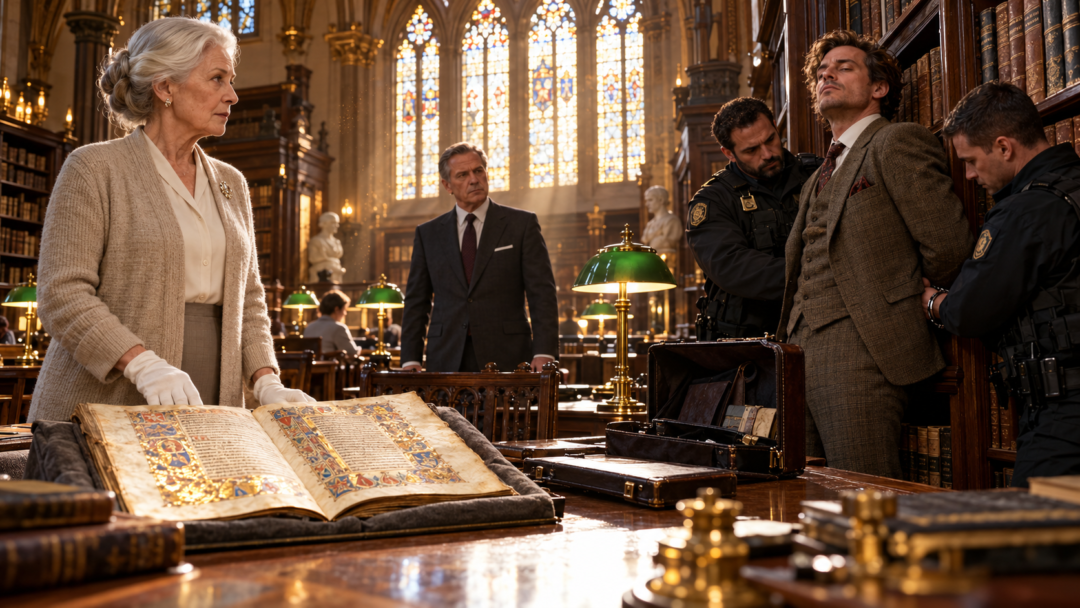
The Stolen Charter Of The Massachusetts Bay And The White Glove
CHAPTER 1: THE TRAMPLED VELVET BARRIER
The October afternoon sun angled through the arched leaded-glass windows of the Boston Athenaeum, casting diamond-patterned pools of amber light across the herringbone parquet. High above the polished oak reading tables, four tiers of cast-iron galleries rose into the quiet gloom of the Special Collections nave, housing two centuries of maritime logs, colonial charters, and leather-bound theological treatises. The atmosphere smelled of ancient rag paper, beeswax, and the quiet vanilla scent of decaying lignin—the sacred, unchanging breath of recorded history.
Dr. Eleanor Price wheeled her three-tiered brass book cart along the central aisle with the silent, practiced grace of someone who had walked these floorboards for fifty-two years. At seventy-two, she was a woman of modest stature, her silver hair coiled into an immaculate braided bun at the nape of her neck. She wore a soft beige cardigan over a dark wool skirt and sensible low-heeled oxfords. On her hands she wore pristine white cotton archival gloves, their fibers slightly yellowed at the fingertips from decades of handling delicate eighteenth-century calfskin.
Upon the felt-lined top tier of the cart lay the pride of the Commonwealth’s historical trust: the 1632 Charter of the Massachusetts Bay, granted under the royal hand of King Charles I. The document consisted of six oversized sheets of scraped calfskin vellum, illuminated with vermilion and crushed-lapis capitals, bound in pigskin over wooden boards.
A sharp, abrasive click of hard leather soles broke the church-like hush of the reading room.
“Out of my way, woman.”
Julian Vance did not pause as he reached the velvet stanchion rope that cordoned off the Special Collections alcove. He was forty-four, impeccably groomed, with slicked dark hair graying distinguishedly at the temples, wearing a tailored charcoal tweed three-piece suit and carrying a slim, gold-clasped attache case of Italian calfskin. With a contemptuous flick of his manicured fingers, Vance unhooked the brass latch of the velvet rope, letting the heavy scarlet cord drop to the floor.
As he strode forward, his knee struck the corner of Eleanor’s brass book cart. The impact sent a violent jolt through the casters. Three leather-bound volumes of early Boston admiralty court records tumbled from the bottom shelf, slamming onto the wool rug with heavy, muffled thuds.
Eleanor did not flinch, nor did she cry out. She stopped the cart with steady hands, turning slowly to face the intruder.
“Sir,” Eleanor said, her voice soft, melodic, yet carrying the crisp, chilling resonance of chilled crystal. “The Special Collections alcove is closed to visitors during conservation inventory. Those seventeenth-century court dockets are fragile municipal property.”
Vance did not even look at the fallen books. He stepped past them, deliberately grinding the heel of his bespoke oxford into the corner of an 1804 harbor survey map that had slid across the floor. He dropped his leather briefcase onto the mahogany reading table with a loud thwack, pulled a pair of tortoiseshell glasses from his vest pocket, and glared down at Eleanor as if she were a smudge of soot on a marble fireplace.
“Do you have any idea who you are addressing, old woman?” Vance sneered, his upper lip curling with habitual condescension. “I am Julian Vance, senior trustee of the North Atlantic Historical Guild and chief benefactor of the upcoming New England Antiquities Gala. I have an exclusive private viewing arrangement signed by the board. Now pick up those books, clear this table, and go down to the staff lounge to fetch me an espresso. Single shot, scalding hot. If you’re back in under three minutes, I won’t report your clumsiness to the head of facilities.”
Without waiting for a response, Vance reached directly into the glass-fronted climate preservation cabinet behind the table, his bare, unwashed fingers reaching for the illuminated 1632 charter.
Eleanor moved. For a woman in her eighth decade, her movement was astonishingly swift, economical, and unyielding. Before Vance’s bare fingers could touch the vellum, Eleanor placed her white-gloved right hand flat across the pigskin binding, pinning the folio firmly against the cedar shelf.
“You will not touch this manuscript with bare hands, Mr. Vance,” Eleanor said, her grey eyes locking onto his with an icy, penetrating clarity that stopped his breath in his throat. “Skin lipids and acidic perspiration transfer instantly to untreated calfskin. And you will not remove this volume from this room. Under Title Eighteen of the United States Code, unauthorized displacement of certified national historical property constitutes a federal felony.”
Vance’s face darkened with violent, aristocratic fury. He leaned across the table until he was inches from her face, his cologne smelling of cloying cedar and bitter tobacco. “You arrogant little cleaner. I have donated four hundred thousand dollars to this moldering crypt. The trustees eat dinner at my townhouse on Louisburg Square. One phone call from me, and you’ll be stripped of your janitorial pension and thrown into the street before nightfall.”
With a vicious snatch, Vance gripped the edge of the vellum folio, attempting to wrench it from beneath her gloved hand.
Eleanor did not struggle. She simply shifted her left hand beneath the desk edge, depressing a small brass toggle concealed inside the mortise-and-tenon molding—the silent duress switch wired directly to the Federal Protective Service dispatch.
As Vance tugged the heavy volume toward his briefcase, Eleanor’s gaze dropped to the illuminated red-and-gold initial letter C on the open folio. Under the intense amber glow of the banker’s lamp, Eleanor noticed something that made her heart freeze.
The gold leaf on the royal crest did not exhibit the characteristic microscopic spider-web fractures caused by three hundred and ninety years of organic contraction. The surface was perfectly smooth, synthetic, and smelled faintly of petroleum-based acrylic polymer.
The volume Julian Vance was clutching was not the authentic 1632 Royal Charter. It was a masterfully executed, chemically aged facsimile. And the real founding document of the Commonwealth had already vanished from the vault.