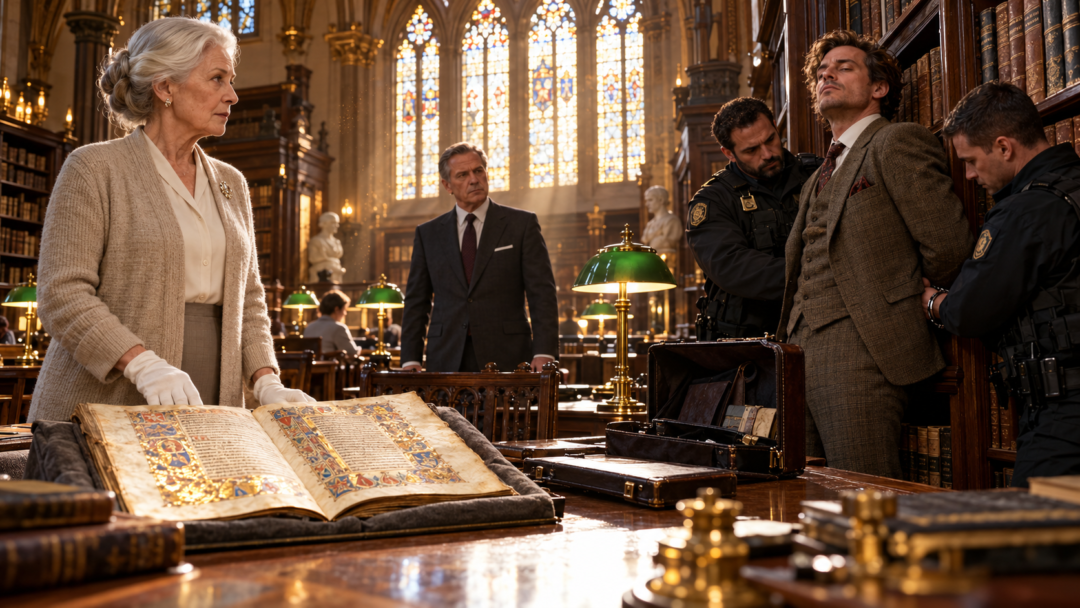
The Stolen Charter Of The Massachusetts Bay And The White Glove
CHAPTER 2: THE SLASHED VELLUM FOLIO
Forty-five minutes after the confrontation, Eleanor walked down the steep brick sidewalks of Mount Vernon Street, her woolen cape drawn tightly against the rising Atlantic fog that rolled in from Boston Harbor. Gas street lamps flickered to life in the gathering dusk, casting long, quivering shadows against the federalist brick facades and black iron boot-scrapers of Beacon Hill.
Her destination was not her modest apartment on Charles Street, but a narrow, four-story clapboard boarding house tucked away on an alleyway in Charlestown, in the shadow of the Bunker Hill Monument.
She climbed the narrow, creaking stairs to the fourth-floor attic. She tapped three times on the peeling green paint of door number four: two light raps, a pause, followed by a firm tap.
The brass deadbolt slid back with a hollow click. The door opened an inch, secured by a heavy brass chain. A pair of bloodshot, exhausted brown eyes peered through the crack.
“Dr. Price?”
“Let me in, Thomas,” Eleanor said gently. “We do not have much time.”
Thomas Lind pulled the door open, his hands trembling as he helped his mentor out of her heavy woolen wrap. At twenty-nine, Thomas possessed the pale, slender hands and hunched posture of a natural-born archival scholar. He had been Eleanor’s most promising graduate student at Harvard before she brought him into the Athenaeum as Assistant Curator of Rare Manuscripts. But over the past six weeks, Thomas had lost fifteen pounds. His cheeks were hollow, his tweed jacket hung loosely from his narrow shoulders, and the small room was choked with the bitter smell of cheap instant coffee and damp newsprint.
Across the small pine desk lay photographic plates, magnifying loupes, and stacks of chemical test strips.
“They’re watching the house, Dr. Price,” Thomas whispered, glancing nervously toward the dormer window that looked out over the darkened slate roofs. “Two men in an unmarked sedan have been parked at the corner of Medford Street since Tuesday. If Julian Vance finds out you’re here—”
“Julian Vance is currently sitting in the Director’s office at the Athenaeum, threatening to withdraw his gala sponsorship because I refused to let him handle the 1632 Charter,” Eleanor said, sitting down in the wooden ladder-back chair beside the desk. She placed her cotton gloves on the blotter. “Thomas, I inspected the display folio this afternoon. The gold-leaf illuminated header is synthetic. The vellum is machine-scraped French parchment aged with potassium permanganate.”
Thomas let out a ragged, shuddering breath, burying his face in his hands. “God help us. Then it’s true. The switch has already happened.”
“Tell me everything from the beginning, Thomas,” Eleanor commanded softly. “From the night you were dismissed.”
Thomas stood up, pacing the small room like a caged animal. “It began six weeks ago, during the annual climate calibration in Vault B. I was cataloging the maritime grant boxes. When I lifted Box Fourteen—the charter box—the weight felt off. Vellum absorbs ambient moisture; a six-sheet seventeenth-century sheepskin binding with lead bullae seals weighs approximately four point two pounds. The box weighed barely three pounds.”
Thomas pulled a leather-bound notebook from beneath his mattress and placed it in Eleanor’s hands. “I opened the binding under thirty-six nanometer ultraviolet light. The iron-gall ink should have shown deep red-brown fluorescence from iron sulfate oxidation. Instead, the text showed uniform inert purple under UV—modern carbon ink mixed with shellac.”
“And when you showed these findings to the Acquisitions Committee?” Eleanor asked.
“Vance was sitting on the committee as vice-chair,” Thomas said bitterly. “The next morning, three police detectives arrived at my desk with a search warrant. They found an exact matching facsimile page of the 1632 charter stuffed inside the lining of my leather satchel in the staff locker room. They claimed I was preparing to forge and steal the document. Director Albright had no choice but to suspend me pending grand jury indictment. Vance told the board he would generously decline to press private civil charges if the library handled my termination quietly.”
Eleanor opened Thomas’s notebook. On page forty-four, Thomas had sketched a detailed macro-drawing of the binding spine. The original linen sewing cords had been sliced clean with a micro-scalpel.
Tucked into the back of the notebook was a folded sheet of heavy cream paper that had been slid under Thomas’s door two nights earlier. It was typed on a manual ribbon typewriter, but at the top left corner, embossed in blind relief, was the distinctive watermark of the North Atlantic Historical Guild.
The note read: Leave the Commonwealth before Friday, Mr. Lind. The Atlantic has swallowed better scholars than you.
The radiator beneath the attic window hissed steam into the freezing room. Outside, the silhouette of the Bunker Hill Monument stood grim against the Boston night. Eleanor sat forward, her spectacles reflecting the lamplight.
For decades, Eleanor had taught that rare manuscripts were living organisms. A calfskin folio possessed memory, bearing the scars of the parchment and the mineral traces of oak-gall ink brewed in iron cauldrons. When a document was violated, the physical trauma remained etched into the collagen matrix forever.
“Thomas,” Eleanor said, her voice dropping into the quiet, rhythmic cadence she had used in Harvard lecture halls, “look at the cross-sections of the binding cords you drew here on page forty-eight. The twine is twisted flax, three-ply, boiled in beeswax. That is the signature cordage of the colonial binder John Ratcliff, who established his shop on Court Street in 1663. When Vance sliced those cords, he severed the physical umbilical cord that tied this charter to the first printing press in North America.”
Thomas nodded miserably, rubbing his reddened eyes with the heels of his hands. “The detectives who came to my apartment didn’t care about John Ratcliff or seventeenth-century flax, Dr. Price. They were accompanied by Vance’s private investigator, a former state police captain named Crowley. Crowley walked straight into my bathroom, reached behind the water tank, and pulled out an envelope containing ten thousand dollars in crisp hundred-dollar bills. Money I had never seen before in my life. They had planted the cash during the morning shift while I was cataloging the maritime manifests in Vault C.”
“They were thorough,” Eleanor observed quietly, “because Julian Vance knew that if you remained in the building for another forty-eight hours, you would discover what was missing from the vault’s auxiliary safe.” She reached into her handbag and withdrew a small brass gauge used for measuring the micron thickness of vellum sheets. “The 1632 charter was only the centerpiece, Thomas. Vance’s international buyers in Geneva have commissioned an entire private collection of early American sovereignty grants. If we do not stop him before the dawn courier leaves Logan, the foundational legal memory of this Commonwealth will be scattered across tax-sheltered private vaults from Zurich to Singapore, never to be seen by the public again.”