The Golden Wheat Ridge Deed And The Locked Easement Gate
CHAPTER 1: THE YELLOW TRIPOD ON RIDGE ROAD
The Palouse heat at three in the afternoon possessed the dry, suffocating weight of an open iron kiln. For miles in every direction, the loess dunes of Whitman County swelled and rolled like frozen ocean swells of pure amber, capped by heavy, bearded heads of dryland winter wheat awaiting the combines. Along the spine of High Ridge Lane, a narrow township easement unpaved since the nineteen-thirties, chalky white caliche dust rose in choking plumes with every breath of the dry western wind.
Beside an ancient dry-stone wall constructed of hand-hewn Columbia River basalt, Sarah Vance knelt in the gravel, squinting through the high-contrast reticle of a heavy yellow Nikon optical transit. She wore faded denim work trousers, heavy steel-toed leather boots caked in pale clay, and a rolled-up red-and-grey flannel work shirt with an official aluminum surveyor’s plumb bob clipped to her belt. Her sunburnt face was streaked with sweat and fine dust, but her hands were rock-steady as she dialed the bronze micrometer thumbscrews, zeroing the crosshairs on a surveyor’s prism rod staked sixty yards down the fence line.
Behind her stood an aging, oxidized-red Ford F-250 pickup with its tailgate lowered, loaded with twenty heavy six-foot steel T-posts and a pneumatic pin-driver. Set squarely in the center of the bed was an open canvas field desk holding a set of blue Whitman County cadastral parcel maps, held flat against the wind by a heavy brass county benchmark disc.
The peace of the ridge died with the rising, violent roar of a supercharged V8 engine.
Tearing around the blind basalt bluff at fifty miles an hour came a metallic-grey Land Rover Defender, its roof rack bristling with aerodynamic carbon-fiber bicycle mounts and high-intensity LED lightbars. The heavy SUV skidded sideways across the washboard gravel, throwing a hail of sharp stones against the side of Sarah’s pickup before grinding to a halt six inches from her yellow aluminum tripod.
The driver’s door opened with an expensive hydraulic thud. Gregory Thorne, managing partner of Thorne Meridian Capital, stepped onto the dirt road. He was in his mid-forties, tanned from Mediterranean sailing holidays, wearing a quilted olive Barbour hunting vest over an Italian linen polo, tailored khaki chinos, and designer aviator sunglasses. He held a silver titanium travel flask in one hand and adjusted the gold Rolex Daytona on his wrist with the other.
“Hey! Girl!” Thorne shouted, his voice ringing with the sharp, impatient arrogance of a man accustomed to having building concierges jump at his arrival. “What the hell do you think you’re doing blocking the lane with this redneck junk? I’ve got architectural contractors following me up from Spokane, and I don’t need dust on my paint.”
Sarah did not take her eye from the transit eyepiece. She reached out, delicately adjusting the horizontal azimuth screw. “The county easement provides fifteen feet of passable right-of-way on the southern verge, sir. If you reduce your speed to the posted twenty-five miles per hour, your vehicle will clear my tripod with four feet to spare.”
Thorne took two aggressive, crunching steps forward, the soles of his handmade Italian loafers kicking dry gravel across Sarah’s boots. “I don’t give a damn about your twenty-five-mile-an-hour advisory, little girl. This lane leads to the Glass Pinnacle. My estate. I paid four point eight million dollars for that ridge plot, and I don’t permit local farm drifters loitering outside my security gates.”
“This is not your gate,” Sarah said calmly. She stood up to her full height of five feet eight inches, dusting her palms on her canvas trousers. Her grey eyes met Thorne’s behind his mirrored lenses without blinking. “This is the boundary apron of Parcel Forty-Four. And you are parked across the legal section line.”
“I am parked on the access road to my house!” Thorne barked, his face reddening with sudden rage. “And your piece-of-crap survey stand is an illegal obstruction!”
Before Sarah could take a step, Thorne drew back his right leg and kicked the heavy aluminum front leg of the survey tripod with all the force of his heel.
The precision tripod buckled. The four-thousand-dollar optical transit toppled sideways off the road shoulder in slow motion, plunging eight feet down into the drainage ditch. It crashed through dry wild mustard weeds and hit a submerged basalt boulder with a sickening crunch of shattered optical glass and crushed internal prisms, plunging into six inches of muddy irrigation seepage alongside Sarah’s rolled spare boundary sheets.
“There,” Thorne sneered, dusting his hands on his quilted vest. “Now get that scrap metal out of the ditch and move your truck, or I’ll call the county sheriff to have you locked up for vagrancy.”
Down the straight mile of gravel between the golden wheat fields, the low rumble of another engine broke the heat. A dusty white-and-tan Chevrolet Tahoe with a black push-bumper and low-profile amber-and-blue lightbar was cruising steadily toward them, kicking up a low, rhythmic cloud of chalk dust.
Thorne smiled, an arrogant, self-satisfied grin spreading across his face as he stepped into the center of the lane and pumped his arm up and down. “Look at that. Deputy Hank Cooper. Perfect timing. Let’s see how much your smart mouth helps you when you’re sitting in the Whitman County lockup.”
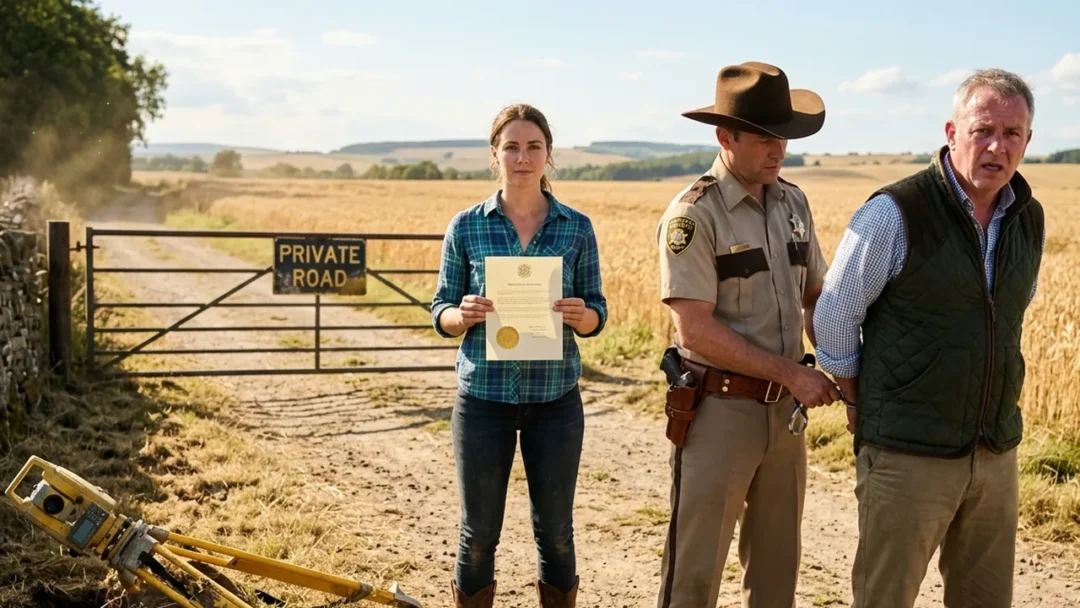
The sheriff’s Tahoe pulled onto the gravel shoulder, its diesel engine idling with a heavy, steady thrum. Deputy Cooper, a tall, broad-shouldered man in his fifties with a sun-cured jaw and a silver Whitman County badge pinned to his tan uniform, stepped out into the dust, pushing back the brim of his felt cowboy hat.
“Afternoon, Gregory,” Cooper said slowly, his eyes sweeping across the tire marks, the shattered yellow tripod lying upside down in the muddy ditch, and Sarah standing motionless beside her pickup truck. “Looked like there was quite a commotion from half a mile back.”
“Deputy! I’m glad you’re here,” Thorne said, puffing out his chest and pointing an accusing finger directly at Sarah’s nose. “This trespasser set up surveying gear right in the center of my private access lane. When I instructed her to move, she grew belligerent. She knocked her own equipment into the ditch trying to threaten me. I want her arrested for agricultural trespass, and I want that rusty pickup impounded immediately.”
Deputy Cooper looked at Sarah Vance. He did not ask for her identification. Instead, he touched the brim of his cowboy hat with two fingers. “Afternoon, Miss Vance. How’s the leveling coming along?”
Thorne’s jaw went slack. His arm dropped an inch. “Wait. You know this girl?”
Sarah reached into the open canvas desk on her truck bed, picked up a heavy, stiff portfolio bound in dark green morocco leather, and handed it to the deputy. “The leveling was complete twenty minutes ago, Hank. Until Mr. Thorne kicked my Nikon transit into the rock ditch.”
Cooper unzipped the portfolio. Inside was a freshly stamped, gold-embossed Certificate of Title from the Whitman County Auditor’s Office, dated eight o’clock yesterday morning. Beneath it was a high-resolution, satellite-calibrated cadastral plat map displaying the three hundred continuous acres of High Ridge Farm outlined in bold green ink.
“Mr. Thorne,” Deputy Cooper said, his voice dropping into a deep, gravelly register that held no warmth whatsoever. “Miss Sarah Vance didn’t trespass on your lane. Yesterday morning, she closed on the purchase of the entire three-hundred-acre estate from her grandfather’s bankruptcy trust—including the exclusive fee-simple ownership of this entire roadbed.”
Cooper looked up from the document, his eyes locking onto Thorne like twin rifle sights. “Furthermore, the private easement your architect claimed you had was a temporary, revocable agricultural license granted to the previous owner that expired thirty days ago. You don’t own this road, Gregory. You don’t even have legal permission to drive on it. And you just destroyed a four-thousand-dollar piece of certified state surveying equipment right in front of a sworn peace officer.”