The Golden Wheat Ridge Deed And The Locked Easement Gate
CHAPTER 2: THE TABLET AND THE BRASS PIN
The silence that fell over Ridge Road was so profound that the dry rustle of wheat chaff blowing across the asphalt sounded like scraping sandpaper.
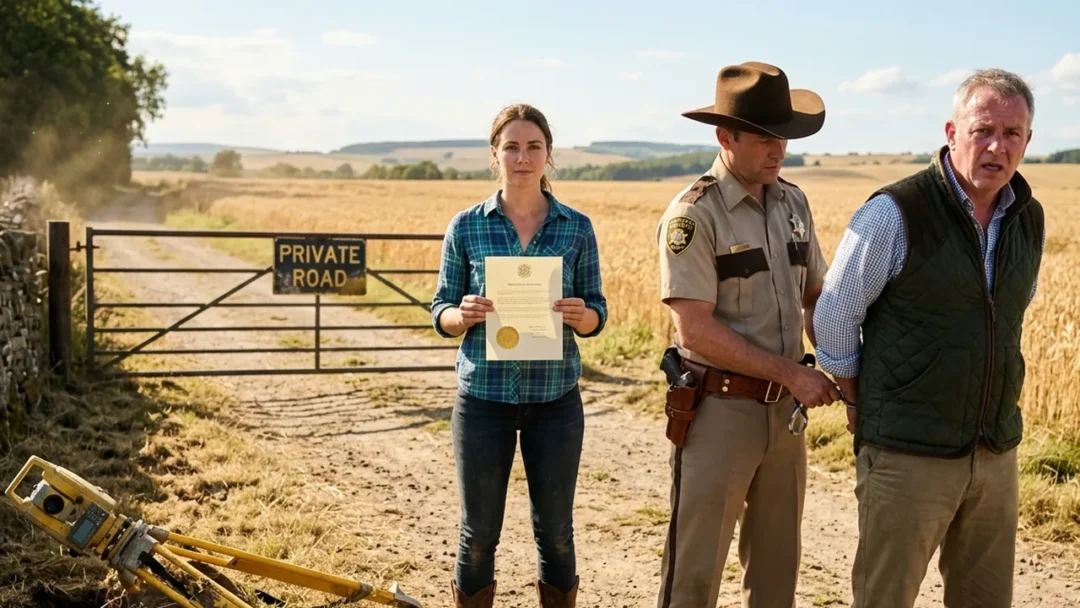
Gregory Thorne stared at the leather portfolio in Deputy Cooper’s hands, then at the young woman in the dusty flannel shirt. A bead of sweat broke through his hairline, carving a pale path through the road dust on his cheek. “That’s… that’s legally impossible. Meridian Capital held the junior mortgage lien on this entire valley. The Spokane National Bank assured my partners that the property was entering foreclosure auction next Tuesday!”
“Spokane National sold the note three weeks ago, Gregory,” Sarah said quietly. Her voice was flat, carrying the calm, crushing weight of someone who understood financial balance sheets far better than the man wearing the Barbour vest. “They sold it to the Columbia Basin Agricultural Land Trust, funded by a private equity grant from the Northwest Conservation Endowment. I am the managing director. We paid off the underlying debt in full, cash, at par value. The deed was registered at the courthouse in Colfax at eight-fifteen yesterday morning.”
Deputy Cooper reached into the driver’s compartment of his patrol Tahoe, retrieving a ruggedized Panasonic Toughbook tablet encased in a black rubber shock-frame. He tapped the touch screen with a stylus, pulling up the Whitman County GIS real-time property mapping interface.
“Parcel Forty-Four,” Cooper read aloud, tilting the screen so Thorne could see the digital grid. A bright magenta line outlined the entire three-hundred-acre bowl of the valley, including the narrow strip of Ridge Road, colored solid blue. “Owner of record: Sarah Vance, Trustee. Status: Unencumbered Private Agricultural Reserve. Easements: None.”
Cooper looked at Thorne. “When you built that glass palace up on the ridge, Gregory, your title insurance company issued a standard Schedule-B exception regarding ingress and egress. They told you that you didn’t have a deeded easement, didn’t they?”
Thorne’s face shifted through three shades of red. “My legal team was negotiating an easement grant with the previous owner! He was an eighty-year-old man who didn’t care about a private road! We had a verbal agreement!”
“My grandfather had Alzheimer’s disease, Mr. Thorne,” Sarah said, her voice dropping into a cold, lethal whisper that made Thorne take an involuntary step backward. “You brought two lawyers and a bottle of scotch to his nursing home in Pullman to try to get him to sign an irrevocable fifty-year right-of-way for five hundred dollars while I was working on an irrigation project in Idaho. My grandfather didn’t sign your paper because he didn’t even remember who you were. But I remembered.”
Sarah pointed down into the drainage ditch, where the shattered yellow transit lay half-submerged in the mud beside the crushed basalt rock. “That instrument was calibrated to certified state standards. It contains a high-speed digital sensor that logs every optical frame in five-millisecond bursts to record atmospheric distortion. And when you walked up and kicked that tripod, it recorded your face, your license plate, and your exact words.”
Deputy Cooper reached to his duty belt, unclipping a pair of heavy, hinged stainless-steel handcuffs. “Gregory Thorne, turn around and put your hands behind your back.”
Thorne backed away toward his Land Rover, his eyes bulging in sheer panic. “Are you insane, Cooper? Do you know who I am? I sit on the board of the State Arts Commission! I personally funded the governor’s rural broadband initiative! You can’t arrest me on a country lane over an agricultural boundary squabble!”
“I’m not arresting you over a boundary squabble, Gregory,” Cooper said, closing the distance in two swift, unstoppable strides. He grabbed Thorne’s left wrist with an iron grip, twisting the man’s arm smoothly behind his quilted vest and ratcheting the first steel cuff around his wrist with a sharp clack-clack. “I’m arresting you under Section Nine-A point forty-eight of the Revised Code of Washington: Malicious Mischief in the First Degree, an intentional act causing damage to professional property in excess of seven hundred and fifty dollars. That’s a Class B felony in this state.”
“Wait! Cooper, stop! Call Marcus Cole in Spokane!” Thorne shouted, his voice cracking into a high-pitched shriek as the second cuff clicked onto his right wrist. “Marcus is on retainer! He’ll have your badge by sundown!”
Deputy Cooper ignored him, leading the stumbling hedge fund manager toward the rear passenger door of the Tahoe. He opened the door, pushed Thorne firmly down onto the molded plastic transport seat, and clicked the seatbelt into place.
Before Cooper shut the door, Thorne leaned forward through the open window, his face contorted in desperate fury. “You can’t lock that road, Cooper! My water filtration trucks are due up from Lewiston at five o’clock! If they don’t deliver my water, my cooling systems will shut down and my art collection will be ruined!”
Sarah walked to the side of the police cruiser, looking down through the window at Thorne with absolute stillness. “The water filtration trucks won’t be coming up this road, Mr. Thorne. Because this road is officially closed.”
Sarah turned to Deputy Cooper. “Hank, would you mind helping me swing the pasture gate shut?”
Cooper smiled for the first time, a dry, wolfish grin. “It would be an honor, Miss Vance.”
Together, Sarah and the deputy walked to the edge of the stone wall, unhooked the heavy iron farm gate—welded from three-inch structural drill pipe—and swung it across the width of Ridge Road until its heavy latch dropped into the steel receiver with a hollow, booming thud. Sarah pulled a heavy brass Abloy industrial padlock from her pocket, clicked it through the chain, and snapped it shut.
Inside the police car, Thorne’s cell phone began to ring loudly against the plastic seat. On the digital screen, the caller ID flashed: Spokane Commercial Bank – URGENT DEFAULT NOTICE.