The Dead Wife’s Shadow: The Little Girl Who Broke Boston’s Darkest Conspiracy
CHAPTER 1: THE PHOTOGRAPH ON WET STONE
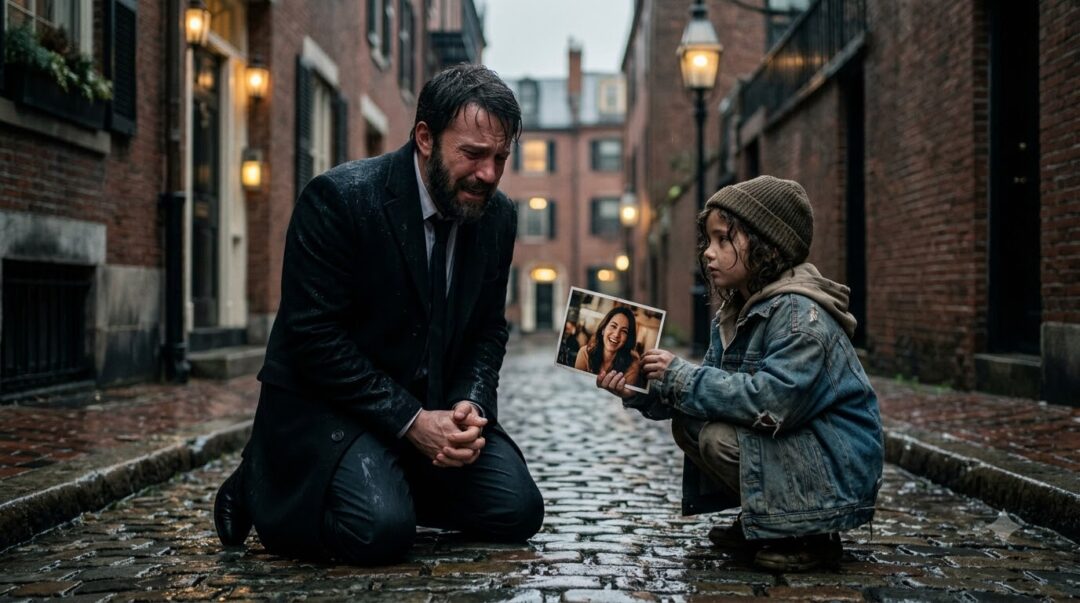
The October rain fell in a steady, freezing drizzle over the narrow cobblestones of Acorn Street, slicking the historic gaslit alleyway into a ribbon of dark slate. Christopher Reed pulled the collar of his tailored black cashmere overcoat tight against the biting New England wind, his leather brogues splashing through shallow gutters choked with dead elm leaves. At thirty-eight, with a neatly trimmed dark beard and hollowed, insomnia-haunted grey eyes, Christopher moved through Boston like a ghost haunting the corridors of his own former life. Inside his breast pocket, pressed against his ribs like a jagged piece of shrapnel, was a printed four-by-six glossy photograph of his wife, Evelyn.
Today marked the exact four-year anniversary of the icy bridge collapse over the Charles River—the night Massachusetts State Police divers dragged Evelyn’s crushed sedan from the freezing depths, but never found her body.
As Christopher reached into his pocket to retrieve his gloves, his thumb caught the corner of the photograph. The glossy paper slipped from his numb fingers, fluttering in slow motion through the cold mist before landing face-up in a shallow puddle on the cobblestones. The printed image showed Evelyn at twenty-nine, her chestnut-brown hair catching summer sunlight on the cliffs of Cape Elizabeth, her warm hazel eyes smiling directly into the lens.
Christopher cursed softly under his breath and reached down to recover it.
Before his fingers could touch the wet paper, a small, dirt-streaked hand darted out from the shadowed alcove of an antique carriage house. A little girl, no older than six or seven, crouched onto the wet stones and scooped up the photograph with astonishing speed. She was trembling, dressed in a worn, oversized denim jacket with torn cuffs and frayed jeans that were two sizes too large for her slight frame. Her matted brown curls were plastered to her forehead by the drizzle, and her cheeks were flushed with the raw chill of the autumn afternoon.
She wiped the dirty rainwater from the glossy portrait with the hem of her sleeve, staring at the woman’s face with wide, solemn eyes.
“Hey, sweetheart,” Christopher said gently, keeping his voice low and non-threatening as he reached out his palm. “That’s mine. Thank you for catching it.”
The little girl didn’t hand it over. Instead, she held the photograph firmly at chest height with both small hands, tilted her chin upward, and fixed Christopher with an unblinking, profoundly serious gaze that made the hair on his arms stand up.
“Mister…” the child’s voice was high, clear, and cut through the sound of the rain like a silver bell. “Why do you have a picture of my mommy?”
Christopher froze. The air vanished from his lungs as if he had been struck in the chest with a sledgehammer. The ambient murmur of distant traffic on Charles Street and the steady hiss of rain on brick melted into a deafening, low-frequency roar in his ears. He stared at the child, his brain refusing to process the words.
“What did you say?” Christopher whispered, taking an involuntary step forward.
The girl didn’t flinch. She tapped the smiling face on the glossy paper with a small, chapped fingernail. “My mommy. She has the same little brown freckle right next to her left eye, and she wears that same silver turtle necklace when she puts me to bed.”
A violent jolt of adrenaline tore through Christopher’s veins. Evelyn had owned an antique silver sea turtle pendant—a piece passed down from her grandmother in Bar Harbor, an intimate detail that had never appeared in any newspaper report, police bulletin, or missing-person broadcast.
Christopher dropped abruptly to his knees on the freezing, wet cobblestones, oblivious to the dirty puddle soaking through the fabric of his black designer trousers. He brought himself directly down to the child’s eye level, his hands trembling so violently he had to clamp them against his knees.
“Listen to me, sweetheart,” Christopher said, his voice cracking, thick with an overwhelming surge of grief and terror. “Look at me. That woman in the photo… that’s Evelyn. She’s my wife. She died four years ago. Her car went through the guardrail into the river. She’s gone.”
The little girl shook her head vigorously, her messy brown curls whipping across her face. Her warm hazel eyes—eyes that possessed the exact, terrifying almond contour of Evelyn’s gaze—hardened with fierce, absolute conviction.
“No,” the girl contested firmly, her small chin trembling with defiance. “My mom is alive. She’s sleeping in the room with the yellow curtains on Beacon Street right now. She sent me out to get her medicine from the corner pharmacy, but I dropped the paper.”
Christopher inhaled sharply, a gasp that burned his throat like liquid nitrogen. The world seemed to tilt on its axis. He reached his trembling hand out toward the child’s face, his fingers hovering millimeters from her wet cheek, his mind caught between the madness of impossible hope and the suffocating dread of an unimaginable lie.
Before his fingers could touch her skin, a heavy black hand clamped onto Christopher’s shoulder from behind, wrenching him backward onto the stone.
CHAPTER 2: THE YELLOW CURTAINS OF BEACON STREET
“Back away from the child, Mr. Reed,” a deep, gravelly voice commanded through the rain.
Christopher scrambled to his feet on the slick cobblestones, his fists balling instinctively. Standing between him and the little girl was a broad-shouldered man in a navy trench coat, holding a heavy black umbrella over the child. Beneath the brim of his dripping fedora, Detective Marcus Vance of the Boston Police Department’s Special Investigations Division stared at Christopher with cold, calculating intensity.
“Marcus?” Christopher’s voice was raw, his eyes darting frantically between the detective and the little girl, who was now clutching Marcus’s coat pocket. “What the hell is going on? Who is this girl? Why does she have Evelyn’s picture?!”
“Her name is Lily,” Marcus said, his tone clipped, keeping his voice pitched low so passing pedestrians on Charles Street wouldn’t overhear. “And you weren’t supposed to cross paths with her for another forty-eight hours.”
“What are you talking about?!” Christopher shouted, surging forward. “She said Evelyn is alive! She said she’s living on Beacon Street!”
Marcus caught Christopher by the lapels of his coat, shoving him back into the dry alcove of the carriage house with formidable strength. “Keep your voice down, Chris! Do you have any idea whose private security patrols this neighborhood? If your father’s men see you talking to this child, she won’t live to see sunrise, and neither will Evelyn.”
The name hit Christopher like physical voltage. “My father? What does my father have to do with Evelyn?!”
Marcus looked down at Lily, kneeling briefly to whisper in her ear. “Lily, sweetheart, go inside Mrs. Higgins’ bakery through the kitchen door. Tell her Marcus sent you for a hot cocoa. Don’t look out the front window.”
The girl nodded obediently, clutched the photograph tightly against her chest, and slipped through a blue wooden side door into the warmth of the bakery.
Marcus waited until the latch clicked before turning back to Christopher, pulling a silver flask from his coat and taking a long swallow. His face was lined with exhaustion, the skin around his dark eyes bruised with sleeplessness.
“Four years ago, Evelyn didn’t lose control on that bridge, Chris,” Marcus said, leaning in until his breath steamed against Christopher’s cheek. “She was run off the road by a black commercial truck registered to a dummy holding company in Delaware. But Evelyn didn’t drown. She kicked out the rear quarter-glass, crawled up the muddy riverbank under the Longfellow Bridge, and collapsed on the doorstep of my precinct in Roxbury.”
Christopher pressed both hands against his temples, his knees shaking so violently he had to lean against the brick wall for support. “Why didn’t she come home to me? I spent six months in a psychiatric ward, Marcus! I wanted to die!”
“Because she couldn’t trust you, Chris,” Marcus said with brutal honesty. “She didn’t know if you were loyal to her, or loyal to the sixty-million-dollar inheritance your father controlled. Three weeks before the crash, Evelyn discovered that Reed Petrochemical was falsifying soil toxicity reports for a four-hundred-acre residential development in Plymouth. The runoff had contaminated the municipal aquifer with carcinogenic benzene. Evelyn had compiled the complete laboratory backups on an encrypted hard drive. She was forty-eight hours away from filing a federal whistleblower complaint with the Department of Justice.”
“My father killed three hundred people in Plymouth?” Christopher whispered in horror.
“He tried to kill his own daughter-in-law to keep the stock price from cratering,” Marcus corrected coldly. “When Evelyn showed up at my station bleeding and hypothermic, I knew the state police were compromised. Two senior troopers on the scene were on your father’s payroll. So I made a call. I filed an official report confirming the recovery of personal effects from the submerged vehicle, classified her as presumed dead, and moved Evelyn into an off-the-books safehouse.”
“And the little girl?” Christopher’s heart hammered against his ribs like a trapped beast. “Whose child is Lily?”
Marcus met Christopher’s gaze with unflinching, merciless gravity. “Do the math, Chris. Evelyn was six weeks pregnant the night her car went into the river. She carried your daughter to term in an attic apartment in Maine, living on cash stipends and generic groceries while you sat at boardroom luncheons in the Financial District.”
A choked, ragged sob tore from Christopher’s throat. He buried his face in his hands, twenty years of aristocratic conditioning dissolving into pure, unadulterated agony. “Where is she, Marcus? Take me to her. Right now.”
Marcus checked his gold wristwatch, his jaw clenching tight. “The safehouse is at 214 Beacon Street. Third floor, behind the yellow curtains. But we have a catastrophic problem. Two hours ago, your father’s chief of corporate security, Frank Vance, flagged an unauthorized pharmacy prescription filled under Evelyn’s maternal maiden name. Frank’s sweep team is en route right now.”
CHAPTER 3: THE THIRD FLOOR OF 214 BEACON
The Victorian brownstone at 214 Beacon Street stood cloaked in rain-soaked ivy and the dignified silence of Boston’s Back Bay, its grand limestone stoop flanked by black wrought-iron gas lamps flickering against the grey gloom. Christopher took the exterior stone steps three at a time, his heart hammering against his ribs like a trapped bird, with Marcus hot on his heels, his service Glock unholstered and resting low against the fabric of his dark navy coat. The heavy front foyer door swung shut behind them, sealing out the damp street noise and immersing them in an atmosphere that smelled of ancient cedar wainscoting, beeswax polish, wet wool, and the subtle, comforting aroma of lavender cleaning soap.
They sprinted up the spiraling oak staircase, bypassing the quiet second-floor residences where the muffled sounds of classical radio played, until they reached the heavy mahogany door of apartment 3B at the end of the third-floor corridor.
Marcus didn’t knock. He punched a six-digit code into the digital deadbolt, grabbed the brass handle, and shoved the heavy panel open with practiced, silent efficiency.
“Evelyn!” Marcus called out in an urgent, low whisper that carried through the dim interior. “It’s Marcus! I have Christopher with me! Clear the room!”
The apartment was spartan and meticulously orderly: a worn camel-colored sofa covered in a hand-stitched plaid wool quilt, tall oak bookshelves packed with botanical field guides and organic environmental chemistry textbooks, and a small pine dining table where a child’s crayon drawing lay—a bright blue house surrounded by green grass and three smiling stick figures labeled Mommy, Lily, and Daddy. Yellow linen curtains hung across the grand bay windows overlooking the wet alleyway, filtering the bleak afternoon rain into a soft, warm amber glow that made the small living room feel like a sacred, hidden sanctuary.
From the narrow hallway leading to the rear bedroom, a floorboard creaked softly.
A woman stepped out into the living room, pausing just beyond the threshold of the kitchen.
Christopher’s breath locked in his throat so violently it felt as though the air had been torn from his lungs. The entire universe, with all its chaotic grief and years of hollow mourning, narrowed down to a single, breathtaking point.
She wore an oversized charcoal wool cardigan over a faded denim work shirt and dark corduroy trousers. Her rich chestnut hair was longer than he remembered, woven into a thick, loose braid that rested over her left shoulder. She was thinner than she had been four years ago, the elegant line of her jawline and high cheekbones sharper, carved by four years of solitary fear and hiding, but the warm hazel eyes and the delicate constellation of pale freckles beside her left eyelid were unmistakable. Resting against her throat, catching the amber light of the yellow curtains, was the antique silver sea turtle pendant—its polished shell gleaming with pristine, untouched familiarity.
Evelyn stopped dead in her tracks. The glass of water she held in her hand wobbled, water splashing over her knuckles before she managed to set it onto the side table. Her lips parted, her chest rising and falling in rapid, shallow gasps as her hand flew to her collarbone.
“Christopher…” she whispered, her voice trembling with an emotion so raw, so terrifyingly pure that it shattered four years of silence like brittle crystal.
“Evie,” Christopher choked out.
He crossed the room in two strides, his overcoat falling open as he swept her into his arms. Evelyn buried her face into the wet wool of his shoulder with a broken, shuddering sob that seemed to tear through her very soul. Christopher held her with fierce, desperate tenderness, pressing his face into the hollow of her neck, breathing in the scent of sea salt, clean soap, and fresh rain that had haunted his dreams every night he had spent in an empty bed.
“I thought you were in the river,” Christopher wept openly, tears soaking into her braid, his hands trembling as they mapped the curve of her spine to convince himself she was made of flesh and bone. “I sat on the Longfellow Bridge every Sunday, Evie. I threw white roses into the current for four years. I thought I lost you forever.”
“I wanted to call you,” Evelyn sobbed, her fingers digging through his coat, gripping his shoulders with white-knuckled desperation. “Every single day, Chris. Every time Lily cried for her daddy, every time she took her first steps in that freezing cabin in Maine, I picked up the payphone. But Marcus warned me… your father had private detectives monitoring your phone lines, your firm’s emails, even the flowers you sent to my empty grave. If Thomas knew I had survived, if he knew I was carrying your child, he would have sent his men to finish the job before Lily drew her first breath.”
Christopher pulled back slightly, cupping her pale face in his palms, his thumbs brushing away the hot tears that streamed down her cheeks. “I saw her, Evie. I saw our daughter on Acorn Street. She picked up your photograph in the rain. She looked up at me with your eyes and told me her mother was alive.”
Evelyn’s eyes widened with sudden, electrifying terror. “Lily? Where is Lily?! Marcus, why isn’t she with you?!”
“She’s completely safe, Evelyn,” Marcus interjected, standing by the bay window with his eyes scanning the wet alley below through the yellow curtains. “I put her in Mrs. Higgins’ bakery on the corner. Mrs. Higgins locked the back door and gave her cocoa. We had to make sure the street was clear before we moved her up.”
Suddenly, the harsh screech of wet tires biting into slick asphalt echoed from the narrow alleyway directly beneath the windows.
Marcus parted the yellow linen curtain by a single inch, his posture instantly stiffening like iron.
Idling beside the carriage house across the alley was a black Cadillac Escalade with commercial plates and heavily tinted glass. Three men dressed in dark water-resistant tactical windbreakers had stepped out into the drizzle, their hands buried inside their jacket pockets, moving with disciplined, synchronized speed toward the brownstone’s service entrance.
“Frank Vance,” Marcus hissed, his voice dropping into a deadly, focused rasp as he racked the slide of his Glock with a sharp metallic clack. “They tracked the pharmacy delivery order. They’re breaching the ground floor.”
“The kitchen fire escape,” Evelyn said without a second’s hesitation, the protective instinct of a mother overriding her shock. “It connects to the carriage house roof. Marcus, we have to get to Lily before they sweep the corner!”
“Take Chris and get down the fire escape now,” Marcus ordered, reaching into his ankle holster, pulling out a compact snub-nosed .38 revolver, and slapping it into Christopher’s hand. “I’ll hold the third-floor landing and draw them up toward the attic. Do not look back. Run straight through the bakery and take the alley to Tremont!”
Before Christopher could protest, the heavy oak entrance on the ground floor splintered beneath the thunderous impact of a tactical hydraulic ram.
CHAPTER 4: THE ASHES OF PLYMOUTH
The descent down the wet iron fire escape was a blur of freezing rain, stinging wind, and the deafening concussive roar of gunfire erupting within the brownstone’s stairwell. Two sharp, muffled cracks from Marcus’s silenced service pistol were instantly answered by the stuttering roar of semi-automatic return fire, blowing out the frosted glass transoms on the fourth-floor landing above them. Shards of glass rained down like jagged hail, bouncing off the rusty metal rungs.
Christopher dropped onto the tarred gravel surface of the carriage house roof, turning immediately to catch Evelyn as she swung down from the iron ladder. Her boots slipped on the wet moss, but Christopher locked his arms around her waist, pulling her flush against his chest before lowering her to the parapet. They vaulted over the brick ledge, dropped six feet into the damp cobblestone alley of Mount Vernon Street, and sprinted through the rain toward the rear service door of Mrs. Higgins’ bakery.
Christopher threw his shoulder against the blue wooden door, stumbling into the kitchen.
The bakery was warm, suffused with the sweet, comforting scent of roasted cinnamon, rising yeast, and strong French roast coffee. Sitting on an overturned flour barrel beside the massive stainless-steel rotary ovens was Lily, her small boots swinging in the air, happily nibbling on a star-shaped gingerbread cookie. Standing guard beside her was Mrs. Higgins, an iron-willed Scottish woman in her seventies, brandishing a two-foot wooden French rolling pin with the grim resolve of an ancient Highlander.
“Mommy!” Lily shrieked, dropping the gingerbread cookie into the flour dust and leaping from the barrel.
Evelyn dropped to her knees on the flour-streaked linoleum, catching her daughter in a frantic, suffocating embrace, covering the little girl’s face, hair, and small cold hands with desperate, weeping kisses. “My baby… my sweet, brave baby girl…”
Lily pulled back, grinning proudly and pointing a flour-dusted finger directly toward Christopher. “See, Mommy? I told you I found the man from the picture! I told you he was looking for us in the rain!”
Christopher sank down onto his knees beside them, his arms wrapping around both Evelyn and Lily, his throat burning with an overwhelming swell of protective fury and profound love. He looked into his daughter’s hazel eyes, seeing his own mother’s stubborn warmth reflected in her smile. “You did, sweetheart. You brought your daddy home. And nobody is ever going to separate us again.”
The bakery’s brass front bell chimed violently, followed by the sound of heavy footsteps.
Christopher surged to his feet, shielding his wife and child behind his broad frame, raising Marcus’s .38 revolver with both hands, his thumb pulling back the hammer with a sharp, lethal click.
The kitchen swinging doors swung open. Stumbling into the room was Marcus, his left hand clamped tightly over his upper shoulder. Dark, arterial blood was seeping between his fingers, staining the dark wool of his trench coat and dripping steadily onto the clean floor tiles.
“Marcus!” Evelyn cried, leaping up to grab a stack of clean linen bar towels from the prep counter.
“Just a through-and-through flesh wound,” Marcus wheezed, groaning as Evelyn pressed the towel firmly against the entry hole. “Frank Vance took a round to the knee on the landing, but two of his shooters broke out through the front vestibule. They’re circling the block with handheld thermal imagers and digital plate scanners. If we step out onto Charles Street or Beacon, they’ll have crosshairs on us within thirty seconds.”
“Where can we go that they can’t track?” Christopher asked, his eyes scanning the alley door.
“The old sub-basement infrastructure beneath the Massachusetts Historical Society,” Evelyn answered, her mind shifting into the razor-sharp analytical mode that had made her the state’s top environmental toxicologist. “Four blocks east. When I was conducting the soil contamination survey for the state archives five years ago, I mapped the abandoned nineteenth-century coal transport tunnels connecting the historical society to the Federal Reserve bank vault. The tunnels run forty feet below street level, encased in two feet of reinforced granite. Their thermal cameras and drone sensors can’t penetrate forty feet of bedrock.”
Marcus grimaced, nodding through the pain as he adjusted his makeshift bandage. “And the evidence, Evie? Do you still have the Plymouth core files?”
Evelyn reached inside the collar of her denim shirt and unhooked a heavy, waterproof titanium thumb drive suspended from a braided steel cable around her neck. “Every single contaminated soil sample, every falsified chain-of-custody affidavit, and every wire transfer authorized from your father’s personal accounts at Reed International. It’s all here, encrypted in duplicate.”
Christopher looked at the small metal cylinder, the true enormity of his family’s darkness pressing down upon him like an anvil. “My father didn’t just dump industrial solvents, did he, Evelyn? He knew what was in the ground.”
“He knew everything, Chris,” Evelyn whispered, her voice shaking with ancient, unquenchable sorrow. “When the independent state inspectors notified your father that forty-eight children in the Plymouth school district had been diagnosed with rare pediatric sarcomas and acute leukemia, Thomas didn’t stop the pipeline. He paid off the regional EPA administrator, hired Frank Vance’s mercenaries to intimidate the pediatricians, and ordered his contractors to pave over the contaminated wetlands with five feet of topsoil. When I refused his million-dollar bribe to sign the environmental clearance, he sent that truck to run me off the bridge.”
Christopher looked down at Lily, who was holding her mother’s hand, watching them with innocent, quiet wonder. A cold, absolute resolve settled into his bones.
“Then we don’t run anymore,” Christopher said, his voice dropping into a register as hard and merciless as Boston granite. “We take the tunnels. We give the files to the Department of Justice. And we tear my father’s empire down to the roots.”
CHAPTER 5: THE SUBTERRANEAN LEDGER
The air within the abandoned nineteenth-century coal tunnels beneath downtown Boston was freezing, thick with the damp, mineral scent of sulfur, wet pulverized limestone, and decades of stagnant coal dust. Water trickled rhythmically from the vaulted brick ceiling, splashing into shallow drainage trenches between the rusting narrow-gauge railway tracks like a relentless metronome counting down the hours. Christopher led the way through the gloom, cutting a narrow beam of white light through the darkness with his tactical flashlight, while Evelyn walked closely behind, carrying Lily bundled inside Christopher’s heavy cashmere coat. Marcus brought up the rear, his right hand gripping his service weapon, his breathing ragged as he fought off the lightheadedness from his shoulder wound.
For twenty minutes, they navigated the pitch-black labyrinth of forgotten transport arteries, turning down forgotten spur lines that bypassed modern subway tunnels and commercial fiber-optic conduits.
Finally, the brick tunnel terminated at a massive, modern blast door forged from solid brushed steel, bearing the official gold seal of the United States District Court for the District of Massachusetts.
Evelyn stepped up to an industrial biometric scanner mounted into the granite bulkhead. She placed her right thumb onto the glass platen and swiped a specialized federal credential card that Marcus had procured for her years earlier. The scanner flashed a vibrant green, and the heavy pneumatic locking bolts disengaged with a deep, echoing hiss of compressed air.
The heavy steel door swung inward, admitting them into the climate-controlled subterranean archives of the federal courthouse on Fan Pier.
Waiting inside the brightly illuminated briefing room were three armed federal marshals in full tactical gear, their rifles lowered in disciplined standby, and two senior prosecutors from the United States Attorney’s Special Crimes Division. Standing at the head of the conference table was United States Attorney Sarah Vance—Marcus’s sister—an imposing, sharp-featured woman in a tailored charcoal suit whose reputation for prosecuting corporate titans was legendary throughout the First Circuit.
“Marcus!” Sarah gasped, rushing forward to support her wounded brother, signaling to two federal medical technicians standing by the side door. “Get him to the triage station immediately.”
“The triage can wait ten minutes, Sarah,” Marcus insisted, waving the medics back with an unyielding grimace. “We have the witness. We have the chain of custody. And we have the digital core.”
Evelyn walked up to the long stainless-steel conference table. With steady hands, she unhooked the titanium thumb drive from her necklace and placed it onto the center of an air-gapped forensic workstation. Beside it, Christopher laid Marcus’s snub-nosed revolver and his own smartphone, which was vibrating relentlessly against the metal surface with forty-seven unreturned calls from Thomas Reed’s executive assistant.
Sarah Vance signaled her lead digital forensic investigator, an expert with twenty years of cyber-forensics experience, who immediately inserted the titanium drive into the terminal with meticulous care.
Within seconds, the high-resolution monitors lining the archive wall illuminated with thousands of digitized documents: high-definition mass spectrometry soil charts, water table toxicity logs showing benzene concentrations four hundred times above lethal federal limits, and unredacted bank routing slips originating from Reed International’s offshore accounts in the Cayman Islands, detailing multi-million-dollar wire transfers to contract security firms and corrupt state laboratory supervisors.
“Merciful God,” Sarah Vance whispered, her eyes darting across the damning financial ledger. “This isn’t just regulatory negligence. This is systematic, premeditated corporate homicide. It links Thomas Reed directly to the illegal toxic dumping in Plymouth, the bribery of state officials, and the attempted assassination of Evelyn Reed on the Charles River Bridge.”
“Will it secure an emergency federal indictment?” Christopher asked, stepping forward, his voice completely void of hesitation.
“It will secure a comprehensive RICO indictment with no possibility of bail,” Sarah replied, looking at Christopher with profound, solemn respect. “A grand jury will sign the arrest warrants within forty-five minutes. But we have a severe jurisdictional complication, Christopher. Your father is currently hosting the annual Reed Foundation Autumn Gala in the grand ballroom of the Boston Harbor Hotel at Rowes Wharf. The governor is there. Three state supreme court justices are in attendance. The entire Boston media establishment is broadcasting live from the red carpet.”
Christopher turned to look at Evelyn and Lily. His daughter was sitting on an archive sofa, eating an apple from the federal commissary, her small hand safely resting in her mother’s lap. He thought of the four years he had spent weeping over an empty grave, the four years Evelyn had spent hiding in freezing garrets, and the dozens of children in Plymouth whose lives had been extinguished for corporate dividends.
“Good,” Christopher said, his eyes burning with cold, absolute finality. “Let the cameras roll. My father has spent forty years hiding his butcher’s apron behind silk tuxedos. Let the world watch us put the cuffs on him in front of every judge in the Commonwealth.”
CHAPTER 6: THE RECKONING IN ROWES WHARF
The grand ballroom of the Boston Harbor Hotel at Rowes Wharf was a shimmering palace of old New England money and political grandeur. Towering crystal chandeliers cast an opulent golden glow across marble floors polished to a mirror finish, while forty-foot panoramic glass windows looked out over the dark waters of Boston Harbor where the city lights danced upon the calm waves. A forty-piece symphony orchestra played an elegant arrangement of Mozart from the balcony, while waiters in pristine white tuxedos circulated among three hundred guests, carrying silver trays laden with vintage champagne and beluga caviar.
Standing upon the raised mahogany dais at the front of the ballroom was Thomas Reed, seventy-two years old, radiating the unassailable, regal authority of an industrial monarch. Dressed in a bespoke midnight-blue tuxedo with diamond studs, his silver hair groomed with perfection, his gold signet ring catching the light, he held a crystal glass aloft as he delivered his keynote address into the gilded microphone.
“True leadership,” Thomas spoke, his rich, baritone voice echoing through the rapt hall, “is not measured by quarterly stock splits or corporate acquisitions. True leadership is defined by our moral responsibility to our heritage, to building pediatric wings for our hospitals, and to ensuring that the Reed name stands as an eternal beacon of philanthropic honor for generations to come.”
The ballroom erupted in polite, thunderous applause. Philanthropists, corporate directors, and high-court judges raised their glasses in synchronized deference.
Then, the heavy brass-trimmed double oak doors at the back of the ballroom were thrown open with a violent, reverberating crash that sounded like a thunderclap, instantly silencing the orchestra mid-crescendo.
Every conversation died. Three hundred guests spun around in bewildered shock.
Walking down the grand center aisle was Christopher Reed. He had discarded his wet overcoat, standing tall in his sharp black suit, his dark beard trimmed, his grey eyes blazing with the terrifying, righteous fury of an avenging angel. But it was not Christopher who froze the room in collective horror.
Walking beside him, her head held high with magnificent, regal pride, was Evelyn Reed. She wore an elegant dark-green velvet gown that accentuated her chestnut hair, her warm hazel eyes sweeping across the frozen crowd with unyielding dignity, the antique silver sea turtle pendant resting prominently against her collarbone, catching the chandelier glare like a blade.
And walking between them, holding both their hands, was seven-year-old Lily, her curly hair neatly brushed, her hazel eyes looking up at the glittering hall without an ounce of fear.
Flanking the family were eight armed United States Marshals in dark tactical raid jackets, led by United States Attorney Sarah Vance, who carried a red-ribboned warrant stamped with the Great Seal of the Federal District Court.
Thomas Reed’s polished smile didn’t merely fade; it disintegrated into an expression of unmitigated, cosmic horror. His crystal champagne flute slipped from his numb fingers, shattering violently against the mahogany stage, vintage champagne pooling around his polished patent leather shoes like spilled blood. His skin turned the color of damp parchment, his chest heaving as if the air had turned to poison.
“Evelyn…?” Thomas choked out, his voice cracking violently into the microphone, echoing through the cavernous ballroom like a dying man’s rattle. “No… this is impossible! Security! Security, remove these fraudulent impostors from this hall immediately!”
“Security has been disarmed and detained by federal agents, Mr. Reed,” Sarah Vance’s voice rang out, amplified by the hall’s sound system, cold and merciless as an executioner’s blade. “By order of the United States District Court for the District of Massachusetts, I hold in my hand an unsealed federal indictment charging Thomas Reed with first-degree murder, conspiracy to commit murder, racketeering, and thirty-four felony counts of toxic environmental poisoning under the Clean Water Act.”
Two marshals stepped onto the dais with practiced efficiency, twisting Thomas’s arms behind his back. The heavy stainless-steel handcuffs clicked shut with three sharp, echoing snaps that seemed to break the spine of the Reed dynasty forever.
Christopher stepped up onto the stage, stopping inches from his father’s trembling face.
“You took four years of my life, Father,” Christopher said, his voice dropping into a register as hard and cold as a tombstone. “You tried to drown the woman I loved in the Charles River, and you left your own flesh and blood to sleep on freezing floors in Maine while you toasted to your own righteousness. The Reed name isn’t a philanthropic beacon anymore. Tomorrow morning, it’s the title of the biggest federal prosecution in New England history.”
Thomas stared into his son’s eyes, his mouth working in silent, pathetic gasps, all arrogance stripped away as the marshals hauled him off the dais and marched him down the center aisle, directly past the flashing cameras of the assembled Boston press corps.
Thirty minutes later, the grand outdoor terrace of Rowes Wharf was silent.
The rain had entirely cleared, carried away by a fresh, clean autumn breeze sweeping off the Atlantic. The heavy clouds had dispersed, revealing a crystalline night sky glittering with cold, brilliant stars.
Christopher, Evelyn, and Lily stood together by the stone balustrade, looking out across the calm, dark waters of Boston Harbor toward the distant beam of the harbor light.
Christopher knelt down on the stone, sweeping Lily up into his arms and setting her gently upon his shoulders. The little girl laughed with pure, innocent joy, pointing out toward the passing ferry boats, her small hands resting in her father’s hair.
Evelyn leaned her head against Christopher’s shoulder, wrapping her arm around his waist. Christopher reached down and took her hand, feeling the warm, steady pulse of life in her fingers, the silver sea turtle pendant resting warm against her skin.
“It’s over, Chris,” Evelyn whispered, her voice filled with a peace that had been stolen for four long years. “We don’t have to look over our shoulders anymore.”
Christopher turned his head, kissing his wife’s temple with deep, reverent tenderness, and held his daughter tight against the crisp ocean breeze.
“We’re going home, Evie,” Christopher said softly, watching the moonlight dance upon the waves. “Our family is finally whole.”