When They Crushed Her Greenhouse, the County Plat Proved the Farm Boundary Was Never Theirs
Chapter 1: The Bucket Crossed the Line Before Anyone Checked
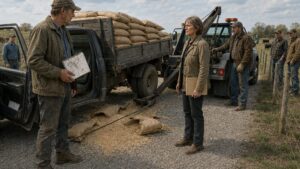
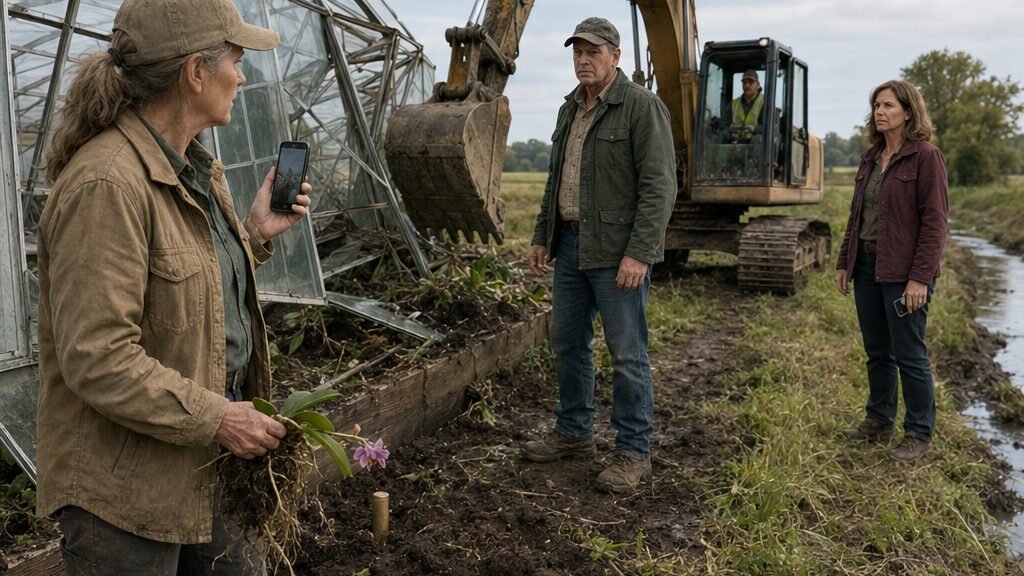
The excavator bucket came through the greenhouse wall before Catherine Harris could reach the door.
Glass burst inward in a hard glittering sheet. One cedar bench twisted sideways, pots hit the floor, and a spray of damp bark and orchid roots scattered across the concrete.
Catherine stopped three feet from the threshold.
For half a second, she heard nothing but the machine.
Then Scott Clark raised one gloved hand toward the operator.
“Keep it there.”
The bucket hung inside the greenhouse.
Catherine looked at the torn frame, then at Scott.
“I told you a surveyor is coming.”
Scott stood beside the ditch in work boots dark with mud. His pickup was parked on the lane behind him. Beyond it, Jennifer Clark held her phone upright.
Scott shook his head.
“You’ve had ten days.”
“I asked you to wait until the line was confirmed.”
“The line has been confirmed for years.”
“By what?”
“The cooperative map.”
Catherine bent and lifted an orchid that had been knocked from its pot. Most of the bark had fallen away. Pale roots hung over her fingers.
Scott glanced at it and then back at the operator.
“We need the maintenance corridor open. If you want to save the rest, start moving it.”
The words landed harder than the breaking glass.
Catherine straightened.
“You’re saying you’ll take the rest down?”
“If it’s still in the corridor.”
“The corridor you haven’t surveyed.”
Scott’s face tightened.
“We’ve maintained this ditch longer than you’ve been growing flowers here.”
Catherine nearly answered that she had kept books for farms longer than Scott had chaired anything.
Instead, she put the orchid down carefully on the grass.
Then she took out her phone.
Jennifer lowered hers just enough to notice.
Scott did too.
Catherine tapped record.
“Scott.”
He exhaled through his nose.
“What?”
“Who authorized you to demolish my greenhouse before the property line was surveyed?”
Jennifer made a small sound behind her phone. Not quite laughter. Close enough.
Scott looked toward the excavator operator as though Catherine had asked an irrelevant question.
“I’m chairman of the drainage cooperative.”
“That isn’t what I asked.”
“I’m acting for the cooperative.”
“Was there a vote?”
Scott stepped closer.
“You’ve been notified. Twice.”
“Was there a vote authorizing this?”
His jaw worked once.
“The board approved full access for maintenance.”
Catherine held the phone steady.
“Full access where?”
Scott pointed from the ditch toward the greenhouse.
“From the bank to that post line. Same as always.”
The operator shifted in his seat. The machine idled, rattling the remaining panes.
Catherine turned the phone slightly so it captured the bucket inside the broken wall.
“You’re ordering him to continue?”
Scott stared at her.
“You can make this harder than it needs to be, Catherine, but the ditch still has to be cleared.”
“That’s another yes-or-no question.”
Jennifer said, “She’s trying to make this into something it isn’t.”
Catherine looked toward her.
Jennifer’s phone was still recording.
For years they had waved to each other from trucks. They had exchanged tomatoes once after a storm flattened Jennifer’s garden. Now Jennifer stood thirty feet away documenting Catherine as if she were the obstruction.
Scott said, “We’ll give you until tomorrow morning to clear whatever you want saved.”
Catherine’s hand tightened around her phone.
“And if I don’t?”
“We finish.”
The excavator bucket backed slowly out of the greenhouse. Another loose pane dropped and shattered.
Catherine flinched.
Scott saw it.
So did Jennifer’s camera.
Catherine hated that more than she expected.
She walked past Scott without speaking and crouched beside the broken cedar bed.
The machine’s track had crushed one corner deep into the soil. Orchid bark, glass, and wet earth had been pressed together under the weight.
Scott called after her.
“You should stay clear of the equipment.”
Catherine brushed aside a snapped board.
Something dull yellow showed beneath the mud.
She stopped.
At first she thought it was part of an irrigation fitting. Then she scraped the soil with two fingers.
A round brass head emerged.
Small. Weathered. Driven nearly flush with the ground.
Catherine stared at it.
She knew that shape.
She had seen dozens of them in survey packets during her bookkeeping years, usually drawn as tiny circles beside coordinates nobody paid attention to until a fence, road, or drainage bill became somebody’s problem.
Behind her, Scott was telling the operator where to park.
Catherine wiped more mud away.
There was a stamped mark on the brass.
Not enough exposed to read.
But it was exactly where the cedar bed had stood.
Exactly where Scott had just said the cooperative’s ground began.
Catherine looked from the pin to the torn greenhouse wall.
Then toward the ditch.
Scott noticed her staring down.
“What is it?”
Catherine covered the brass head with her palm.
“Nothing I’m ready to discuss.”
His expression hardened.
“That right there is the problem. You keep acting like nobody else has a stake in this.”
Catherine rose slowly.
The orchid roots were still lying on the grass behind her. Her greenhouse wall was open to the humid August air. Jennifer was still filming.
Catherine slipped her phone into her pocket.
“You said tomorrow morning?”
Scott nodded.
“Eight.”
She looked once more at the patch of mud beneath her boot.
A brass survey pin sat inside the strip Scott had just claimed the cooperative had owned for years.
And Catherine had less than a day to find out why.
Chapter 2: The Map Scott Used Was Never a Deed
Ten days earlier, Catherine found the second notice clipped beneath the magnet on her mailbox.
The first had called the greenhouse a possible obstruction.
The second gave her a deadline.
She stood at the end of the lane reading it while the irrigation pump clicked on behind the barn.
Remove structures and plantings from cooperative maintenance corridor prior to scheduled ditch work.
The greenhouse was underlined in pen.
Below that was a date.
Monday.
Catherine carried the page into the farmhouse and laid it beside the first notice.
Then she opened her green ledger notebook.
Dates went on the left. Names on the right. Facts in the center.
She wrote:
Second notice received.
Demolition implied.
No survey attached.
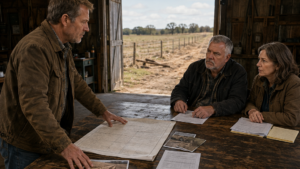
At the cooperative shed that afternoon, Scott spread a laminated map across a folding table.
“There,” he said.
A thick shaded band ran beside the ditch.
Catherine leaned over it.
“How wide is that?”
“Depends on the section.”
“That isn’t an answer.”
Scott put one finger on the greenhouse symbol.
“This section needs room for equipment.”
“Is this map recorded?”
“It’s the cooperative maintenance map.”
“I asked whether it’s recorded with the county.”
Scott looked toward Jason Roberts, who was sorting invoices at the other end of the table.
Jason glanced up, then down again.
Scott said, “It’s what we’ve used for years.”
Catherine folded the notice once.
“That still isn’t what I asked.”
Scott’s patience thinned.
“You know how that ditch works. Your place drains into it too.”
“Yes.”
“Then you know we can’t maintain it from four feet of grass between your greenhouse and the bank.”
“I know you don’t get ownership by drawing a wider stripe on a map.”
Jason stopped moving papers.
Scott gave Catherine a long look.
“Nobody said ownership.”
“The notice says I have to remove structures from your corridor.”
“Maintenance corridor.”
“Show me where my deed gives you that width.”
Scott tapped the map again.
“County’s got the same records we do.”
Catherine took him at his word.
The county recorder’s office smelled faintly of paper dust and floor cleaner. Catherine gave the clerk her parcel number and asked for the recorded plat, deed references, and any drainage easement affecting the western boundary.
The clerk pulled up the records.
Catherine laid Scott’s photocopied map beside the counter.
“Is this one of yours?”
The clerk adjusted her glasses.
“No.”
“Could it have been filed under the cooperative?”
“Maybe as an exhibit somewhere. But that’s not a recorded parcel plat.”
Catherine felt a small, sharp satisfaction.
“Then what is it?”
The clerk studied the heading.
“Looks like a maintenance sketch.”
“Legal boundary?”
“No.”
“Recorded easement?”
“Not by itself.”
The satisfaction lasted less than ten seconds.
The clerk printed the plat.
A narrow strip along the ditch was marked with an easement.
Catherine traced it with one finger.
“That’s real?”
“Yes.”
“How wide?”
The clerk gave her the recorded description.
Catherine read it twice.
The easement was narrower than Scott’s shaded corridor.
Much narrower.
But it existed.
She paid for the copies and carried them to a table beneath the window.
Her greenhouse appeared inside her parcel.
The western wall sat beyond the recorded easement line.
At least on paper.
One of the cedar beds came close enough that Catherine could not tell where its corner landed without measurements.
She opened her ledger.
Scott’s map not deed/plat.
Recorded drainage easement exists.
Width differs.
She stopped writing.
Being right had felt cleaner before the clerk handed her the second page.
Back home, Catherine spread both maps across the kitchen table.
Scott’s maintenance sketch showed a broad strip sweeping past the greenhouse.
The recorded plat showed a narrow easement following the ditch.
For years, tractors and small excavators had occasionally crossed the grass there. Catherine had never questioned it. Neither had her husband.
That thought made her sit back.
Her husband had handled the drainage people.
Catherine handled invoices, crop accounts, tax folders, seed orders, insurance, and payroll when they had seasonal help. He handled fences, culverts, and the kind of neighbor conversations that ended with two men nodding over a gate.
She had always considered that division efficient.
Now she wondered what had been agreed to while she was balancing books inside.
Catherine went to the file room.
Three metal cabinets stood against the wall, labels written in her own hand.
Taxes.
Equipment.
Land.
She opened the bottom drawer under Land.
Survey.
Deed.
Well.
Drainage.
Nothing unusual.
Then she saw a thin manila folder shoved behind an old insurance envelope.
The writing on the tab was not hers.
It was her husband’s.
DITCH ACCESS.
Catherine stood very still.
Outside, water from the irrigation line clicked against the greenhouse roof.
She pulled the folder free.
Inside were four pages, yellowed at the edges, and an envelope from fifteen years earlier.
On the first page, beneath a typed paragraph, was her husband’s signature.
Catherine did not read the rest immediately.
She only stared at the two words above it.
Temporary access.
Chapter 3: Her Husband Had Given Permission, Not the Ground
Catherine read her husband’s signature three times before she trusted herself to read the paragraph above it.
Temporary access for drainage maintenance equipment during the 2011 ditch improvement project.
She sat at the kitchen table.
The paper trembled slightly in her hand.
Not because the wording was unclear.
Because it wasn’t.
Her husband had allowed the cooperative to cross the strip beside the greenhouse.
Fifteen years earlier.
Catherine turned the page.
The permission described a route wide enough for excavation equipment to enter from the lane, work along the ditch, and leave through the lower field.
For a moment, Scott’s certainty made more sense.
Then Catherine reached the final paragraph.
Permission granted for the project described above does not convey, enlarge, or permanently alter any ownership interest or recorded easement.
She read that twice too.
Her shoulders loosened.
Then tightened again.
The letter proved Scott did not own the wider strip.
It also proved he had not invented the history of using it.
Catherine found a handwritten note clipped behind the agreement.
Brass corner marker west of greenhouse—do not disturb.
She looked toward the kitchen window.
The greenhouse roof gleamed through the trees.
She had no memory of the marker.
At the ditch bank that evening, Catherine paced the distance between the greenhouse and the water.
Grass had grown high along the edge. Tire tracks from years of occasional maintenance had flattened a broader path than the recorded easement.
Habit had done what paper had not.
It had drawn its own boundary.
Jason Roberts pulled up in his pickup before she finished measuring.
He climbed out and shut the door.
“Scott said you went to the recorder.”
Catherine kept the tape measure stretched between two stakes.
“Scott reports my errands now?”
Jason ignored that.
“He says you’re contesting access.”
“I’m contesting the width.”
Jason looked toward the ditch.
“We’ve always come through here.”
“That doesn’t make all of it yours.”
“Nobody’s saying it’s ours.”
“The notice orders me to remove my greenhouse from it.”
Jason scratched at the side of his jaw.
“The ditch has to be maintained.”
“I haven’t argued otherwise.”
“You know what happened three years ago when the lower section backed up.”
“Yes.”
“Two fields sat under water for four days.”
Catherine reeled in the tape.
“Then you’d think the cooperative would want the right map.”
Jason’s mouth tightened.
“That map has been used longer than Scott’s been chairman.”
“That doesn’t turn it into a deed.”
He looked past her toward the greenhouse.
“Your husband never fought us on access.”
The sentence hit exactly where Catherine had feared it would.
She kept her face still.
“No.”
“He understood why we needed room.”
“He also understood the difference between permission and ownership.”
Jason looked at her then.
Catherine almost told him about the letter.
She could have taken it from her pocket. She had folded a copy there before coming outside.
Instead she said, “A surveyor needs to mark the easement before anybody moves equipment.”
Jason sighed.
“You wait for every piece of paper, we lose another week.”
“Then Scott should’ve ordered the survey when he ordered the work.”
Jason had no answer to that.
At the cooperative meeting two nights later, the folding chairs were nearly full.
Catherine sat near the end of the table with her green ledger closed in front of her.
Scott stood beside the maintenance sketch pinned to the wall.
“We have a narrow window,” he said. “The ditch has silt buildup, and the forecast is turning wetter. Equipment is available Monday.”
Catherine raised one hand.
Scott stopped.
“Has a licensed surveyor marked the recorded easement?”
“No.”
“Has one been scheduled?”
“We have historic access.”
“That wasn’t my question.”
A few people shifted in their chairs.
Scott pointed toward the map.
“We’ve maintained that corridor for decades.”
Jason spoke from two seats away.
“That part’s true.”
Catherine turned toward him.
Jason continued, “Equipment has used that strip as long as I can remember. Catherine’s husband never objected.”
The room grew quieter.
There it was.
The history Catherine had chosen not to explain.
Scott folded his arms.
“You want to tell them something, Catherine?”
Her copy of the temporary-access letter was inside the ledger.
She could feel its thickness under the cover.
She imagined pulling it out.
She also imagined Scott seizing on the first paragraph and ignoring the last.
Temporary access.
Equipment route.
Her husband’s signature.
Catherine had spent forty years watching people read the number they wanted and skip the footnote beneath it.
“I’m saying the county record shows a narrower easement than your maintenance sketch.”
Scott shook his head.
“And I’m saying actual use matters.”
“Not enough to erase a deed.”
“No one is erasing anything.”
“You’re ordering me to tear down a greenhouse.”
“I’m ordering the corridor cleared.”
“Before the corridor is surveyed.”
Scott looked around the room, then back at her.
“Monday stays.”
Catherine’s stomach dropped.
“What time?”
“Eight.”
“You don’t even have a survey appointment.”
“We don’t need one to perform maintenance we’ve performed for years.”
Catherine opened the ledger.
For one second, her fingers touched the folded letter.
Then she closed the cover again.
That was her mistake.
She knew it even as she made it.
But uncertainty had always felt safer to Catherine when kept private until every edge was squared.
She told herself she needed one more day.
One more call.
One more confirmation.
She would show the letter when nobody could twist it.
After the meeting, she stood alone in the parking area while trucks pulled away.
Scott came out carrying the rolled maintenance map.
“You could save yourself some trouble,” he said.
“How?”
“Move the plants this weekend. We can work around the frame if you start taking it down.”
Catherine stared at him.
“You’ve already scheduled the machine.”
“Monday morning.”
“Before a survey.”
Scott opened his truck door.
“We’re out of time.”
He got in and drove away.
Catherine remained beside her car with the green ledger pressed against her ribs.
Inside it was a letter proving Scott’s corridor was not permanent.
Inside that same letter was the reason he believed he had the right to use it.
And by keeping both facts to herself, Catherine had left him free to tell everyone only the half he already believed.
Monday morning, the excavator was coming at eight.
Chapter 4: The Camera Caught More Than the Greenhouse Falling
Catherine found the second camera angle at 9:17 that morning.
She was still wearing the same mud-streaked boots she had worn beside the excavator. Broken glass glittered in the cuffs of her jeans. Her hands smelled of wet cedar and potting bark.
On the laptop, the first security camera showed mostly the lane.
The second showed Scott.
Catherine stopped the recording.
Rewound ten seconds.
Played it again.
Scott stood beside the excavator cab before the machine moved toward the greenhouse. The operator leaned out through the open side window.
The audio was faint beneath the diesel engine, but the words were there.
“You want me inside that frame?”
Scott pointed.
“Take that corner first. We need the corridor.”
Catherine froze the image.
Behind Scott, not five feet from his boot, the cedar bed was still intact. Beyond it, a small round spot showed through the grass.
The brass pin.
Before the machine.
Before the broken glass.
Before debris covered almost everything.
Catherine opened her green ledger.
Camera two—Scott directs first cut.
Pin visible before demolition.
She had barely finished writing when a truck door slammed outside.
Scott did not knock.
He stopped on the porch instead.
“Catherine.”
She closed the laptop halfway and stepped outside.
He looked more tired than he had beside the excavator. Dust had settled into the creases of his work shirt.
“The operator’s parked,” he said. “We’ll finish tomorrow.”
“No.”
Scott stared at her.
“You heard me yesterday.”
“And you heard me ask for a survey.”
“The board approved access.”
“Show me.”
His shoulders rose slightly.
“You were at the meeting.”
“I heard you say the board supported the ditch work. I didn’t hear anybody vote to demolish my greenhouse.”
Scott glanced toward the damaged structure.
“That greenhouse is in the corridor.”
“Then you should have no trouble showing me the recorded corridor.”
“We’ve been over this.”
“Yes. That’s why I’m asking for the paperwork now.”
Scott looked through the screen door toward the laptop.
“You recording me again?”
Catherine did not answer.
His mouth tightened.
“This isn’t some accounting dispute where you can fix everything with folders.”
“No. Accounting disputes usually have better records.”
For a moment, neither spoke.
Then Scott said, “You think because you found something at the county, the ditch stops needing work?”
“I think because there’s a property dispute, you stop destroying property until somebody marks the line.”
His expression changed—not anger exactly.
Fear, perhaps, pushed immediately beneath irritation.
“We don’t have time.”
“You keep saying that.”
“Because it’s true.”
“Then tell me who authorized yesterday’s demolition.”
Scott took one step off the porch.
“The cooperative did.”
“Name the vote.”
He turned away.
Catherine watched him cross the yard.
“Scott.”
He stopped.
“I have footage from before the bucket moved.”
He looked back.
Catherine did not tell him how much.
That old instinct again.
Keep the useful fact private until she knew every edge of it.
Scott said, “Footage doesn’t change the easement.”
“No.”
“It doesn’t change thirty years of maintenance.”
“No.”
“It doesn’t change what has to happen.”
Catherine rested one hand against the porch post.
“But it may change who pays for what already happened.”
Scott left without another word.
By noon, Catherine had copied both camera files to two drives and uploaded another copy to secure storage. She photographed the greenhouse from every side, including the cedar bed where the brass pin had disappeared beneath debris.
Then she called the cooperative office.
The treasurer answered.
“I need the minutes from the meeting where demolition of my greenhouse was authorized.”
A pause.
“The board approved the ditch project.”
“That isn’t what I asked.”
“I’ll have to look.”
“Please do.”
Twenty minutes later, Catherine called Jason.
He answered from somewhere noisy.
“What’s going on?”
“Did you vote to authorize Scott to tear down my greenhouse?”
The noise behind him stopped when he moved somewhere quieter.
“We voted to proceed with maintenance.”
“Did that vote name my greenhouse?”
“No.”
“Did it authorize removing structures outside a surveyed easement?”
Jason was quiet.
“Catherine, you knew access was an issue.”
“I asked about the vote.”
“No. Not specifically.”
She wrote his answer down.
“Would you sign a statement saying the board ordered Scott to demolish it?”
“Hold on.”
“That’s not a complicated question.”
“It is when lawyers start getting involved.”
“I haven’t called one.”
“Scott has.”
That surprised her.
“Who?”
“The cooperative’s attorney. Paul Anderson.”
Catherine put down her pen.
“When?”
“This morning.”
The first call from Paul came just after three.
His voice was controlled, professional, almost gentle.
“Ms. Harris, I represent the drainage cooperative. I understand there was an unfortunate incident yesterday.”
“Someone drove an excavator bucket through my greenhouse.”
“I’ve seen photographs.”
“I have video.”
“So I’m told.”
“Two angles. Audio included.”
Paul paused.
“That may establish what occurred physically. It does not necessarily establish the extent of the cooperative’s easement rights.”
Catherine looked at the laptop.
On the frozen frame, Scott’s finger was extended toward the greenhouse.
“I agree.”
Paul hesitated.
She continued.
“That’s why I’ve been asking for a survey.”
“The cooperative’s position is that the area has historically functioned as its maintenance access.”
“Historically used isn’t the same as owned.”
“Possibly. Easement rights can involve more than ownership.”
“Then send me the instrument that gives you the width Scott claims.”
Paul’s tone cooled slightly.
“You have documentation supporting a different boundary?”
Catherine looked toward the green ledger.
Inside it was the temporary-access letter she had still not shown anyone.
“I have the recorded plat.”
“Anything else?”
Her hand rested on the ledger.
“Yes.”
“What?”
Catherine stared at the old folded edge protruding from between the pages.
For fifteen years, that letter had sat in a drawer because nobody needed to distinguish a favor from a right.
Now it might either save her case or complicate it.
“I’ll send what supports my claim,” she said.
Paul answered carefully.
“Ms. Harris, selective disclosure rarely helps once liability is disputed.”
The sentence irritated her because it was true.
Catherine looked through the window at the missing greenhouse wall.
“I’ll send you everything relevant.”
“Good.”
“And you’ll send me the authorization for the demolition.”
Another pause.
“I’ll review what exists.”
“What exists?”
Paul did not answer directly.
“Send your materials first.”
When the call ended, Catherine opened the old ditch-access folder.
The letter lay beside the county plat.
For the first time, she placed them on the table together instead of treating one as protection and the other as danger.
Paul had asked for every document supporting her claim.
The problem was that the document most likely to prove the limits of the cooperative’s rights also proved why Scott thought he had some rights there at all.
Chapter 5: The Survey Proved Scott Wrong and Catherine Incomplete
The surveyor found the brass pin under four inches of mud, broken cedar, and orchid bark.
“Here.”
Catherine crouched beside him.
Three days had passed since the demolition. The damaged greenhouse stood open beneath a temporary plastic sheet. Every gust made it snap against the frame.
The surveyor cleaned the brass head with a rag.
A stamped number emerged.
Catherine recognized it from the old plat.
“That’s it?”
“That’s one of them.”
“Original?”
“Matches the record.”
Scott stood ten yards away near the ditch with his arms crossed.
Jason had come too.
Nobody spoke while the surveyor set his equipment and worked down the line.
The process was slower than Catherine wanted and faster than Scott seemed comfortable with.
A flagged stake went in near the greenhouse.
Then another.
Then the surveyor measured from the recorded easement description.
He checked twice.
Finally he called Catherine and Scott over.
“The property line is here.”
He pointed to the flagged stakes.
Catherine’s greenhouse foundation sat on her side.
Scott looked toward the maintenance sketch folded under his arm.
“And the easement?”
The surveyor moved several feet toward the ditch.
“Here to here.”
He marked the narrower band.
Catherine followed the line with her eyes.
It cleared the greenhouse.
A slow pressure eased inside her chest.
Then the surveyor walked toward the cedar beds.
One had been destroyed by the excavator.
The other remained intact.
He measured its corner.
“This one clips the easement.”
Catherine looked up.
“How much?”
“Several inches at the corner.”
Scott exhaled through his nose.
Catherine felt the satisfaction drain out of the moment.
“Show me.”
The surveyor did.
He stretched the line and placed a small flag beside the bed.
The cedar board crossed it by less than the width of Catherine’s hand.
Scott said, “So there is an obstruction.”
Catherine turned to him.
“There is a corner of one bed inside the easement.”
“It still has to move.”
“Yes.”
Scott seemed almost disappointed by how quickly she agreed.
Catherine looked back at the greenhouse.
“But the greenhouse didn’t.”
The surveyor said nothing.
Scott unfolded his maintenance map.
“This doesn’t address the access width equipment needs.”
“No,” Catherine said. “It addresses the width you legally have.”
Scott stared at the flags.
For three days Catherine had imagined this moment as clean vindication.
The pin would be found.
The line would be marked.
Scott would be wrong.
Instead, the ground had divided the truth with maddening precision.
Scott had crossed Catherine’s property.
Catherine had also built several inches into a legitimate easement.
The surveyor packed his equipment near the lane.
Jason lingered by his truck.
Catherine asked him, “Still think the old map is enough?”
Jason shook his head.
“No.”
Scott heard.
His face changed.
“You both know machinery can’t work inside that narrow strip.”
“That’s a planning problem,” Catherine said.
“It’s a drainage problem.”
“You made it a property problem.”
Scott rolled the map and walked toward the ditch.
Catherine followed.
“Why didn’t you survey it?”
He kept walking.
“Scott.”
He stopped near the bank.
Water moved sluggishly below them, dark between mats of grass.
“You had weeks before the equipment came.”
“I had months,” he said.
The answer caught her off guard.
Scott looked toward the downstream fields.
“We started planning this in spring.”
“Then why wasn’t there a survey?”
“Because that corridor has been used since before I joined the board.”
“That’s not an answer.”
He gave a tired laugh.
“No, Catherine. It’s the answer you don’t like.”
She folded her arms.
Scott rubbed one hand over the back of his neck.
“The maintenance bid was based on that access width. The excavator was scheduled around harvest work. The contractor had another county job after ours.”
“You still could’ve checked.”
“I should have.”
It was the first time he had said it.
Catherine waited.
Scott looked down at the ditch.
“The lower farms almost flooded three years ago. We got lucky. This section is worse now.”
“How bad?”
He pulled out his phone.
Not defensively this time.
He showed her photographs of sediment buildup farther downstream and a weather-service forecast the cooperative had been watching.
“If we get a wet September,” he said, “water backs through this section first.”
Catherine studied the images.
“Why didn’t you show me this before?”
“Because I thought you understood.”
“No. You thought saying ‘maintenance’ ended the discussion.”
Scott put the phone away.
His jaw tightened.
“And you knew your husband gave us access.”
Catherine went still.
Scott saw enough in her face.
“You did know.”
“I found the letter after the second notice.”
“And you never showed it.”
“It says temporary.”
“It says he let equipment through.”
“For one project.”
Scott stepped closer.
“You let me stand in that meeting and talk about historic use when you had the letter.”
Catherine’s anger rose, then caught on the truth inside his accusation.
“Yes.”
“Why?”
“Because I knew exactly which half you’d read.”
Scott stared at her.
“That doesn’t make hiding it right.”
“No.”
The word surprised both of them.
Catherine looked toward the survey flags.
“You should have surveyed.”
“Yes.”
“I should have brought the letter.”
Scott said nothing.
The ditch water moved beneath them.
For the first time, the argument did not feel like one person holding truth and the other refusing it.
It felt worse.
Two people had protected the facts most useful to themselves until a machine made the ambiguity physical.
Scott said quietly, “The rain risk is real.”
“So is the line.”
“I know.”
“Do you?”
His expression hardened again, but not completely.
“I knew there was an argument about the width.”
Catherine stared at him.
“When?”
“Before Monday.”
“How long before Monday?”
Scott looked away.
That was enough.
“You knew.”
“I knew you disputed it.”
“You knew it wasn’t settled.”
“I knew we didn’t have time to keep waiting.”
Catherine’s voice dropped.
“So you ordered the machine anyway.”
Scott did not answer.
Behind them, Jason shut his truck door.
Catherine walked back toward the greenhouse before anger made her say something she could not use later.
Near the porch, Jennifer was waiting.
Catherine had not heard her arrive.
Jennifer held a manila envelope.
“I need to give you something.”
Catherine stopped.
Jennifer looked toward Scott, still standing by the ditch.
“He doesn’t know.”
“What is it?”
Jennifer handed over the envelope.
Inside was a copy of an equipment invoice.
Catherine scanned the date.
Then read it again.
The excavator had been booked before the cooperative sent Catherine its final warning.
She looked at Jennifer.
“You ordered the machine before you gave me the deadline.”
Jennifer’s face tightened.
“Scott ordered it.”
“And you processed this?”
“I handle the farm office.”
Catherine held up the invoice.
“Why give it to me?”
Jennifer looked toward her husband.
“Because I kept telling myself he was just pushing the schedule.”
She swallowed.
“I don’t think that anymore.”
Catherine looked back at the invoice.
The final notice had given her days to comply.
The machine had already been reserved.
Whatever choice Scott claimed Catherine had been given, he had planned for the greenhouse to be in the excavator’s path before that choice expired.
Chapter 6: Put the Authorization in Writing
“Scott acted on board guidance,” Paul Anderson said through the speakerphone.
Catherine sat at one end of the cooperative’s folding table.
Scott sat at the other.
Jason and the treasurer were between them, with enough empty space around each person to make the room feel larger than it was.
Paul’s voice came from a phone placed in the center.
“The cooperative authorized the drainage project, and Mr. Clark acted in his capacity as chairman.”
Catherine opened her green ledger.
“Then put the authorization in writing.”
Nobody moved.
Paul spoke first.
“Which authorization?”
“The one permitting Scott to order an excavator through my greenhouse outside the recorded easement.”
“That characterization assumes—”
“No.”
Catherine slid the survey across the table.
“The survey settled where the easement is. The greenhouse was outside it.”
Scott shifted in his chair.
Paul said, “There remains an argument regarding historic maintenance access.”
Catherine placed the old letter beside the survey.
“There was historic access.”
Jason leaned forward.
Scott stared at the page.
Catherine continued.
“My husband gave the cooperative temporary permission during the 2011 ditch project.”
Scott reached toward it.
Catherine pushed a copy across the table.
He read quickly.
Jason read over his shoulder.
Scott stopped at the final paragraph.
His expression changed.
Jason said it aloud.
“Does not convey, enlarge, or permanently alter any ownership interest or recorded easement.”
The treasurer leaned back.
Scott looked at Catherine.
“You had this.”
“Yes.”
“How long?”
“Since before the meeting.”
Jason turned toward her.
“You should’ve shown us.”
Catherine held his gaze.
“I should have.”
Scott seemed almost startled by the admission.
Catherine continued before he could use it as an escape.
“My silence does not turn temporary permission into permanent rights. And it does not authorize demolition.”
Paul’s voice came through the phone.
“Agreed, the letter creates complications.”
“Complications for whom?”
“For everyone.”
Catherine looked at Scott.
“Fine. Then let’s make it simple.”
She opened the invoice Jennifer had given her.
“The excavator was booked before my final notice was issued.”
Scott looked toward Jennifer’s usual empty chair, though she was not present.
The treasurer took the invoice.
“Where’d you get this?”
“It’s a cooperative copy.”
The treasurer checked the date.
His face tightened.
“You committed the equipment before the deadline?”
Scott rubbed both hands over his thighs.
“The contractor needed an answer.”
Jason said, “That isn’t what she asked.”
Scott looked at him sharply.
Jason did not look away.
Paul said, “The scheduling date alone does not prove intent to demolish a particular structure.”
Catherine nodded.
“No. The cameras do.”
She placed a printed transcript on the table.
Scott closed his eyes briefly.
Catherine read one line.
“‘Take that corner first. We need the corridor.’”
The room stayed silent.
“I’m not asking whether the ditch needed work,” Catherine said. “I’m asking who authorized that instruction.”
The treasurer looked at Scott.
Jason looked down at the transcript.
Paul said, “The board approved proceeding with maintenance.”
Catherine turned toward Jason.
“Did you vote to demolish my greenhouse?”
“No.”
The answer came quickly.
Scott looked at him.
Jason continued.
“I voted to proceed with the ditch work. I thought the maintenance map reflected the access we had.”
“Would you sign a statement saying the board ordered Scott to remove structures outside the recorded easement?”
Jason shook his head.
“No.”
The treasurer said, “Neither would I.”
For the first time since the excavator arrived, Scott looked alone.
Not defeated.
Not yet.
Just separated from the authority he had been speaking through.
Paul’s tone changed.
“Scott, I need you to answer carefully. Were you acting under a specific instruction from the board when you directed the operator to strike the greenhouse?”
Scott stared at the table.
Catherine could hear the fluorescent lights humming.
Finally he said, “No specific instruction.”
The treasurer leaned forward.
“Then why did you do it?”
Scott’s eyes lifted.
“Because the ditch had to be opened.”
Jason said, “That doesn’t answer it.”
Scott pushed his chair back an inch.
“You want the answer? Fine.”
He looked toward Catherine.
“We’d already lost two weeks arguing about access. The contractor had one day for the upper section. Rain models were getting worse. If we missed him, we waited almost a month.”
“You could have changed the route,” Catherine said.
“Not without another bid.”
“You could have surveyed.”
“Not before he was scheduled.”
“Because you scheduled him first.”
Scott’s mouth tightened.
“Yes.”
No one interrupted.
He continued.
“I used the old map because everybody had always used the old map. I thought the worst that happened was you made us argue about a cedar bed.”
Catherine felt something cold settle inside her.
“You didn’t think I’d hold the line.”
“No.”
The answer was quiet.
Scott looked at the survey.
“And by the time I realized you might be right about the width, I had equipment booked, money committed, three farms calling me about water, and a board expecting the work finished.”
Jason said, “So you went ahead.”
Scott turned on him.
“What would you have done if those fields flooded?”
“I don’t know.”
“That’s the problem. Nobody knows until it’s their beans under water.”
Catherine looked at him.
There it was.
Not greed.
Not even primarily pride.
Fear.
Scott had built the project on an assumption. Correcting that assumption meant delay. Delay meant money, rain, angry farmers, and an admission that he had signed off on a plan without checking the legal width.
He had chosen to make Catherine absorb that risk instead.
Paul said, “Scott, the drainage concern may explain your decision. It does not resolve the authority issue.”
Scott laughed once without humor.
“I know that now.”
Catherine closed the ledger.
For years, when numbers did not balance, she had believed patience would eventually force them to.
People were harder.
They could know an account was wrong and keep spending anyway because stopping cost too much in the moment.
She slid a blank page toward Scott.
“I’m not asking you to say the ditch didn’t matter.”
He looked at the page.
“What are you asking?”
“Write down what you just said.”
Paul interrupted.
“I would advise against anyone drafting informal statements during this call.”
Catherine looked at the phone.
“Then you draft it.”
Silence.
She continued.
“State that no board vote specifically authorized demolition outside the recorded easement. State that Scott knew the width was disputed before the machine moved. State that he ordered it forward because he believed the drainage deadline mattered more than waiting for the survey.”
Scott’s face flushed.
“That makes it sound—”
“Like what happened?”
His eyes met hers.
Catherine did not raise her voice.
“You wanted me to clear my property because you were afraid your planning mistake would cost everybody else.”
Scott flinched slightly.
Not from accusation.
From recognition.
Catherine continued.
“I should have shown the temporary-access letter sooner. I’ll put that in writing too.”
Jason looked at her.
The treasurer did as well.
Catherine opened the ledger and removed the original copy.
“I’m done keeping the inconvenient half of the truth in my drawer.”
Scott looked toward the survey packet, the invoice, the transcript, and the letter laid out across the table.
When he spoke again, his voice had lost its chairman’s certainty.
“I ordered the machine forward.”
Nobody moved.
Scott swallowed.
“I thought if we lost the drainage window, I’d have to explain why the whole project was built around access I never verified.”
Catherine watched him.
“And now?”
Scott looked toward the windows, beyond which the ditch ran between fields that still needed the water carried away.
“Now we still have to fix the ditch.”
Catherine rested one hand on the green ledger.
He was right.
That was the part that prevented victory from feeling simple.
The greenhouse was hers.
The demolition had been wrong.
Scott had overstepped.
And the water still had to go somewhere.
Chapter 7: The Boundary Had to Hold Without Blocking the Water
The forecast changed before breakfast.
Catherine stood at the kitchen counter watching the county weather alert load on her phone while coffee cooled beside the green ledger.
Three inches possible by Friday night.
Four days.
She looked through the window toward the ditch.
The survey flags were still there, bright against the grass. Beyond them, the greenhouse wore its temporary plastic wall like a bandage.
At nine, Jason pulled into the lane with the cooperative treasurer behind him.
Scott arrived last.
No excavator this time.
No rolled maintenance map.
Just his truck and a folder.
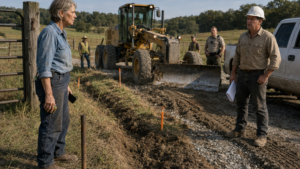
Catherine met them beside the ditch.
Jason glanced toward the sky.
“We need a decision today.”
Catherine nodded.
“I have one.”
Scott looked at her.
“What kind?”
“The kind with measurements.”
She opened the green ledger.
Inside was a sketch based on the licensed survey. Catherine had spent the previous evening working through the dimensions, comparing the recorded easement to the equipment specifications the treasurer had sent her.
A narrower route existed.
It would require the excavator to enter from the lower lane instead of crossing beside the greenhouse. The machine could clean the ditch within the actual easement if the operator worked in shorter sections and repositioned twice.
It would cost more.
It would take longer.
But it would work.
Catherine handed the sketch to Jason.
He studied it.
“The lower entrance is soft.”
“Then lay temporary mats.”
“That adds money.”
“So did breaking my greenhouse.”
Scott looked down.
The treasurer took the sketch.
“This came from the survey?”
“The boundary and easement measurements did. The route is mine.”
Scott finally spoke.
“You’re not an engineer.”
“No.”
“Then how do you know the machine can work it?”
“I called the contractor.”
Scott looked up sharply.
Catherine continued.
“He said he can do it if the route is cleared and mats are down before Thursday.”
Jason gave Scott a glance.
“You called him?”
“He called me back.”
Scott took the sketch from the treasurer.
“And what did you tell him?”
“That nobody puts a bucket over my line again without written permission.”
Scott’s face hardened.
Catherine held up one hand.
“And I told him I would grant temporary access where the survey says it can be granted.”
That stopped him.
Jason looked at her.
“Temporary?”
“For this project.”
The word carried more weight now than it had fifteen years earlier.
Catherine opened the ledger to a typed page.
“You get access from the lower lane. Equipment stays inside the marked route except where I specifically allow crossing. Mats go down first. The intact cedar bed gets moved six inches at cooperative expense because its corner crosses the easement.”
The treasurer nodded slowly.
“Reasonable.”
Catherine continued.
“The greenhouse gets repaired. Same grade of framing. Replacement panels. Damaged benches rebuilt. The orchids that can be replaced are replaced.”
Scott said, “Some of those plants were years old.”
“I know.”
“You can’t replace years.”
“No.”
The answer quieted the group.
Catherine looked toward the torn greenhouse.
“That’s why I’m not pretending a check fixes everything.”
She turned back.
“The cooperative covers the repair costs and survey expense. We sign the access limits before equipment comes back.”
Jason asked, “And Scott?”
Catherine had known that question was coming.
Scott looked at her without expression.
She said, “The cooperative decides who chairs the cooperative.”
“That’s not what I meant.”
“No.”
Catherine closed the ledger halfway.
“Scott ordered work outside the easement after he knew the width was disputed. I want that acknowledged in writing. Whatever portion your insurer refuses because of that decision doesn’t become my loss.”
The treasurer rubbed his chin.
“That could leave personal liability.”
Scott’s voice was flat.
“I know.”
Catherine watched him.
A week earlier, she would have wanted that sentence to hurt him.
Now it only sounded tired.
Jason looked at Scott.
“You knew the survey issue was unresolved.”
Scott stared at the ditch.
“Yes.”
“You didn’t tell the rest of us how unresolved.”
“No.”
“And you committed the equipment before the final notice.”
“Yes.”
The treasurer exhaled.
“We’ll need a vote.”
Scott gave a short nod.
Catherine reopened the ledger.
“There’s one more thing.”
Everyone looked toward her.
“If you accept the route, I sign temporary access today. Not after the repair. Not after an apology. Today.”
Scott frowned.
“Why?”
“Because the water doesn’t care who was wrong.”
No one spoke for several seconds.
Catherine felt the old instinct rise inside her—the need to keep something back, to hold leverage until every other person had done exactly what she wanted.
She let it pass.
“I won’t use my property line to flood somebody else’s field.”
Jason looked down at the survey flags.
The treasurer said, “That ought to be in the minutes.”
“It will be.”
They met that afternoon in the cooperative shed.
For the first time since the dispute began, Scott did not stand at the front.
Jason read Catherine’s proposed access terms aloud.
The board discussed repair estimates, contractor timing, insurance, and the cost of temporary ground mats.
No one raised their voice.
The hardest part came when the treasurer moved to address Scott’s chairmanship.
Scott sat with his hands folded.
Jason spoke carefully.
“I don’t think you were trying to hurt Catherine.”
Scott looked at him.
Jason continued.
“But you knew enough to stop and didn’t.”
A neighboring grower said, “We were all worried about drainage.”
“That’s not the same as approving what happened,” Jason replied.
Scott said nothing.
The vote removed him as chairman.
Not unanimously.
But clearly.
He remained a cooperative member because his farm still drained through the same system.
That mattered to Catherine.
There would be no clean disappearance.
No villain driven away.
Tomorrow, Scott would still farm across the road.
The ditch would still carry water past both properties.
When the vote on Catherine’s access agreement came, Jason raised his hand first.
The treasurer followed.
Then the others.
Approved.
Catherine signed.
The cooperative signed.
The surveyor returned before sunset to place a permanent marker beside the verified brass pin.
Catherine watched him tamp the soil around it.
Two markers now sat side by side.
One old and nearly forgotten.
One new and impossible to misunderstand.
Scott stood several yards away.
When everyone else began leaving, he approached.
“Contractor says he can start in the morning.”
“I know.”
Scott looked at the markers.
“You could’ve shut the whole thing down.”
“For a while.”
“Maybe long enough to make us miss the rain.”
“Yes.”
He nodded once.
“Why didn’t you?”
Catherine looked toward the ditch.
“Because being right about where my land ends doesn’t tell me where my responsibility ends.”
Scott absorbed that without answering.
Catherine picked up her ledger.
“Don’t mistake that for forgiveness.”
“I won’t.”
“And don’t mistake temporary access for ownership.”
His eyes dropped to the brass pin.
“I won’t do that again either.”
The next morning, ground mats appeared at the lower lane.
The excavator entered from the route Catherine had marked.
Its bucket never crossed the new boundary.
By noon, water was moving faster through the first cleaned section.
And for the first time since the greenhouse shattered, Catherine could watch the machine work without wondering whether anyone still believed the line belonged to whoever was willing to cross it.
Chapter 8: The New Glass Stopped at the True Line
Rain struck the rebuilt greenhouse roof in a steady silver rush.
Catherine stood beneath the new panels and listened.
No leaks.
Outside, water ran hard through the cleaned ditch, brown from the first hour of rain but moving cleanly between the banks.
It did not spill toward the lower fields.
It did not collect beside the greenhouse.
It went where it was supposed to go.
Catherine touched the new cedar bench.
The cooperative had paid for the replacement framing, glass, benches, and survey. The insurer covered most of it. The remaining portion tied to the unauthorized demolition had been split under an agreement Scott signed personally.
No one called it punishment.
The paperwork called it responsibility.
Catherine preferred that.
Several orchids had been replaced.
Others could not be.
One old plant had survived.
Its pot had shattered during the demolition, but the crown remained green. Catherine had wrapped its roots in damp moss while repairs were underway and kept it beside the kitchen window.
Now it waited on the bench.
She was trimming a damaged root when a truck slowed on the lane.
Scott.
He parked outside the marked access area.
That detail did not escape her.
He stepped out without a folder, map, work gloves, or cooperative jacket.
Just jeans and a raincoat.
Catherine watched him approach through the glass.
He stopped outside the greenhouse.
Did not enter.
She opened the door.
“You’ll get wet standing there.”
“I’ve been wetter.”
“That isn’t permission.”
Scott gave a small nod.
“Can I come in?”
Catherine stepped aside.
He wiped his boots before crossing the threshold.
For a moment, they stood among the new benches listening to the rain.
Scott looked around.
“Looks good.”
“It’s square.”
He almost smiled.
“I figured that would matter.”
“It does.”
His eyes settled on the surviving orchid.
“That one made it?”
“Barely.”
Scott looked toward the ditch through the new wall.
“The lower fields are draining.”
“I saw.”
“We probably would’ve had trouble if we hadn’t cleaned it.”
“Probably.”
The word hung between them.
Scott put both hands into his coat pockets.
“I’ve been thinking about your husband’s letter.”
Catherine continued trimming the root.
“What about it?”
“I read it the way I wanted to.”
She looked up.
Scott stared at the rain on the glass.
“When I took over the cooperative, everybody said access along this section had always been settled. Your husband had let equipment through. Nobody complained. The map showed the path.”
“The maintenance map.”
“I know.”
He rubbed his jaw.
“I stopped seeing permission as permission.”
Catherine said nothing.
“I saw it as something we’d earned by using it.”
“There’s a lot of that in farm country.”
Scott glanced at her.
“Maybe.”
“Fence moved for a wagon once, twenty years later somebody thinks the gate belongs there.”
“Something like that.”
Catherine set the pruning scissors down.
Scott looked at her directly.
“I was afraid.”
She had expected an apology.
The admission was harder to dismiss.
“Of what?”
“That the ditch would back up again.”
“I know that part.”
“No.”
Scott shook his head.
“I was afraid everybody would find out I built the whole job around an access width I never checked.”
Catherine waited.
“If I stopped the machine when you asked, the contractor walked. The board asked why. The downstream farmers asked why. Then I had to tell them I’d approved the bid using a sketch because that’s what everybody had always used.”
“And instead?”
“I made you carry the risk.”
Catherine looked toward the orchid.
“Yes.”
Scott nodded.
“I’m sorry.”
She let the silence stand.
He did not fill it.
That mattered.
Finally Catherine said, “I should have shown the letter at the meeting.”
Scott’s forehead creased.
“That doesn’t excuse what I did.”
“No.”
“Then why say it?”
“Because it’s true.”
She picked up the green ledger from the bench.
The cover was worn at the corners now.
“For forty years I made a living finding mistakes before they got expensive. Somewhere along the way I started believing facts were safer if I kept them to myself until I could prove every last one.”
Scott looked at the ledger.
“You didn’t trust us.”
“No.”
“You had reasons.”
“I also made it easier for you to keep believing the version you already liked.”
Rain hammered briefly against the roof.
Scott gave a quiet breath.
“Jason says the new policy requires a recorded easement map before any cooperative equipment crosses private ground.”
Catherine raised an eyebrow.
“That seems obvious.”
“It does now.”
She almost laughed.
Instead, she closed the ledger.
Scott glanced toward the door.
“I won’t take more of your time.”
At the threshold, he paused.
“Catherine.”
“Yes?”
“I meant what I said. About being sorry.”
She looked at him.
“I know.”
It was not forgiveness.
But neither was it refusal.
Scott stepped into the rain and walked back to his truck.
Catherine watched until he drove away.
Then she carried the surviving orchid outside.
The new cedar bed had been rebuilt entirely inside her parcel.
Not merely outside the easement.
She had asked the contractor to leave a deliberate strip of open soil between the bed and the surveyed boundary.
The brass pin remained visible there.
Beside it stood the permanent marker installed after the dispute.
Catherine knelt.
The rain had softened the ground enough that she could dig with a hand trowel.
She made a hole for the orchid several inches inside the cedar bed.
Not at the edge.
Not as close to the line as she could legally manage.
Several inches back.
She eased the roots into place and pressed soil around them.
For years, the old brass pin had been nearly invisible because nobody had needed it.
Then people forgot what it meant.
Catherine brushed mud from its head.
A boundary was not an insult.
It did not say neighbors could not help one another.
It did not say water could not cross land, machinery could never be allowed through, or one farmer owed nothing to another.
It simply said that help required permission.
That habit was not ownership.
That urgency was not authority.
And that a favor did not become permanent merely because nobody had objected lately.
Catherine stood.
Across the marked line, the ditch carried rainwater steadily toward the lower farms.
On her side, the new greenhouse glass reflected a pale break in the clouds.
Inside, replacement orchids sat on new cedar benches.
Some blooms were smaller than the ones she had lost.
Some would take years.
That could not be repaired by invoice.
Catherine understood that now too.
Restoration was not pretending nothing had happened.
It was deciding what could be rebuilt, what had to be remembered, and what would never again be left vague.
She picked up the green ledger and walked back toward the greenhouse.
At the door, she looked once more at the surviving orchid.
It stood safely inside the true line.
The ditch kept moving beside it.
And this time, both things could be true.
The story has ended.