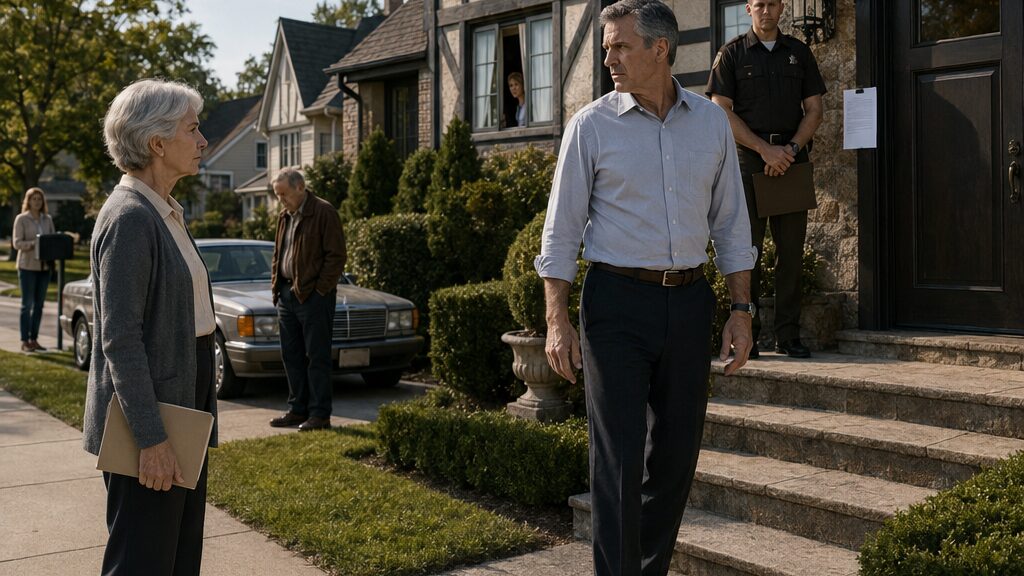
The HOA Put a $1,200 Lien on Her Cottage—Then Its President Found a Notice on His Own Mansion
Chapter 1: The Notice Nailed to Cynthia’s Paid-Off Front Door
The yellow notice was fastened beside Cynthia Mitchell’s brass door knocker with two silver tacks.
She saw it before she saw the man standing at the end of her walkway.
For three seconds she remained inside, one hand still on the curtain. The paper was bright enough to look almost cheerful against the white front door. At the top, in heavy type, were the words NOTICE OF LIEN.
Cynthia opened the door.
George King adjusted the cuff of his jacket.
“Morning, Cynthia.”
She ignored the greeting and read.
The amount due was $1,214.80.
Her eyes moved down the page.
Architectural violation. Administrative fee. Late charges. Legal preparation fee.
“You put a lien on my house?”
George’s expression did not change.
“The association did.”
“My house is paid off.”
“That doesn’t exempt it from covenants.”
Cynthia looked past him toward the white picket fence bordering her side yard. She had repainted it six weeks earlier in a warm cream almost identical to the old shade. The only other change had been replacing three warped boards.
George followed her glance.
“We gave you opportunities to correct the violations.”
“You sent two emails.”
“And a certified letter.”
“The certified letter asked me to submit a color sample.”
“You didn’t.”
“I brought the sample to the management office.”
“That isn’t the approved submission process.”
Cynthia looked at him.
She had spent thirty-one years in the county records system watching people confuse procedure with authority. Clerks did it. Attorneys did it. Contractors did it. Citizens did it most often.
A piece of paper could frighten somebody long before it proved anything.
Still, this one was attached to her home.
That made the fear physical.
George stepped closer to the fence and rested one hand on a post.
“The height at the front return is three inches above the approved limit.”
“It was that height when I bought the property.”
“That doesn’t make it compliant.”
“And the color?”
“Not approved.”
Cynthia looked at the fence again.
“I used the manufacturer code listed on the association sheet.”
“The association sheet has been revised.”
“When?”
“Last year.”
“Was it distributed?”
“It was available.”
That answer irritated her more than the notice.
Cynthia turned back to the page.
Near the bottom was language she knew too well: recorded or to be recorded against the property, collection remedies, costs recoverable.
She looked at George.
“When is the hearing?”
“There isn’t another hearing.”
“Another?”
“The board reviewed the matter.”
“I wasn’t invited.”
“You were notified.”
“Of a hearing?”
“Of the violations.”
“That isn’t the same thing.”
George’s jaw tightened slightly.
“This has gone on long enough.”
Cynthia felt something old rise in her chest, the instinct she had spent her working life suppressing: the desire to correct a person sentence by sentence until they had nowhere left to stand.
Retirement was supposed to have ended that part of her life.
She had bought this cottage because it was small enough to manage, quiet enough to sleep in, and completely hers. No mortgage. No office commute. No fluorescent records room. No stacks of disputed deeds.
She had promised herself that she was finished spending mornings arguing over documents.
So she asked only one question.
“Has the lien been recorded?”
George hesitated.
That was enough.
“When?”
“It was sent to county recording Friday.”
Cynthia stared at him.
“You posted this today after submitting it Friday?”
“The association had no obligation to delay.”
“You told me last Wednesday I could request a hearing.”
“You had already missed the compliance window.”
Cynthia remembered the email exactly.
If you wish to dispute the determination, contact management regarding hearing procedures.
She had contacted them.
No one had answered.
A lawn mower started two houses down. Cynthia could see a neighbor through the hedge pretending not to look toward her porch.
George lowered his voice.
“Cynthia, nobody wants this to become more difficult than it needs to be. Correct the fence, repaint it, pay the balance, and we can move on.”
“We?”
“The neighborhood.”
For the first time, she heard what he believed.
Not that he was punishing her.
That he was maintaining something.
George had the controlled patience of a man accustomed to being thanked for rules other people disliked.
Cynthia reached up and touched one silver tack.
“Don’t remove the notice yet,” he said. “It’s required to remain posted.”
She stopped.
“Required by what?”
“Association enforcement procedure.”
“Which section?”
George looked at her.
“I don’t carry the governing documents in my head.”
“No,” Cynthia said quietly. “Neither do I.”
She went inside.
She did not slam the door.
That would have satisfied him too much.
Her study was the smallest room in the house, containing one oak desk, two filing cabinets she had sworn she would never need, and a bookshelf holding the closing documents from when she purchased the property.
She pulled down the Oakmont Ridge declaration, bylaws, enforcement policy, and architectural standards.
The familiar weight of paper landed on her desk.
For half an hour she read without taking notes.
Then she returned to the enforcement policy.
Hearings.
Notice requirements.
Board action.
Quorum.
Authorization of collection remedies.
Cynthia read the lien notice again.
One phrase bothered her.
Pursuant to authorization of the Board of Directors.
Authorization.
Not management discretion.
Not automatic escalation.
Board authorization.
She opened the bylaws.
A majority of serving directors constituted quorum. Certain collection actions required approval at a duly called meeting.
Cynthia found the board roster.
Five directors.
That meant three.
She returned to the posted notice outside and photographed it before touching anything.
George’s SUV was gone.
The neighbor’s mower had stopped.
Cynthia carefully removed the two tacks and brought the paper inside.
On the final page were signatures.
One belonged to George King.
The second belonged to another board member.
There was no third.
Cynthia sat down slowly.
For the first time that morning, she smiled.
Not because the lien had disappeared.
It had not.
But because she finally knew where to begin.
Chapter 2: Three Inches, One Paint Sample, and a Missing Vote
The director listed as voting for Cynthia’s lien had been in Florida on the day of the meeting.
Cynthia knew because the minutes said he had attended in person.
She also knew because Sandra Davis had posted photographs from a neighborhood group trip to Sarasota that same week, and the director appeared smiling in the background beside a fishing boat.
Cynthia stared at the screen.
Then she printed the meeting minutes.
The document showed three votes approving “continued enforcement measures.”
George King.
One board member.
And the director who had been nearly a thousand miles away.
That made three.
Exactly enough for quorum.
Cynthia circled the third name.
At ten that morning she drove to the HOA management office, a converted storefront in a small commercial strip near the subdivision entrance.
The management representative looked uncomfortable before Cynthia even sat down.
“I’d like the attendance record for last Thursday’s board meeting.”
“The minutes are online.”
“I have the minutes.”
“Then you have the record.”
“I’m asking whether attendance was verified.”
The representative folded her hands.
“Board minutes are provided by the board secretary.”
“So management doesn’t verify them?”
“Not unless there’s a discrepancy.”
“There is.”
Cynthia slid the printed photograph across the desk.
The representative looked at it and then pushed it gently back.
“You’d need to raise that with the board.”
“I’m raising it with the entity administering a lien against my property.”
“We administer at the board’s direction.”
“Who directed you to send the lien?”
“George.”
“Personally?”
“The president submitted authorization.”
“Was there a resolution?”
“I can’t discuss internal communications.”
Cynthia nodded.
Years ago, people had mistaken her quietness for agreement.
She had learned not to rescue them from that mistake.
“Did you receive my hearing request?”
The woman’s eyes shifted toward her monitor.
“I believe so.”
“When?”
A pause.
“Thursday afternoon.”
“The lien was submitted Friday.”
“Yes.”
“And no hearing was scheduled.”
“No.”
“Why?”
“The board considered the matter resolved.”
Cynthia stood.
“Thank you.”
Outside, she found George talking with two homeowners beside the community mailbox pavilion.
He saw the folder in her hand.
“Still working on this?”
“I am.”
One of the homeowners gave Cynthia a small, embarrassed smile before leaving.
George waited until they were alone.
“You’re turning a simple compliance issue into a procedural fight.”
“A lien is not a simple compliance issue.”
“You knew the fence didn’t meet standards.”
“I knew you said it didn’t.”
“There’s a difference?”
“Yes.”
He exhaled.
“This is exactly the problem.”
“What is?”
“People agree to rules when they buy, then decide the rules shouldn’t apply to them.”
Cynthia studied him.
“You really believe that’s what I’m doing.”
“I believe exceptions spread.”
He pointed toward the street.
“One person paints outside the approved palette, another parks a trailer for six months, someone else stops mowing because enforcement suddenly became optional. Property values don’t fall overnight. Standards erode one exception at a time.”
It was the first thing he had said that sounded less like power and more like fear.
Cynthia understood the fear.
She simply didn’t accept what he had done with it.
“Rules matter,” she said. “So does the process used to enforce them.”
George’s face hardened.
“That sounds like someone looking for a technicality.”
“It sounds like someone reading what your board wrote.”
She walked away.
By afternoon, the story had already moved farther than Cynthia realized.
Sandra caught her near the end of the block while Cynthia was checking the fence measurement herself.
Sandra was carrying a small grocery bag and looked reluctant to stop.
“Can I say something?”
“You usually do.”
Sandra smiled faintly.
“You might want to come to the informal neighborhood meeting tonight.”
“What meeting?”
“George asked a few people over to talk about the enforcement situation.”
“My enforcement situation?”
“He didn’t say it like that.”
“How did he say it?”
Sandra looked down the street.
“That there’s concern about homeowners challenging standards after violations have already been confirmed.”
Cynthia let the tape measure retract.
“So I’m the concern.”
“People don’t understand why you’re fighting over three inches.”
“It isn’t three inches anymore.”
“That’s not what they’re hearing.”
Cynthia felt irritation flare.
“Then they should read the documents.”
Sandra’s expression changed.
Not anger.
Disappointment.
“Most people aren’t going to read fifty pages of documents, Cynthia.”
“That doesn’t make them less relevant.”
“No. But it means if you don’t explain yourself, George will.”
Cynthia folded the tape measure.
“I’m not campaigning for my own innocence.”
“That’s not what I said.”
“I’m not going to sit in somebody’s living room defending myself because the president misused a lien.”
Sandra shifted the grocery bag to her other hand.
“Then don’t be surprised if people decide silence means you don’t have an answer.”
Cynthia watched her walk away.
For the first time, the problem felt larger than the paper.
That evening she stayed home.
She told herself the meeting had no legal significance.
She told herself facts would matter more than gossip.
She told herself she had spent too much of her working life explaining obvious things to people who preferred convenient ones.
At nine fifteen, an email arrived from the association.
EMERGENCY ENFORCEMENT REVIEW.
George had scheduled a special board session for the following afternoon to consider additional collection costs arising from Cynthia’s challenge.
She read the notice twice.
He was not retreating.
He was accelerating.
Cynthia opened the association’s online owner portal and began saving everything she could access before permissions changed.
Minutes.
Budgets.
Annual reports.
Delinquency summaries.
The last file was an aging spreadsheet posted with the previous year’s financial packet.
She almost skipped it.
Instead she opened it.
Rows of addresses appeared beside account codes.
Most were marked current.
Several had late balances.
One code was the same collection category appearing on Cynthia’s account.
She scrolled.
Then stopped.
The address was impossible to mistake.
The largest house in Oakmont Ridge.
George King’s Tudor mansion.
Beside it sat a delinquency entry.
Cynthia leaned closer to the screen.
For months, the president demanding that she pay every dollar immediately had carried a balance of his own.
Chapter 3: The President’s Name in the Delinquency Ledger
George King’s account carried the same delinquency code as Cynthia’s.
That was what bothered her.
Not the amount.
Not yet.
The code.
On Wednesday morning, Cynthia drove to the county records office where she had spent more than half her adult life.
She had not visited since retirement.
The lobby looked smaller than she remembered. Same pale tile, same numbered service windows, same low murmur of people discussing deeds, transfers, releases, plats, and mistakes that had suddenly become urgent because someone was buying, selling, divorcing, inheriting, or dying.
The clerk behind the counter recognized her.
“Couldn’t stay away?”
“Apparently not.”
“What are you looking for?”
“Nothing private.”
“That sounds ominous.”
Cynthia gave her George’s property address.
“I need recorded liens, releases, and association filings tied to this parcel.”
The clerk typed.
Cynthia watched the screen without leaning forward.
Old habits.
Never crowd a clerk who is trying to help you.
Several entries appeared.
Mortgage release.
Property transfer.
Utility easement.
No association lien.
That told Cynthia something important.
George’s delinquency had not reached the point hers had.
She requested copies of the public filings relating to Oakmont Ridge and returned home.
By noon, her study floor had become a grid of documents.
Her own yellow notice lay at the center.
To its left: governing documents.
To its right: financial reports.
Below it: the copied delinquency summary showing George’s address.
Cynthia calculated the assessment schedule.
The balance corresponded almost exactly to several unpaid quarters of a special assessment adopted for drainage and common-area repairs.
She checked the dates again.
George had been overdue before Cynthia ever received her first fence notice.
At three thirty she called Benjamin Clark.
He had served as treasurer until the previous winter.
He answered on the fifth ring.
“Yes?”
“Benjamin, this is Cynthia Mitchell.”
Silence.
“I know who it is.”
“I need to ask you about an old association ledger.”
“I don’t keep association records anymore.”
“I have a copy.”
Another silence.
“What do you want?”
“George King’s account shows the same delinquency code being used against me.”
“That’s an accounting category.”
“I know what a category is.”
“You don’t know what that number means.”
“Then tell me.”
“I’m not getting involved.”
“You already were involved. You were treasurer.”
“That was exactly my mistake.”
The line went dead.
Cynthia stared at the phone.
At four fifteen she received an email from the association attorney.
It stated that further challenges to the lien could result in additional recoverable legal expenses under the governing documents.
The wording was careful.
It did not quite say, Stop fighting or we will charge you for fighting.
It did not need to.
Cynthia printed it.
For a few minutes she sat without moving.
This was the point where an ordinary person might have paid.
She understood that now.
Twelve hundred dollars was painful but survivable for many homeowners. Legal fees were undefined. Undefined numbers frightened people more effectively than fixed ones.
She could pay, repaint the fence, cut three inches from the posts, and be finished.
Nobody would call her unreasonable.
Nobody would need to take her side.
Sandra might even bring over pie and tell her she was glad the unpleasantness was done.
Cynthia looked at the yellow notice.
Then at George’s ledger entry.
The problem was no longer whether he owed money.
The problem was why identical delinquency categories had produced dramatically different consequences.
At six that evening she drove to a coffee shop outside the subdivision and found Benjamin already seated in a corner booth.
She had not invited him.
He had texted only three words.
Twenty minutes. Coffee shop.
He looked older than Cynthia remembered from association meetings. His shoulders sagged beneath a brown jacket, and there were deep half-moons under his eyes.
Cynthia sat.
Benjamin did not greet her.
He looked at the folder.
“You printed it.”
“Yes.”
“You should be careful with what you think you found.”
“Then explain it.”
Benjamin rubbed a thumb against the edge of his paper cup.
“George’s account isn’t like yours.”
“How?”
“The special assessment was handled differently.”
“Why?”
“There were timing issues.”
“What timing issues?”
“Cash flow. Board decisions. Payment arrangements.”
“Was there an arrangement?”
Benjamin looked toward the counter.
“You’re asking questions that will cause more trouble than your lien.”
“That isn’t an answer.”
“It’s the only one I’m giving you.”
He stood.
Cynthia remained seated.
“Benjamin.”
He stopped.
“If George’s account was properly deferred, I’ll leave it alone.”
Benjamin’s shoulders tightened.
“And if it wasn’t?”
“Then I’ll want to know why mine went from dispute to lien while his didn’t.”
For a moment she thought he would sit back down.
Instead he said quietly, “You still don’t understand what that number means.”
Then he walked out.
Thursday brought confirmation from another direction.
The association’s archived budget packets contained quarterly delinquency totals. George’s balance had not vanished. It had shifted categories.
One quarter it appeared overdue.
The next it was listed as temporarily deferred.
Then back to outstanding.
No formal payment-plan authorization appeared in the meeting minutes Cynthia could find.
The debt was real.
The accounting treatment was not ordinary.
Friday morning George’s attorney sent a second letter.
Additional fees had already been added to Cynthia’s account.
The total now exceeded thirteen hundred dollars.
Cynthia placed the letter beneath her yellow notice.
Defensive resolve had become something more dangerous.
Leverage.
She did not like the feeling.
Leverage encouraged people to stop asking what was right and start asking what they could force.
At eight forty-three Friday night, her phone rang.
Benjamin.
Cynthia answered without speaking.
His voice came low and fast.
“I’ll tell you what happened.”
She sat upright.
“When?”
“Tomorrow morning.”
“Where?”
“My house.”
A pause.
“And Cynthia?”
“Yes?”
“Don’t email me. Don’t put anything in the portal. Don’t tell George I called.”
“Why?”
Benjamin breathed into the line.
“Because George didn’t hide that account by himself.”
Chapter 4: The Morning the Second Notice Went Up
The sheriff’s civil-process deputy was halfway up George King’s front walk when Cynthia saw the yellow paper in his hand.
She had parked on the public street across from the Tudor house, exactly where Benjamin had told her to wait. George’s mansion rose behind trimmed hedges and stone pillars, its dark front door polished enough to reflect the deputy’s uniform.
For one strange second, Cynthia saw her own cottage instead.
Her white door.
Her brass knocker.
Two silver tacks.
Then the deputy climbed the last step.
The notice went up beside George’s door.
Cynthia did not smile.
Benjamin stood several yards away beside his older sedan, hands buried in his jacket pockets.
“You said it would be served,” Cynthia said.
“I said the process had started.”
“This is more than started.”
Benjamin looked at the mansion.
The notice had not appeared because Cynthia had somehow seized George’s property. Nothing was that simple. After Benjamin’s call the previous night, he had shown her copies of association records supporting a challenge to the unequal enforcement, including documentation of George’s unpaid special assessment. Cynthia had filed the appropriate counterclaim and request for enforcement review with the court that morning.
The posting was notice of that proceeding and the delinquency attached to it.
Still, from the street, it looked brutally simple.
A yellow sheet on a rich man’s door.
Exactly like the yellow sheet that had been placed on hers.
The deputy stepped back and checked something on a clipboard.
The front door opened.
George appeared in shirtsleeves.
He looked first at the deputy, then at the paper, then across the lawn.
His eyes found Cynthia.
“Are you serious?”
The deputy said something Cynthia could not hear.
George ignored him.
He walked down the front steps.
“Cynthia.”
She stayed on the sidewalk.
“George.”
“What did you file?”
“A challenge.”
“This is my home.”
“Yes.”
His face tightened.
“You had a dispute over an architectural violation. You turned it into this?”
“You turned it into a lien.”
“That was the association.”
“And this is a court notice.”
George glanced toward a house across the street. A curtain moved.
His voice dropped.
“Withdraw it before half the neighborhood sees.”
Cynthia looked at the bright notice behind him.
“You mean before people see that you’re delinquent?”
“You don’t understand the account.”
“I’ve heard that before.”
“It is not the same as yours.”
“Then the review will establish that.”
George stepped closer.
The deputy moved slightly toward them.
George noticed and stopped.
“This is retaliation.”
“No.”
“You’re standing across the street watching.”
“I came to confirm service.”
“You wanted me embarrassed.”
Cynthia felt the accusation land because part of it was not entirely false.
She had wanted him to feel something.
Not ruin.
Not panic.
But perhaps one minute of what she had felt standing behind her curtain on Monday morning.
She could have said that.
Instead she looked toward the notice.
“I wanted the same procedures applied to both accounts.”
George gave a short, bitter laugh.
“You think paperwork makes things equal?”
“No. People do.”
A car slowed as it passed.
George’s eyes followed it.
There it was again.
His fear of being seen losing control.
He turned toward the deputy.
“This can be removed.”
“Not by me,” the deputy said. “Service is complete.”
George looked back at Cynthia.
“Fix what you started.”
“I didn’t create the balance.”
“You created the spectacle.”
The word bothered her.
Because he was right about one thing: once a dispute became visible, the facts stopped belonging only to the people who understood them.
By eleven, the neighborhood message board was full of questions.
Cynthia did not respond.
George did.
He sent a community-wide email announcing an emergency meeting for Sunday evening.
The message accused “certain residents” of using procedural technicalities to interfere with lawful enforcement and warned that unresolved litigation could increase association legal expenses for every household.
Sandra appeared at Cynthia’s door twenty minutes later.
She did not come inside.
“What happened at George’s house?”
“A notice was served.”
“I gathered that.”
“Then why are you asking?”
“Because people are saying you’re trying to foreclose on him.”
“I’m not.”
Sandra’s shoulders relaxed slightly.
“Then what are you doing?”
“Challenging unequal enforcement.”
“Which means?”
Cynthia almost told her to read the filings.
The words reached the back of her teeth.
Then she remembered Sandra standing beside the fence, telling her that if she stayed silent George would explain for her.
Cynthia stepped aside.
“Come in.”
Sandra hesitated, then followed her to the study.
Cynthia showed her the records.
Her own lien.
George’s assessment balance.
The differing treatment.
The missing hearing.
The questionable quorum.
Sandra read more carefully than Cynthia expected.
When she finished, she did not say George was innocent.
She did not say Cynthia was right.
She only asked, “How bad could this get?”
“For me?”
“For all of us.”
Cynthia looked at the budget sheets spread across the desk.
“I don’t know.”
That answer frightened Sandra more than certainty would have.
At noon, Benjamin called.
“Can you meet me outside?”
Cynthia found him near his car.
His face was gray.
“You saw George’s email?”
“Yes.”
“He’s going to make this about legal costs.”
“Maybe they are a concern.”
“They are. That’s what makes it useful.”
Cynthia folded her arms.
“What exactly did you do, Benjamin?”
He looked toward Sandra’s house.
“When the special assessment came due, George asked for time.”
“That isn’t illegal.”
“No.”
“Did the board approve a payment plan?”
Benjamin shook his head.
“I changed the account classification.”
Cynthia said nothing.
“He said he’d catch it up after a property commission closed. Then another quarter came due.”
“And?”
“I left it deferred.”
“Why?”
Benjamin’s jaw worked.
“At first because I believed him.”
“And after that?”
He looked at her.
“Because I didn’t want him turning enforcement on me.”
The answer was so ordinary Cynthia almost missed its weight.
Not conspiracy.
Not bribery.
Fear.
“You were treasurer.”
“I know.”
“You could have stopped it.”
“I could have objected.”
“You didn’t.”
“No.”
A car door slammed somewhere down the street.
Benjamin spoke more quietly.
“George didn’t hide the account alone.”
Cynthia’s attention sharpened.
“Who else?”
“I showed the board the balance.”
“All of them?”
“Enough.”
“And they approved the deferral?”
“Not formally.”
“Then what did they do?”
Benjamin looked toward George’s distant roofline.
“They agreed not to ask questions.”
Cynthia felt the morning’s satisfaction disappear.
The yellow notice on George’s mansion was no longer the end of anything.
It was the first visible crack in a much larger wall.
Chapter 5: The Ledger Was Wrong for More Than One House
Benjamin placed two ledgers on his kitchen table.
At first glance, they looked identical.
Same dates.
Same addresses.
Same assessment columns.
Same neat accounting codes.
Then Cynthia found George King’s line.
In the first ledger, his balance appeared under delinquent special assessments.
In the second, the same amount had been moved into administrative deferral.
No vote number.
No payment agreement.
No expiration date.
Nothing explaining why.
“Which one went to management?” Cynthia asked.
“The second.”
“And the board?”
Benjamin tapped the first.
“They saw this one.”
Cynthia stared at him.
“You showed the board a delinquency, then sent management a version that made it look deferred?”
“Yes.”
“On whose instruction?”
“George asked me to fix the classification until he could pay.”
“That is not an answer.”
Benjamin looked down.
“I did it.”
Cynthia sat back.
For several days she had imagined George manipulating the system alone.
That version had been easier.
One bad actor.
One correction.
Benjamin destroyed that simplicity.
“You said the board knew.”
“They knew he was behind. They didn’t know exactly how I coded it.”
“So they knew enough to ask.”
“Yes.”
“And didn’t.”
“No.”
“Why?”
Benjamin pushed one ledger away.
“Because George had been right about a lot of things before he was wrong about this.”
Cynthia waited.
Benjamin told her about years of uneven enforcement before George became president. Boats parked in driveways for entire summers. A collapsing fence left unresolved because nobody wanted an argument. Drainage complaints that turned into legal expenses after the board delayed action.
George had taken over promising consistency.
At first, residents liked it.
So did Benjamin.
“He answered emails,” Benjamin said. “He showed up. He made management do its job.”
“And then?”
“He started believing any exception meant the whole system would fall apart.”
Cynthia thought of George at the mailbox pavilion.
One exception at a time.
“What happened when people challenged him?”
“He got harder.”
“And nobody stopped him.”
Benjamin gave a humorless smile.
“People like order until order reaches their door.”
Cynthia copied the ledgers.
Before leaving, she asked one final question.
“Were other accounts treated differently?”
Benjamin hesitated too long.
“How many?”
“I don’t know.”
“Benjamin.”
“There were arrangements.”
“Formal?”
“Some.”
“And others?”
He did not answer.
That afternoon, Cynthia compared delinquency reports against meeting minutes.
She found enough inconsistencies to make her stomach tighten.
Not dozens.
Not some vast secret operation.
But several.
A homeowner whose late fees had been waived after serving on a landscaping committee.
Another whose balance remained under review for months.
A third whose account moved directly to attorney collection after missing a deadline.
Different cases could justify different outcomes.
The problem was that the records did not explain the differences.
At Sunday’s emergency meeting, the community room filled before Cynthia arrived.
George stood near the front with the association attorney.
Several homeowners turned when Cynthia entered.
Nobody applauded.
Nobody whispered loudly enough to be obvious.
That was worse.
George opened the meeting by warning that litigation threatened association resources.
“We have a duty,” he said, “to protect all homeowners from escalating costs created by unnecessary legal disputes.”
Cynthia sat beside Sandra.
Sandra leaned toward her.
“He’s talking about you without saying your name.”
“I noticed.”
When resident comments opened, Cynthia rose.
She did not bring the photograph of George’s posted notice.
It was in her purse.
For an hour that morning she had considered printing it larger.
That impulse embarrassed her now.
She carried only copies of the ledgers.
“There are two issues,” she said. “Whether my lien followed required procedure, and whether enforcement has been applied consistently.”
George interrupted.
“This is not an accounting trial.”
“No. Which is why an independent review would help.”
A homeowner near the aisle asked, “Who pays for that?”
Nobody answered immediately.
That was the question George had been waiting for.
“Everyone,” he said.
The room shifted.
Cynthia felt the atmosphere move away from her.
Legal principles were clean on paper.
Special assessments were not.
Refunds were not.
Attorney fees were not.
If past enforcement actions had been defective, correcting them could cost the association money it did not have.
Another homeowner asked whether Cynthia wanted every old fine reversed.
“No.”
“Then what do you want?”
Before Cynthia answered, Sandra stood.
Her voice was calm.
“Can I ask something first?”
George nodded.
Sandra looked at Cynthia.
“Do you want this fixed, or do you want George humiliated?”
The room went still.
Cynthia felt heat rise into her face.
In her purse, the photograph seemed suddenly heavy.
She could have answered immediately.
Instead she sat with the question.
Four days earlier she had wanted nothing except her lien removed.
Then she had found George’s delinquency.
Then the second notice had gone up.
Some part of her had enjoyed the symmetry.
She disliked admitting that.
“I want the records corrected,” Cynthia said.
Sandra kept looking at her.
“And the picture?”
George frowned.
“What picture?”
Cynthia reached into her purse.
She pulled out the photograph of the notice on George’s mansion.
For one second she considered laying it on the table.
Instead she tore it once through the middle.
Then again.
“I don’t need this.”
George’s expression changed, though only slightly.
Cynthia continued.
“If my lien was unauthorized, release it. If George owes an assessment, treat him under the same written policy used for everyone else. If other accounts were handled differently, determine why before deciding what must be refunded or corrected.”
The association attorney leaned toward George.
A board member asked Benjamin whether the duplicate ledgers were genuine.
Benjamin stood at the back.
“Yes.”
The room changed again.
This time against nobody in particular.
Toward uncertainty.
That was more dangerous.
By the end of the meeting, residents were arguing about possible reimbursements, prior fines, legal expenses, and whether old cases would need review.
Cynthia realized she had been thinking like a records specialist.
Find the defect.
Correct the record.
Move forward.
Communities did not work that neatly.
Every correction touched somebody.
Every mistake had a cost.
The meeting ended without a vote.
George waited near the hallway while homeowners left.
When Cynthia passed him, he said quietly, “You wanted fairness. Now look around.”
She stopped.
“I am.”
“People could get assessments because of this.”
“Possibly.”
“Legal fees. Refunds. Accounting review. You can make every household pay for your principle.”
The accusation struck harder than she wanted.
George lowered his voice.
“There is still a simpler solution.”
“What?”
“Tomorrow. Your porch. Six o’clock.”
“For what?”
“I remove your lien.”
Cynthia studied him.
“And?”
“You stop challenging the older records.”
There it was.
Her house back.
Her problem finished.
All she had to do was let everyone else keep theirs.
Chapter 6: The Deal That Would Have Saved Only Her House
George arrived at six without his leather portfolio.
That frightened Cynthia more than if he had brought an attorney.
He stood on her porch with his hands empty.
“No board meeting,” he said. “No lawyers. Just a conversation.”
Cynthia did not invite him inside.
They sat on opposite ends of the porch bench.
Through the screen door, the original yellow lien notice remained tucked beneath the edge of a framed landscape print in the front hall.
George saw it.
“You kept it.”
“I keep records.”
“That one seems more like a trophy.”
Cynthia glanced toward it.
“Maybe it was.”
George rested his forearms on his knees.
“I can get your lien released.”
“You said that yesterday.”
“I mean tomorrow.”
“And in return?”
“You withdraw the broader challenge.”
“Not the challenge to my lien?”
“No. That can be resolved.”
“The accounting review?”
“Yes.”
“The inconsistent collection records?”
“Yes.”
“Your balance?”
His mouth tightened.
“I’ll pay it.”
“Under what terms?”
“The same ones everyone else gets.”
“You didn’t take the same ones everyone else got.”
“No.”
It was the first time he had said it without qualification.
Cynthia waited.
George looked toward the street.
“When I took over the board, this place was a mess.”
“You’ve said that.”
“You haven’t lived here long enough to know.”
He told her about a drainage dispute that had cost the association thousands because nobody enforced maintenance responsibility early. A fence disagreement that had turned into a property-line lawsuit. Months when directors stopped returning calls because every decision produced another argument.
“I fixed that,” he said.
“You imposed control.”
“I imposed deadlines.”
“You skipped a hearing.”
“Yes.”
The answer stopped her.
George looked at her directly.
“Yes. I knew you had requested one.”
“Then why?”
“Because I knew what would happen.”
“What?”
“You would come in with binders and sections and challenge every step. Then someone else would do it. Then somebody whose shed actually violates the setback would claim selective treatment. Every case becomes a debate.”
“That is what hearings are for.”
“No. Hearings are supposed to resolve disputes. They became permission to delay.”
“So you decided not to have them.”
“I decided some cases were obvious.”
Cynthia stared at him.
“My fence is three inches high.”
“Three inches becomes six. Then a foot.”
“And a different paint shade becomes what?”
George rubbed both hands over his face.
“You think this is about paint.”
“What is it about?”
“Losing control.”
The honesty of it left no room for satisfaction.
George leaned back.
“My brokerage has compliance people asking about the court notice. A reporter called the office today. If this keeps expanding, I could lose my position there before anyone proves I did anything dishonest.”
“You received different treatment on your own debt.”
“I asked for time.”
“And Benjamin changed the classification.”
“I didn’t tell him how to code it.”
“You knew the board had not approved a formal arrangement.”
“Yes.”
“So why should anyone trust your enforcement?”
George looked at the lawn.
“They shouldn’t have to trust me.”
The words surprised both of them.
He continued more quietly.
“They should trust the system. I thought keeping the system strong meant keeping control of it.”
“And now?”
“Now I’m sitting on your porch asking you to stop.”
Cynthia looked through the screen door.
The yellow notice was still there.
For days it had been evidence of what George had done.
Then proof she had survived it.
Then, privately, something darker.
A reminder that she could hurt him back.
George followed her gaze.
“Take it down.”
“Why?”
“Because you already won.”
“No.”
“You did.”
“My lien still exists.”
“I’ll remove it.”
“That is not winning.”
“What is?”
Cynthia did not answer.
The question followed her into the next morning.
At the association attorney’s office, she sat across from the attorney, two board members, Benjamin, and George.
The attorney laid out three possible paths.
Private settlement.
Continued litigation.
Independent financial and procedural review.
The first was cheapest.
The second could become expensive.
The third would cost money but might limit larger damage by identifying which cases actually required correction.
George favored settlement.
One board member favored fighting.
The other looked exhausted.
Cynthia listened.
Then the attorney asked what relief she was requesting.
For weeks, Cynthia had prepared for that moment.
She could demand her lien released.
Attorney fees withdrawn.
George’s account placed immediately into collection.
Past enforcement reopened.
Board records disclosed.
Maximum pressure.
She had enough leverage to make those requests painful.
Instead she opened her folder.
“I want my lien released because the authorization was defective.”
George looked down.
“I want George’s delinquency handled through the written policy that should have applied in the first place.”
The attorney nodded.
“And the other accounts?”
“Independent review. Not automatic reversal.”
Benjamin looked at her.
Cynthia continued.
“If a homeowner owes money legitimately, they still owe it. If fees were imposed without required procedure, correct them. If a payment plan should have been documented, document it. I am not asking the association to pretend rules don’t exist.”
George raised his eyes.
“What about the board?”
“That isn’t my decision.”
One of the directors spoke.
“It may become ours.”
The room went quiet.
The attorney looked at Cynthia.
“You understand the review could still cost the association.”
“Yes.”
“And it might show some actions you objected to were valid.”
“Yes.”
“And some residents may blame you for starting it.”
Cynthia thought of Sandra.
She thought of refusing the neighborhood meeting because the truth was in the documents.
She had been correct about the documents.
She had been wrong about people.
“I understand.”
Afterward, George caught her near the courthouse entrance.
“You could have asked for more.”
“Yes.”
“Why didn’t you?”
Cynthia removed the folded yellow notice from her folder.
She had brought it without deciding why.
For a moment she held it between them.
Then she folded it once more until the bold heading disappeared inside.
“Because this started with somebody using a rule to make another person smaller.”
George said nothing.
“I’m not interested in finishing it the same way.”
She put the folded paper into her purse.
That afternoon, Sandra knocked on Cynthia’s door.
“Have you heard?”
“No.”
“Two directors requested an emergency executive session.”
“For what?”
Sandra handed her a printed email.
Pending independent review, George King’s authority to direct collection and enforcement actions had been suspended.
Cynthia read the line twice.
Her first feeling was relief.
Her second was fear.
Because now Oakmont Ridge had to discover whether it knew how to govern itself without simply finding another person to control everything.
Chapter 7: The Door Was Clear, but the Rules Stayed
The county recorder clerk slid the release across the counter and tapped the stamped corner with one finger.
“There you are.”
Cynthia Mitchell did not touch it immediately.
The document looked disappointingly ordinary.
No yellow paper. No bold warning. No silver tacks. Just a clean page showing that the lien against her home had been formally released.
She had imagined this moment several times.
In some versions, she felt triumphant.
In others, exhausted.
What she actually felt was careful.
“Effective today?” she asked.
“Recorded this morning.”
“And the associated filing?”
“Released with it.”
Cynthia picked up the page.
For weeks, twelve hundred dollars had felt less like money than a hand wrapped around the deed to her house. Now the hand was gone.
The clerk smiled.
“You want a certified copy?”
“Yes.”
“Still yourself, then.”
Cynthia almost smiled.
“Some habits survive retirement.”
Outside, she stood beside her car and read the release again.
Her cottage was hers in exactly the same way it had been before George King posted that notice on her door.
And yet nothing was the same.
Oakmont Ridge had spent the previous three weeks combing through years of records under the supervision of an outside accountant and association counsel.
The review had found mistakes.
Not the catastrophe some residents feared.
Not innocence, either.
Several late-fee calculations had to be corrected. Two homeowners were due modest refunds. Three payment arrangements had never been formally documented. A handful of enforcement cases had technically followed procedure but had been recorded so poorly that no one could explain them without reconstructing emails and meeting notes.
George’s special assessment balance remained valid.
So did most of the debts owed by other homeowners.
That mattered to Cynthia.
The truth was less dramatic than revenge.
It was also harder to dismiss.
George had not stolen association money.
Benjamin had not fabricated accounts.
The board had not operated some secret criminal enterprise.
They had done something more recognizable.
They had made exceptions for people they trusted, applied pressure to people they did not, and gradually stopped noticing the difference.
George remained suspended from enforcement authority.
He had also signed a repayment agreement using the same written schedule now available to every homeowner.
Cynthia folded the certified release into her purse and drove home.
The first thing she saw was the front door.
For weeks, she had avoided looking too closely at the tiny tack holes beside the brass knocker.
Now she stopped.
Two pale marks remained in the paint.
She went inside, found a small tin of matching paint in the utility closet, and returned with a fine brush.
She filled the first hole.
Then the second.
A ridiculous amount of trouble for two marks no wider than pinheads.
Sandra Davis crossed the sidewalk carrying a stack of folders.
“You’re doing home repair now?”
Cynthia glanced over.
“Corrective maintenance.”
Sandra laughed.
“You’re expected at the community room.”
“I know.”
“You’re late.”
“I’m retired.”
“That excuse has limits.”
Cynthia capped the paint tin.
“What are the folders?”
“Draft procedures.”
Sandra lifted them.
“You’re going to hate the formatting.”
“I already do.”
“You haven’t seen it.”
“I can tell from here.”
They walked together.
The community room was almost full.
Not tense in the old way.
Different.
Tables had been arranged in a square rather than facing one chair at the front. Copies of proposed collection procedures sat at every place.
Benjamin Clark stood near the coffee station.
When Cynthia entered, he gave her a small nod.
It was not an apology.
He had already done that privately.
More importantly, he had done something harder publicly.
During the review, Benjamin had admitted in an open meeting that he changed George’s account classification without proper approval.
He had not blamed George for everything.
He had not hidden behind instructions.
“I knew the board had not authorized it,” he had told the room. “I did it because I wanted the problem to go away.”
The admission had cost him some friendships.
It had also made the review useful.
People stopped asking who the villain was and started asking where the system had allowed fear, convenience, and personal relationships to replace written procedure.
Cynthia took her seat.
One board member cleared her throat.
“We have two final matters.”
The first concerned George.
He entered through the side door while she was speaking.
The room changed slightly.
Not dramatically.
No one hissed.
No one applauded.
George walked to an empty chair and sat.
He looked thinner than he had on Cynthia’s porch.
The polished certainty was gone.
His brokerage had not fired him, despite neighborhood rumors. It had placed him under internal compliance review after the court notice became public. He had been removed from a supervisory assignment temporarily.
That had been enough.
George had discovered that reputational pressure worked much like an HOA notice.
The uncertainty did most of the damage.
The board member read the resolution.
George would remain ineligible for association enforcement authority for the remainder of his term. His special assessment would be repaid according to the standard written arrangement adopted during the review. No special classification. No informal deferral.
When she finished, she looked at him.
“Do you accept those terms?”
George’s jaw shifted.
“Yes.”
A neighbor near the back whispered something.
George heard it.
He did not respond.
Cynthia watched him sign.
The same repayment schedule.
The same deadlines.
The same consequence language.
No extra punishment.
That felt more complete than seeing another yellow notice ever could.
The board member moved to the second matter.
“We need someone to serve as interim president until the next election.”
Several heads turned.
Cynthia felt it before anyone spoke.
Sandra looked at her.
Benjamin looked at her.
Even George did.
The board member smiled cautiously.
“Cynthia, several homeowners submitted your name.”
“No.”
The answer came so quickly that a few people laughed.
The board member blinked.
“You might want to hear—”
“I heard.”
Sandra leaned toward her.
“You could at least pretend to consider it.”
“I spent thirty-one years maintaining records other people argued about. I did not retire so I could chair meetings about mailbox colors.”
A homeowner across the room said, “You’re the reason we finally fixed any of this.”
Cynthia turned toward him.
“That is exactly why I should not be president.”
The room quieted.
She stood.
Not to give a speech.
She had no interest in becoming George from the opposite direction.
“If this works only because one person knows the rules better than everyone else,” she said, “then we have not fixed anything.”
She touched the draft procedure in front of her.
“The collection schedule should be public. Hearing requests should be logged. Meeting attendance should be verifiable. Payment plans should use the same written form. If the board makes an exception, the reason should be recorded.”
Sandra nodded.
“So you’ll help?”
Cynthia hesitated.
That was the real question.
Weeks earlier, she would have said no.
She would have handed them a corrected document and gone home, satisfied that the paper was accurate.
Being right, she had learned, did not make a system healthy.
People had to understand how it worked.
“Yes,” she said. “I’ll help set it up.”
A few shoulders relaxed.
“But I’m not running it.”
George looked at her from across the table.
For the first time since the conflict began, there was no challenge in his face.
Only recognition.
After the meeting, he approached while Cynthia gathered loose drafts.
“I heard your lien was released.”
“This morning.”
He nodded.
“Good.”
Cynthia waited.
He looked toward the public shelf along the wall where old newsletters and landscaping guides had always been stacked.
“I was wrong about something.”
“Only one?”
A trace of his old expression returned.
“Still sharp.”
“Still retired.”
George looked at the procedures.
“I thought people needed somebody willing to enforce rules.”
“They do.”
That surprised him.
Cynthia continued.
“They just shouldn’t need to trust that person blindly.”
George looked down.
“No.”
For several seconds they stood with nothing comfortable to say.
Then he left.
No apology big enough to erase the previous weeks.
No reconciliation clean enough to pretend they would become friends.
Cynthia preferred it that way.
Sandra brought over a thick white binder.
“Where do you want this?”
Cynthia took it automatically.
The label read Oakmont Ridge Procedures and Records.
For an instant, she imagined carrying it home.
Her desk had room.
She could organize the tabs better.
Correct the index.
Make sure nobody misplaced anything.
The old instinct was immediate.
Possession felt like responsibility.
Responsibility felt like safety.
Then she looked at the public shelf.
“Put it there.”
Sandra raised an eyebrow.
“Out here?”
“Out here.”
“Someone could move it.”
“Then we put it back.”
“Someone could lose a page.”
“We keep a digital copy.”
“Someone could misunderstand it.”
Cynthia smiled.
“Then they can ask.”
Sandra set the binder on the shelf.
It looked almost too plain for everything it represented.
No seal.
No warning.
No authority concentrated in one pair of hands.
Just rules where people could reach them.
Cynthia walked home alone.
Her cottage came into view at the bend in the street, small and neat behind the cream-colored fence.
The fence was still three inches higher at the front return.
The board’s independent review had found that the old architectural diagram conflicted with the later enforcement sheet, so the height standard was being rewritten before any homeowner was required to alter an existing fence.
The paint shade had been approved retroactively after management confirmed that Cynthia had used a color listed on the association’s prior palette.
Ordinary solutions.
Almost embarrassingly ordinary.
At the porch, Cynthia touched the place beside the brass knocker.
The paint over the tack holes had already begun to dry.
From more than a foot away, nobody would know anything had ever been posted there.
She opened the door.
Her study waited down the hall.
For once, she did not go to it.
Cynthia set the certified lien release in a small drawer, closed it, and walked to the kitchen.
Outside, Oakmont Ridge remained what it had always claimed to be.
A neighborhood with rules.
The difference was that now the rules belonged to everyone who lived there.
The story has ended.